Before you start: Thailand’s visa rules change often. Always confirm the current steps, fees, and documents on the official Thai e-Visa portal before you travel. Book a flexible or refundable flight and do not plan a tight return. Your approval now arrives by email, and the timing is hard to predict.
Thailand is a beautiful country that many Americans dream of exploring.
From wide, sandy beaches in the south and on Thai islands, to the beautiful mountains in the north, Thailand is geographically varied and truly does offer something for just about everyone.
The United States has an excellent relationship with Thailand, so there are plenty of different visas available for Americans who want to travel, work, or even live in the Land of Smiles.
Let’s take a look at all the options you have as a US citizen.
Disclaimer: Some links in this article go to our partners, and we may earn a commission if you use them. It costs you nothing extra, and we only recommend services we'd use ourselves. Read more in our Advertising Disclosure.
Contents
- Key Takeaways
- Common Thailand Visas for Americans
- General Requirements
- Do Americans Need a Visa to Enter Thailand?
- Thailand Digital Arrival Card (TDAC) for Americans
- Tourist Visa
- Applying for a Thai Visa From the US
- Business Visa
- Retirement Visa
- Privilege Visa
- Marriage Visa
- Education Visa
- SMART Visa
- Other Visa Types
- Moving to Thailand From the US: Which Long-Stay Visa Fits
- Visa Extensions
- 90-Day Reporting
- Overstaying Fees And Penalties
- Frequently Asked Questions
- Now, on to You
- Sources Cited
Key Takeaways
- The US and Thailand have a strong relationship, so Americans have a wide choice of visas covering travel, work, study, marriage, retirement, and medical treatment.
- Americans get a visa exemption stamp on arrival at no charge, extendable once by 30 days for 1,900 baht. From 15 September 2026 that stamp is 30 days rather than 60, so the ceiling without a visa is 60 days rather than 90.
- The visa exemption is meant for occasional visits. Enter too often in one calendar year and you may be turned away or asked for extra documents such as proof of funds and onward travel.
- For longer or repeat trips a tourist visa is the usual choice. A single-entry version gives 60 days for $40 and can be extended a further 30 days for 1,900 baht.
- To work or run a business you need a business visa, while retirees over 50 and people married to a Thai each have their own dedicated visa.
- Carry a passport valid for at least six months with two blank pages, a clean record, and the exact documents your chosen office wants, since requirements differ between embassies and change often.
- At the border, be ready to show proof of onward travel and sometimes proof of funds: 20,000 baht in cash per person, or 40,000 baht per family.


Common Thailand Visas for Americans
Here’s a list of common visa types that are allowed to enter Thailand right now as a US citizen:
- Privilege visa – for anyone who can afford their programs
- Business visa – for those who are allowed to legally work or run a business in Thailand
- Retirement visa – for those who are older than 50 years old
- Marriage visa – for those who have a Thai spouse
- Dependent visa – for those who have parents or children of Thai nationals
- Destination Thailand Visa (DTV) – for remote workers and freelancers, and for Thai soft power activities such as Muay Thai
- Education visa – for those who are students in Thailand, only for schools or universities
- Medical treatment visa – for those who need medical treatment in Thailand
- Tourist visa – for those who want to travel in Thailand
General Requirements
It’s quite easy for Americans to get a Thailand visa because of the good relationship between Thailand and America.
As long as you have a passport that is valid for at least 6 months, two empty visa pages that are blank on both sides, a clean history, and all required documents, you shouldn’t have any problems getting a visa.
From the US, you apply online through the Thai e-Visa system, addressed to the Royal Thai Embassy in Washington, D.C. or a Thai consulate. The embassy cannot issue visas to people who are already in Thailand.
Thailand embassies, consulates, and immigration offices are usually crowded.
Be prepared to spend the better part of your day there.
Visa rules and regulations change often. Each Thailand embassy may require different documents even for the same visa. If you have any doubts, go ahead and visit the office in person. It’s always better to be safe than sorry, and you do not want to play around with overstaying on your visa.
Many immigration offices close for lunch, so make sure that you plan accordingly and try to get there right when they open.
You should bring more documents than you think you will need and plan to spend more time there than you anticipate.
Do Americans Need a Visa to Enter Thailand?
Americans can enter Thailand without applying for a visa, on a “visa exemption”. The stamp is good for 30 days from 15 September 2026, cut from 60 by a Ministry of Interior announcement published in the Royal Gazette on 31 August 2026. If you are stamped in before 15 September, your 60 days stand to the date printed in your passport.
This comes in the form of a stamp and is issued right as you enter the country. There are a few things that you will need to have before entering Thailand, but if you check off all of the boxes, it’s smooth sailing!
- You will need at least six months of validity on your passport.
- You will sometimes be asked to provide proof of onward travel, such as a return ticket home. You can provide proof of ongoing travel by land, sea, or air.
- If you’ve overstayed your visa in Thailand before, you might be denied entrance to the country.
- The Royal Thai Embassy in Washington, D.C. says you must carry 20,000 baht in cash per person, or 40,000 baht per family. Sometimes you aren’t asked for this, but it always helps to be prepared.
- If you’re traveling from a country that has a problem with yellow fever, mainly African countries, you might be asked to prove that you’ve been vaccinated against the disease.
Unlike other Thailand visas, you will not be charged for the visa exemption.
If you want to stay longer than the exemption allows, you can extend it once by another 30 days at any Immigration Office in Thailand. On a 30-day stamp that gives you 60 days in total, where the old 60-day stamp gave 90. If you need more than that, apply for a tourist visa before you fly.
The cost of this extension is 1,900 baht.
Although you can come to Thailand with a visa exemption stamp, it doesn’t mean that you can leave and re-enter Thailand every month. Arriving at a land border, the limit is now explicit: two visa-exempt entries per calendar year. Arriving by air there is no stated number, but officers read your full passport history and a monthly pattern draws attention.

Otherwise, you may be asked for additional documents, such as proof of onward travel and proof of funds.
Thailand Digital Arrival Card (TDAC) for Americans
Yes, you need one. Every American entering Thailand by air, land or sea fills in the Thailand Digital Arrival Card (TDAC) online before arriving. It replaces the paper arrival card, and it’s free. You need it whether you enter visa-exempt or on a visa. (Verified October 2026.)
Submit it within 3 days before you arrive, counting the arrival date itself. Each card covers one entry, so a new trip means a new TDAC. Children and infants need their own.
Have these ready before you start:
- Your passport details.
- Your flight number and arrival date.
- Your address in Thailand and your purpose of travel.
- Health declaration information, if the form asks for it.
- An email address. That’s where the TDAC and its QR code are sent.
The only official site is tdac.immigration.go.th, run by the Immigration Bureau. If the QR code doesn’t arrive, an immigration officer at the checkpoint can help. Our TDAC walkthrough goes through the form screen by screen.
Tourist Visa
If you want to travel to Thailand and don’t want to rely on the visa-exemption scheme for whatever reason, you should get a tourist visa before coming to Thailand.
This is the most popular visa for people traveling to Thailand.
It’s illegal to work while traveling on a tourist visa, and there are stiff penalties for breaking this rule. The idea is that you will be sightseeing in the country.

You have two options for the tourist visa:
- Single-entry tourist visa
- Multiple-entry tourist visa
You can find out more about what you need for a tourist visa on the Thailand Consulate website.
Single-Entry Tourist Visa
The single-entry Tourist Visa allows you to stay in Thailand for 60 days. It costs $40.
If you leave Thailand, the visa will be automatically cancelled. You can make a single-entry Tourist Visa at any Thailand embassy or consulate.
Similar to the visa exemption, you can extend a single-entry tourist visa for another 30 days for 1,900 baht at any Immigration Office in Thailand.
A single-entry Tourist Visa is valid for 3 months after it is issued.
Multiple-Entry Tourist Visa
With a multiple-entry Tourist Visa, you can leave and enter Thailand as many times as you want. Each entry gives you 60 days in Thailand. And you can extend it for another 30 days at any Immigration Office in Thailand for 1,900 baht.
It costs $200 for a multiple-entry tourist visa. It’s valid for 6 months. You apply online through the e-Visa system, addressed to a Thailand Embassy or Consulate in America.
Applying for a Thai Visa From the US
Americans apply for visas online through the Thai e-Visa system at thaievisa.go.th. The Royal Thai Embassy in Washington, D.C. has used a stickerless e-Visa service since 27 September 2021, so you don’t mail your passport anywhere.
Here’s how it works from home:
- Fill in the application on thaievisa.go.th, addressed to the Royal Thai Embassy in Washington, D.C. or the consulate that serves your state. Our list of Thai embassies and consulates has the offices.
- Upload your documents as clear JPEG or PDF files, up to 3MB each.
- Pay the fee by credit card. It’s the only payment method the e-Visa system takes, and the fee isn’t refundable.
- Track the status in the same system. If the embassy asks for more documents, expect an updated status 3 to 5 business days after you upload them.
The embassy advises applying at least 30 days before you leave, and no more than 90 days ahead. That’s because most visas are valid for 90 days from the day they’re issued. The embassy can’t issue visas to foreigners who are already in Thailand. (Verified October 2026.)
For a tourist visa, the embassy asks you to upload:
- Your passport photo page, valid within 6 months of your travel date.
- A photo taken within the past six months.
- A document showing where you live now, such as a driver’s license, bank statement or proof of stay.
- A flight itinerary into and out of Thailand, with your name, dates, airports and flight numbers.
- Proof of accommodation, such as a booking or an invitation letter from friends or family in Thailand.
- Bank statements for the last three months, each showing an ending balance of at least $700 per person or $2,000 per family.
Fees at the Washington embassy for the visas Americans ask about most:
| Visa | Fee | Validity |
|---|---|---|
| Tourist (TR), single entry | $40 | Visa valid 3 months, stay up to 60 days |
| Tourist (TR), multiple entry | $200 | Visa valid 6 months, up to 60 days per entry |
| Non-Immigrant B (business), single entry | $80 | 90 days |
| Non-Immigrant B (business), multiple entry | $200 | 1 year |
| Non-Immigrant ED (study) | $80 | 90 days |
| Non-Immigrant O (visiting Thai family) | $80 | 90 days |
| Long-stay O-A (retirement, age 50+) | $200 | 1 year |
| Long-stay O-X (age 50+) | $400 | 5 years at a time, up to 10 |
| Destination Thailand Visa (DTV) | $400 | 5 years |
Business Visa
If you want to work or run a business in Thailand, then you should check out the business visa (Non-Immigrant Type B Visa).
You can apply for this visa at either an immigration office in Thailand or at a Thai Embassy before arriving. It initially allows you to live in Thailand for 90 days.
Once you get a work permit, you can extend it for another year or two.
You can’t get a business visa yourself. You usually need to either have your own company in Thailand or have a job in Thailand.
Although the rules governing business visas change often, it’s quite a straightforward process.
You can apply for the Non-Immigrant B Visa through your school or company. Generally, they will have a specific person to help with your visas.
You will need a letter from your employer attesting that you work for them. If you are working as a teacher, you will need a copy of your diploma and TEFL certificate, as well as a police clearance certificate.
But you still need to go to the immigration office or the Thailand embassy yourself.
At the Royal Thai Embassy in Washington, D.C., the Non-Immigrant B visa costs $80 for a single entry (valid 90 days) and $200 for multiple entries (valid 1 year). (Verified October 2026.)
If you are planning on leaving the country several times during your stay in Thailand, consider getting multiple entries. It’s more money upfront but will save you a lot of headaches in the long run.
The Non-Immigrant B Visa can be renewed within Thailand.
To find out more, please read our in-depth article on how to make a business visa in Thailand.
Retirement Visa
Who doesn’t want to retire in paradise?
Retirement Visas are for those who want to retire in Thailand.
You need to be at least 50 years old, have a clean criminal record, and meet minimum financial requirements.
As an American, you have two options for a retirement visa:
- Non-immigrant Type O-A Visa
- Non-immigrant Type O-X Visa

They are basically the same retirement visa, but the Non-Immigrant Type O-A Visa gives you a 1-year stay in Thailand while the Non-Immigrant Type O-X Visa gives you 10 years, but comes with a higher financial requirement.
You need to have at least 3,000,000 baht in a Thai bank account for the Non-Immigrant O-X Visa, while the O-A requires 800,000 baht.
Lately, requirements for retirement visas have been changing regularly. Now, you also need to have health insurance of at least US$100,000 in total coverage.

To find out more, please read our in-depth article on retirement visas in Thailand.
Privilege Visa
The Privilege Visa is for anyone who can afford the visa fee and has a clean police record.
As the name suggests, the Privilege Visa gives you the white-glove treatment during your time in the kingdom. It gives you 5-20 years in Thailand.
You can also exit and enter the country on this visa, and enjoy other perks as well, like golf club memberships, special treatment at immigration, healthcare, and some first-class accommodations.
The most important perk of the Privilege Visa is how convenient it is. Unlike other visas, you can apply for the visa online. The required documents are also minimal and significantly decrease the Thai bureaucracy you need to deal with.
Because of this, it’s a popular option among digital nomads, business owners, and retirees.
Cost is the main problem with the Privilege visa. The cheapest one is the Bronze membership at 650,000 baht for 5 years. (Verified October 2026.)
To find out more, please read our Privilege Visa review here.
Marriage Visa
If you are married to a Thai person and wish to live in Thailand, you can apply for a Marriage Visa (Non-immigrant O). This visa is good for a year, and you can renew it right while you are in Thailand.
You must have your marriage certificate and proof of residency to get this visa. If you are male, you also need to have at least 400,000 baht in a Thai bank account that you’ve had for at least two months, or provide proof that you make at least 40,000 baht a month.
You may also need a medical certificate and police clearance certificate. This visa is good for one year and can be renewed at an immigration office in Thailand.
You will need to facilitate the same documents you used to get the visa in the first place.
To find out more, please read our guide to the marriage visa.
Education Visa
Education Visas (Non-immigrant ED) are popular choices for people who want to stay in Thailand longer than the tourist visa but don’t want to get a Business Visa or an Privilege Visa.
To get the visa, you need to get into any course that’s approved by the Thailand Ministry of Education.
Essentially, you can stay in Thailand for the entire time that you are studying. Some popular subjects are the Thai language, yoga, Thai cooking, scuba diving, TEFL, and Muay Thai.
You need a passport with at least six months validity on it, as well as a completed visa application and a recent passport photo.
You will also need to have an official letter from the school that you’re attending, attesting to the fact that you are actually studying there. The education visa is good for three months and can be renewed in Thailand. The fee at the Washington embassy is $80.
SMART Visa
This relatively new visa is designed to attract talent to Thailand. There are a few specific categories, but all of them have been identified as desirable and therefore worthy of catering to.
The SMART Visa is basically an upgraded version of a Business Visa. It comes with more strict requirements but gives you more time in Thailand as well.
Investors are one type of people who can get a SMART Visa. These people must have a proven track record of investing in businesses or currently invest in a Thai business. Generally, the minimum investment amount is 5 million baht for a startup and 20 million for a tech firm.

Technology-based startups are also included, but you must invest at least 600,000 baht to get the visa and commit to working and growing your company in Thailand, as well as have endorsements and funding on the ground.
Executives are included, as long as they make at least 200,000 baht per month, as are professionals identified as ‘talent.’ These can be people working in innovative roles in tech companies, or other coveted positions. SMART Visa holders can also bring their spouses and children with them.
All SMART Visas have different requirements, so visit this website for specific information. You will need at least six months validity on your passport and evidence of work. You will need to apply with the SMART Visa program 60 days before your visa expires if you want to extend it.
The processing cost is 10,000 baht per year and can be done at either a consulate or immigration office. SMART Visas are good for four years and can be renewed.
Other Visa Types
In addition to the aforementioned visas, there are other visa types for Americans to visit Thailand. Some missionaries might come here with a religious visa. News reporters can come here with a media visa. There’s also a diplomat visa.
Please check out our Thailand visas article for all visa options you have in Thailand.
Moving to Thailand From the US: Which Long-Stay Visa Fits
Pick the visa by what you’ll be doing here. The 30-day exemption and the tourist visa are for visiting. If you plan to live in Thailand, the right long-stay visa depends on your age, your savings or income, and whether you work remotely. (Verified October 2026.)
- Destination Thailand Visa (DTV): $400, valid 5 years. It covers remote workers and freelancers. It also covers Thai soft power activities such as Muay Thai, Thai cooking courses and medical treatment. You show three months of bank statements with at least 500,000 baht (about $16,000) each month. Since 31 August 2026, the embassy also asks for proof of permanent residence and a criminal record clearance certificate (an FBI certificate issued within 3 months). The embassy’s examples of permanent residence proof are a valid US visa or a permanent resident card. Check with the embassy what a US citizen should upload. Our DTV guide has the full document list.
- Long-stay O-A (age 50+): $200, valid 1 year, no work allowed. You need 800,000 baht in the bank over the last three months, or a monthly income of at least 65,000 baht, or a mix of the two that adds up to 800,000 baht a year. You also need an FBI certificate and a medical certificate on the embassy’s form. Health insurance must be at least 3,000,000 baht or $100,000 per policy year. See our retirement visa guide.
- Long-stay O-X (age 50+): $400, valid 5 years at a time for up to 10 years. US passport holders are on the list of eligible nationalities. You need 3,000,000 baht on deposit in a Thai bank. The other route is 1,800,000 baht plus an annual income of at least 1,200,000 baht. Either way, you need Thai health insurance for the whole stay.
- Business (Non-B): $80 single entry or $200 multiple entry. The embassy asks for an invitation letter from the Thai company, plus bank statements for the last three months.
Once the visa is sorted, living in Thailand as an American covers daily life. Our guide to taxes for American expats covers what to file.
Visa Extensions
In most cases, you can extend your Thai visa by visiting immigration. Usually, you can extend your visa for 30 days for a minimal fee, generally 1,900 Thai baht or roughly $60.


Alternately, you can do what’s called a “border run”, where you leave the country briefly and then come back in. Border runs are a bit of a legal and ethical grey zone and it’s actually preferable to just do it the proper way.
If you decide to do a border run, you can book one in Bangkok.
Essentially, you will meet your border run group at a specified location and give them a certain amount of money, generally 5,000 baht. The van will take you to the border of Laos and Thailand, where you will wait until sunrise before crossing the border on foot. You will be met on the other side by your group and taken to immigration.
At that point, you will need to apply for an additional visa and spend the night in Laos before returning to Thailand again.
Sometimes people leave the country for a legitimate vacation and return much later to get an extra 30-day stamp. This is seen as totally acceptable, and, if you’re a backpacker, very common. Many backpackers will map out their route around Southeast Asia and circle back to their favorite places.
Also, Bangkok is a huge international hub for flights, so there’s a good chance that your flight will either come in or leave from this massive city. Generally, you can get re-entry to Thailand after being in another country, as long as you have an ongoing flight and enough money in your bank account. Be advised that you will not be asked for these things every time, but it’s good to have them just in case.
90-Day Reporting
People with certain types of visas will need to do 90-day reporting of their current address. This can be done easily at your local Thai immigration office. All offices vary, so it’s important that you check online to see what you need to do.
If you are employed, your school or employer should be able to do it on your behalf.
Once you’ve completed your 90-day reporting, you will get information to put into your passport to stay in the kingdom.
Although it’s possible to do the 90-day reporting online, many people are unsuccessful in doing it and prefer to do it in person.
Overstaying Fees And Penalties
Do not overstay in the kingdom of Thailand. There are penalties for overstaying on your visa, and you might even get banned from the country in general. Fines start at roughly 500 baht, or $15, per day and go up to 20,000 baht, or nearly $650.
You could even get arrested if your overstay is egregious enough, or if you don’t have enough money to cover the charges.
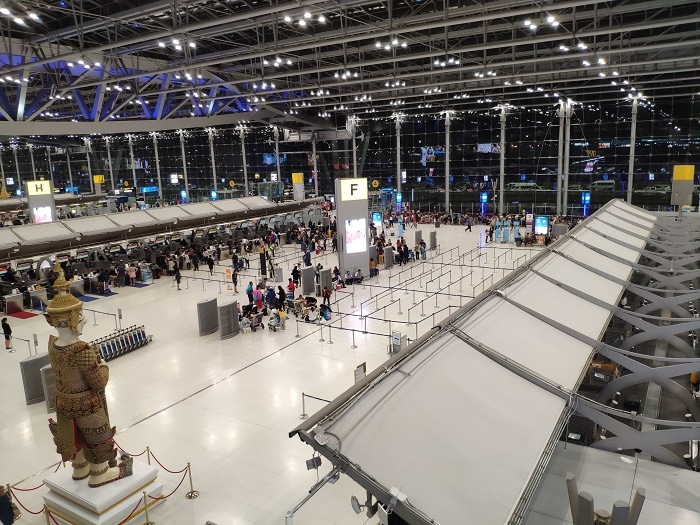
It’s imperative that you keep an eye on when your visa expires, especially if you are planning to stay in the country long-term. Some people think that if they have Thai spouses or children, they will be allowed to slide.
This is almost never the case. Thailand routinely cracks down on overstayers, and you could even be banned from the kingdom regardless of your living situation.
Bans are fairly extreme and usually last at least ten years. It’s truly a gamble that you do not want to take!
Frequently Asked Questions
How long can an American stay in Thailand without a visa?
30 days for tourism, from 15 September 2026. You can extend once by up to 30 days at an immigration office, but the immigration officer decides. The Royal Thai Embassy in Washington, D.C. says to carry cash of 20,000 baht per person or 40,000 baht per family. (Verified October 2026.)
Do I need to complete the TDAC before flying from the US?
Yes. Every non-Thai traveller, including children, submits the Thailand Digital Arrival Card online within 3 days before arrival. It’s free, and it applies to visa-exempt entries and to every visa type. (Verified October 2026.)
Can I apply for a Thai visa online from the US?
Yes. The Royal Thai Embassy in Washington, D.C. takes visa applications only through the e-Visa system at thaievisa.go.th. You upload documents and pay by credit card, so you don’t mail your passport. (Verified October 2026.)
How much money do I need to show for a Thai tourist visa?
Three months of bank statements, each with an ending balance of at least $700 per person or $2,000 per family. That’s separate from the 20,000 baht cash you carry when you enter visa-exempt. (Verified October 2026.)
Do I need a TDAC if I only connect through Bangkok?
Not if you stay airside and never pass through immigration. If you leave the airport, you need one. (Verified October 2026.)
Now, on to You
For a short visit, you may not need a visa at all. Most American tourists get a 30-day visa exemption stamp on arrival. Since the United States and Thailand have excellent relations, so Americans are usually let right in.
Think about what you will be doing in Thailand. Will you spend your time exploring the gorgeous nature of the country, or are you there to work? There are different visas for different things.
Ultimately, Thailand welcomes all visitors, so you should not have any problems getting in and seeing this beautiful country as long as you operate on the level, obey all of the rules, and don’t take advantage and overstay on your visa.
If you have any questions or doubts about what type of visa to get, always check with the Royal Thai Embassy in Washington, D.C. or your nearest Thai consulate for clarification.
Sources Cited
- Royal Thai Embassy, Washington D.C.: Visa Information: 30-day exemption for US citizens from 15 September 2026, stickerless e-Visa since 27 September 2021, TDAC, DTV change of 31 August 2026, processing and timing advice.
- Royal Thai Embassy, Washington D.C.: Tourist Visa Exemption Scheme (30 Days): 30 days, one extension of up to 30 days at the officer’s discretion, 20,000 baht cash per person or 40,000 baht per family.
- Royal Thai Embassy, Washington D.C.: Tourist Visa: $40 and $200 fees, validity, document list, $700 bank balance.
- Royal Thai Embassy, Washington D.C.: Destination Thailand Visa (DTV): $400 fee, 5-year validity, 500,000 baht balance, proof of permanent residence, FBI certificate.
- Royal Thai Embassy, Washington D.C.: Long-Stay (O-A): $200 fee, age 50+, 800,000 baht or 65,000 baht monthly income, insurance, FBI and medical certificates.
- Royal Thai Embassy, Washington D.C.: Long-Stay (O-X): $400 fee, 5 years at a time, US eligibility, financial and insurance requirements.
- Royal Thai Embassy, Washington D.C.: Non-Immigrant Visa B: $80 single entry and $200 multiple entry fees.
- Royal Thai Embassy, Washington D.C.: Non-Immigrant ED to Study: $80 fee, 90-day validity.
- Royal Thai Embassy, Washington D.C.: Non-Immigrant O (Visiting Thai Family): $80 fee, 90 days.
- Immigration Bureau: Thailand Digital Arrival Card FAQ: who must submit, 3-day window, free, one entry per card, transit rule.
- Immigration Bureau: TDAC guide: information needed and how to submit.
- Thai e-Visa (Ministry of Foreign Affairs): the official application portal.
- Ministry of Foreign Affairs, Consular Department: DTV notice of 28 August 2026: DTV rule change effective 31 August 2026.
- Royal Gazette, 31 August 2026: Ministry of Interior announcement behind the 30-day exemption.


 Deutsch:
 Français:
 Español: