The Destination Thailand Visa (DTV) is a 5-year multiple-entry visa for digital nomads, remote workers, and those pursuing Thai soft-power activities. Here is everything you need to know to apply successfully and avoid the most common rejection reasons.
If you are a digital nomad or remote worker and want to live in Thailand legally, you should check out the Destination Thailand Visa. The visa was created to attract digital nomads and remote workers to Thailand.
After the visa was released in 2024, it became one of the most popular visas in Thailand. Many people have obtained it, including retirees, since it provides a 5-year stay in Thailand. The requirements are also quite low.
Here is everything you need to know about the Destination Thailand Visa (DTV) for moving to Thailand.
Before you start: Thailand’s visa rules change often. Always confirm the current steps, fees, and documents on the official Thai e-Visa portal before you travel. Book a flexible or refundable flight and do not plan a tight return. Your approval now arrives by email, and the timing is hard to predict.
Disclaimer: Some links in this article go to our partners, and we may earn a commission if you use them. It costs you nothing extra, and we only recommend services we'd use ourselves. Read more in our Advertising Disclosure.
Contents
- Key Takeaways
- What Is It?
- What Can You Do With DTV?
- How to Extend the DTV in Thailand
- Type
- Requirements
- Paperwork
- New Requirements: Permanent Residence and a Criminal Record Check
- Where Can You Apply for the DTV Now?
- Visa Fee
- How the Thai e-Visa Portal Works for the DTV
- How to Apply for the Destination Thailand Visa
- A Reader's DTV Story: London, Freelancer, Approved in 3 Days
- Common Rejection Reasons (and How to Avoid Them)
- FAQs
- Good to Know
- How Do I Keep My DTV Visa Active?
- Do I Need to Do the 90-Day Report?
- Do I Need a Re-entry Permit?
- How Long Does It Take to Get Visa Approval?
- Can My Dependant Apply for the DTV Together With Me During My Initial Visa Application?
- Is It Easy to Get the DTV Visa?
- Do I Need to Use a Visa Agent?
- What If My Visa Application Form Doesn't Have the DTV Visa Option?
- DTV Visa vs Other Digital Nomad Visas in Asia
- Can You Work in Thailand With DTV?
- Additional Benefits
- How to Apply for the DTV Visa
- Sources Cited
Key Takeaways
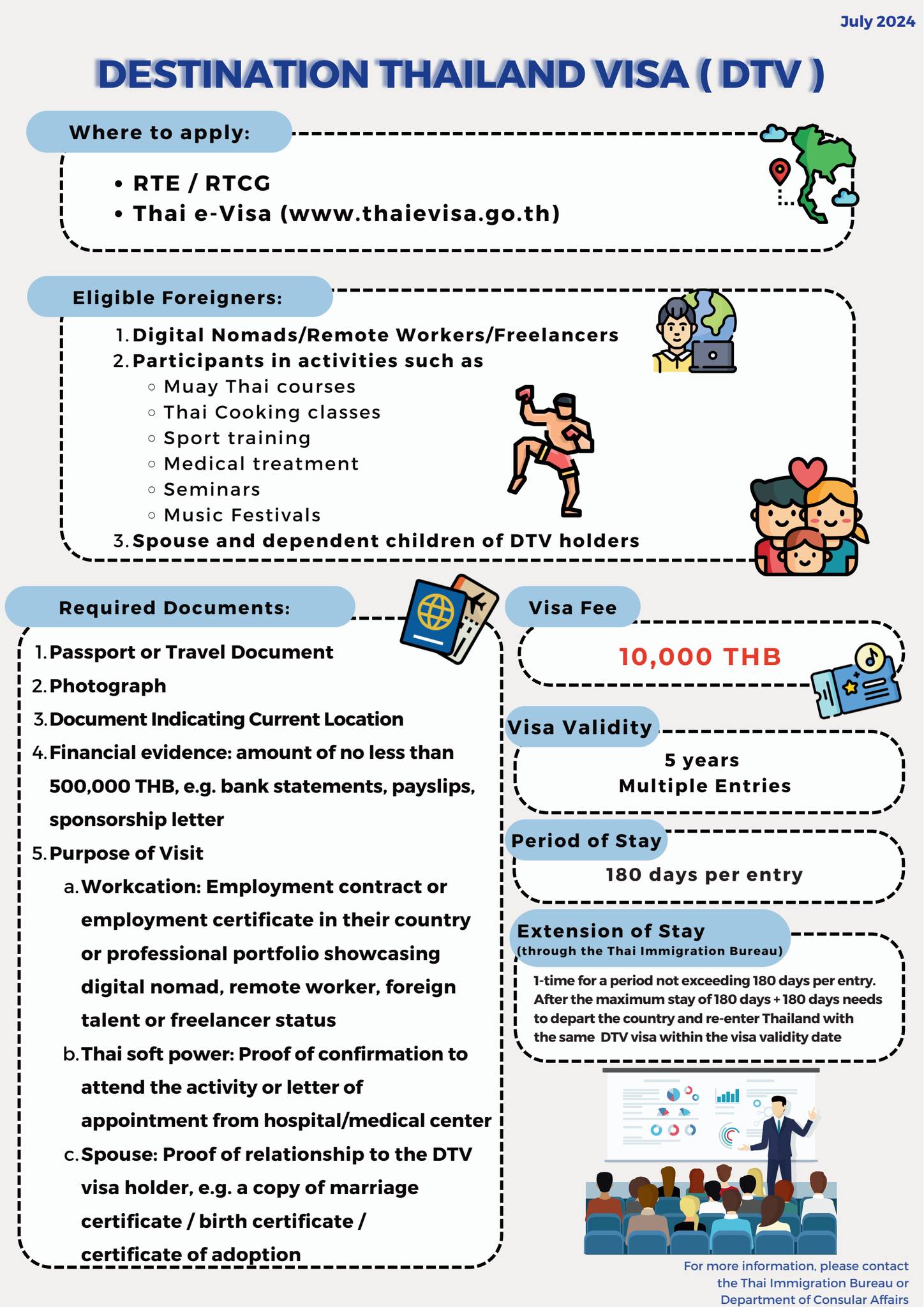
- The DTV is a 5-year multiple-entry visa that lets you stay in Thailand up to 180 days per entry, with an option to extend once for a total of 360 days.
- You need at least THB500,000 in your bank account, and at most embassies (including Vientiane and HCMC) the funds must have been sitting there for at least 3 months.
- There are three visa categories: Workcation for remote workers and freelancers, Thai Soft Power for cultural activities like Muay Thai and Thai cooking, and Dependent for spouses and children under 20.
- Qualifying soft-power activities include Muay Thai, Thai cuisine, medical treatment, seminars, and art events; general language schools are not on the qualifying list.
- Rejection rates have climbed in 2025-2026, with the most common reasons being recently deposited funds, vague freelance documentation, and using a non-qualifying soft-power provider.
- The visa fee is THB10,000 at most embassies, though the exact amount in local currency varies by location.
- You cannot work for a Thai company on this visa, but you can work remotely for overseas clients.
- The DTV has lower financial requirements and longer validity than most other digital nomad visas in Asia.


Quick requirements
- Age20 years or older.
- FundsTHB500,000 (or equivalent) in your account; most embassies, including Vientiane and HCMC, want it seasoned for at least 3 months.
- CategoriesWorkcation (remote workers/freelancers), Thai Soft Power (Muay Thai, Thai cuisine, medical treatment, seminars, art), or Dependent (spouse/child under 20).
- Stay & validity5-year multiple-entry visa; 180 days per entry, extendable once for a 360-day continuous stay.
Documents to prepare
- PassportValid for more than 6 months.
- THB500,000 financial proofA statement from your Thai bank account or a home-country account holding the equivalent amount.
- Proof of purposeOne document matching your category: an employment certificate or professional portfolio (Workcation), a letter of acceptance from a gym, cooking school, or hospital (Thai Soft Power), or a marriage/birth/adoption certificate (Dependent).
- Proof of permanent residenceProof that you are a citizen or permanent resident of the country where you apply (since 31 August 2026), plus a criminal record certificate.
Get your bank statement directly from the bank rather than a banking-app PDF – stricter embassies require a stamped original. Requirements vary by embassy, so confirm the exact list with the one you’re applying through.
Phase A · Apply for the visa
Use your home country’s Thai embassy or consulate. Since 31 August 2026, you apply in the country where you are a citizen or permanent resident. See “Where Can You Apply for the DTV Now?” below.
Upload all required documents through the eVisa system.
Embassy staff usually reply within a few days if they need more documents. Submit exactly what’s requested.
Processing generally takes around 3–7 business days, though it varies by embassy.
Print your approved visa and present it to immigration on arrival. Each entry gives you an initial 180-day stay.
Phase B · Manage your stay
Before your 180 days end, get a one-time extension of stay at a Thai immigration office for a continuous 360-day stay, or exit and re-enter Thailand for a fresh 180-day stay.
Once you’ve stayed 360 days continuously, exit Thailand for at least a day before your next stay period begins.
Required on the DTV just like other visas – visit your local immigration office to complete it.
Continue the entry/extension cycle for the full 5-year validity of the visa.
If you need help applying for your visa, you can use a visa service from Baan Thai Immigration Solutions (sponsored).
What Is It?
While it’s said that the DTV visa is for anyone who wants to come to Thailand as a digital nomad or a remote worker, in my opinion, it’s just for everyone who can prove that they can do remote work.
It’s also for those who come to Thailand for the following activities:
- Muay Thai
- Thai cuisine
- Education
- Sport activities
- Medical treatment
- Foreign talent
- Seminars
- Art and music events
What Can You Do With DTV?
The Destination Thailand Visa is a multiple-entry visa that allows you to live in Thailand for 5 years.
Each entry to Thailand initially allows you to stay in Thailand for 180 days. Once the 180 days are up, there are two ways to extend your duration of stay:
- Leave the country and enter Thailand again for at least a day.
- Get an extension of stay in Thailand, giving you a 360-day continuous stay in Thailand.
Once you stay in Thailand for 360 days, you must exit Thailand for at least a day to reset your stay. Spending more than 180 days in a calendar year can also trigger tax residency, so review how Thai taxes on foreign-earned income apply.
Repeat the process until the visa expires.
How to Extend the DTV in Thailand
You can extend a DTV stay once at a Thai Immigration office. The Royal Thai Embassy in London states that the extension is for a period not exceeding 180 days per entry. After the full 180 days plus 180 days, you must leave Thailand and re-enter on the same DTV before it expires. (Verified October 2026.)
The Immigration Bureau lists the documents for a DTV extension. You apply in person on form TM.7 and bring:
- A copy of your passport (data page, visa and arrival stamp) and a photo.
- Proof of at least THB500,000, either in Thai and foreign bank accounts or combined, held for not less than 30 days before the application date. A guarantee or company support letter of at least THB500,000 is the alternative.
- Proof of your category: work evidence for Workcation, an activity certificate for Thai Soft Power, or proof of relationship for a dependent.
- Evidence of where you live, such as a lease, a hotel or condo payment, or a certified title deed.
- Copies of your previous 90-day notification (TM.47) and your TM.30 residence notification.
The Immigration Bureau lists a THB1,900 application fee on form TM.7 for extensions of stay. Its DTV entry does not repeat the amount, so confirm the fee at the counter before you queue. (Verified October 2026.)
The 30-day seasoning at Immigration is shorter than the 3 months many embassies ask for at the visa stage. Keep your TM.30 and 90-day paperwork current, since the office asks for copies.
Type
There are three types of the Destination Thailand Visa, each with a different purpose of visit:
- Workcation: For digital nomads, freelancers, or remote workers who want to come to Thailand.
- Thai Soft Power: For those who want to learn Muay Thai, Thai cuisine, receive medical treatment, and so on.
- Dependent: For the legal spouse or child (less than 20 years old) of the main DTV visa holder.
Requirements
There are three main requirements:
- You need to be at least 20 years old
- You need to provide bank statements from the last 3 months showing an ending balance of at least THB500,000 for each of those months at the time you apply.
- You need to have proof of the purpose of your visit:
- If you are a digital nomad, remote worker, or freelancer, you normally need to show
- An employment certificate
- A professional portfolio showcasing your work
- A letter explaining your remote work
- The latest invoices to your clients
- If you want to do Muay Thai training, learn Thai cooking, attend a seminar or music festival, or receive medical treatment, you need to get a letter of acceptance from a related organization.
- If you are a dependent of the main DTV visa holder, proof of relationship such as a marriage certificate or a birth certificate is required.
- If you are a digital nomad, remote worker, or freelancer, you normally need to show
Paperwork
Here’s a list of paperwork you need to have:
- Passport: It must be valid for more than 6 months.
- Visa Application Form: You can pick it up at the embassy or consulate.
- THB500,000 Financial Proof: Depending on where you apply, you can use a statement from your Thai bank account or your home country account with the THB500,000 equivalent.
- If you use your Thai bank account, it should be a financial statement for up to 6 months from your bank. You should get it directly from your bank. PDF downloads from your banking app have been accepted at some embassies, but stricter consulates require a stamped original issued directly by the bank. Confirm with your specific embassy before submitting.
- If you use your overseas bank account, it’s possible to use a financial statement from your home country bank as long as it has an equivalent amount.
- Proof of Purpose: You need to prepare one of the following documents, based on the type of the DTV visa:
- Employment Certificate (Workcation): An employment certificate from a company you are currently working for as a remote worker. The certificate should clearly state that you can work remotely and may need to be notarized.
- Professional Portfolio (Workcation): While there’s no clear guideline from the official source, successful applicants uploaded their tax record from a previous year and a letter showcasing their experience as a digital nomad in detail. Contracts with your clients as well as recent invoices also work.
- Letter of Acceptance (Thai Soft Power): For example, a letter from a Muay Thai gym or cooking class, or an appointment letter from a hospital. Please note that not all embassies accept it at the moment.
- If it’s Muay Thai training, find a gym that can provide paperwork confirming that you will train with them for at least a month. (To be safe, it should be at least a year.) Two gyms readers have successfully used for DTV applications: Tiger Eye Muay Thai in Bangkok (1, 3, and 6-month programs available) and Battle and Conquer in Pattaya (6-month program: one applicant was allowed to pay a half deposit upfront for the visa and settle the balance afterwards). Most gyms will also provide their business license and a copy of the director’s ID; ask for these upfront as some embassies require them. A typical Muay Thai DTV document set: passport biodata page, passport photo, acceptance letter from the gym (plus their business license and director’s ID), and 3-4 months of bank statements showing the THB500,000 balance.
- If it’s for medical treatment, contact your hospital and request a treatment confirmation document. To be safe, the treatment plan should cover at least a month, ideally at least a year.
- Proof of relationship (Dependent): a marriage certificate, birth certificate, or an adoption certificate.
- Proof of Permanent Residence: Since 31 August 2026, this replaces the old document showing your current location. Use proof that you are a citizen or permanent resident of the country where you apply, such as a residence card.
- Criminal Record: Since 31 August 2026, the Ministry of Foreign Affairs requires a criminal record certificate for DTV applications, from your country of nationality or the country where you apply. In London, that means an ACRO certificate. Check your own embassy’s page before you apply.
Please note that each Thai embassy or consulate may require different documents.
For example, it’s reported that sometimes you also need to prepare:

- A photograph taken within the last 6 months.
- Proof of onward travel such as a flight ticket.
It’s best to contact the Thai embassy or consulate or check their websites for a full list of documents you need.
Here’s a list of popular Thai embassies/consulates:
- Laos: Royal Thai Embassy, Vientiane
- Malaysia: Royal Thai Consulate-General, Kota Bharu
- UK: Royal Thai Embassy, London
- USA:
- Royal Thai Consulate-General, New York
- Royal Thai Embassy, Washington D.C.
- Royal Thai Consulate-General, Los Angeles
If you want to apply online, check the eVisa website.
New Requirements: Permanent Residence and a Criminal Record Check
From 31 August 2026, the Ministry of Foreign Affairs changed the documents for DTV applications. The Royal Thai Embassy in London lists the change like this:
- Proof of permanent residence in the UK, Ireland, or the British Overseas Territories. UK indefinite leave to remain (ILR) or Irish long-term residency both count. This replaces the old rule, where a document showing your current location, such as a lease or utility bill, was enough. Now you have to prove you actually live there long-term.
- A criminal record check. You need a police clearance certificate from your country of nationality or the country where you apply. London asks for one issued within the last 6 months. UK applicants use the ACRO certificate, and Ireland has its own police certificate. Order it early, because these can take a few weeks to arrive.
London is not the only one. The Royal Thai Embassy in Washington D.C. posts the same announcement with the same start date of 31 August 2026. Proof of permanent residence replaces the old current-location document, and a criminal record clearance certificate is now mandatory.
The Royal Thai Embassy in Vientiane has confirmed the same rule and says it takes effect worldwide from 31 August 2026. You must be a national or permanent resident of the country where you apply, so applying in a neighbouring country you are only visiting no longer works at embassies that apply the rule.
Where Can You Apply for the DTV Now?
Since 31 August 2026, the Thai Ministry of Foreign Affairs asks every DTV applicant for proof of permanent residence instead of a document showing your current location. You also need a criminal record clearance certificate. The Royal Thai Embassy in Vientiane describes the rule as taking effect worldwide: you must be a national or permanent resident of the country where you submit the application.
In practice, you apply from the country where you are a citizen or hold permanent residence. Applying in a neighbouring country as a visitor is no longer an option at the embassies that have published the new rules. Applications submitted and paid before 31 August 2026 are processed under the old rules. (Verified October 2026.)
| Embassy | Who can apply | Criminal record certificate | Fee |
|---|---|---|---|
| London | Permanent residents of the UK, Ireland or the British Overseas Territories (for example UK indefinite leave to remain or Irish long-term residency) | Police certificate issued within 6 months of submission (ACRO or the Irish police certificate) | GBP 300 |
| Berlin | Permanent residents of Germany (ID card or Meldebescheinigung; non-Germans add the residence permit card) | From your country of nationality or the country where you apply | Check the embassy page |
| Manila | Permanent residents of the Philippines | From your country of nationality or the country where you apply | PHP 19,250 |
| Vientiane | Lao nationals or permanent residents of Laos only | From Laos or your country of nationality | Paid in cash in baht at the consular section |
| Singapore | Singapore citizens and permanent residents only | Not listed on its 7 September 2026 page | SGD 500 |
| Washington D.C. | Follows the 31 August 2026 notice posted on its visa page | Required under that notice | USD 400 |
The Singapore page still lists a “document indicating current location” in early September, so not every embassy page has caught up with the notice. Follow the checklist inside the e-Visa form for your embassy, and read the embassy page for anything the form does not show.
Visa Fee
There’s a visa fee of THB10,000 for the Destination Thailand Visa. However, the actual amount depends on the embassy. For example, the Royal Thai Embassy in Washington D.C. charges US$400.
How the Thai e-Visa Portal Works for the DTV
Embassies take DTV applications through the official portal at thaievisa.go.th. The Royal Thai Embassy in London, for example, no longer accepts physical applications. The Ministry of Foreign Affairs guide to the portal lists six steps:
- Create an account.
- Fill in the application form.
- Upload your supporting documents.
- Pay the visa fee. The portal warns that there is no refund after payment.
- Wait while the embassy processes the application.
- Receive the approval by email, and print it for the airline and Thai immigration.
Check every field before you pay. Documents in other languages need a Thai or English translation, notarised as your embassy describes.
Timing depends on the embassy. Vientiane quotes 5 to 10 working days from the date the fee is paid, and Kuala Lumpur quotes about one month or more. Kuala Lumpur asks you to apply at least 30 working days before travel, and Singapore asks for 21 working days. (Verified October 2026.)
London also expects you to stay in the UK or Ireland while the application is open. It may ask for an in-person interview, and leaving can cancel the application.

Need your documents in English for the e-Visa? Translayte provides certified translations with a signed, stamped certification statement, and delivery can be as quick as 12 hours. Notarisation is available as an add-on, but check your embassy’s checklist for what it asks for. Get a certified translation (Sponsored)
How to Apply for the Destination Thailand Visa
You can apply for the Destination Thailand Visa from the Thailand consulate or embassy.
- Home Country: If you are in your home country, contact the Thai embassy or consulate to begin the process. In many cases, you can complete it through the E-Visa system.
- Outside Your Home Country: You can apply only where you hold citizenship or permanent residence. Since 31 August 2026, the DTV requires proof of permanent residence and a criminal record certificate.
The application process typically goes as follows:
- Submit all required documents online through the eVISA system.
- The embassy/consulate staff will usually respond within a few days, informing you if additional documents are needed.
- Submit the documents EXACTLY as requested.
- Wait a few more days for your visa to be approved.
- Print out the approved visa and present it to immigration upon your arrival in Thailand. Remember that submitting a Thailand Digital Arrival Card (TDAC) is a separate mandatory step before arrival.
If you apply in a neighboring country of Thailand, in many cases, you will need to make an appointment online, attend on the scheduled date, submit all the required documents, and wait approximately 3-7 days for visa approval.
Where you apply makes a real difference. Community reports single out the Thai embassies and consulates in Malaysia as some of the slowest and least accommodating for DTV applications. Applicants there describe waiting a month or more, being asked repeatedly for information they had already submitted (sometimes the same document more than once), and revising the application form three or more times before a decision. One applicant reported nearing two months of waiting with the case still open. Moderators in expat groups have gone as far as calling Malaysia one of the worst places to apply for a DTV. If you have the flexibility to choose, a smoother-running embassy can save you weeks; if you’re set on applying in Malaysia, submit an airtight document set from the outset and expect several rounds of follow-up.
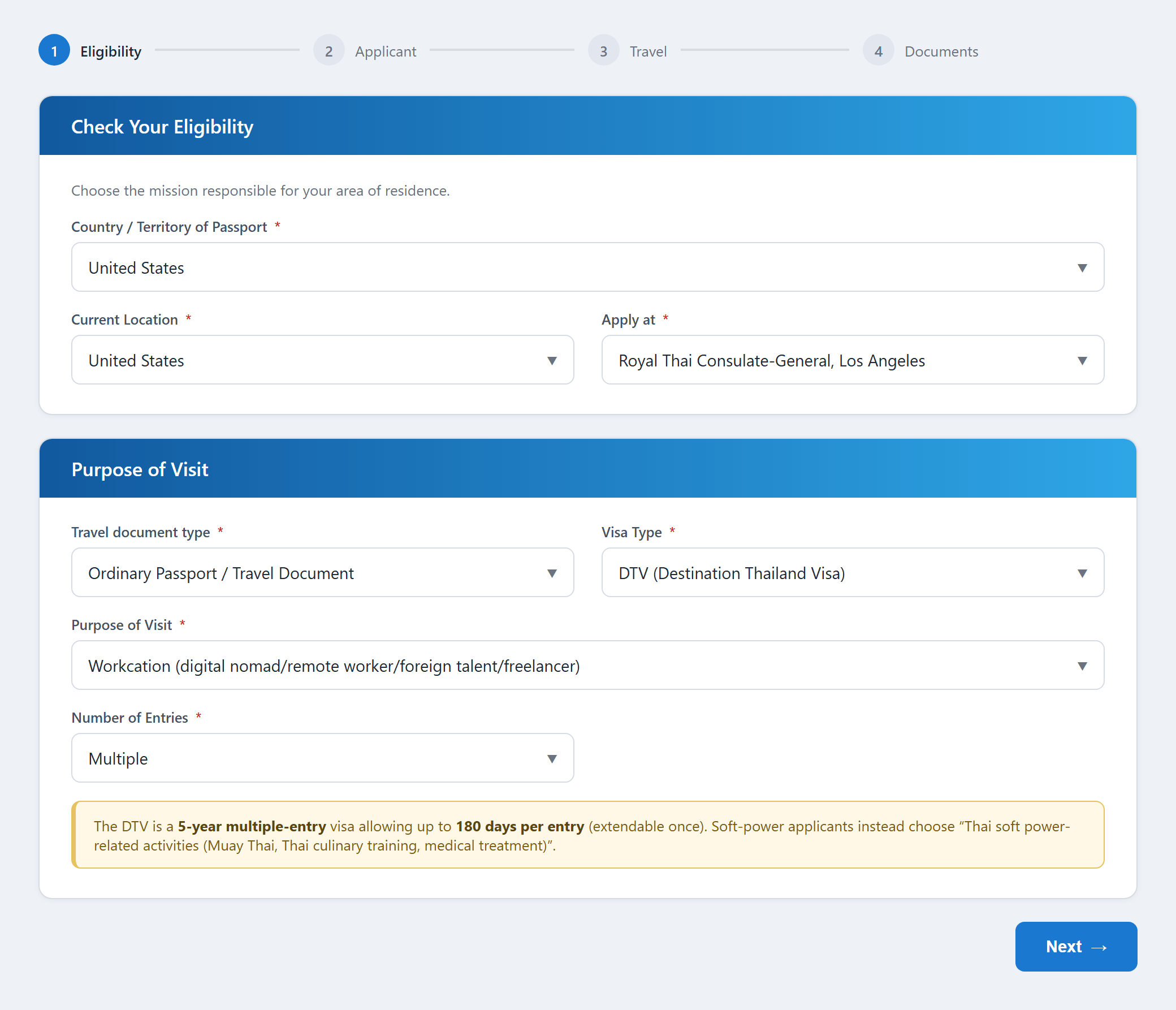
How to Fill Out the Thai eVisa DTV Application Form (Filled Example)
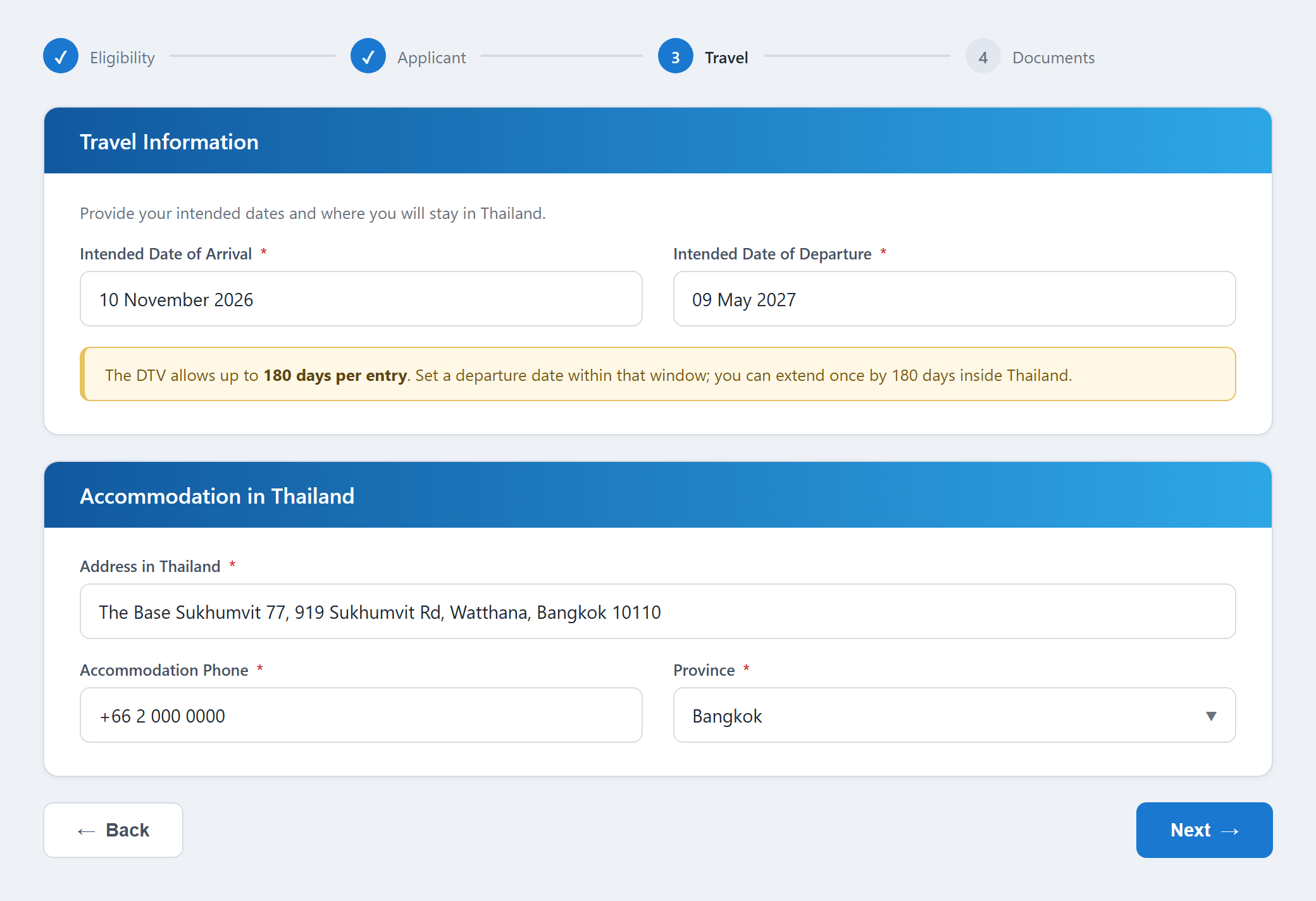
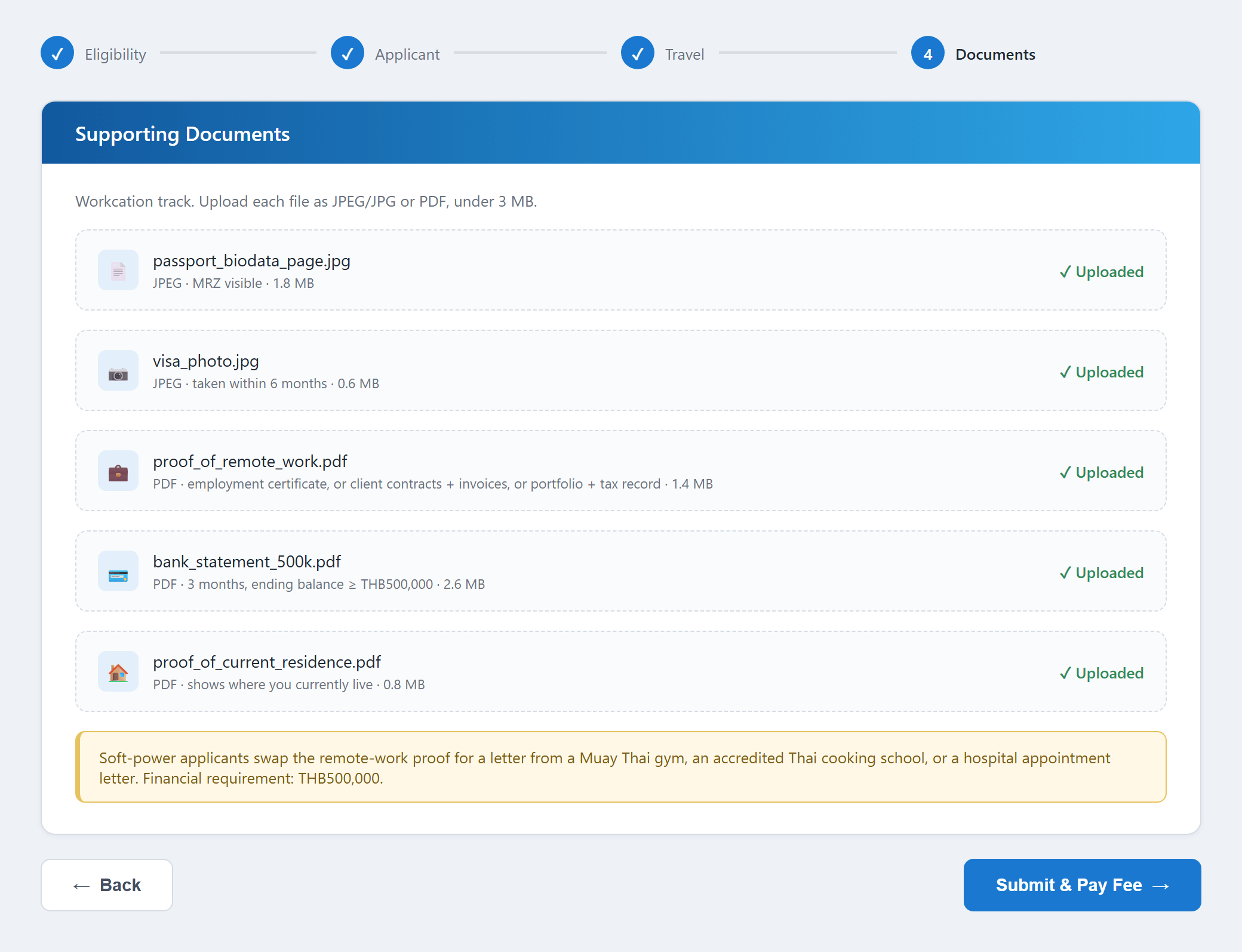
The DTV application is completed on the eVisa website in four steps (the workcation track is shown below).
Step 1: Check eligibility and select the visa
Choose DTV (Destination Thailand Visa) as the Visa Type, then pick “Workcation” for remote workers, freelancers and digital nomads, or “Thai soft power-related activities” for Muay Thai, Thai cooking or medical treatment. The DTV is multiple-entry, valid five years with 180 days per entry.
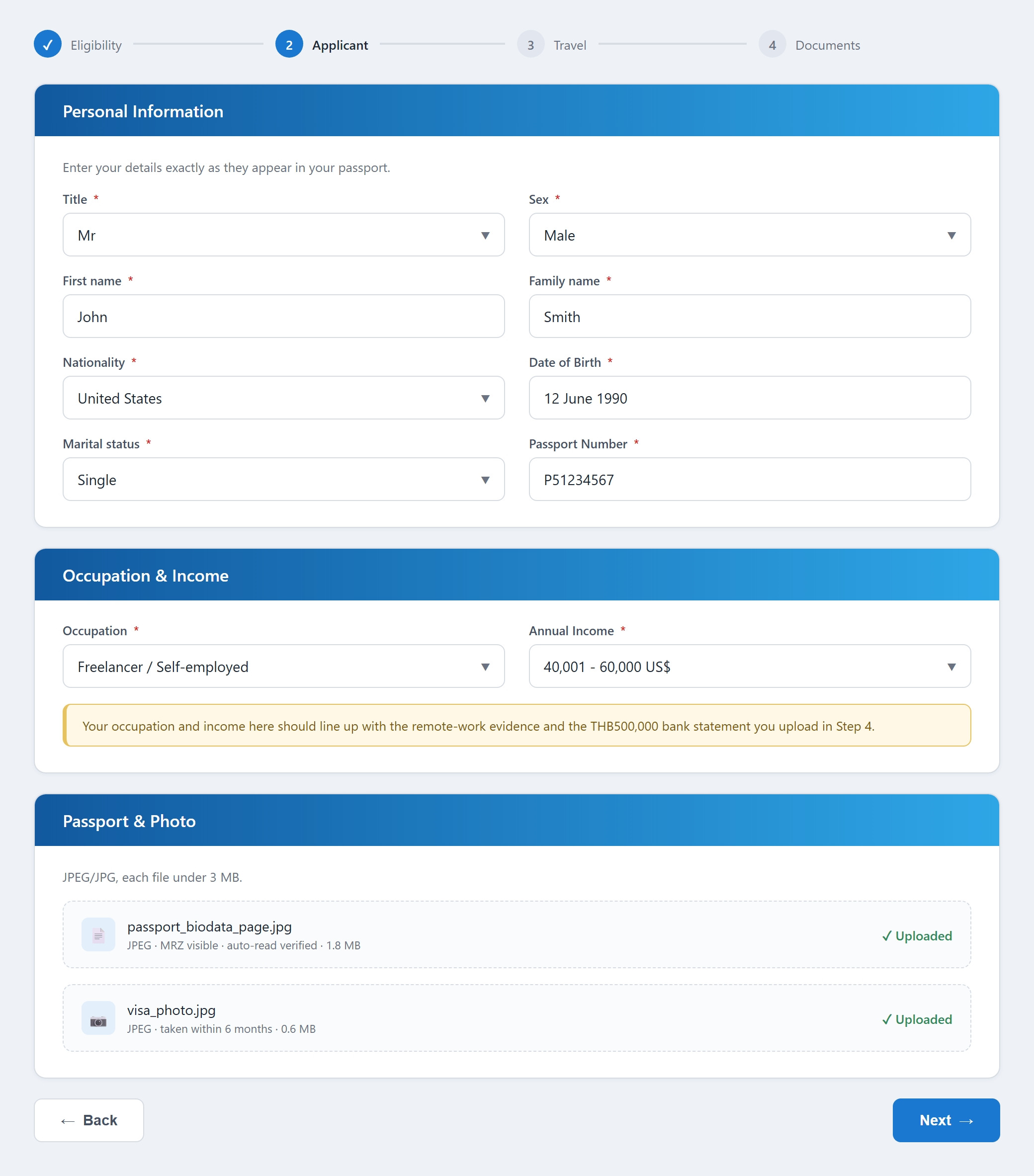
Step 2: Applicant information
Enter your personal and passport details and set your occupation and income so they line up with the remote-work and THB500,000 evidence you upload later. Upload your passport page and photo here too.
Step 3: Travel and accommodation
Add your arrival date and a departure within the 180-day per-entry limit, plus where you will stay in Thailand.
Step 4: Supporting documents
Workcation applicants upload proof of remote work (an employment certificate, client contracts and invoices, or a portfolio with a tax record), a bank statement showing at least THB500,000, and proof of where they currently live. Soft-power applicants upload a letter from a Muay Thai gym, cooking school or hospital instead of the work proof.
A Reader’s DTV Story: London, Freelancer, Approved in 3 Days
One of our readers just got their DTV as a freelancer through the Thai Embassy in London, and it came through in three days. Here’s what worked for them.
Their first tip: don’t bother with an agent. They got quoted anywhere from THB50,000 to THB250,000 for someone to handle the paperwork, which is a lot of money to hand over documents you can upload yourself. Doing it on your own also means you stay in control of what goes in.
What You Send First
When you first apply, you upload:
- Passport bio-data page in colour
- Passport photo in colour, 3.5 x 4.5 cm, saved as a JPEG file
- Proof of current residence: a recent flight, a recent electricity or water bill, or a hotel or accommodation confirmation
- Proof of THB500,000 in a bank account, held for more than 3 months
- Any client contracts or sponsorship letters
What They Ask for Next
Once you clear that first check, the embassy comes back and asks for more:
- 3 months of recent pay slips or invoices
- 3 months of bank statements that match those pay slips or invoices
- The most recent tax return documents
- A signed letter acknowledging the DTV’s limitations
- Your flight to Thailand
Here’s the important bit: you need all of these. Miss one and you’re rejected, no exceptions. Our reader knew a few people who didn’t want to hand over their tax returns and went looking for a workaround. There isn’t one. So get everything ready before you start, not after the embassy asks for round two.
Keep in mind this is one person’s experience at one embassy. Every embassy has its own quirks and the rules shift over time, so double-check the exact list with the embassy you’re applying through.
Common Rejection Reasons (and How to Avoid Them)
Rejection rates for the DTV have risen noticeably in 2025-2026 as embassies tighten their document reviews. Understanding why applications fail is the quickest way to make sure yours doesn’t.
THB500,000 Not Seasoned Long Enough
The most common rejection trigger is funds that have not been sitting in the account long enough. At the Royal Thai Embassies in Laos and Vietnam, officers look for a full 3 months of bank history showing that balance consistently maintained. A large transfer into the account shortly before the application date is a red flag that can result in an immediate rejection.
Tip: Make sure your THB500,000 (or its foreign currency equivalent) has been in the account for at least 3 months before you apply. If you plan to apply through Vientiane or HCMC, start building that balance now, not the week before your appointment.
Vague or Incomplete Freelance Documentation
Freelancers and self-employed applicants are rejected at a higher rate than salaried remote workers because their documentation is harder to standardize. A generic self-written letter stating “I work online” is not enough. Officers want to see a clear pattern of income. The more you can show an ongoing, established work relationship with overseas clients, the stronger your application.
Non-Qualifying Soft-Power Provider
The Thai Soft Power category has a specific list of qualifying activities, and not every school or institution counts. General language schools are not on the qualifying list, regardless of how long the course runs. Only activities tied to Thai cultural identity qualify. If you are applying under the soft-power route, confirm your chosen provider is recognized before you pay any fees or request enrollment documents.
Tip: Ask your gym, cooking school, or institution directly whether they have provided enrollment letters for successful DTV applicants before. Schools that have done this will have a standard document format that embassies already recognise.
Embassy-Specific Formatting Issues
Each embassy has slightly different document requirements. Submitting documents in the wrong format is an easy rejection to avoid, so confirm the exact format your embassy expects before you submit.
Pre-Application Checklist
Before submitting your application, confirm all of the following:
- THB500,000 (or equivalent) has been in your account for at least 3 months
- Bank statement is issued by the bank directly (not printed from an app), dated within 14 days of application
- Freelance applicants: tax records, client contracts, and recent invoices are all included
- Soft-power applicants: the provider is a recognized qualifying institution (not a language school)
- Enrollment or acceptance letter covers at least 12 months
- All foreign-language documents are translated into Thai or English and notarized
- You have checked the specific document requirements of the embassy where you plan to apply
- For Vientiane: appointment booked through the official embassy website before attending
How to Reapply After a Rejection
A rejection is not a permanent ban. You can reapply once you have addressed the reason for the denial. The embassy will typically not give a detailed written explanation, so review your documents against the checklist above and identify what was likely missing or insufficient. Fix the specific issue, gather the stronger documentation, and resubmit. Some applicants switch to a different nearby embassy for their second attempt if they believe the rejection was partly due to that particular embassy’s interpretation of the rules.
FAQs
This section covers frequently asked questions about the Destination Thailand Visa (DTV).
What Happens After 180 Days?
Once your initial 180-day stay under the DTV visa is coming to an end, you have two main options:
- Extend your stay: You can extend your visa once at a Thai immigration office. You’ll need to provide supporting documents, including financial proof and any requirements related to your visa category.
- Leave and reenter Thailand: You can exit Thailand and come back to receive a new 180-day stay. This is essentially a legal visa run, and many digital nomads prefer this option because it’s usually simpler and quicker.
Community Insights
Reader experiences back this up. DTV holders who have done border runs, including same-day hops, say re-entry has been smooth and that immigration treats the visa like any normal multiple-entry visa. Several have stayed four to six months at a stretch, left briefly, then come back without extra questions.
Most say they were asked for nothing beyond their passport and the usual stamps, not proof of funds or work, though a few still print their documents just in case. The tighter entry checks Thailand introduced in 2025 have mainly targeted people stacking long stays on visa exemptions and tourist visas, not DTV holders. The DTV is still classed as a short-term visa, so how it is treated could change over time.
Do I Need Health Insurance for the DTV?
The DTV document lists we checked do not ask for health insurance. The London, Berlin and Manila embassy pages list a passport page, photo, proof of permanent residence, THB500,000 in funds, proof of purpose and a criminal record certificate, with no insurance item. Embassies can ask for more, so read your own checklist. You should still carry cover, because hospital bills are yours to pay. See our guide to digital nomad health insurance in Thailand. (Verified October 2026.)
How Much Does It Cost to Extend a DTV?
The Immigration Bureau lists a THB1,900 application fee on form TM.7 for an extension of stay. Its DTV entry does not state the amount, so confirm it at your local office. The visa fee you paid at the embassy is a separate charge. (Verified October 2026.)
Which Criminal Record Certificate Does the DTV Need?
You need a certificate from your country of nationality or the country where you apply. London requires it to be issued within 6 months of submission and names the ACRO certificate and the Irish police certificate as examples. Order it before you start the application, since some take weeks.
Can I Apply for the DTV From Another Country or From Inside Thailand?
Not as a visitor. Under the rule effective 31 August 2026, you apply where you are a national or permanent resident. The Washington D.C. embassy states that it cannot issue visas to foreign nationals who are currently in Thailand.
Do I Pay Thai Tax on a DTV?
The visa itself carries no tax, but your days in Thailand count. The Revenue Department says anyone staying in Thailand for more than 180 days in a calendar year is a tax resident. A resident is taxed on Thai income and on the part of foreign income brought into Thailand. Two 180-day stays can cross that line, so read income tax for foreigners in Thailand before you settle in. (Verified October 2026.)
Good to Know
Soft Power applications are getting more scrutiny
The Thai Soft Power route has gotten tougher lately, mostly because people were gaming it. Embassies have caught on to the cheap, short “enrollment” packages bought just to tick the box, and those one- to three-month courses get rejected more and more. Sign up for something longer (six months or more) at a well-known gym, cooking school, or hospital and you’ll usually have a much smoother ride. Thai language schools don’t count anymore either, since they were dropped from the list in 2026.
Extensions are where it gets stricter
Here’s something readers keep running into: the extension is where immigration really digs into your paperwork. Some DTV holders say that when they go in for their 180-day extension, they’re asked to show everything all over again, the soft-power acceptance letter, bank statements with the THB500,000, proof they’re still doing the activity. A few have had this happen even when a quick border bounce would have skipped the hassle, and they’ve noticed people on other long-stay visas didn’t get grilled the same way. It really comes down to which office and which officer you get, so if you’re planning to extend instead of leaving and coming back, bring every document from your original application.
How Do I Keep My DTV Visa Active?
Simply avoid overstaying and either extend your visa or leave Thailand before your visa entry stamp expires. You should avoid legal issues as well.
Do I Need to Do the 90-Day Report?
Yes, the 90-day report is required. The process is the same as with other visas. Visit your local immigration office to complete the report.
Find out more: How to Do Your 90-Day Reporting in Thailand
Do I Need a Re-entry Permit?
No, the DTV Visa is a multiple-entry visa. You can leave and reenter Thailand as many times as you like without needing a re-entry permit.
How Long Does It Take to Get Visa Approval?
It varies considerably by embassy, from about 5 to 10 working days in Vientiane to a month or more in Kuala Lumpur. Some applicants have been approved much faster. One reader applying for a Muay Thai soft-power DTV through the Los Angeles consulate received approval in roughly 10 hours.
Can My Dependant Apply for the DTV Together With Me During My Initial Visa Application?
Yes, your dependent can apply for the DTV Visa at the same time as you during your initial application process. They also may not need to be with you during the visa application.
Is It Easy to Get the DTV Visa?
With the right paperwork it is straightforward, but rejection rates have been climbing since 2025. The process goes smoothly for applicants who prepare their financial documents and work-proof well in advance.
Do I Need to Use a Visa Agent?
No, there is no need to use a visa agent. The process is straightforward, and you can handle it on your own.
What If My Visa Application Form Doesn’t Have the DTV Visa Option?
Some visa application forms may not list the DTV option yet. In this case, simply write down “DTV Visa” on the form.
DTV Visa vs Other Digital Nomad Visas in Asia
The Destination Thailand Visa is very attractive since the income requirement is much lower than most countries in Asia that have a digital nomad visa.
For example, in Malaysia, you need to have an annual income of US$24,000 while Japan requires a much higher amount at US$68,000 for a digital nomad visa.
In addition to that, it is valid for 5 years, while for other countries, it is normally only 1-2 years. You can also look into the Thailand LTR visa and compare the DTV vs LTR to decide which one fits your long-term goals.
However, the only disadvantage is that the visa allows you to stay in the country for only 180 days at a time. You need to leave Thailand or obtain an extension of stay to extend your stay.
Find out more: Thailand’s digital nomad visa options

Can You Work in Thailand With DTV?
While the Royal Gazette doesn’t clearly state this point, you can work online for your overseas clients while living in Thailand.
However, you cannot work for a company in Thailand since this should be only for those who have a Thailand work permit. If you are interested in local employment, read our guide on finding work in Thailand.
Additional Benefits
Another great benefit of the Destination Thailand Visa is that you can bring your legal dependent, including:
- Your legal spouse
- Your children who are younger than 20 years old.
How to Apply for the DTV Visa
There are two ways to apply for the DTV visa:
- Applying on your own: Check the website of the Thai consulate or embassy in your country to start the process. In most cases, it’s done through the e-Visa website.
- Using a visa agent: If you need help from a visa agent, you can use Baan Thai Immigration Solutions.
Sources Cited
- Department of Consular Affairs, Ministry of Foreign Affairs: announcement of 28 August 2026 on the adjusted DTV supporting documents, effective 31 August 2026.
- Royal Thai Embassy, Washington D.C., Destination Thailand Visa (DTV): https://washingtondc.thaiembassy.org/en/page/dtv-visa
- Thailand Electronic Visa (official e-Visa portal): https://thaievisa.go.th/
- Royal Thai Embassy, London, Visa General Information (permanent residence and criminal record requirements, effective 31 August 2026): https://london.thaiembassy.org/en/page/visa-general-information
- Royal Thai Embassy, Washington D.C., Visa Information (New Requirement for DTV, effective 31 August 2026): https://washingtondc.thaiembassy.org/en/page/visa-information
- Department of Consular Affairs, Ministry of Foreign Affairs: announcement of 28 August 2026 on the adjusted DTV supporting documents (proof of permanent residence added, criminal record certificate added, effective 31 August 2026).
- Royal Thai Embassy, Vientiane, Applying for a Visa: the DTV rule effective worldwide from 31 August 2026, national or permanent resident requirement, processing time and cash payment.
- Royal Thai Embassy, London, Destination Thailand Visa: GBP 300 fee, extension of stay up to 180 days per entry, document list including the police certificate.
- Immigration Division 1, Bangkok, Visa Extension: documents for the DTV extension (item 39).
- Immigration Bureau, Visa Extension: TM.7 application fee of THB1,900 for extension categories.
- Ministry of Foreign Affairs, Thai e-Visa user guide: portal steps, payment and the no-refund warning.
- Revenue Department, Personal Income Tax: the 180-day tax residence test.


 Deutsch:
 Français:
'/%3E%3Cpath%20fill='%23b2b2b2'%20d='M241%20382q0%2016%2017%2026%2017%2011%2042%2011t42-11q16-11%2017-26V269H241'/%3E%3Cpath%20fill='%239f7e00'%20d='M241%20379q0%2014%208%2023%209%209%2021%209%2014%200%2021-9%209-9%209-23V269h-59'/%3E%3Cpath%20d='M241%20339v-70h59v110q0%2014-9%2023l-6%205v-68h-15v72q-8%200-14-4v-68zm59%2040c0%2022%2015%2032%2029%2032%2021%200%2030-18%2030-32v-40h-59'/%3E%3Cpath%20fill='%239f7e00'%20d='M266%20277v5h2v12h-3v-5h2v-5h-9v5h2v5h-4v9h3v18h-5v10h34v-10h-5v-18h3v-9h-4v-5h2v-5h-9v5h2v5h-3v-12h2v-5zm42%20101q0%2010%206%2017%206%206%2015%207%2010-1%2016-7%206-7%206-17v-29h-43'/%3E%3Ccircle%20fill='%230044ad'%20cx='329.5'%20cy='372'%20r='6'/%3E%3Cellipse%20fill='%230044ad'%20cx='300'%20cy='340'%20rx='16'%20ry='21'/%3E%3C/svg%3E) Español:
Español: