

For a lot of expats, riding a motorbike in Thailand doesn’t seem like a great idea.
However, there are benefits to owning a motorcycle here. It’s cheap, easy to maintain, fun, and can dramatically decrease your time spent in traffic.
It can also be dangerous to ride a motorcycle in Thailand. So if you plan to ride one, buying motorcycle insurance is recommended.
Let’s take a look at all of the options you have.
Disclaimer: Some links in this article go to our partners, and we may earn a commission if you use them. It costs you nothing extra, and we only recommend services we'd use ourselves. Read more in our Advertising Disclosure.
Contents
- Key Takeaways
- Compulsory vs. Voluntary Motorcycle Insurance in Thailand
- Compulsory Third-Party Liability Insurance (CTPL)
- Going without Insurance
- Applying for Insurance
- Frequently Asked Questions
- Is motorbike insurance legally required in Thailand?
- How much does CTPL cost, and what happens if I don't have it?
- Do I need a Thai driving licence or an International Driving Permit to be covered?
- Does my rental motorbike come with insurance?
- Does travel or health insurance cover motorcycle accidents in Thailand?
- Is Type 1 or Type 2+ better for a normal motorbike?
- Sources Cited
Key Takeaways
- CTPL (Por Ror Bor) is mandatory for every motorcycle and costs THB161.57 to THB645.21 a year, but it only covers medical expenses and the limits are low, especially if you caused the accident.
- Most riders add private insurance on top of CTPL. Type 2+ is the most popular option because it covers collision, theft, and third-party damage at a price well below Type 1.
- Type 1 is the most comprehensive and mainly applies to big bikes over 250cc. It is the only type that covers single-vehicle accidents like hitting a wall, and the only one with flood damage included as standard. On CheckDi, Type 1 for a 2024 Honda CB500F started at THB6,595 a year in October 2026.
- Common claim rejections include riding without a Thai driver’s license, drunk driving, and letting an unlisted rider use the bike. Read the fine print carefully before assuming you are covered.
- Excess and deductible are often confused, even by insurance reps in Thailand. An excess can sometimes be waived; a deductible cannot.
- Official garages use genuine parts and certified mechanics but have longer wait times. Independent garages are faster and cheaper, though quality varies a lot, so research before committing.
- Use a comparison site like CheckDi to see all available plans and prices at once rather than contacting each insurer separately.

Compulsory vs. Voluntary Motorcycle Insurance in Thailand
Thai law treats motorcycle insurance as two separate layers, and mixing them up is the single biggest source of confusion for new riders. One is a legal requirement tied to your vehicle registration. The other is optional cover you choose to add, priced by how much protection you want.
- CTPL (Por Ror Bor): compulsory for every registered motorcycle, renewed every year alongside your vehicle tax. The premium is a low fixed amount, THB161.57 to THB645.21 a year depending on engine size. It only pays out for injury, death, or disability to people, not damage to your bike, and the payout is capped much lower if you caused the accident.
- Voluntary insurance (Type 1, 2+, 2, 3+, 3): a separate commercial policy, sold by private insurers, that you layer on top of CTPL. This is what actually covers your own motorcycle, theft, and fire, and extends damage cover to the other party’s vehicle, none of which CTPL touches. Coverage and price scale down from Type 1 (most complete, most expensive) to Type 3 (cheapest, most limited).
You need CTPL to register or renew tax on a motorcycle, full stop. Voluntary insurance is a separate decision, and it’s the one this guide spends most of its time on below.
Compulsory Third-Party Liability Insurance (CTPL)
Compulsory third-party liability insurance (CTPL) is known as Por Ror Bor among locals. You need to buy it every year. It’s required by law.
The CTPL premium for a private motorcycle is fixed by engine size, from THB161.57 to THB645.21 a year. (Verified September 2026.)
- 75cc or less: THB161.57 a year
- Over 75cc to 125cc: THB323.14 a year
- Over 125cc to 150cc: THB430.14 a year
- Over 150cc: THB645.21 a year
It’s cheap, but it only pays for injuries and deaths, not for damage to anyone’s bike.
The coverage limit depends on whether or not you are the cause of the accident.
- If an accident happens because of you, you only get the basic payment: up to THB30,000 for medical bills, or THB35,000 for death or permanent disability, and no more than THB65,000 in total.
- If not, then the coverage limit increases to THB80,000 for medical expenses and THB500,000 for death or permanent disability, plus THB200 a day for up to 20 days as a hospital inpatient. (Verified September 2026.)
Riding a motorcycle that doesn’t have CTPL can get you a fine of up to THB10,000, and the owner faces the same maximum fine for not insuring it. (Verified September 2026.)
Since compulsory third-party liability insurance only comes with medical coverage, a majority of motorcycle riders in Thailand decide to buy private insurance as extra protection.
Where to Buy: You can buy CTPL at the Department of Land Transport, insurance representatives, or insurance brokers. Normally, you should buy it at the same time that you pay your annual vehicle tax.
Private Insurance
Motorcycle insurance has limited options when compared to car insurance. There are only a handful of companies available. Viriyah, Roojai, and Thaivivat are the three companies that regularly offer motorcycle insurance. However, checking each insurance company’s plans and pricing individually can be inconvenient.
In my case, I use CheckDi to find out and compare available motorcycle insurances in Thailand at once.
Coverage
- One-party Accidents: Only Type 1 insurance covers accidents that happen without a third party involved. This includes hitting a wall or dog, scratching a structure, crashing into a tree, and so on. However, you may need to pay an excess fee of at least THB1,000. The fee differs based on your insurance plan.
- Collision: Type 1, 2+, and 3+ insurance normally comes with collision coverage. It covers the cost of repairing your motorcycle as long as the damage is caused by hitting another vehicle. Pay attention to small details on the collision coverage policy since expensive plans allow you to have your motorcycle repaired at the official garage of your motorcycle’s brand, while cheaper plans send you to individual garages. If you caused the accident, an excess fee might be required. If the collision damage is beyond repair, you may receive 70%-100% of the insurance limit in return.
- Medical Expenses: All insurance types include medical expenses caused by road accidents. The coverage amount is likely to be similar no matter what insurance types you are using. And it is lower if you cause the accident. Insurance companies require a medical receipt for reimbursement unless you go to their partner hospital. You can use motorcycle insurance, health insurance, and family insurance to cover your medical expenses.
- Theft: You may not be under theft protection coverage if your motorcycle is stolen because of your own carelessness, including forgetting to lock it, parking it in an unsafe place, or embezzling it. You may only receive 70-80% of the insurance limit based on your vehicle’s age.
- Fire/Flood: Type 1 is the only type with flood damage included as standard. Fire cover comes with Type 1, Type 2+ and Type 2 insurance. (Verified September 2026.)
- Type 2+ and 3+: flood damage is only covered if you bought flood cover as an add-on, so check your policy schedule before the rainy season.
- Parked vs. ridden: a bike that was parked when the water rose is the most straightforward flood claim. If you deliberately ride into deep floodwater, the insurer may treat the damage as your own negligence and reject the claim.
- After a flood: don’t try to start a bike that has been sitting in water, because that can wreck the engine. Push it out, photograph the damage, and call your insurer first. Our guide to flood cleanup and insurance claims in Bangkok covers the claim steps.
- 3rd Party Property Damage: The whole idea of the 3rd Party Property Damage is similar to collision coverage but only covers the car of the opposing party. This is the selling point of Type 3 coverage because you’ll only need to fix your own motorcycle from the accident without having to worry about the opposing party.
- 3rd Party Personal Injury: All types of insurance, including Compulsory Third-Party Liability Insurance, or CTPL, come with 3rd Party Personal Injury coverage as long as it is caused by a car accident. It means that if you get hit by a car while walking down the street, you can at least get reimbursed from CTPL in addition to asking the driver for compensation.
Exclusions
Below are standard exclusions that every motorcycle insurance company can reject your claims for: not having a driver’s license, drunk driving, unauthorized driver, using your bike as a taxi or moving vehicle, leaving the scene of an accident, and wars. The exclusion may be different between each insurer. Be sure to read fine print carefully.
- Driver’s License: If you don’t have a Thai driver’s license, the insurance may reject your claims.
- Drunk Driving: Thai law treats a rider as drunk above 50 mg of alcohol per 100 ml of blood (50 mg%). Drunk riding gets your insurance claim denied, and you also risk a fine and jail. (Verified September 2026.) The limit drops to 20 mg% if you are:
- under 20
- on a temporary licence
- riding on a licence for a different vehicle type, such as a car licence
- riding with no licence, or a suspended or revoked one
- Unauthorized Rider: This is different based on the insurance package. Some packages might cover every rider as long as he/she has a license and isn’t drunk, while some only cover a specific person who can ride the motorcycle.
- Incorrect Purpose: Some insurance companies might not cover you if you use a motorcycle in an unsafe manner. This includes carrying more passengers than the vehicle should carry or using a personal motorcycle to transport goods or move.
- Leaving the Scene of an Accident: If you cause the accident and leave the scene, the insurance company does not cover costs. This is considered a crime in Thailand and will result in court.
- War: Motorcycle insurance companies might reject claims caused by war and protest, no matter if you are living in a risk area or not. If the damage is caused by these events, you are not under coverage.
International Driving Permits and Claim Validity
The Exclusions list above flags an invalid driver’s license as a standard reason insurers deny a claim, and it comes up constantly for foreign riders specifically. The wrinkle isn’t just having a licence. It’s having the right one for a motorcycle.
A car licence, whether Thai or foreign, does not cover you to ride a motorcycle. To ride legally, and keep a claim valid, you generally need one of the following:
- A Thai motorcycle driving licence, or
- A foreign motorcycle licence from your home country, plus a matching International Driving Permit (IDP) that carries a motorcycle endorsement.
A car-only licence, or an IDP without the motorcycle category, generally won’t satisfy this, even if a rental shop never asks to see it. If an insurer finds this out after a motorcycle accident, it can be grounds to deny the claim entirely, leaving you to cover medical bills and repair costs yourself.
This matters just as much if you rent rather than own. A rental agency’s own insurance almost always carries the same licence requirement, and rental agreements rarely spell that out clearly before you sign.

Good to know: Exact requirements can vary by insurer and policy. Confirm what your specific policy requires before you ride, rather than assuming your home licence or a car-category IDP is enough.
Type
There are a number of insurance types you can get for your motorcycle.
Type 1 insurance is mainly available for big bikes, or motorcycles over 250 cc. It comes with the highest coverage limits and is also the most expensive.
Type 2+ and 3+ are for normal motorcycles of less than 249 cc.
Below is a detailed outline of each type.
Good to know: Please note that people have different definitions of big bikes in Thailand. Some say that it means motorcycles over 400cc, while others say that any motorcycle over 250cc is considered a big bike.
Type 1
This is the most expensive and comprehensive type of insurance offered in Thailand. It should cover you from all accidents and problems. Also, it’s the only insurance type that covers an accident not involving a third party, such as hitting a wall, hitting a dog, getting a scratch, and so on. In some cases, you need to pay an excess, and in other cases, you don’t have to pay for it.
1st class insurance is normally available to a vehicle that is less than five years old. However, it is still possible to get Type 1 insurance for an older bike as long as it has a good record and history without major accidents involved.
Good to know: When buying type 1 insurance, you may have the option to choose the excess fee amount, the name of the rider, and whether repairs are done at an official garage or an individual one, which can increase or decrease the annual premium.
Type 2+
Type 2+ is the second most expensive motorcycle insurance option in Thailand. Its coverage is similar to Type 1 insurance but does not cover accidents where no third party was involved. In addition, Type 1 insurance tends to send your bike for repairs at official garages while type 2+ insurance will be sent to 3rd party independent garages instead.
Type 2+ is quite popular for motorcycle insurance in Thailand because of the coverage and premium.
Type 2
Type 2 insurance is similar to Type 2+, including price, but doesn’t have collision coverage. Because of this, a majority of people prefer Type 2+ over Type 2 insurance. And only a few insurance companies are now offering it.
Type 3+
Type 3+ insurance comes with necessary road accident protection, collision coverage, and third-party property damage. The main difference between 2+ and 3+ is that Type 3+ does not have theft, fire, and terrorism protection, and flood cover only comes as an optional add-on.
For example, yearly Type 3+ insurance for a motorcycle less than 110 cc normally comes with:
- collision: THB10,000
- medical expenses: THB50,000
- medical expenses for third-party personal injury: THB300,000
- Third-party property damage: THB600,000
- annual fee: THB1,499
Type 3
This is a basic private insurance and covers only medical expenses and third-party liability. It is popular with many Thais for old or low-value bikes.
Below is a table comparing normal coverage for all insurance types. It should give you a rough idea of what should be covered.
You can use CheckDi to get the exact quote and coverage amount for all insurance types.
Please note that coverage varies based on several factors.
| Coverage Type | 1 | 2+ | 2 | 3+ | 3 | CTPL |
| Self Accident | O | X | X | X | X | X |
| Collision | O | O | X | O | X | X |
| Medical Expenses | O | O | O | O | O | O |
| Theft | O | O | O | X | X | X |
| Fire | O | O | O | X | X | X |
| Flood | O | Add-on only | X | Add-on only | X | X |
| Terrorism | O | O | O | X | X | X |
| 3rd Party Property Damage | O | O | O | O | O | X |
| 3rd Party Personal Injury | O | O | O | O | O | O |
Roojai publishes its motorcycle premiums by type, and they show how wide the price gap is (verified September 2026):
- Type 1: from THB4,250 a year, averaging THB9,500
- Type 2+: from THB2,200 a year, averaging THB4,000
- Type 2: from THB1,700 a year, averaging THB3,000
- Type 3+: from THB1,750 a year, averaging THB3,100
- Type 3: from THB880 a year, averaging THB1,280
Your own quote depends on the bike, its age, and the add-ons you pick, such as flood cover. You can check Roojai’s motorbike insurance page for the current figures.
Real quotes for two common bikes land in the same range. We ran them on CheckDi in October 2026 for personal use. The 2024 Honda Click 125i is the standard city scooter, and the 2024 Honda CB500F is a mid-size big bike. (Verified October 2026.)
| Type | 2024 Honda Click 125i | 2024 Honda CB500F |
|---|---|---|
| Type 1, garage repair | From THB5,385 a year | From THB6,595 a year |
| Type 2+ | From THB2,501 a year | From THB3,474 a year |
| Type 2 | THB2,215 a year | THB2,690 a year |
| Type 3+ | From THB1,880 a year | From THB2,297 a year |
| Type 3 | From THB1,008 a year | From THB1,057 a year |
| Theft and total loss only | THB550 a year | THB1,450 a year |
Roojai had the cheapest Type 1, Type 2 and Type 3 prices for both bikes. Its quotes can shift with the rider’s age and profile.
Plans at almost the same price can cover very different amounts. Thai Paiboon’s THB2,501 Type 2+ pays up to THB10,000 for damage to your Click. Roojai’s THB2,811 Type 2+ pays up to THB33,000, so compare the cover limit before the price.
Excess
Excess is a fixed amount you agree to pay in order to make a claim. It is quite expensive for a big bike and might start at THB20,000 per time.
You need to pay an excess when the damage or scratch occurs without a clear cause or any third party isn’t involved, such as a nail piercing a tire while riding, a windshield suddenly breaking without reason, parts damaged by animals, and so on.
Excess can be waived if a motorcycle is damaged by something that isn’t a vehicle, such as hitting a wall, poles, trees, animals, and stones. If damaged by another vehicle, the excess can still be waived if you didn’t cause the accident.
However, each insurance company has a different policy to waive an excess. And even some insurance representatives can give you the wrong answer. Read the fine print in detail and recheck everything whenever you are unsure whether the excess can be waived or not.
Deductible
Deductible, on the other hand, is a fixed amount you agree with the insurer whenever you would like to make a claim. It cannot be waived, but the total insurance price will be decreased.
Note that excess and deductible are commonly confused in Thailand, even with insurance representatives. They share the same word in Thai. So carefully read the fine print.
No-Claim Bonus
Many insurance companies in Thailand offer no-claim bonuses, giving discounts on renewal rates for those who have not made any claims, or who’ve made only a few small claims, in that year. This is only available with some insurance plans, mostly on the Type 1 class insurance. On the other hand, the renewal rate will be increased if claims are made several times within the same year.
Official and Individual Garage
When choosing motorcycle insurance, especially for Type 1, 2+, and 3+, you will be asked whether you want to have your motorcycle repaired at an official garage or individual garage.
The official garage is the garage from your motorcycle’s manufacturer. For example, if your motorcycle is a Honda, it will be sent to an official Honda garage for repair.
Pros of the official garage are that your bike will be repaired by certified motorcycle mechanics using genuine replacement parts. The garage may replace a new part instead of fixing the old part. This results in the motorcycle having no problems after repair.
However, repairing at the official garage tends to take a lot of time because of long queues. Garage locations, especially in the countryside provinces, are also quite limited, and the insurance package is more expensive.
There are a lot more individual garages than official garages. They are easier to find, faster, and cheaper. However, you need to carefully pick the garage. It is common to hear stories from people sending their bikes to an individual garage resulting in more problems.
Some individual garages may use fake parts and carelessly fix your motorcycle causing more problems in the future. It is also common to hear that paint jobs by individual garages do not match the original color. There are, of course, individual garages with good standards. But this would require further research.
It is also different when making a claim on an individual garage who is a partner with the insurance company and who is not.
Theft Protection Insurance
With many motorcycle theft gangs in Thailand, there is specific theft protection insurance for registered motorcycles. It costs THB1,000 to THB2,000 per year for a new motorcycle, covering 80% of the motorcycle’s market price.
The coverage amount decreases 10% every year together with the insurance fee. However, theft protection insurance usually has a THB50,000 limit.
For a motorcycle older than four years, theft protection insurance can be even lower than THB500 a year, but the overall limit decreases to between THB6,000 and THB10,000.

In case your motorcycle is stolen, it is important to first report to the police and insurance company. After that, the insurance company will try to find the stolen vehicle and summarize your claim. This process normally takes thirty days.
To receive compensation, the motorcycle owner needs to transfer the vehicle ownership to the insurance company.
Insurance for Big Bike
Only a few insurance companies offer Type 1 for big bikes, meaning bikes over 250 cc. On CheckDi in October 2026, Roojai was the only one quoting Type 1 for a 2024 Honda CB500F. It started at THB6,595 a year with garage repair, or THB7,887 with dealer repair. (Verified October 2026.)
Pricier bikes cost more to insure, because the premium follows the bike’s value.
Sometimes it can be more expensive but provide lower coverage. This is due to the higher chances of road accidents and expensive repair costs.
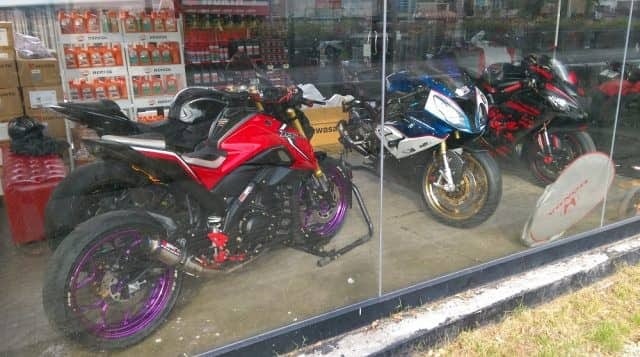
You can get Type 1 insurance for big bikes from CheckDi. The insurance fee is lower than major insurance companies with similar coverage.
Here’s the cheapest Type 1 plan CheckDi showed for a 2024 CB500F in October 2026, from Roojai:
- own damage (collision): THB137,000
- fire and theft: THB137,000
- personal accident and medical expenses: from THB50,000 each, and you can raise them
- bail bond: THB50,000
- deductible: you pick one from THB3,000 to THB50,000 per claim
- riders: one named rider only
- annual fee: THB6,595
If you want to buy from an insurance company instead, a popular Type 1 insurance for big bikes is offered by Viriyah.
One major point for big bike insurance is that most companies require an excess fee of THB5,000 on average for any claim, regardless of whether the damage is caused by the insured or not.
Type 2+ and 3+ are also available for big bikes. The insurance fees and coverage are slightly higher than for normal motorcycle insurance.
Going without Insurance
You might be tempted not to buy additional private insurance for your motorcycle.
It’s possible to do but not recommended.
According to the Accident Data Center Thailand, several hundreds of thousands of people in Thailand are injured in road accidents every year. Over 75% of severe accidents came from motorcycles. The Royal Thai Police showed that 50% of that came from reckless drivers.
What does this mean for you?
It means that motorcycle accidents regularly happen in Thailand. They end up in fatalities often.
Therefore, relying on the compulsory third-party liability insurance alone might not be enough.
Even with THB80,000 medical expense coverage, that isn’t enough if you need to be admitted to a hospital for a few days.
Therefore, if you plan to buy a motorcycle and regularly ride it in Thailand, it’s better to purchase motorcycle insurance.
Good to know: Having health insurance is a good idea. But that only comes with medical coverage for yourself, without coverage on your motorcycle, third-party liability, and public liability that commonly happen when it comes to road accidents.
Applying for Insurance
Nowadays, the easiest way to buy insurance for your motorcycle is to do it online.
There are many insurance brokerage websites allowing you to compare different motorcycle insurance plans and buy the one you like the most.
The following documents might be required when purchasing motorcycle insurance:
- a copy of the vehicle’s registration
- a copy of the first page of your passport
- a copy of your driver’s license
- a copy of your previous insurance policy
For Type 1 insurance, you may need to provide pictures of your motorcycle from all sides, including the front, back, left, and right.
You can start looking for your own insurance with CheckDi. It’s the website I use every time I need to buy insurance for my motorcycle.
Related articles:
- Car Insurance in Thailand: A Complete Buying Guide
- How to Get a Thai Driving License: Documents, Tests, and Renewals
Frequently Asked Questions
Is motorbike insurance legally required in Thailand?
Yes, but only one layer of it. CTPL (Por Ror Bor) is compulsory for every registered motorcycle and is checked when you renew your vehicle tax each year. Voluntary commercial insurance (Type 1 through 3) is optional, though strongly recommended given how limited CTPL’s payout is.
How much does CTPL cost, and what happens if I don’t have it?
CTPL runs THB161.57 to THB645.21 a year depending on your engine size. Riding without it carries a fine of up to THB10,000, and you won’t be able to renew your vehicle tax until you buy it.
Do I need a Thai driving licence or an International Driving Permit to be covered?
Generally, yes. Insurers commonly list an invalid or missing licence as grounds to deny a claim, and for foreign riders that means holding a Thai motorcycle licence, or a foreign motorcycle licence plus a matching IDP. A car licence alone does not cover a motorcycle.
Does my rental motorbike come with insurance?
Not always, and rarely as much as you’d assume. Ask the rental shop exactly what type of coverage is included and whether it requires the same Thai licence or IDP as a policy you’d buy yourself. Many rental agreements are thin on this detail until something goes wrong.
Does travel or health insurance cover motorcycle accidents in Thailand?
Health insurance covers your own medical costs after an accident, but not damage to your bike, third-party liability, or public liability. Motorcycle-specific insurance is what covers those.


Is Type 1 or Type 2+ better for a normal motorbike?
For a standard motorcycle under 250cc, Type 2+ is usually the practical choice. It covers collision, theft, and third-party damage at a much lower premium than Type 1, which is priced mainly for big bikes and the rare accident with no other vehicle involved.
Sources Cited
- Bangkok Insurance, standard CTPL policy wording: CTPL basic payments (THB30,000 medical, THB35,000 death or disability) and full limits (THB80,000 medical, THB500,000 death or permanent disability, THB200 a day inpatient for up to 20 days).
- Office of Insurance Commission, Protection for Motor Vehicle Accident Victims Act B.E. 2535: fines of up to THB10,000 for owning or using a vehicle without CTPL.
- Muang Thai Insurance Broker, motorcycle CTPL rate table: CTPL premiums of THB161.57 to THB645.21 by engine size.
- Roojai, motorcycle insurance: flood and fire cover by policy type, and premium ranges for Type 1 to Type 3.
- Thai PBS, Office of Insurance Commission flood guidance (September 2026): Type 1 covers flood damage; Type 2+ and 3+ only with flood cover added.
- Government Public Relations Department, drink-driving limits: the 50 mg% general limit and the 20 mg% limit for young, temporary, wrong-category and unlicensed drivers.
- CheckDi motorcycle insurance comparison: annual quotes by policy type for a 2024 Honda Click 125i and a 2024 Honda CB500F, and the cheapest CB500F Type 1 plan details, October 2026.


 Deutsch:
 Français:
 Español: