
Hello, I’m Ben. In 2017, I started a remarkable journey learning Thai after moving to Thailand. As someone who has had zero formal Thai language classes, I’ve made many mistakes along the way.
My adventure began in Tak, a traditional area with fewer foreigners than tourist hotspots like Chiang Mai or Bangkok. At first, speaking Thai and fitting in was tough. But with hard work and practice, I’ve improved a lot. I can tell you that learning Thai is possible — and you don’t even need to live in Thailand to learn it fast. There are a lot of resources out there.
By the end of this guide, you’ll know the tips, tricks, and resources that worked for me, and I’ll reveal the mistakes I made so you can get a head start. I’ll show you what I think is important, why it matters, and how it helped me learn Thai fast.
Contents
- Key Takeaways
- Why Should You Learn Thai?
- How Long Does It Take to Learn Thai?
- Why Thai is Hard
- Why Thai is Easy
- How I Became Fluent in Thai
- Step 6: Practice Thai in the Real World
- Additional Free Resources for Learning Thai
- Additional Tips
- What About AI?
- Common Mistakes That Slow You Down
- FAQs About Learning Thai Fast
- How Long Does It Take to Learn Thai Fast?
- What's the Single Most Effective Way to Learn Thai Quickly?
- Are There Specific Apps or Resources That Speed Things Up?
- How Much Vocabulary Do I Need for Basic Conversations?
- What Common Mistakes Slow People Down?
- Should I Focus on Reading, Writing, or Speaking First?
- How Do I Stay Motivated Learning a Language This Different From English?
- What to Read Next
- Sources Cited
If you want to actually speak Thai, check out ThaiPod101. You get a full Thai course with short audio lessons, podcasts, and quizzes for every level, starting at US$8 a month. Start learning here. (Advertisement)
Key Takeaways
- Learn to read Thai first to understand phonetics and tones, which helps you progress much faster than speaking-only approaches.
- Use ThaiPod101 or Learn Thai from a White Guy to tackle specific challenges and speed up your learning.
- Practice reading in real-world situations like menus, signs, and product labels.
- Combine apps with real conversations to get immediate feedback and stay motivated.
- Focus on sounds first by mastering basic character recognition and phonetics before worrying about perfect tones.
Why Should You Learn Thai?
When I first started learning Thai, I didn’t think much about the benefits. But once I could actually speak it, I realized there were many advantages I hadn’t expected.
The rewards of learning Thai go far beyond ordering food or asking for directions. It goes far beyond that. As you improve, you start to think differently, understand cultural perspectives that weren’t obvious before, and connect with people on a deeper level.
- Lower cost of living: In many cases, you can avoid inflated foreigner prices just by speaking Thai. I’ve found that asking “Can you lower the price?” in Thai (lot raka dai mai/ลดราคาได้ไหม) often gets you a better deal at markets and other places where negotiation is possible.
- Freedom to live: Many Thais can’t speak English. If you don’t speak Thai, you may feel limited to expat-heavy areas. But once you learn Thai, you can live and travel anywhere in Thailand with much more confidence.
- More job opportunities: Your chances of landing a job improve the longer you stay and the better your Thai gets. I’ve seen many people grow their network simply because they can communicate in Thai, which opens doors over time.
- Making friends becomes easier: I’ve personally noticed that speaking Thai surprises people in a good way. It often leads to more natural conversations and stronger connections.

How Long Does It Take to Learn Thai?
There’s no single answer, but here’s what I’ve seen in my own progress. You can pick up survival phrases in a few weeks. Comfortable everyday conversation takes six months to a year of daily practice. Solid reading fluency lands at around a year if you start with the script early instead of putting it off like I did.
Two reference points help set expectations. The US Foreign Service Institute classifies Thai as a Category III “hard” language and estimates roughly 1,100 class hours for English speakers to reach professional proficiency. Chulalongkorn’s Intensive Thai course runs 100 hours per level across 9 levels, which gives you a concrete sense of the hours involved. Before you fixate on a timeline, it helps to decide what fluency actually means for your goals.
Why Thai is Hard
It may feel impossible to learn Thai from scratch, but believe me, it’s not. Anyone can do it, provided you put the effort in. I did it, and continue to do so, and I don’t consider myself a master of languages.
In my experience, here are the most difficult things about learning Thai:
- Thai tones: Thai has five distinct tones that change word meanings, making pronunciation challenging for speakers of non-tonal languages.
- Unknown script: The Thai alphabet has 44 consonants, 15 vowel symbols that combine into 28 vowel forms, and various tone marks, which might scare you away from reading.
- Different sentence structure: Thai follows a subject-verb-object pattern but has significant differences in word order, omitted subjects, and unique classifier system compared to English.
Go Deeper: Is It Hard to Read and Write Thai?
But I’m not here to scare you. I have some good news too. There are quite a few things that make the Thai language quite easy to learn.
Go Deeper: What is Thai Tone? Rules, Patterns, and How to Master It
Why Thai is Easy
Difficulties aside, I’ve found Thai to be easier to learn when compared to other languages. I’ll cover a few of these reasons below.
- Compounded vocabulary: Words combine to form new meanings (e.g., “naam/น้ำ” (water) + “pla/ปลา” (fish) = “naam pla/น้ำปลา” (fish sauce)).
- Limited vocabulary range: Fewer distinct words to learn compared to English, with basics combining to create new meanings.
- Simplified grammar: No conjugations, declensions, or inflections in Thai.
- No word form changes: Thai words remain the same regardless of gender, person, number, or tense. Time indicators are added separately.
- No articles: No equivalents for “a,” “an,” or “the,” with unnecessary words omitted.
One verb form only: Learn just one form per verb instead of dozens in languages like Spanish or French.
With both the hard and easy aspects of learning Thai covered, let’s talk about how you can set up an everyday routine that helps you learn Thai fast.
How I Became Fluent in Thai
After many trials and errors, here’s what I did to become fluent in Thai.
Step 1: Integrate Thai Into Your Daily Life
While I was in Tak, I found that incorporating Thai into my everyday routine sped up my learning process because I was exposed to Thai in practical ways. Fact is, by surrounding myself with Thai digitally and physically, I transformed passive moments into active learning.
You can use the following methods to do the same:
- Use it in your daily life: I’ve found Thais to be very friendly and forgiving, even when you say something wrong. Sometimes, they’ll even correct you. Even if your Thai isn’t perfect, don’t be afraid to use it. The more you use it, the faster you learn.
- Find a Thai partner: This can be a friend, a partner, or even a language buddy. The key is having someone you can regularly practice with in real situations.
- Use a Thai keyboard on your devices: Install a Thai keyboard on your phone, tablet, and laptop so you can practice typing when messaging, taking notes, or searching online.
- Use Thai OCR tools: Apps that scan and translate Thai text from menus, signs, and documents can help you learn from things you see every day.
- Practice with AI conversation partners: You can use ChatGPT or similar tools for 24/7 speaking and listening practice. It’s great for quick feedback, although I’ve found the language and accent can feel a bit unnatural at times.
Step 2: Learn to Read Thai
This was my biggest mistake. Like most Thai learners, I didn’t want to learn how to read Thai at first because it looked difficult. And it’s not just me. In our survey, 22 out of 50 learners said that ignoring tones and pronunciation was a major mistake.

The problem is, you can’t really get these right without learning how to read Thai.
When I moved to rural northern Thailand knowing zero Thai (not even “hello”), I focused only on speaking and listening — a decision that slowed my progress. For six months, I struggled to retain pronunciation, tones, and vocabulary skills because my English-trained ear had, until then, never heard them.

Everything changed when I began learning to read Thai. Reading creates a crucial visual framework for understanding the phonetic elements that make Thai challenging. Without seeing the written language, many sounds remain the same to our ears, making both listening and pronunciation difficult.
The Thai writing system shows tones and distinct consonant sounds that are confused when only heard. By learning to read first, you get the complete sound system of Thai, allowing your brain to group and see patterns that remain hidden in spoken language alone.
Here are a few free online resources where you can practice reading Thai as it’s used in everyday life:
- r/thaithai subreddit: It might seem overwhelming at first, but browsing this popular subreddit for just 15 minutes a day will show you how the Thai vocabulary that you’re learning is used in context. As a bonus, you also get a glimpse into the world of Thailand’s newer generation, what they like, dislike, and so on, giving you plenty to talk about when practicing speaking Thai in the real world.
- University of Wisconsin at Madison: Thai professors at the university created a free Thai reader project with two volumes packed with practical Thai reading practice. Altogether, there are nearly 100 lessons available for you to download and practice with. Keep in mind these lessons aren’t for immediate beginners. But remember — the more exposure to Thai, the faster you learn.
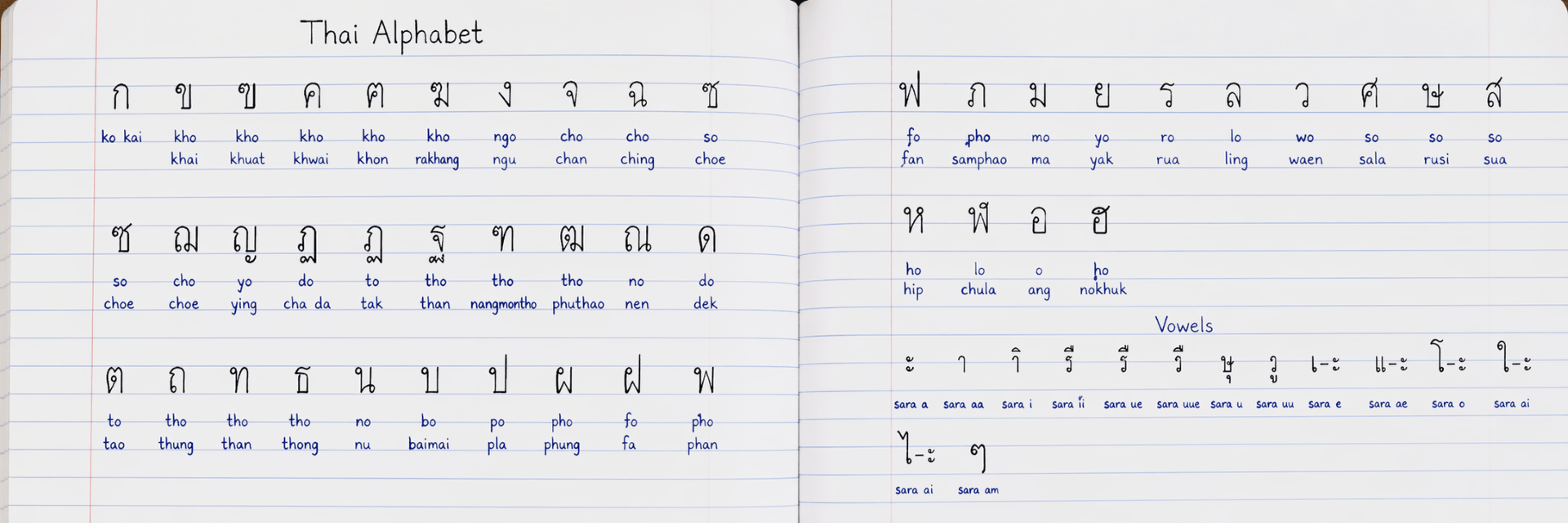
Thai is a phonetic language; unlike Chinese or Japanese. If you can see, hear, and practice the sound of a letter singled out and alone, then you’re practicing your listening and speaking at the same time.
Plus, writing the symbol helped me retain the memory of the shape as it became a part of my muscle memory. I also wrote the symbols on a separate page at the back of my notebook with no notes. I then used this page to see if I could remember the sound of the symbol I was reading, using my notes to check my answers.
Tip: If you’re serious about learning Thai quickly, start with reading rather than focusing on speaking. This provides the most efficient path to overall fluency.
Go Deeper: The Complete Guide to Learning the Thai Alphabet
Step 3: Learn to Pronounce Thai
Mastering Thai pronunciation is crucial for you to be understood, and the unique phonetic challenges of Thai require practice. My struggles with tones and consonants improved once I developed a system for pronouncing Thai.
Just like it’s difficult for some Asian people to pronounce R’s and L’s in English, your accent will be very strong and difficult to understand for some Thais.
Some words will be muddled up when speaking if you don’t practice the phonemes first. Think of words like correct and collect, grass and glass, or fry and fly. It can be confusing for an English speaker to hear these words mixed up and pronounced.
You will do the same in Thai with sounds that cannot be spelled out using the Romanized alphabet. Learning to read is also learning to listen and speak the language, just in small steps, which is what you need in a difficult language like Thai.
So, work on the following:
- Master the five tones: Low, mid, high, falling, and rising tones are essential as they change word meanings — practice each tone pattern daily.
- Focus on consonant clusters: Thai contains sounds that don’t exist in English, like the aspirated “ph” or the unique “ng” initial sound.
- Use minimal pairs practice: Drill words that differ only by tone or similar-sounding consonants to train your ear and mouth.
- Record and compare yourself: Record your pronunciation, then compare it with native speakers to identify specific areas for improvement.
- Slow down: Pronounce words slowly at first to ensure you’re hitting the correct tones before attempting natural speech speed.
The mirror technique — watching your mouth movement while practicing difficult sounds — helped me with certain consonants that require specific tongue positions. Exaggerated hand movements to trace the tone contours while speaking reinforced the correct pitch patterns in my muscle memory.
Remember that perfect pronunciation isn’t required for speaking. Focus first on the tones and sounds that cause misunderstandings, and refine your accent as you progress. Thai speakers will appreciate your efforts even if your Thai isn’t clear yet.
Step 4: Learn to Comprehend Thai
Understanding spoken Thai becomes easier once you develop reading skills. The connection between written symbols and sounds creates a cognitive framework that helps your brain process and recognize spoken Thai more, even at natural speaking speeds.
Developing Thai listening comprehension happens as you progress:
- Reading builds familiarity with sound patterns and tones that appear in everyday speech.
- Audio lessons become more effective when you can visualize the written words as you listen.
- Recognizing tone marks in writing translates to better tone recognition in conversation.
- Common word combinations seen in writing become easier to identify when heard in rapid speech.
This reading-supported approach to listening creates a multi-sensory learning experience where visual and auditory processing reinforce each other, speeding up your ability to understand Thai in the real-world.
Step 5: Build Your Thai Vocabulary
Reading Thai while you go about your daily life expands your vocabulary through practical, memorable exposure. When you can read Thai, then menus, road signs, and product labels become language learning resources.
You can build real-world vocabulary in the following ways:
- Supermarket aisle signs: teach you food categories like “snacks” or “beverages” while you shop.
- Restaurant menus: reinforce essential food terms like “chicken” (ไก่) and “pork” (หมู) each time you order.
- Food cart signs: help you remember the names of dishes you enjoy, allowing you to order them again with confidence.
These everyday reading chances make routine activities into vocabulary-building exercises. You can learn new words through regular, meaningful exposure rather than just using books to learn Thai words you might never use.
Step 6: Take a Thai Language Course
Learning to read Thai is important because it helps you take small but steady steps toward better pronunciation and recognizing sounds in spoken language. But where do you start? And doesn’t it take a long time? Honestly, not as much as many people think.
Some people can learn Thai using only free resources. That’s true. But in my case, using a language course helped me learn much faster.
I personally learned to read Thai in just one month using ThaiPod101. It offers a structured path to reading Thai through in-depth lessons that build step by step. I could start reading within a month, although becoming truly fluent at reading took me around a year. With consistent practice, you may progress even faster.
After that, there are thousands of lessons available to help you keep improving your Thai. You can also read our ThaiPod101 review to learn more.
In addition to ThaiPod101, there are other courses worth checking out:
- Learn Thai from a White Guy: A structured course created by Brett Whiteside. It focuses heavily on reading and writing Thai. Unlike many other courses, it was built by an English speaker who understands the challenges foreigners face.
- Ling: An interactive app for learning Thai. Think of it as something similar to Duolingo.
- iTalki: A platform for finding private tutors. Thailand Starter Kit editor John has used italki to continue learning Thai. He liked the wide range of tutors, flexible scheduling, and the ability to tailor lessons to his needs.
In addition to online courses, there are also many Thai language schools worth considering. One private Thai tutor once told me that students who studied at Duke Language School or Chulalongkorn University often had stronger Thai skills than many of her other students.
Chulalongkorn’s Intensive Thai program runs 9 levels, with each level covering 6 weeks and 100 hours of class time. On-site tuition is THB29,500 per course, while the online version runs THB23,000 to THB23,500 per course. If you prefer a full-immersion classroom, the AUA language school in Bangkok is another well-known option.
Find out more: The Complete Guide to Learning Thai Online And Available Courses
Step 6: Practice Thai in the Real World
This is the fun part. Use what you’ve learned as a starting point for real conversations, then practice in the real world.
In my case, I tried to speak Thai as much as possible with everyone I met. Since I lived in Tak, there were only a few people who could speak English. So the situation naturally pushed me to speak Thai, which helped a lot.

The more you use Thai in daily life, the faster your confidence grows. You start by making mistakes, then slowly improve through real conversations. That’s when the language begins to feel natural.
Tip: If you can’t find someone to practice with, another good option is to hire a private tutor. The key is to tell your tutor what topics you want to learn, then spend your sessions practicing and talking as much as possible.
Additional Free Resources for Learning Thai
In addition to paid resources I mentioned earlier, there are many good free sources you should check out.
Comprehensible Thai
Comprehensible Thai stands out as an exceptional free resource that immerses you in authentic Thai as it’s spoken. It’s also the favorite channel of Thailand Starter Kit’s programmer.
This YouTube channel offers a different approach from translation-based methods, helping you develop natural language processing skills.
- Comprehensible-input method: You learn by understanding messages in context, much like how children pick up their first language.
- Full Thai immersion: Teachers speak only Thai with no translations, forcing your brain to adapt.
- Visual aids: Teachers use gestures, objects, and context to make meaning clear.
- Natural language patterns: Exposes you to how Thai people communicate in real life.
- Content for all levels: Offers thousands of videos suitable for beginners through advanced learners.
- Immersion-based teaching: The channel is run by experienced Thai teachers who focus on comprehensible input rather than grammar drills or translation.
This resource excels at training your ear to understand spoken Thai in context without relying on your native language as a crutch. By watching, you’ll develop the crucial skill of thinking in Thai rather than translating, a key breakthrough for achieving true fluency.
ThaiPod101 Free YouTube Channel
ThaiPod101’s free YouTube channel provides crucial Thai language fundamentals that help you communicate every day. Their verb-focused videos are valuable since Thai often uses direct expressions like “want food” rather than the more formal “may I have food” structures used in English.
Anki
Anki‘s spaced repetition flashcard system provides one of the most effective free methods for expanding your Thai vocabulary. You can customize this app to help you memorize thousands of words through optimized review intervals.
Recommended decks:
- Thai for Beginners – Becker
- Thai for Intermediate Learners – With Audio
- Thai vocabulary frequency 4,000
- Thai 1,000 Common Words.
You can read our full Anki review for a step-by-step setup. Memrise is another spaced repetition option that still supports Thai, and it now includes an AI conversation partner called MemBot that you can practice speaking with.
Additional Tips
Here are some extra things I did and which you can do to learn Thai fast.
Practice Spaced Repetition
Anki leverages spaced repetition technology to speed up vocabulary building by showing you difficult words more often while spacing out words you know well.
This proven method trains both short-term and long-term memory at the same time, making it my most valuable tool for rapid Thai vocabulary building.
- Daily consistency is crucial: Learn Thai every single day without exception — even just 15 to 20 minutes produces significant results.
- Progress from words to phrases: Once single-word vocabulary becomes comfortable, advance to phases
- Tackle Thai sentence structure: Use phrase-based learning to overcome the different word order of Thai compared to English.
- Build casual speaking patterns: Learn common expressions as complete units to jump start your speaking skills.
The beauty of this approach is its efficiency — I’ve never needed more than an hour daily, and often just 15 minutes produces noticeable improvement. As you progress to sentence-level learning, you’ll begin getting Thai’s unique grammatical patterns.
Maintain and Cement Your Reading Skills
Spelling familiar Western names and places in Thai script accelerates your writing proficiency by forcing you to apply the writing system rules to sounds you know well.

This practical exercise cements both the phonetic principles and the writing order of Thai characters, which doesn’t flow left to right like English.


- Use familiar words as practice: Write your name, hometown, and country in Thai script to make abstract rules concrete.
- Master the symbol patterns: Thai characters follow consistent patterns once learned, making the system more approachable than it appears.
- Prioritize character recognition over tone rules: I wasted valuable time obsessing over tone rules when I should have focused on recognizing and writing the basic symbols.
- Let tones develop: Unlike characters, you can internalize tones through exposure and practice rather than through memory.
- Practice daily writing exercises: Regular handwriting practice develops muscle memory that reinforces character recognition.
One of my biggest mistakes was getting bogged down in the complex tone rule system when I should have been building foundational character recognition. The tone system becomes more intuitive with practice, but the basic symbols require you to memorize and repeat them.
Do Not Rely Only on Apps
One of my most valuable Thai learning insights came after becoming focused on my screen. Despite making exciting initial progress with Anki and Memrise, I hit a frustrating plateau because I couldn’t transfer my digital skills to real communication. Breaking free from this screen-focused approach transformed my learning journey.
- Motivation stalls: When I started speaking with locals, I experienced an immediate motivation boost that apps couldn’t provide. Real conversations created a feedback loop of visible improvement. App success became repetitive once I reached that point with them. The excitement of quick progress had faded, leaving me feeling stuck.
- Real-world mistakes are valuable teachers: My early conversations taught me more than perfect app scores ever did. Language is a living entity, not confined to phrases in apps. People react, introducing expressions beyond any tool’s reach. Human interaction is something no app can replicate.
- Apps can create a vocabulary ceiling: I found myself revising what I knew rather than expanding my range. Apps with large vocabulary sets consumed my day reviewing familiar content. It’s important to recognize when to drop an app or course. Letting go allowed my Thai to flourish rather than being caged into a limited set of words.
What About AI?
We’re living in the AI era now, and I’ve seen many AI tools that can help you learn Thai. I haven’t tested them in detail yet, but based on what I’ve seen so far, they offer another interesting way to learn the language.
Personally, it’s not my preferred method. While AI is cheap and convenient, I still prefer talking and practicing with a real person rather than a machine.
Another issue is that some pronunciation still doesn’t sound natural. If you rely on it too much, it could also affect your own pronunciation.
That said, AI is improving quickly. Who knows, in the future it may become another very effective way to learn Thai.
Common Mistakes That Slow You Down
Looking back, most of what held me up came down to a handful of habits. Here are the ones to watch for:
- Skipping reading and going straight to speaking.
- Relying only on apps without real conversation.
- Translating word-for-word instead of learning phrase patterns.
- Getting stuck memorizing tone rules instead of getting exposure.
- Avoiding speaking out of embarrassment.
FAQs About Learning Thai Fast
How Long Does It Take to Learn Thai Fast?
There’s no single number, but a realistic range: basic survival phrases in a few weeks, comfortable everyday conversation in six months to a year of consistent daily practice, and solid reading fluency in about a year if you start with the script early. Structured programs like Chulalongkorn’s Intensive Thai course run 100 hours per level across 9 levels, which gives you a sense of the total hours serious fluency takes.
What’s the Single Most Effective Way to Learn Thai Quickly?
Learn to read the script before you focus on speaking. It sounds backwards, but Thai’s writing system shows you the tones and sounds that get lost when you only listen, so reading first builds the foundation everything else sits on. Combine that with daily spaced repetition and real conversation as early as possible.
Are There Specific Apps or Resources That Speed Things Up?
ThaiPod101 and Learn Thai from a White Guy both offer structured, script-first courses. Anki and Memrise use spaced repetition to build vocabulary efficiently, and Memrise now includes an AI conversation partner for extra practice. iTalki connects you with tutors for live correction, which matters once you’re past the basics.One thing I do regularly when practicing reading is to read everything I see in Thai.
How Much Vocabulary Do I Need for Basic Conversations?
Around 1,000 to 2,000 of the most common words cover roughly 80% of everyday conversation. Prioritize practical words for food, transport, and daily interactions over memorizing lists in isolation.
What Common Mistakes Slow People Down?
Skipping reading and going straight to speaking, relying only on apps without real conversation, translating word-for-word instead of learning Thai’s own phrase patterns, and getting stuck trying to memorize every tone rule before speaking a word. Progress comes faster from exposure and use than from getting everything technically correct first.
Should I Focus on Reading, Writing, or Speaking First?
Reading first. It gives you the phonetic foundation for tones and sounds that’s nearly impossible to build from listening alone. Speaking and listening should develop alongside it, not after it. Full writing fluency can come later.
How Do I Stay Motivated Learning a Language This Different From English?
Set small daily goals instead of fixating on fluency as one distant finish line. Recognizing a word on a menu or ordering food successfully in Thai counts as real progress. Once you’ve outgrown what an app can teach you, moving into real conversations keeps the momentum going.
What to Read Next
- A Big List of Learn Thai Apps
- Online courses
- Language schools
- How to Learn Thai Language for Beginners
- How to Find Thai Language Partner
- Thai Language Teachers and Tutors
Sources Cited
- Chulalongkorn University Intensive Thai Program (CTFL): https://www.arts.chula.ac.th/CTFL/intensivethai/
- Memrise: https://www.memrise.com/en/learn-thai
- iTalki (Thai tutors): https://www.italki.com/en/teachers/thai

 Deutsch:
 Français:
 Español: