Thinking about opening an office in Thailand?
Already have a virtual team and wondering what the additional costs of co-locating them would be?
Curious about how much overhead and benefits contribute to the total costs?
I have been running a business in Thailand for many years. The following data offers some answers based on my experience, allowing you to make a more informed decision.
Contents
- Key Takeaways
- Quick Summary
- Included Data
- Company Profile
- Expense Summary
- Expense Details
- Salary (฿35,000)
- Rent incl. Service Fees (฿3,200)
- Accounting and Auditing (฿2,050)
- Social Security and Welfare (฿1,800)
- Entertainment (฿1100)
- Hardware and Software (฿1000)
- Electricity (฿500)
- Internet and Phone (฿120)
- Office Supplies (฿102)
- Office Furniture and Fixtures (฿473)
- Transportation, Messengers, and Postage (฿270)
- Government Fees (฿950)
- Snacks and Coffee (฿370)
- Drinking Water (฿35)
- What's Not on the List
- Now, on to You
Key Takeaways
- The total cost per employee at a small Bangkok company comes to around THB46,970 per month (roughly US$1,300), with salary making up the bulk of it at THB35,000 on average.
- Overhead costs add about THB11,970 per employee, covering rent, accounting, social security, internet, supplies, and more.
- Salary ranges widely: fresh graduates typically earn around THB18,000 while experienced managers can exceed THB50,000.
- Office rent outside the CBD runs around THB550 per sqm plus a 10% service fee. In central areas like Sukhumvit or Asok, expect THB750 to THB1,000 per sqm or more.
- Social security is mandatory and capped at THB875 per month from each side (employee and employer). Private group health insurance is not required but most companies add it so staff can skip government hospital queues.
- Government fees for a single foreign worker (visa, work permit, re-entry permit) total around THB10,000 in government charges, but using a visa agent adds THB25,000 to THB40,000 on top.
- These figures are based on a BOI-promoted software company with 5 to 20 staff. Costs will differ for larger companies, non-BOI setups, or businesses outside Bangkok.

Quick Summary
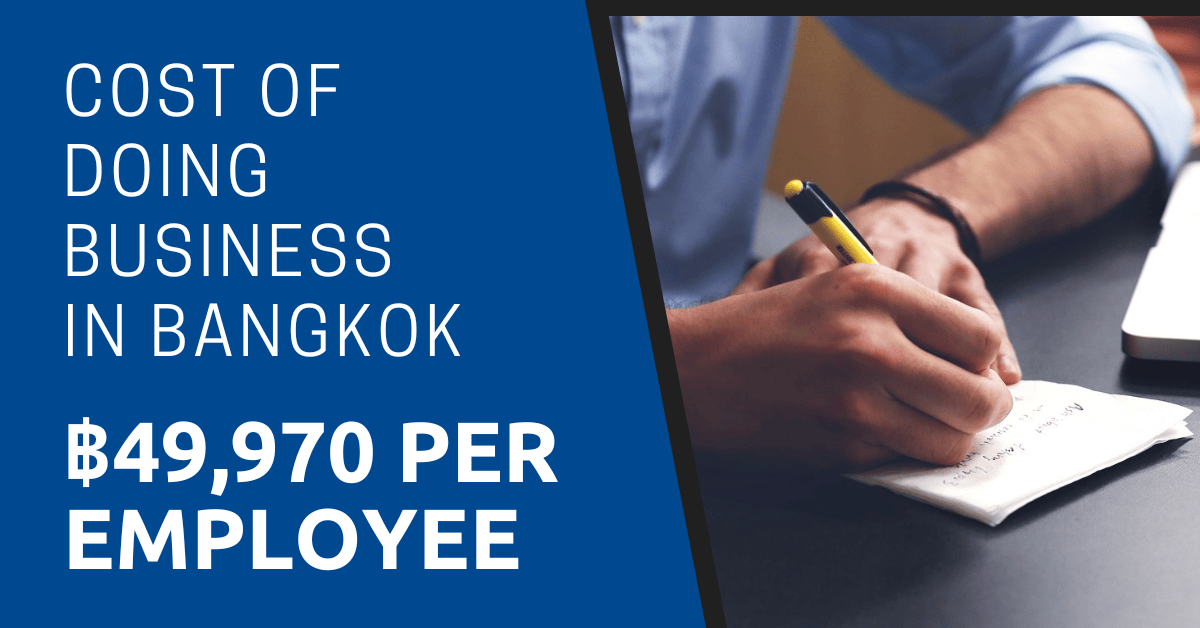
Starting with the big numbers: My total cost per employee is ฿46,970 baht per month – or roughly US$1,300.
Overhead costs account for ฿11,970 of that and include items from rent to drinking water.
Included Data
All the data in this report is an average expense per employee per month.
While this isn’t representative of businesses of all sizes, it gives you a rough idea of the overhead expenses you can expect when running a small company (think 5 to 20 employees) in Bangkok.
It doesn’t include all overseas expenses (e.g., advertising, commissions, exchange rates, payment processing, suppliers) since those have little connection to the base of operations and can vary greatly between businesses.
The data is meant to give you an idea of the local cost structure and overhead costs of running a company in Thailand.
If there’s anything missing, or if you’re just curious, leave a comment below, and I can some provide additional details.
Company Profile
The cost of doing business in Thailand in this article applies to a small software company in Bangkok that is promoted by the Board of Investment.
The company’s payroll includes janitorial, administrative, marketing, customer service, sales, and technical staff.
It’s a basic company that uses mostly IKEA furniture and functional computers from brands like Lenovo and Asus, with open-source software such as Ubuntu, Linux, and Python.
Expense Summary
Here’s a brief summary of the expenses per employee per month.
| Category | Monthly Expense |
| Salary | ฿35,000 |
| Rent incl. Service Fees | ฿3,200 |
| Accounting and Auditing | ฿2,050 |
| Social Security and Welfare | ฿1,800 |
| Entertainment | ฿1,100 |
| Hardware and Software | ฿1,000 |
| Electricity | ฿500 |
| Internet and Phone | ฿120 |
| Office Supplies | ฿102 |
| Office Furniture and Fixtures | ฿473 |
| Transportation, Messengers, and Postage | ฿270 |
| Government Fees | ฿950 |
| Snacks and Coffee | ฿370 |
| Drinking Water | ฿35 |
Let’s look at the data in more detail.
Expense Details
Salary (฿35,000)
Unsurprisingly, salary is the largest expense per employee. On average, you should expect to pay around 35,000 baht per employee in Thailand.
The distribution of salaries typically follows a bell curve, influenced by individual qualifications.
A salary for a fresh graduate is around 18,000 baht. For experienced managers, it can exceed 50,000 baht.
Rent incl. Service Fees (฿3,200)
Renting office space is another significant expense for running a company.

You should expect to pay around 550 baht per square meter with another 10% for service fees (air conditioning, building maintenance, etc.). This is for a building called Forum Tower on Rachadaphisek Road in Huay Khwang. It’s not a business district.
If you want to rent an office in a central business district like Sukhumvit or Asok, the cost will be much higher. It can easily exceed 750 baht per square meter. Sometimes, it can even be higher than 1000 baht per sqm.
For a rough estimate, I paid around 32,000 baht per month for an office in Bangkok.
Accounting and Auditing (฿2,050)
Accounting and auditing fees can be costly in Thailand, especially when your company is promoted by the Board of Investment and deals with complicated tax issues from overseas.
They can be well over 12,000 baht a month. And you should expect to pay another 25,000 or so for annual financial statements and auditing.
But if it’s a typical company, the cost of accounting will be much less. It can be only in the range of 5,000 to 8,000 baht.
This is for a local accounting firm.
If you want to use an international accounting firm, they might not work with you unless they can earn over 30,000 baht a month.
Employing an accountant with significant experience in international corporate accounting and taxation on a freelance basis is an option.
Social Security and Welfare (฿1,800)
Social Security is mandatory in Thailand. It’s a percentage of the base salary, capped at THB875 from the employee’s salary and another THB875 that the company must pay (the cap is reached at a salary of THB17,500 a month).
This provides staff with free treatment at their chosen social security hospital. Additionally, there are some minor unemployment and retirement benefits.
The other part of this is private corporate health insurance.
While it’s not mandatory, it’s a good idea to have it to keep your employees healthy and to guard against any major illnesses or accidents.
The coverage limits aren’t as high as those in most Western countries, but neither are the costs of health treatment here, so it usually works out.
My staff mostly uses it for outpatient care – it means they can go to a much wider range of hospitals without potentially having to wait for hours at the social security government hospital.
Entertainment (฿1100)
Entertainment expenses can include a free office lunch on Fridays, staff events (karaoke, dinner, etc.), and the occasional company trip.
In Thailand, the office environment is also a social environment, so that’s just part of it.
For more details about our company culture, you can read my account of cross-cultural management challenges.
Hardware and Software (฿1000)
The cost of hardware in Thailand is quite reasonable.
I never paid for than 25,000 baht for a functional laptop from brands like HP, Acer, Asus, and Lenovo for my employees.
It can last for five years without any problems. Some may already come with Microsoft Windows and Microsoft Office, so you won’t need to buy additional software.
The main cost is actually the salary of a full-time system administrator who can take care of both online servers (if you have them) and local infrastructure.
Electricity (฿500)
Electricity costs are mainly for computers and air conditioning. They are a bit higher during the hot season due to increased A/C usage and a bit lower during the ‘cold’ season.
It should be more than 5,000 baht per month.
Internet and Phone (฿120)
Just a normal home internet package and mobile phone contracts. The internet in Thailand is very fast and affordable.
If you have large data transfer volumes, you might need a custom arrangement, but most smaller offices will be fine with what is offered by TRUE, AIS, 3BB, and their counterparts.
Office Supplies (฿102)
Paper, post-its, pens…
Office Furniture and Fixtures (฿473)
Surprisingly, outfitting an office in Thailand was more expensive than in Germany.
Now, you can simply pick up new furniture at IKEA. It looks good and doesn’t cost a fortune.
Or you can opt for local furniture chains such as OfficeMate or SBFurniture. They tend to be more expensive than IKEA but offer better quality. However, the designs may not be as modern.
You can essentially eliminate the cost of office furniture if you use a serviced office.
Transportation, Messengers, and Postage (฿270)
These are the costs of low-tech operations.
Many companies and government offices don’t offer online handling of documents.
So, occasionally, you still need to send a document via a messenger. Or you can use Thailand Post for mailing. It costs almost nothing at 3 baht per letter but can take up to two weeks to arrive.
The downside is that it can rarely be used. It aligns with my observation that if you’re content with ‘commonly available standards of quality’ in a ‘developing’ country, you’ll find good deals.
If your standards are higher (e.g., reliable and fast delivery), you might end up paying more than in a developed country.
Government Fees (฿950)
Stamp fees, visas, work permits – the fees themselves are not high (the government costs to obtain a work permit, a visa, and a re-entry permit for a single foreign worker total about 10,000 baht), but the time required to navigate the process is substantial.
The real cost of government processing is thus much more in the form of hiring staff to work on compliance and preparation than the fees themselves.
If you use a visa agent, they charge around 25,000 to 40,000 baht for processing or renewing a visa and a work permit.
You will still need to have your company admin prepare the necessary company documents.

Snacks and Coffee (฿370)
Snacks, coffee, and etc.
Drinking Water (฿35)
Did you know that employers are legally required to provide drinking water in Thailand?
Well, at 18.15 baht per employee, it’s one of the easier and cheaper government requirements (not the reason we’re doing it, of course).
You can have a water provider like Sprinkle deliver water to your office every week. It costs only 70 baht for a 5-gallon bottle.
What’s Not on the List
You’ll notice that this list doesn’t include legal fees.
While you may need to consult with lawyers occasionally, you may not need to hire them unless you are faced with a legal issue.
While you’re less likely to encounter litigation in Thailand than in the US or Europe, the costs if you do have to hire a lawyer are not that different from what you would pay in Europe.
Now, on to You
This gives you a pretty comprehensive picture of the expenses you can expect when operating out of Bangkok.
If you have any questions, please feel free to leave a comment below.


 Deutsch:
 Français:
 Español: