If you want to pronounce Thai language correctly, you need to spend some time making sure that you are pronouncing each letter correctly. Sounds are the basic building blocks of a language, you assemble them first into words and then into sentences. Since Thaiʼs grammar is pretty simple, once you know a bunch of words they can easily be combined into sentences. No need to deal with verb conjugations or noun declensions.
It is likely true that if you approach Thai using (one of the many) Romanization methods, that you will get down some basic vocabulary faster than a student studying the Thai alphabet first. Unfortunately, your chances of being understood are not very good. Sure people can probably figure out what you are saying if you say “Hi,” “Bye,” “How are you?”, but this is often based on guesswork. Once you try to broaden your vocabulary and talk about anything of substance, you will likely be met with confused stares.
While many people say that learning the writing system is essential if you want to pronounce Thai correctly and how itʼs really not that hard (itʼs not), but what seems to be missing is a good tutorial on how to make sounds pop out of your mouth that youʼre not used to.
Disclaimer: Some links in this article go to our partners, and we may earn a commission if you use them. It costs you nothing extra, and we only recommend services we'd use ourselves. Read more in our Advertising Disclosure.
Contents
- Why can't I just learn Thai using romanized spelling instead of the alphabet?
- Does vowel length actually change the meaning of a word, or is that a myth?
- How many tones does Thai have?
- Why do Thai words sometimes sound cut off at the end?
- What's the difference between aspirated and unaspirated consonants?
- Is it true that being "tone-deaf" means you can't learn to speak Thai properly?
- Can one Thai syllable really mean five different things?
- What is RTGS, and does it show tones?
- Is "ph" in Thai pronounced like an English "f"?
- How do I know which tone a Thai word has?
- What's the fastest way to build on what I learn here?
Get Visual Representation
Thai alphabet (like that of many Indic languages) maps directly to the human mouth, but for someone who isnʼt used to thinking about his mouth, nose, throat and tongue this can be tricky.
Learn Thai Without the Guesswork
Get our free Thai Language Cheat Sheet: printable worksheets and cheat sheets to crack the alphabet, tones, and your first words, sent to your inbox.
- ✓A 16-page alphabet worksheet (all 44 consonants and vowels)
- ✓Tone marks, clusters, and pronunciation cheat sheets
- ✓A phonetic consonant map and reading/writing summaries
- ✓Quick-start vocabulary and printable flashcards
- ✓Plus our top course, tutor, and school picks
I had a singer friend come visit for a week once and he was one of the few people who could perfectly pronounce Thai words after hearing them only once or twice. The thing is singers are used to thinking about the mouth as an instrument but the rest of us arenʼt.
When learning a new language, itʼs very important to sit down and figure out how to make your mouth reproduce the sounds required before digging into the vocabulary.
The upside of Thai is that each letter and vowel has (generally) only one corresponding sound. There are some exceptions when consonants change their pronunciation at the end of a word, but this is all laid out in easy-to-remember rules.


There are some unfortunate non-standard pronunciations that have worked their way into the language over time, but they are much fewer than in English where even simple words like “go” and “do” have totally different vowel sounds.
Position Your Tongue, Lips, Throat, and Mouth
As you approach Thai phonetics having to think about the position of the tongue, lips, throat and mouth you may get the feeling that it will be totally impossible to speak this language with any form of speed close to which you speak English.
It is true that at first your words will come out slowly (albeit correctly), but the thought process behind it all will eventually fade away. Work with the system and over time, you will find that your mouth just does what itʼs supposed to do, you no longer have to will it into action.
The Thai language is composed of 21 distinct consonant sounds which are represented by 44 different characters. Vowels are constructed using 16 different symbols, for a total of 9 single-vowels, 12 double-vowels (diphthongs) and 3 triple-vowels (triphthongs).
Why Vowel Length Changes the Meaning of a Word
Several Thai vowels come in a short and a long version of the same sound. Holding a vowel for the wrong length can turn one word into a completely different one.
- วัด (short vowel) means temple.
- วาด (long vowel) means to draw or paint.
Same consonant sounds, same consonant class, different word. The vowel length is the main difference, and it also changes the tone. This is one of the most common ways foreigners get misunderstood: they nail the consonant and get the general shape of the word right, then clip a long vowel short (or drag out a short one) and say something else entirely.
Vowel length also feeds directly into Thai’s tone rules. Whether a syllable’s vowel is short or long is one of the factors, along with the consonant’s class and whether the syllable ends “dead” or “live,” that determines which of the five tones a word takes. For the full rule set, see Thai Tone Rules Explained.
The Five Thai Tones, With One Word to Test Each
Thai has five tones (mid, low, falling, high and rising), and the pitch of a syllable can change the whole word. The five words below use the same sounds, kh plus a long aa, and differ only in pitch. Spelling is written with the learner marks used in this guide: no mark for mid, à for low, â for falling, á for high and ǎ for rising.
| Tone | Thai name | Example | Sounds like | Meaning |
|---|---|---|---|---|
| Mid | สามัญ | คา | khaa | stuck, lodged |
| Low | เอก | ข่า | khàa | galangal |
| Falling | โท | ค่า | khâa | value, price |
| High | ตรี | ค้า | kháa | to trade |
| Rising | จัตวา | ขา | khǎa | leg |
Here is how each one sounds in plain terms.
- Mid: a flat, relaxed pitch, about where you speak normally.
- Low: flat, but lower than your normal pitch.
- Falling: starts high and drops, like a firm “No!” in English.
- High: starts around mid and rises to a high pitch.
- Rising: dips slightly, then climbs, like the end of “Really?”.
The Royal Institute dictionary says Thai has four tone marks (ไม้เอก, ไม้โท, ไม้ตรี and ไม้จัตวา) for five tones. A mark alone does not give you the tone, because the consonant class changes what it means. That is why ค่า is falling while ข่า, with the same mark, is low. The full rules are in Thai Tone Rules Explained.
To drill the five tones until they come out without thinking, try the Thai tone twisters.

Want someone to help with your pronunciation? Learn Thai from a White Guy includes unlimited email support from Brett, who has taught Thai for over 20 years. The first course, Read Thai in 2 Weeks, covers the script and sounds, with a 30-day money-back guarantee. See the Learn Thai from a White Guy course (Sponsored)
Why Final Consonants Sound Cut Off
English lets a word-final consonant burst open. Say “cat” out loud and you’ll feel a small puff of air release on the “t.” Thai final consonants don’t do that. Sounds like a final k, t, or p are stopped, not released: you close your mouth or throat into position and cut the airflow, but you never let it pop.

This is also why several different Thai consonant letters can share the exact same final sound even though they sound completely different at the start of a word. A letter that sounds like “s” or “ch” at the front of a syllable can collapse into the same clipped stop as a “d” or “t” once it lands at the end. The full chart of which letters do this, initial sound next to final sound, is in Thai Alphabet: Chart, Consonants and Vowels.
Practice this the same way the rest of this guide recommends for tones and aspiration: say a word ending in one of these sounds, then say the English word it resembles, and feel the difference in what your mouth does at the very end.
Tone Isn’t the Problem
Aside from the visual representation of the language, new students to Thai are likely intimidated by the idea of having to make tones come out of their mouth. Some will even go as far as to say that they are tone-deaf and incapable of getting their body to make the proper sounds. The thing is (as anyone who has spent time in a Thai karaoke bar will attest to) there are tons of tone-deaf Thais who are able to speak their own language perfectly.
The tones are more a side-product of learning to control the throat, tongue and nose properly. Something that most of us arenʼt used to doing, but possible to pull off with a little work.
Talk with a Native Speaker
OK, so hereʼs the thing that every guidebook tells you not to do …. find a native speaker who speaks clearly and touch his throat as he says the consonants. As foreigners when we learn Thai, we need to really think about which sounds exist in the throat, the lips and nose; we also need to be aware of which sounds require air to be expelled from the mouth (aspirated) and which donʼt.
The deal with these sounds is that at first our ears will have a hard time differentiating the subtle differences between a correct and incorrect sound. Further complicating matters is that most native speakers will just tell you that youʼre saying it wrong, but are so far removed from the learning process that they will not be able to tell you what exactly is wrong. Until your ear becomes accustomed to these sounds, using your sense of touch adds another layer via which you can fully understand whatʼs happening.
You can speed up this process by talking with an experienced Thai teacher.
Aspirated and Unaspirated Pairs That Change the Word
Thai treats k, t and p as different sounds from kh, th and ph, and swapping them gives you a different word. The k, t and p versions have no puff of air. The kh, th and ph versions do. Each pair below has the same tone, so the puff of air is the only difference.
| Pair | No puff of air | With puff of air |
|---|---|---|
| k / kh | กา (kaa): crow | คา (khaa): stuck, lodged |
| t / th | ตา (taa): eye | ทา (thaa): to apply, to smear on |
| p / ph | ปา (paa): to throw | พา (phaa): to take someone along |
The “h” in kh, th and ph marks the puff of air. It does not make the sound “f” or the English “th” in “think”. Use the palm test from the voice chart below: hold a hand in front of your mouth, say ตา and then ทา, and only the second should push air onto your palm.
Voice Chart
The following chart breaks down the consonants based on where in the mouth you need to make the sound in order for it to come out. Donʼt rush through it, you may be happy just learning one row per week or so. Remember this part of the language is critical.
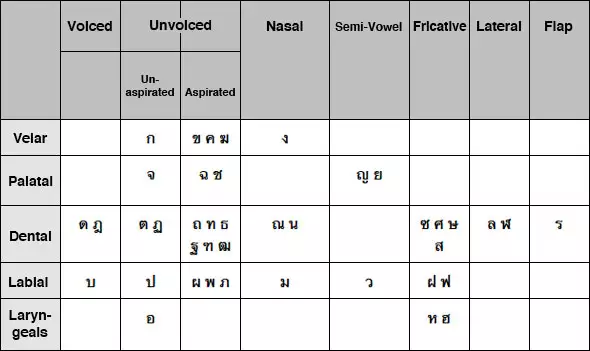
People seem to respond in one of two ways to information organized in charts, they either bubble with excitement or just glaze over and try to move on. If youʼre the type to be turned-on by information organized neatly in columns and rows, then you can probably dive right in. For those of you who feel intimidated by information in this fashion, stop for a moment and familiarize yourself with what it all means.
It may seem like a lot of hard-to-digest information is being thrown at you, but approaching the Thai writing system is really important as it helps you to get the sounds right. Work with a native speaker to get them down. Putting the time and energy into getting them down will make a huge difference when you start learning vocabulary.
To use this chart below, you should also be able to memorize all consonants.
Voiced vs Unvoiced…
The difference between voiced and unvoiced consonants lies in whatʼs happening with your vocal cords.

Voiced consonants cause the vocal cords to vibrate, while unvoiced ones donʼt. To fully understand this difference, lightly place your index finger at the base of a Thai personʼs throat while he reads over the third and fourth rows. Try the same thing with your own throat while going over the consonants. If you donʼt notice the change in your vocal cords between the voiced and unvoiced ones, you are saying them incorrectly.
Aspirated vs Unaspirated…

Aspirated sounds require that air be softly expelled from the mouth and non-aspirated ones require that air not be expelled from the mouth. Try this experiment as you look at the first row in the table. First have a Thai friend say the five consonants in the row and as he does try to repeat each sound only once. For the second round hold one palm about two inches from his mouth and your other palm two inches from your mouth. Note which sounds cause air to be softly expelled and make sure that you mouth does the same thing.

Nasal…
Nasal sounds require that there be some sensation happening in the nose caused when the sounds make their way out. I donʼt mean a huge rush of air, itʼs much more subtle than that. Iʼm not sure if you want to stick your finger up your friendʼs nose to get a feel for this one, but if youʼre struggling, you may want to place the tip of your pinky finger inside your own nose. You should feel the nose vibrate slightly when you say ง.
Semi-Vowel…
A semi-vowel exists in that nether-world between a vowel and a consonant. Growing up in USA, we were told that Y was sometimes a vowel and sometimes a consonant but rarely got much more of an explanation as to what that means. Linguistically, the difference between consonants and vowels lies in your throat. Vowels are pronounced with an open throat while consonants require the throat to be constricted some. When pronouncing a semi-vowel, the throat is only semi-obstructed. This may all seem a little confusing (it is), but try not to stress over that. As you work with the letters and become familiar with your mouth and throat it will make more sense.
Fricative…
A fricative is created when the air is pressed through a narrow channel created in the mouth. The letters, ซ ศ ษ ส, are a subset of fricative called sibilants which are similar to the S sound in English. They are formed as the air is pushed out through the teeth.
Lateral…
Lateral consonants are formed when air escapes along one or both sides of the tongue. In Thai, the ล and ฬ sounds are similar to L in English and are formed when the tongue hits the teeth and the air escapes around it.
Flap…
Flap consonants are produced with a single contraction of muscles, basically this means that the tongue is thrown against itself. Admittedly this may seem really hard to grok, but as with other tricky aspects just try to understand the basics and then slowly return to it as you work on this letter.
Another important thing to notice about the chart is that each row groups the sounds by the part of the body which needs to make the sound. In the first row, the throat needs to be activated in order to get the proper sound out. The reason that I said to go through this one row at a time is that most people arenʼt used to thinking about these parts of the body and you should really take time to make sure that youʼre getting the sounds down. If you put in the effort to master these sound-building blocks now, youʼll be very happy with the results when you actually start to assemble them into words.
What youʼll notice is that in addition to grouping sounds by the location they occur in the mouth, the rows also group similar sounds together. The first row has sounds roughly similar to the English K/G, the second row has sounds similar to J/CH/Y. The reason that these sounds are similar is that they occur in a similar part of the mouth, this also provides yet-another memory device that you can use in memorizing the letters.
Velar…
Velar consonants are pronounced with the back of the tongue near the soft palate, which is the fleshy, flexible part of the mouth near the back of roof of the mouth. Take a moment to play around with the four consonants in this group and really start to think about the things that are happening with your tongue.
Palatal…
In working with the Palatal consonants, the tip of the tongue moves towards the hard palate which is located at the front of the roof of the mouth (but not all the way up to the teeth). Each of the five consonants in this group require that the tongue move up and make soft contact with the hard palate. The first consonant in this group can be especially tricky to get down, due to its similarity in sound to the English letter J. Notice what happens with your tongue when you say the English word “jazz”, it rests towards the bottom of your mouth. When many people approach Thai, they assume that จ is pronounced similar to the J in jazz, when in fact it requires that the tongue be moved to a different location. Work through this column slowly, make sure that your tongue is going to the correct place for every letter.
Dental…
The dental consonants are the biggest grouping and will provide the greatest challenge for you when writing out the letters. While visually different, they are phonetically very similar. Each of the seven groupings has only a single sound, the broad variation in letters is used to give coverage to all the tones and to deal with words of Sanskrit and Pali origin.
Labial…
As you can probably guess from the name, labial consonants happen out towards the lips. This one you can experience with your eyes more than your fingers, focus on your friendʼs lips as he works through this row.
Laryngeals…
This category is a little trickier since thereʼs not much you can do to see or feel it. The sound is made in the larynx with the vocal cords partly closed and partly vibrating. Try to think about this part of your body as you say these letters.
Official Romanisation vs What You See on Signs
The Royal Thai General System of Transcription (RTGS) is the official way to write Thai in English letters, and it leaves out both tones and vowel length. That makes it good for spelling names on documents and maps, and poor for learning to speak. Under RTGS, วัด (temple) and วาด (to draw) are both written wat, and all five words in the tone table above are written kha.
RTGS also merges some letters that Thai keeps apart. Here is what that means in practice.
- Aspiration is kept. ก is k and ข or ค is kh, so the puff of air shows up in the spelling.
- Some letters collapse. จ, ฉ and ช are all written ch at the start of a word.
- Final letters follow the sound. ด, ต, จ and ซ are all written t at the end of a word, matching the clipped final sound covered above.
- Tones and vowel length are dropped. You cannot tell the five tones apart, or a short vowel from a long one.
Outside RTGS, spellings vary. Language-learning books usually use their own systems, and shop signs and personal names follow no single rule. Treat any romanised spelling as a hint, and use the Thai script as the source of truth. Our Thai alphabet chart is the quickest way to start reading it.
Frequently Asked Questions
Why can’t I just learn Thai using romanized spelling instead of the alphabet?
Because there’s no single agreed system for writing Thai sounds with English letters. Tourist maps, menus, and even official road signs each romanize the same Thai word differently, and English letters like “p” and “ph” that look similar actually mark a real difference in Thai (unaspirated vs. aspirated). Romanization gets you close enough to be guessed at; it rarely gets you understood.
Does vowel length actually change the meaning of a word, or is that a myth?
It’s real, not a myth. วัด (short vowel) means temple, while วาด (long vowel) means to draw or paint. Same consonants, same consonant class, different word. The vowel length makes the difference, and it changes the tone too.
How many tones does Thai have?
Five: mid, low, falling, high, and rising. This guide focuses on the mouth mechanics behind pronunciation; for the rules on which tone a given syllable takes, see Thai Tone Rules Explained.
Why do Thai words sometimes sound cut off at the end?
Thai final consonants are unreleased stops: you close into the sound but never let the air burst out, unlike English word endings. This also means several different Thai letters can share the same final sound despite sounding different at the start of a word.
What’s the difference between aspirated and unaspirated consonants?
Aspirated sounds release a soft puff of air from the mouth; unaspirated ones don’t. Hold your palm a couple of inches from your mouth while saying each consonant in a row of the voice chart above to feel which is which.
Is it true that being “tone-deaf” means you can’t learn to speak Thai properly?
No. Plenty of Thais who can’t carry a tune in karaoke speak their own language perfectly. Thai tones come from controlling the throat, tongue, and nose, not from musical ability.
Can one Thai syllable really mean five different things?
Yes. คา (khaa, stuck), ข่า (khàa, galangal), ค่า (khâa, value), ค้า (kháa, to trade) and ขา (khǎa, leg) are all real words, and only the pitch separates them. This is why a tone that is slightly off can turn a sentence into a different one.
What is RTGS, and does it show tones?
RTGS is the Royal Thai General System of Transcription, the official Thai-to-English-letters system issued by the Royal Institute in 1999. It does not show tones or vowel length, so วัด and วาด both become wat.


Is “ph” in Thai pronounced like an English “f”?
No. In Thai romanisation “ph” is a “p” with a puff of air, as in พา (phaa, to take along). The “f” sound has its own letters, ฝ and ฟ.
How do I know which tone a Thai word has?
Four things decide it: the class of the first consonant (the Royal Institute dictionary lists ก as mid class, ข as high class and ค as low class), the tone mark if there is one, whether the vowel is short or long, and whether the syllable ends in a stop sound. The step-by-step rules are in Thai Tone Rules Explained.
What’s the fastest way to build on what I learn here?
Once the individual sounds feel natural, the fastest progress comes from structured daily practice rather than piecing things together at random. How to Learn Thai Language Fast and the best apps for learning Thai cover structured routes and app-based drills that pair well with the pronunciation work on this page.
What to Read Next
- What is Thai tone? And How to Master It
- Thai Tone Twisters
- 325 Common Thai Phrases with Pronunciation and Audio
- Basic Thai Phrases for Everyday Use
- A List of 3000 Most Common Thai Words
Sources Cited
- Royal Society of Thailand (Royal Institute) Dictionary online: meanings of กา, คา, ตา, ทา, ปา, พา, ขา, ข่า, ค่า, ค้า, วัด and วาด; consonant classes; the five tones and four tone marks.
- Journal of the Royal Institute of Thailand, Vol. 31 No. 3 (2006), “Romanization, Transliteration, and Transcription for the Globalization of the Thai Language”: the Royal Institute’s romanisation systems, including that diacritical marks are omitted in the General System.

 Deutsch:
 Français:
 Español: