
Thailand Starter Kit’s complete guide to sending money to Thailand, covering Wise, Remitly, bank transfers, SWIFT codes, and the best method for every situation.
Sending money to Thailand can be a tricky matter.
Between international transfer fees and hidden fees in exchange rates, you face a lot of challenges when transferring money.
Aside from traditional forms of banking, you have other options that may yield you more Thai Baht for your buck.
Each offers its own benefits, from lower fees to easier payments.
By the end of this guide, you’ll know how to transfer money from your home country into Thailand while getting the best exchange rates and avoiding the largest transfer fees.
Disclaimer: Some links in this article go to our partners, and we may earn a commission if you use them. It costs you nothing extra, and we only recommend services we'd use ourselves. Read more in our Advertising Disclosure.
Contents
- Key Takeaways
- What to Know Before Sending Money to Thailand
- Current Exchange Rates for Thailand
- Requirements to Send Money to Thailand
- Bank of Thailand Rules for Money Coming In
- Options to Send Money to Thailand
- How Long Does it Take to Send Money to Thailand?
- What's the Fastest Way to Send Money to Thailand?
- How Much Does it Cost to Send Money to Thailand?
- Baht Account or Foreign Currency Account?
- SWIFT Codes for Popular Banks in Thailand
- Do You Pay Thai Tax on Money You Send Yourself?
- Best Ways to Send Money to Thailand by Situation
- Frequently Asked Questions
- Sources Cited
Key Takeaways
- The three most important things to consider when sending money to Thailand are transfer fees, exchange rates, and transfer speeds.
- Wise is usually the cheapest way to send under US$10,000 to Thailand. However, for transfers over US$20,000, a bank transfer might be cheaper.
- Since transfer fees and exchange rates often change, open a Wise account to lock in low fees and great exchange rates with one of the most trusted money transfer services.


What to Know Before Sending Money to Thailand
When you send money to Thailand you should pay attention to:
- transfer fees
- exchange rates
- transfer speeds
Transfer Fees
No matter which method you use to send money to Thailand, you have to pay transfer fees. Transfer fees come in three forms:
- fixed amount fees
- percentage fees
- combination fees
These fees are decided by the banks that you transfer money from.
Fixed Fees
Fixed fees are good if you want to transfer large amounts to Thailand, but they aren’t great for small transfers. No matter how much money you send, you pay the same fee. This is likely the most prominent part of the fees you’ll notice (though it’s usually not the biggest, as we’ll cover shortly). Many banks use the fixed fee method.
Percentage Fees
You can also pay transfer fees based on a percentage of the amount you send. This happens when you use your home country credit card while in Thailand.
Combination Fees
Sometimes you pay a combination of both, a small fixed fee plus a high percentage fee. The transfer method you choose should match the amount you’re sending. If not, you end up overpaying for a small transfer.
Exchange Rates
The lion’s share of international transfer fees lies in hidden exchange rates.
Besides the fees charged by your bank, PayPal, or other service providers, you can end up paying another fee of up to 4 percent or more of the transfer amount buried in the exchange rate.
Sometimes companies call it a hedging fee (e.g. in the fine print of credit cards and PayPal), other times they don’t mention it at all. Like airlines’ fuel surcharges, it’s just an extra cost you end up paying.
Even services that claim to have no separate fee often hide an extra charge in the exchange rate.
This difference can be bigger than any transfer fee shown on your receipt or quote.
Case Study on an Exchange Rate: Sending British Pounds to Thailand via Kasikorn Bank
If you send British Pounds to Thailand, Kasikorn Bank keeps around 3.4 percent of the entire transfer amount in the form of an exchange rate spread, on top of any fixed fees you pay.
This exchange rate fee is rarely mentioned outside of the fine print, and for larger amounts it adds up fast.
Transfer THB 100,000, and that’s up to THB 3,400 in hidden fees. For a THB 2,000,000 condo purchase, that’s THB 68,000 gone to transfer fees alone. That’s a lot for a cost your bank usually doesn’t bother pointing out.
When you use an online money transfer provider such as Wise, on the other hand, you pay a transparent fee, typically 0.5 to two percent depending on the currency, with no hidden exchange rate markup.
Transfer Speeds
Transfer speeds from your home country into Thailand can take a matter of seconds or a few days, depending on whether you have a money transfer service account already set up.
- A standard bank international wire transfer takes about two to three business days.
- A money transfer service like Wise or Remitly can also be nearly instant.
Cashing a check from America in Thailand can take up to six weeks to clear.
Currency
Some foreign banks take up to a 4 percent cut of the entire transfer in the form of unfavorable exchange rates when you let them do the conversion from your home currency to Thai baht.

The solution is simple: don’t let them. Ask your bank to send the amount in your home currency, then make sure the money goes to a Bangkok Bank account, which tends to offer the best conversion rates for inbound transfers.
For amounts less than THB400,000, you’ll be better off using an online money transfer service, since Bangkok Bank charges an inbound fee that outweighs its rate advantage on smaller sums.
For very large transactions, Bangkok Bank’s slightly better exchange rate makes up for that fixed fee.
Current Exchange Rates for Thailand
Although every money transfer service provider will show you the current Thailand exchange rate you’re getting, that doesn’t mean it’s the best one available. Check the mid-market exchange rate for Thai Baht on XE.com and compare it with what your money transfer service is offering you.
Keep in mind that these are mid-market rates, so you’ll never get exactly that rate. Your goal is to get as close to it as possible.
Requirements to Send Money to Thailand
To send money to Thailand, you need a bank to send from and a Thai bank account to receive into. If you go the online route, you also need to sign up with a money transfer service like Wise. That means providing your personal details and proof of ID, such as a passport, to open an account.
For the recipient’s side of the transfer, you’ll need:
- recipient’s name
- recipient’s bank
- recipient’s bank account number
- SWIFT code
Bank of Thailand Rules for Money Coming In
Thailand does not cap how much money you can send in. The Bank of Thailand says foreign currency or baht can be transferred or brought into the country without limit. The rules you will notice are about paperwork. (Verified October 2026.)
Here is what to expect when a transfer lands.
- A purpose for every transfer: Bangkok Bank says the sender must state a purpose each time, because Thai banks have to report it to the Bank of Thailand. Common purposes are living expenses, paying for goods, buying a condominium and investing in a business. Pick the one that matches, and use the same wording each month for regular transfers.
- Documents for large amounts: The Bank of Thailand tells banks to ask for supporting documents on transactions worth USD 200,000 or more, unless the bank has already completed its Know Your Business checks on the customer. Individual banks can set a lower trigger. Kasikornbank asks for supporting documents on inbound transfers of US$50,000 or more and gives you 10 working days to provide them.
- Very large receipts: Anyone receiving foreign currency from abroad worth USD 1 million or more must sell it to an authorized bank or deposit it in a foreign currency account within 360 days of receipt.
- Cash in your luggage: Bringing in more than THB 450,000 in baht banknotes or more than USD 15,000 in foreign banknotes (or the equivalent) needs a customs declaration.
- Buying a condo: Foreign buyers under the foreign quota must show that foreign currency was brought into Thailand (or withdrawn from a non-resident baht account or a foreign currency account) for at least the price of the unit. That is why the bank paperwork matters. Our guide to buying a condo in Thailand covers the rest of the process.
For anything large, ask your Thai bank which documents it wants before the sender releases the money. A transfer that waits for paperwork can sit for days.
Options to Send Money to Thailand
Here are popular options to send money to Thailand, so you can pick the best option for your situation.
Exchange Cash in Thailand
Pros:
- Best exchange rates available
- No transfer fees or processing delays
- No account setup required
Cons:
- Risky to carry large amounts of cash
- Foreign banknotes over USD 15,000 (or THB 450,000 in baht) must be declared to customs
- The queue to exchange money can sometimes be very long
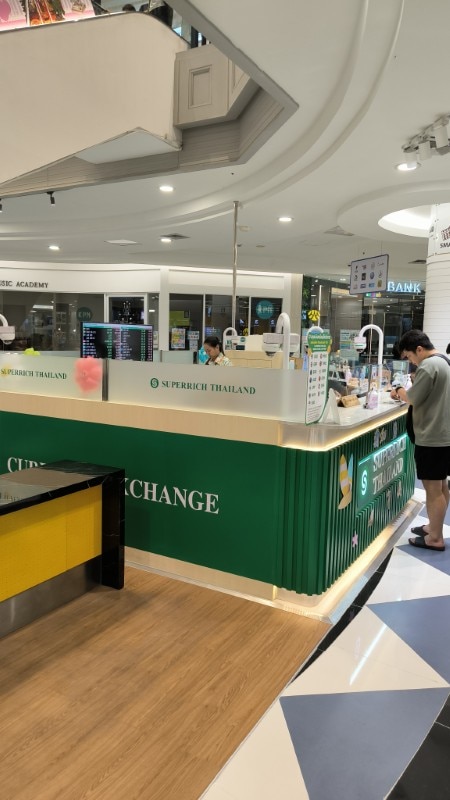
Exchanging cash in Thailand gets you the best exchange rates, and you can bring up to USD 15,000 in foreign banknotes (or THB 450,000 in baht) into the country without declaring it with Thai customs officers.
If you skip the airport kiosks and exchange at SuperRich instead, you’ll get the best rates available anywhere in Thailand.
Compared to a bank transfer, the cash route saves roughly US$80 for every US$20,000 you bring in. Most people, myself included, wouldn’t walk around with that much cash just to save US$80. So an online service is the next best option.
Read more: Thai Baht: How to Get the Absolute Best Exchange Rates
Online Money Transfer Services
If you want to save the most on fees and get your money there quickly, use an online money transfer service. These services have grown considerably since I first published this guide, and they’re now the default choice for most expats.
To get started, you open an account with the company and verify your identity by uploading your passport or ID card. The whole process usually takes three to five business days.
You also need a bank account in Thailand to receive money into.
Let’s take a look at two popular online money transfer services: Wise and Remitly.
Wise
Pros:
- Transparent fees with no hidden charges
- Mid-market exchange rate
- Fast transfers, often same day
- PromptPay payments rolling out to Thai-address accounts during 2026 (up to THB 10,000 per received payment)
Cons:
- Fees vary by currency and can reach 2 percent
- Non-baht payments from other people auto-convert to Thai baht from October 2026 for accounts opened before 21 January 2026
- Requires identity verification regularly
- Maximum transfer of THB 2,000,000 to Kasikorn Bank and Bangkok Bank, THB 1,499,999 to SCB and THB 500,000 to other banks
Wise lets you send money to Thailand with no hidden fees. What you see upfront is what you pay. It’s probably the most well-known of all these providers.

Wise charges 0.5 percent to 2 percent of the transfer amount, depending on the source currency.
This makes it a strong option for transfers under US$2,000, where a traditional bank transfer would cost you more.
For example, one of my employees transferred US$1,605.95 to Thailand using Wise. He paid US$18 in transfer fees and got the mid-market exchange rate.
With an exchange rate of about 33 baht to the dollar at the time of the transfer, he received THB52,402.35 in his Thai bank account.
Note for 2026: Wise is rolling out changes to personal accounts with a Thai address between March and October 2026. The changes bring useful new features (including PromptPay payments, card delivery in Thailand, and the ability to send Thai Baht abroad) but also mean that, from October 2026 for accounts opened before 21 January 2026, payments from other people in a non-baht currency convert automatically to Thai baht. Topping up from your own foreign bank account does not convert. If you hold multiple currencies, this affects how you manage conversions. Read the full breakdown of what’s changing for Wise in Thailand.
Remitly
Pros:
- First transfer fee is waived
- Cash pickup option is useful if you don’t have a Thai bank account yet
- Express option delivers within minutes
Cons:
- Rates are generally worse than Wise
- Economy transfers can take three to five business days
- Cash pickup banks may charge an additional fee
Remitly is a money transfer service that offers two ways to send money to Thailand: bank transfers or cash pickups.

If you use Remitly to transfer up to US$1,000 into a Thai bank account, there are two costs to factor in:
- Transfer fees
- Exchange rate fees
Remitly offers two transfer options: Express and Economy.
The Express option delivers money within minutes, with transfer fees up to US$12.99. The Economy option charges a maximum of US$3.99, but your transfer may take three to five business days.
Remitly also charges an exchange rate margin that isn’t separately disclosed.
Still, it’s a solid option, especially for first-time transfers, since the first transfer fee is waived.
You can also use Remitly to schedule a cash pickup at one of the following banks in Thailand:
- Siam Commercial Bank
- Krung Thai Bank
Keep in mind these banks may charge an additional pickup fee of around 0.25 percent of your transfer.
Others
Wise and Remitly aren’t your only options for sending money online. If you want an alternative, take a look at our review on WorldRemit. Most of these services work the same way at the core: register, verify your ID, and initiate a transfer.
There are always new ones popping up, though I haven’t seen any others that would make it worth switching. However, nothing stops you from creating accounts with multiple companies, getting a quote, and using whichever offers the best rates.
International Bank Transfers
Pros:
- Accepted for official purposes like visa income requirements and condo purchases
- Rates can be competitive for large transfers
- No transfer limits for large amounts
- Works with any Thai bank account
Cons:
- Costs are spread across multiple parties and hard to calculate upfront
- Fees can reach 4 percent or more of the transfer amount
- Slower processing times compared to online services
- Rates are poor for small transfers
An international bank transfer is often the first thing people think of when sending money to Thailand. Without preparation, though, it can cost you up to 4 percent or more of the transaction amount without anyone telling you. And that’s on top of the stated fees.
You need to pay transfer fees to these parties:
- Sending bank: This is the bank you send money from, typically in your home country. Each sending bank has its own fee structure. Transfer fees are usually easy to find, but if you want your sending bank to handle the currency conversion, compare their exchange rate with the mid-market rate on XE.com before you confirm.
- Receiving bank: This is the bank that receives the money in Thailand. Bangkok Bank, for example, charges:
- A receiving fee of 0.25% of the transfer amount (minimum THB 200, maximum THB 500), converted at Bangkok Bank’s Telegraphic Transfer Buying Rate
- A cable fee of around THB 200
- An exchange rate fee of around 0.5%
In general, bank transfers tend to have higher fees and longer processing times than online services. Unless you have a specific reason to use one, they’re usually not the best option. Common reasons you might need one include:
- Establishing a foreign fund transfer record for buying a condo
- Meeting the income transfer requirements for certain visas, like the Thailand Retirement Visa
- Sending more than THB 2,000,000 in a single transfer
Good to know: International bank transfer fees are also harder to calculate than you’d expect. Unlike online services, banks rarely disclose them clearly on their websites. You’ll need to dig into both the transfer fees and exchange rate spreads for your sending bank and your receiving bank.
Western Union
Pros:

- Available at 5,000+ locations across Thailand
- Same-day cash delivery if needed
- No Thai bank account required
Cons:
- One of the most expensive options, with exchange rate markups up to 7.5 percent
- Fixed fees of US$10 to US$50 on top of the exchange rate margin
- Limited opening hours at pickup locations
Western Union is one of the most well-known instant transfer services. In principle, you can use them to make cash available to anyone in the world within minutes. But the service comes at a price. Part of that price is visible on their website.
Depending on where you send from, fixed fees range from US$10 to US$50.
The real cost is in exchange rates. Non-instant transfers through banks start at around 4 percent. For instant transfers, you pay roughly 7.5 percent of the transfer amount.
If you need the money the same day, Western Union can deliver at one of their 5,000 locations in Thailand, though those have limited opening hours.
PayPal
PayPal is moving all Thailand accounts to PayPal Thailand, and keeping a personal account means registering with a Thai National ID (NDID). Foreigners may not be able to get one, so don’t count on PayPal for money coming into Thailand. Read our PayPal relaunch article for the latest.
How Long Does it Take to Send Money to Thailand?
If you use an online service like Wise, you usually receive the money almost instantly, provided you’ve already set up an account with both sending and receiving bank details linked.
For first-time Wise users, it could take a few hours or days to get approved and complete your first transfer.
With a traditional bank transfer, it could take several days, depending on how many banks are involved. Sometimes a third or fourth correspondent bank is part of the chain, especially when the sending or receiving bank isn’t well-known for international transfers.
What’s the Fastest Way to Send Money to Thailand?
No matter what country you’re from, for the fastest money transfer into Thailand, use one of these online services:
In most cases, you’ll get your money in minutes once you have an account.
How Much Does it Cost to Send Money to Thailand?
The cost depends on which service you use and how much you send. On average, expect to pay around US$10 to US$20 for every US$1,000 you transfer into Thailand.
Baht Account or Foreign Currency Account?
Unless you say otherwise, your Thai bank converts incoming foreign currency to baht before crediting your account. Bangkok Bank, for example, applies its own “Telegraphic Transfer Buying Rate” for the conversion. (Verified October 2026.)
A foreign currency deposit account (FCD) lets you keep the money in dollars, euros or pounds until you choose to convert. The Bank of Thailand allows residents to deposit foreign currency received from abroad without limit, and non-residents can also hold foreign currency accounts without limit.
| Account | Good for | What to know |
|---|---|---|
| Baht savings account | Day-to-day spending | The bank converts on arrival at its own buying rate. |
| Foreign currency account (FCD) | Holding a currency until the rate suits you, or sending money back out | Transfers from abroad can be deposited without limit. Foreign banknotes can be deposited up to the amount you brought in or USD 15,000 per day per person. |
Some banks ask the sender to leave the money unconverted. The Government Savings Bank, for instance, tells senders to instruct their bank not to convert to baht and to send in one of the currencies it accepts (USD, EUR, GBP, JPY or CNY).
SWIFT Codes for Popular Banks in Thailand
If you’re setting up an international bank transfer, you’ll need the receiving bank’s SWIFT code. Here are the SWIFT codes for the most popular banks in Thailand, just in case your sender asks for one.
| Bank | SWIFT Code |
|---|---|
| Bangkok Bank | BKKBTHBK |
| Kasikorn Bank (KBank) | KASITHBK |
| Krung Thai Bank | KRTHTHBK |
| SCB (Siam Commercial Bank) | SICOTHBK |
| Bank of Ayudhya (Krungsri) | AYUDTHBK |
| TMBThanachart Bank (TTB) | TMBKTHBK |
| Government Savings Bank | GSBATHBK |
| CIMB Thai | UBOBTHBK |
| UOB Thailand | UOVBTHBK |
| Citibank Thailand | CITITHBX |
Do You Pay Thai Tax on Money You Send Yourself?
Moving your own savings into Thailand is a transfer, not income. The tax question is about income you earn abroad and then bring in.
Since 1 January 2024, Revenue Department Instruction Por. 161/2566 (amended by Por. 162/2566) makes foreign income taxable in Thailand when both of these are true. (Verified October 2026.)
- You earned the income on or after 1 January 2024, in a tax year when you spent 180 days or more in Thailand.
- You bring that income into Thailand in the same tax year or any later one.
The income is then added to your Thai taxable income for the year you bring it in. Income earned before 1 January 2024 is outside the instruction, even if you transfer it later. The Revenue Department’s own example is rental income from a property abroad: earned in 2024, transferred to a Thai bank account in 2025, and taxed in the 2025 tax year.
So the date your money was earned can matter more than the date you send it. Keep statements that show when and where each amount came from. Our guides to tax on foreign-earned income in Thailand and income tax for foreigners go through the details, and a Thai tax adviser can check your own case.
Best Ways to Send Money to Thailand by Situation
The best method really depends on what you need the money for. Here’s what we typically recommend based on the most common situations.
Daily Life
For everyday expenses, an online money transfer service is the way to go. Our entire Thailand-based team uses one, and most of them have been on Wise for years without complaints, aside from the occasional identity re-verification. It’s fast, transparent, and the fees are easy to understand upfront.
Pension
An online transfer service works well for pension payments too, but it depends on how your pension is paid out. Some pension providers only send via bank transfer, which means you may not have a choice in the method.
Check with your pension provider first before setting anything up.
Buying Property
If you’re buying a condo or property in Thailand, a wire transfer through a Thai bank is the most straightforward option. We generally recommend using Bangkok Bank for this.
Two reasons stand out.
- First, exchange rates for large transfers can actually be more competitive than online services at that size.
- Second, and more importantly, you’ll receive an official Foreign Exchange Transaction (FET) form, which is the document you need to prove the funds came from abroad. This paperwork is a legal requirement for foreign nationals buying property in Thailand, so getting it right matters.
Visa Requirements
For certain visa types, like the Thailand Retirement Visa, you need to show that your funds were transferred from overseas. A direct bank transfer is typically the most hassle-free way to satisfy this requirement.
Some expats use online services for this too, but you may need to request additional documentation from the provider, which isn’t always straightforward. When in doubt, a bank transfer keeps things simple.
Frequently Asked Questions
Is there a limit on how much money I can send to Thailand?
No. The Bank of Thailand allows foreign currency or baht to be transferred into the country without limit. Your Thai bank can ask for supporting documents on large amounts, and the Bank of Thailand sets that trigger at USD 200,000 for banks (some banks ask earlier). Your provider may also cap single transfers. Wise, for example, shows THB 2,000,000 for Kasikornbank and Bangkok Bank, THB 1,499,999 for Siam Commercial Bank and THB 500,000 for other banks. (Verified October 2026.)
Why does my bank ask for the purpose of a transfer?
Thai banks must record a reason for incoming transfers and report it to the Bank of Thailand. Bangkok Bank explains that the rule is there to guard against fraud and money laundering. Choose the purpose that fits, such as living expenses or buying a condominium, and keep it consistent across transfers.
Do I need to declare cash when I fly into Thailand?
Yes, above the limits. The Bank of Thailand says bringing in baht banknotes worth more than THB 450,000, or foreign banknotes worth more than USD 15,000 (or the equivalent), requires a customs declaration. Bringing cash in has no cap, but it must be declared above those amounts. (Verified October 2026.)
Can I keep the money in dollars instead of baht?
Yes, with a foreign currency deposit account (FCD). Funds received from abroad can be deposited without limit, and you can later convert to baht or send money out. Ask the bank which currencies it supports, because each bank has its own list.
Will Thailand tax the money I transfer from my home account?
Only if it is foreign income that falls under the Revenue Department’s 2024 rules. If you spent 180 days or more in Thailand in the year you earned the income, and you earned it on or after 1 January 2024, bringing it into Thailand makes it taxable in the year you transfer it. Savings you built before then are a separate question, so check with a tax adviser.
Sources Cited
- Bank of Thailand, Exchange Control Regulation: unlimited inflows, USD 1 million repatriation rule, foreign currency accounts, documents at USD 200,000, customs declaration limits.
- Bangkok Bank, FAQs about transferring funds into Thailand: purpose of transfer, receiving fee, conversion rate, SWIFT code.
- Kasikornbank, Global Inward: supporting documents for inbound transfers of US$50,000 or more.
- Government Savings Bank, Advice for receiving international fund transfers: sending in a non-baht currency and the accepted currencies.
- Revenue Department, Departmental Instruction Por. 161/2566: foreign income taxed when brought into Thailand, with the 1 January 2024 cutoff added by Por. 162/2566.
- Revenue Department, Q&A on Por. 161 and Por. 162: 180-day test and worked examples.
- Wise Help Centre, Upcoming changes to your Wise account in Thailand: PromptPay features and conversion of incoming non-baht payments.
- Department of Lands, Condominium Act B.E. 2522 and ministerial regulations: section 19 proof of foreign currency brought into Thailand.


 Français:
 Español:
 Deutsch: