Do you own a business in Thailand and need healthcare coverage for your employees?
Of course, you need to pay for public health insurance, which is Social Security, for your employees. But in most case, it isn’t sufficient.
Health insurance is a good way to keep your employees in good health. In Thailand, there are group health insurance plans that are quite affordable and provide good health coverage. It’s much cheaper than individual health insurance and comes with more flexibility.
This article is written based on our experience with buying health insurance for our own company in Thailand.
It will give you a good understanding of how corporate health insurance works in Thailand, including coverage, requirements, application, plans, and where to get coverage.
In case you want to read about group insurance for your family, please read this article instead.
Contents
Key Takeaways
- Group health insurance is not a legal requirement in Thailand, but it has become the industry norm.
- Local plans cost around THB8,000 to THB12,000 per employee per year, which is 20% to 40% less than buying individual policies for the same people, and the full premium counts as a tax-deductible company expense.
- Pre-existing conditions are excluded from every plan.
- To qualify for a local group plan, your company must be registered in Thailand, employ at least five people, and not operate in a high-risk industry like manufacturing.
- Buying through a broker costs the same as going direct and gives you more plan options to compare.
- Employees’ spouses and children can usually be added at group rates, as long as the marriage is legally registered and the children fall within the insurer’s age limits.
- Social Security alone is not enough: employees face long waits at a single designated hospital, and claiming a reimbursement requires multiple documents most people won’t bother collecting.

Do you need group health insurance for your company?
When running a business in Thailand, you don’t need to provide health insurance for your employees. But it comes with many benefits like:
- employee retention
- company productivity
- tax write-offs
Please note that the group health insurance mentioned in this article is different from Social Security.
Employee Retention
In Thailand, there’s an unwritten rule that companies should offer health insurance to their employees. While it’s not necessary, many companies in Thailand buy health insurance for their employees.
Unlike in many Western countries, many Thais don’t buy health insurance because of its cost. So, when you offer health insurance to them, they’re more likely to stick around.
In addition, a potential employee will pick to work for your company over a company that doesn’t offer health insurance.
Company Productivity
It’s no secret that having healthy employees increases productivity. When they are sick, they can go to a hospital and receive treatment immediately without worrying about the cost. This leads to a faster recovery, allowing them to return to work sooner.
On the other hand, if an employee has to rely on the Social Security System for healthcare, they’re less likely to go to the doctor.
And because they’re less likely to stay home from work, this means they show up to work sick. In turn, they’re less productive and may even spread their sickness to other employees, and maybe even you.
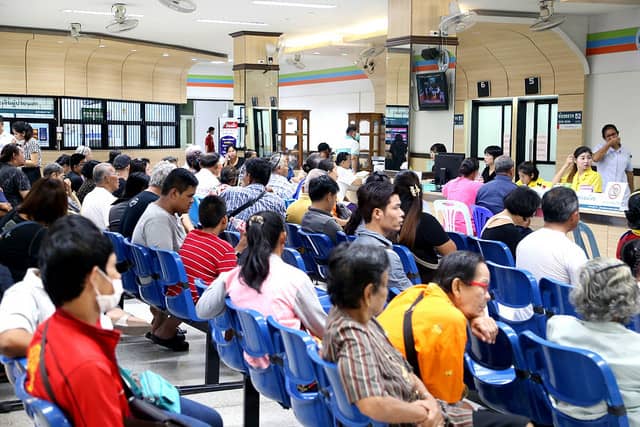
Employees with health insurance are more likely to go to the doctor when they’re sick. They know it’ll be an easier process than dealing with hospitals under Social Security. At the very least, they do not have to wait for many hours just to see a doctor for 1 minute.
When employees are healthy, they become more productive in your company. Human resources are one of the most important assets for running a business, after all.
Tax Write-offs
The cost of group health insurance is considered a company expense. So you can write it off at the end of the year.
Corporate income tax rate in Thailand is 20%, that means you’d get a 20% discount on group insurance.
Here’s what we mean:
If your company’s annual profit is 2,000,000 baht, the corporate tax you’d have to pay is 400,000 baht.
If you buy group health insurance costing 300,000 baht, your company’s tax amount will be decreased to 340,000 baht, which means you’d get a 60,000 baht discount for buying group insurance.
The deductible amount can be different depending on your company’s income and business type. It’s best to recheck it with your accountant.
Coverage
Group health insurance plans for small businesses and large corporations work similarly to individual health insurance plans.
They have similar limits, exclusions, and age restrictions. And they follow the same rule: they don’t pay out benefits for pre-existing conditions.
Here is a list of basic costs you should ask about when buying group health insurance:
- outpatient benefits (OPD)
- room and board
- intensive care unit
- hospital expenses
- emergency outpatient treatment
- surgical treatment and consultation
- ambulance
- personal accidents
Let’s look at each one a bit closer.
Outpatient Benefits (OPD)
OPD coverage may not be important for individual health insurance. However, when it comes to group health insurance, it’s the real key benefits that employees are looking for. If you have some budget for it, choose the plan that pays at least 1,500 baht per OPD visit. This is the average amount you need to pay when visiting a standard private hospital in Thailand.
Tip: Please note that some insurance companies may already include OPD coverage in their corporate group insurance plans, while other companies, you’ll have to buy it separately. But your insurance rates will also be lower.
Room and Board
Coverage for room and board is only eligible for in-patient benefits, or IPD. Coverage includes the cost of the hospital room, food, nurse fees, and other medical charges while at the hospital.
The daily in-patient room rates and nursing care services start at 5,000 baht for mid-range private hospitals and 10,000 baht for top-tier private hospitals. The difference in cost can be justified by the fact that the quality of the rooms and service provided at private hospitals is second to none.
You can find out more in our guide to private hospitals in Thailand.
Intensive Care Unit
Coverage for the intensive care unit, or ICU, tends to be double that of coverage for room and board, but is capped at 15 days a year.
The average daily cost for a stay in the ICU is 10,000 baht for mid-range private hospitals such as Praya Thai Hospital and Paolo Hospital.
Coverage for ICU comes in handy not because the rooms are so expensive, but because the medical expenses, which we cover in the next section.
Hospital Expenses
Medical expenses can easily sail past the 80,000 baht mark for every day you’re in the hospital.
This amount includes the cost of medicine, materials, x-rays, lab tests, operating room, and emergency treatment.
Emergency Outpatient Treatment
Coverage for emergency outpatient treatment covers you and your employees in the event of an accident.
But to get coverage for accidents, the injured person must go to the hospital within 24 hours of the accident. They’ll also get follow-up treatment up to 15 days after the accident.
Emergency outpatient treatment has its own limits but is usually included in a hospital’s general expenses.
Surgical Treatment and Consultation
As the name implies, this covers surgery consultation fees and surgeons’ fees.
Ambulance
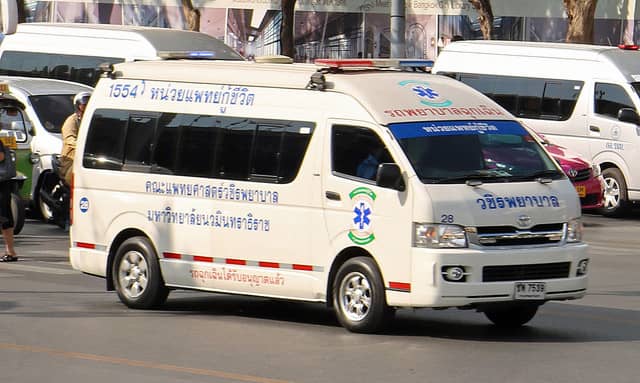
In case of emergency, corporate group insurance covers the cost of an ambulance. The usual limit of this coverage is 1,000 baht to 2,000 baht per time.
The ambulance fee is also included in a hospital’s general expenses. The cost of ambulance fees is based on:
- distance traveled
- medical equipment used
- medical personnel involved
Ambulances can be free if you use the emergency ambulance service from the National Institute of Emergency Medicine by calling 1669.
Or they can cost 25,000 baht if you use a top tier ambulances with doctors and nurses.
But the average cost for a standard ambulance in Bangkok is 2,000 baht.
Personal Accidents
Often confused with emergency accidental outpatient treatment, personal accident coverage provides compensation in case of:
- death
- dismemberment
- loss of sight or hearing
- disability
You’ll only be covered for 50% of the costs of these accidents if you were driving or sitting on a motorcycle.
Price
Group insurance for corporations comes with a discount that is cheaper than individual insurance plans by 20% to 40%. This does not include an indirect discount that comes in the form of a corporate tax deduction.
It’s common to see that group insurance for five people can even be 20% cheaper than individual health plans for three people with similar coverage.
On average, you should expect to pay around 8,000 THB to 12,000 THB per employee per year for a group health insurance plan.
Prices for group insurance depend on the number of employees you have. The higher the number, the cheaper the insurance rates will be per person.
Similar to individual health insurance, your employees’ ages also affect the insurance rates.
Another factor to keep in mind is that certain high-risk industries, including drivers and factory workers, may have higher rates than office workers.
Family Discounts
Group health insurance benefits employees’ families too. The group insurance rates can be applied to any employee who is married or has children.
To be eligible for the discount, a couple needs to be married legally and have a marriage certificate. And children must be younger than eighteen or twenty-five years old depending on the insurance policy.
Options
You have two options between local insurance and offshore insurance.
When choosing group health insurance, there’s no definitive best plan. Your choice will be based on your company’s needs.
Local Insurance
Local insurance is the most popular option when it comes to group insurance for businesses in Thailand. Although coverage is somewhat limited, it’s usually enough for middle-tier private hospitals in Thailand.
Local insurance is also affordable. You should expect to pay around 8,000 baht to 12,000 baht per employee per year. The annual premium can be lower or higher depending on your plan and options.
Since major local insurance companies in Thailand offer group insurance, using the health insurance comparison website CheckDi will help you make a better decision and find the right plan for your company.

Their comparison tool is comprehensive and covers a majority of local insurance companies in Thailand.
We asked around to see what other companies in Thailand are using for group insurance. And here’s what the people said:
Offshore Insurance
If you have a team of remote workers, you need to check out offshore insurance. It comes with full health coverage in over 175 countries for all of your employees who live both inside and outside of Thailand.
However, it’s also much more expensive. You will be paying over 30,000 baht per year per employee. As of now, Remote Health is one of the few offshore insurance companies that offer group insurance.
They also cover pre-existing conditions if your team has ten or more members, which is a really good benefit that isn’t usually offered with other insurance companies.
Requirements
When you buy local group health insurance for your business, you’ll need to meet five requirements.
- Your company must be registered in Thailand with the Department of Business Development. You’ll need your business registration certificate to prove this.
- Your company must work and have an office in Thailand. It can be a traditional office, a serviced office, or a virtual office.
- Your workforce numbers must fall in the range stated by insurance companies. Aetna only requires five to fifty employees for their group insurance plan. Allianz requires eleven to one hundred employees.
- Your employees must be between fifteen and sixty-five years old. Some insurance companies want your employees to fall into an average age of no more than forty-five years old.
- Your business must not operate in a high-risk industry, such as mechanics or manufacturing.
If you don’t have a registered company in Thailand, you need to look at offshore insurance instead.
Buying Group Insurance
It’s common in Thailand to purchase group insurance through brokers instead of insurance companies. The rates you get from brokers are the same rates you’ll get buying directly from insurance companies.
The major benefit to using brokers is that you have more choices, and they can suggest a plan based on your requirements.
Here at Thailand Starter Kit, we also got group insurance from a broker. We contacted a brokerage company, and they sent us a few plans based on our needs. And then we picked the plan that was most suitable for us.
When buying corporate group insurance, you need the following documents:
- company registration
- vat registration (Por Por 20)
- application form for employer
- application form for employees
You’ll have lots of flexibility when buying group insurance for your company. You can choose different plans for your employees based on their positions and salary ranges.
You can also add new hires to the group insurance plan. The rate will be on a pro rata basis after the plan has begun.
If an employee leaves the company, you can get a refund under the same basis.
Renewal
Group insurance plans can be renewed every year. A few months before the plan expires, an insurance rep will get in touch with you.
They’ll send you a list of coverage options and rates for you to consider again. But this time you won’t have to resend your company documents. You’ll just have to send your payment.
Self-employed
What if you’re self-employed? Can you get group health insurance for digital nomads or freelancers who work together but don’t have a registered company in Thailand?
Unfortunately, group insurance for the self-employed is unavailable. Most of the time, the insurance companies will ask you to buy individual health insurance instead.
What about Social Security?
The public health insurance system in Thailand is part of Social Security, which your employees get if they work legally in Thailand. And although it’s cheap, it offers limited coverage and is complicated to use.
- Waiting Time: First, you spend the whole day at the hospital just to see the doctor for a common ailment. Once you do see the doctor, you might get a few minutes to explain yourself before the doctor quickly looks you over and rushes you out the door.
- Limited Choice of Hospital: Second, you need to go to a hospital listed on your Social Security card. If you don’t, you have seventy-two hours from the time of your medical treatment to get to the Social Security Office and ask for a reimbursement. Social Security will reimburse you only if you have the right documents. You need a Social Security form, medical certificate, receipts, and a copy of your bank book.
Because of these two negatives, business owners and employees in Thailand tend to ignore medical treatment benefits from Social Security and opt for private group health insurance instead.
Don’t get us wrong, Social Security can help you and your employees in a life-threatening situation. Any insurance is better than no insurance. But when it comes to getting health coverage for yourself and your employees, Social Security should not be your go-to insurance.
Find out more: Thailand SSO vs. Private Health Insurance: Which One Is Better?
Now, on to You
Now that you know how to buy group health insurance for your Thailand company, go to CheckDi and compare a few different plans to see which one best suits your needs. Quotes are free and you’ll get to compare different plans all in one convenient place.
Disclaimer: We are not insurance brokers and don’t sell insurance plans. The information provided in this article is based on our intensive research on the topic. However, it’s important to recheck the information again with insurance brokers or insurance companies.


 Deutsch:
 Français:
 Español: