
Learn how to get a motorcycle driver’s license in Thailand, including required documents, training options, DLT tests, costs, timeline, and practical tips for foreigners in Thailand.
Few experiences can match the thrill of exploring on a motorcycle. Whether you’re a seasoned rider or new to the world of two-wheeled exploration, acquiring a motorcycle driver’s license is your key to experiencing the diversity of this country safely and legally in Thailand.
Having recently completed the requirements for a motorcycle driver’s license, I’ve walked the path you’re about to embark on.
My personal journey has left me not only well-versed in the intricacies of the process but also filled with the desire to make your own experience as accessible and rewarding as possible.
In the following article, we’ll walk through the process of securing a motorcycle driver’s license in Thailand, from the initial preparations to the moment you proudly hold the license card in your hand.
Disclaimer: Some links in this article go to our partners, and we may earn a commission if you use them. It costs you nothing extra, and we only recommend services we'd use ourselves. Read more in our Advertising Disclosure.
Contents
- Key Takeaways
- What You Need to Prepare
- Where to Get the Motorcycle Driver's License
- License Test
- Getting the License
- Renewal
- Converting a Foreign License
- Can I Obtain a Motorcycle Driving License with a Tourist Visa?
- How Much Does It Cost to Obtain a Motorcycle License in Thailand?
- What Happens When My Motorcycle License Expires?
- Lost, Damaged, or Renamed License: Getting a Replacement
- Your License on Your Phone: The DLT QR Licence App
- Frequently Asked Questions
- What documents do I need to get a motorcycle license in Thailand?
- How much does a motorcycle license cost in Thailand?
- What's on the motorcycle license theory test?
- How long is a Thai motorcycle license valid?
- Can tourists get a motorcycle license in Thailand?
- Do I need separate licenses for a car and a motorcycle in Thailand?
- What happens if my motorcycle license expires?
- Can I get a motorcycle license through a driving school instead of the DLT directly?
- Can I convert my foreign motorcycle license to a Thai one?
- What do I do if I lose my motorcycle license or it gets damaged?
- Can I show my motorcycle license on my phone instead of carrying the card?
- Now, on to You
- Sources Cited
Key Takeaways
- It’s very easy and cheap to get a motorcycle license in Thailand.
- You can apply through a private driving school or directly at the Department of Land Transport (DLT).
- DLT offices may not accept walk-ins, so book an appointment via the call center (1584), the office’s Facebook page, or the DLT Smart Queue app.
- If your local DLT has a long wait, check a neighboring province, as appointment slots can vary significantly across offices.
- Car and motorcycle licenses are separate in Thailand, so if you want both, you need to complete the full process for each one.
- The theory test draws 50 questions from a bank of 500; you need at least 45 correct to pass. Practice online before your exam.
- Your first license is valid for two years and can be renewed to a five-year license without retaking any tests.
- When completing the required e-learning videos for renewal, use your phone rather than a desktop, as the videos load far more reliably.

What You Need to Prepare
Embarking on this journey begins with gathering a set of essential documents and items. It’s exactly the same as getting a driving license.
Each item on this checklist plays a vital role in the process, so ensure you have them ready to make your motorcycle license acquisition as smooth as possible.
To help you prepare, here’s a comprehensive checklist:
Copies of Passport Pages
Ensure you have a copy of your passport picture page and a valid, unexpired visa. These two documents serve as proof of your identity and legal residency in Thailand.
Both documents should also be signed, with your name written just below the signature.
Medical Certificate
Pay a visit to a local clinic or a hospital, and request a medical certificate for your motorcycle driver’s license. Simply inform them of your purpose, and they will provide the documentation. It costs only a few hundred baht.
Receipt of Notification
Make a copy of the receipt of notification (TM30) for your house or accommodation in Thailand. This receipt is crucial for confirming your Thai address.
Passport-Sized Picture
Obtain a recent 1×1.25-inch photograph of yourself, ensuring the background of the picture is either white or blue.
Please note that not all driving schools or the Department of Land Transport require this picture, but it’s best to prepare in advance.
Residence Certificate
To obtain a residence certificate, start by visiting your local immigration office with all the aforementioned documents. Then, simply inform them that you want to get a motorcycle driver’s license.
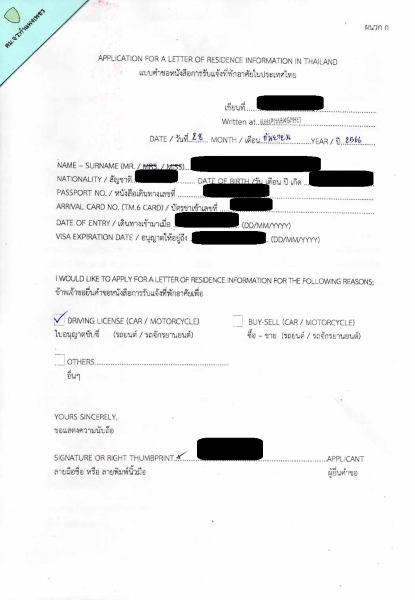
You may need to provide additional information, such as your rental contract, but the immigration office handles the process itself without requiring extra paperwork beyond what’s listed above.
The residence certificate will include your name, photograph, the signature of the deputy inspector general of immigration, an official stamp, and information about your confirmed residence in Thailand.
Find out more: How to Get a Residence Certificate in Thailand
Where to Get the Motorcycle Driver’s License
Now that you’ve gathered all the essential documents, it’s time to take the next steps. You can obtain it at either a driving school or the Department of Land Transport.

Driving School
With all the required documents secured, it’s time to bring all your paperwork to your chosen local driving school. Here, you can enroll in seminars, classes, and tests essential for obtaining your motorcycle driver’s license.
If you prefer a streamlined process, you also have the option to pay THB1,000 for an agency that acts as an officially recognized independent driving school to handle all the necessary tasks over two days, as I did.
These two days are usually scheduled for a Friday and Saturday, so you may need to take a business leave day off from your workplace to accommodate the Friday.
Department of Land Transport
Alternatively, you can also register directly at your nearest Provincial Land Transport Office.
To do so, just search for “Provincial Land Transport Office” followed by the name of your province on Google and follow the specified guidelines.
Depending on which Land Transport Office you go, they may not accept walk-ins.
Therefore, you may need to make an appointment in advance by calling the call center at 1584 or visiting your local Land Transport Office. They will then provide you with the date for your license application.
The waiting time can vary from a few days to a few months, depending on how busy they are at that time.
Tip: If your local office has a long wait, it is worth checking a neighboring province. For example, if you are in Rayong, there is usually a much shorter queue in Chanthaburi, which is far less busy.
Tip: Another great way to contact your local Land Transport Office is through their Facebook page, if they have one. You can also download the DLT Smart Queue app to book appointments directly from your phone.
License Test
Earning your motorcycle driving license in Thailand is a comprehensive two-day process, running from 8 a.m. to 5 p.m.
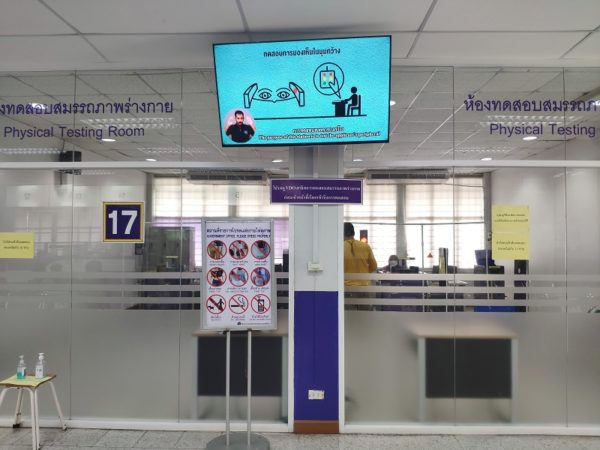
Sight and Reaction Tests
Day 1 starts with a series of sight and reaction tests, which take approximately 10 minutes:
Eye Chart Test
During this test, you’ll stand in front of a chart with colorful circles of varying sizes. The examiner will point to a circle, and you will promptly name the color: red, yellow, or green.
The chart includes other colors, but they are merely distractions that you can easily ignore as long as you focus on the examiner’s cues.
Peripheral Vision Test
In this test, you’ll place your head inside a device that resembles blackout goggles.
A colored circle will appear on either side of your vision, and your task is to call out the color without moving your head. Even with a weaker right eye, I experienced no difficulties with this test.
Brake Reaction Test
This test involves an accelerator pedal, a brake pedal, and two vertical rows of lights that begin to rise as soon as the first bottom green light appears.
Your job is to lift your foot off the accelerator and press the brake when the green lights appear. You fail if you brake while the lights are still red, which only appear near the top of the rows.
However, don’t worry! The pedals are based on an automatic car system, so there’s no need to fret about clutch control, which makes it easier.
Alignment Test
The final sight test requires you to sit at a distance from a box containing two sticks.
You’ll be provided with a remote control to bring the rear stick forward and stop it when they both align, which is relatively straightforward.
These tests are generally manageable, as I was able to pass each on the first attempt in my experience.
Seminars
After you pass the sight and reaction tests, you’ll also embark on seminar training, which continues into day 2. This training covers various topics:
- Road Traffic Law and Car Laws (1.5 hours): Including traffic rules, vehicle check-ups, and the repercussions of violating laws in Thailand.
- Safe Driving Lessons (2 hours): Focusing on teaching safe riding practices.
- Consciousness and Driving Etiquette (1 hour): Covering right of way, road awareness, and the meanings of road signs.
- How to Act in Emergencies and Provide First Aid (30 minutes): Equipping you with knowledge of emergency procedures and first aid.
- Basic Knowledge About Cars and Motorcycle Basics (5 hours): Going into the physical and mechanical features of vehicles.
This process equips you with the knowledge and skills needed to obtain your motorcycle driving license in Thailand, ensuring your safety and confidence on the road.
Practical Experience and Test
You’ll also have the opportunity to gain practical experience during a 5-hour training session that covers various riding scenarios within your driving school’s test-driving area.
You can bring your own motorcycle, or you can rent it from a driving school.
The same license covers electric motorcycles, which are increasingly common in Thai cities.
Here’s how this practical training is structured:
Practice (3 hours)
In the first part of your practical training, you’ll be guided through the route you will need to drive for your upcoming practical exam.
This route includes various elements like turns, using turn signals, navigating roundabouts, and interacting with fellow riders who are also working toward getting their licenses.
During this session, you’ll have a chance to practice the specific test items that will be assessed during your 2-hour practical exam on day 2.
On day 2, the practical exam assesses the following:
Braking Ability
This test involves riding at 30 km/h along a straight path until you approach a row of cones. Your task is to apply both brakes to bring your motorcycle to a stop before your front wheel crosses a second row of cones.
Driving Ability
You will navigate the same route as in your 3-hour practice session.
During this test, assessors will evaluate your ability to approach and stop at junctions, follow road signs, safely enter roundabouts, and adhere to general traffic rules while driving alongside other road users.
Balance Test
In this challenge, you need to ride your motorcycle onto a narrow metal platform that’s only slightly wider than your wheels.

The goal is to traverse this platform without touching the ground or putting your feet down. The catch is that you must maintain your balance on the platform for 10 seconds.
The balance test can be tricky. It took me two attempts to pass, and the second attempt is your last chance to succeed.
Based on my experience, I recommend maintaining a constant low speed during this test.
Tucking your legs into the frame of the motorcycle also helps maintain a stable center of gravity, allowing you to rely solely on your arm movements for balance. Extending my legs during the first test led to the balance issues that caused my initial failure.
Control Test
In the final assessment, you’ll need to ride over a series of speed bumps placed at different angles. Your objective is to navigate these bumps without losing control of your motorcycle.
These tests are generally manageable.
Theory Test
On day 2 of your license journey, you’ll face the ultimate test: the theory test. This is the last step before obtaining your license.
Here’s what you need to know about this exam:
Multiple Choice Questions
In the theory test, you’ll encounter a total of 500 multiple-choice questions, each with four possible answers.
However, don’t worry; you’ll be given a random set of 50 questions to answer. To pass, you must achieve a score of 45 out of 50.
Study Material
The good news is that the information from the seminars you attended will be included in this test. Plus, you’ll have a 30-minute period to practice before the actual test.
Some of the questions relate to driving practices around the world, with only a few focusing on specific Thai laws and penalties.
To help you prepare, you can access practice tests online.
Practicing at Home
In my opinion, practicing this test at home is essential for success. While the English translations of the questions may not always be 100% accurate, with enough practice, you can gradually understand the intended meaning of some of the more vague or incorrectly worded questions.
To make the most of the practice website, I recommend the following procedure:
Practice each of the four categories: traffic signs and markings, traffic law, driving and maintenance, and accident prediction, until you’ve seen all possible questions.
Clicking on these categories will give you a random set of 50 questions. Aim to score at least 45 out of 50 in each category three times in a row.
After achieving this consistency, practice the random test of 50 questions until you can comfortably get 45 out of 50 each time. By doing this, I was able to achieve a perfect score of 50 out of 50 on my real test.
So, with dedication and strategic preparation, you can conquer this last hurdle on your path to securing your motorcycle license.
Getting the License
After successfully completing the seminars and passing the required tests, the driving school will provide you with a document certifying your successful completion.
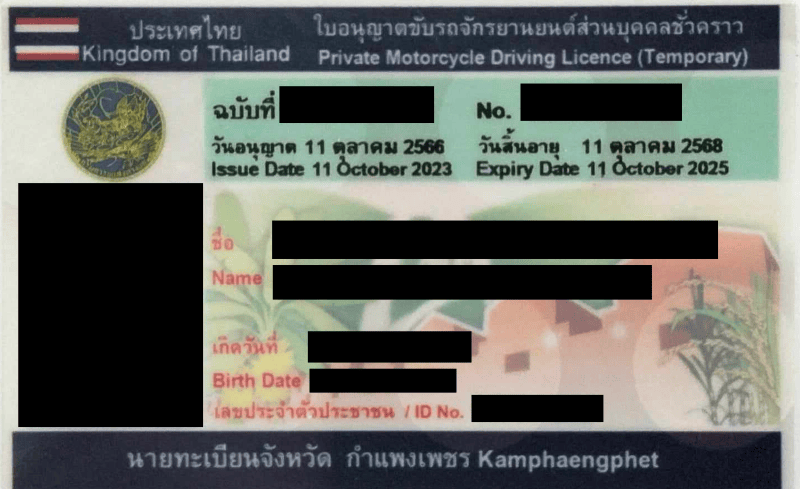
They will also return all the original documents you initially provided them, bringing you to the final steps of obtaining your license.
The remaining steps involve a visit to the Department of Land Transport Office.
Here’s how to proceed:
Document Submission
Gather all the necessary documents, including those you submitted to the driving school, along with the new document confirming your completion of all requirements.
Payment of Fees
You’ll then be required to pay a fee of THB105. That covers THB100 for the license and THB5 for the application form.
Photo Processing
After submitting the essential paperwork and settling the fee, you’ll have your photo taken for the license card.
Obtaining Your Motorcycle License
Following the processing of your photo and verification of your information, the Department of Transport will issue your official motorcycle driving license the same day.
With this, you’ll have successfully navigated the process and secured your license to explore Thailand by motorcycle.

Got your license? Sort out insurance next. On CheckDi you can compare motorbike insurance from over 30 insurers in English, for any engine size. Plans start at THB350 a year, and you can split the cost into 0% installments over up to 10 months. Compare motorbike insurance on CheckDi (Sponsored)
Renewal
Initially, your motorcycle driving license will be valid for two years. You can renew it 90 days before it expires.


Here’s what you need to do:
2-year license to 5-year license
You need to prepare the same set of documents as when you apply for a motorcycle driving license.
However, this time, you can simply visit the Department of Land Transport, pay a THB255 fee, and get the 5-year driving license right away without having to take any tests.
Renewing a 5-year license
Renewing a 5-year license can be more complicated. In addition to preparing the same set of documents, this time you need to take a series of sight and reaction tests again.
Then, you need to create an account at the DLT e-learning and watch a video to remind you about driving regulations in Thailand. The videos can be unreliable on desktop, so use your phone to avoid issues.
Once that’s done, visit the Department of Land Transport to renew your license.
Converting a Foreign License
If you already hold a driving license from your home country or an International Driving Permit, the process is shorter. You still have to pass the written theory test, but you can skip the practical riding test, and the whole thing can usually be done in a day.
You watch the one-hour DLT e-learning video for your online certificate, bring your documents to any Department of Land Transport office, take the physical tests (color-blindness, reflexes, and so on), and pay the standard fee for a two-year license. If your home-country license is not in English, you need an official translation certified by your embassy or consulate.
Thai law issues car and motorcycle licenses separately, so a foreign car license does not automatically cover you for a motorcycle. For the full step-by-step on converting a foreign license, see our guide to the Thai driving license.
Can I Obtain a Motorcycle Driving License with a Tourist Visa?
In fact, it is possible to obtain a motorcycle driving license with a tourist visa. However, the main issue is the residence certificate, which requires a long-term visa in order to be obtained from an immigration office.
In short, if you can manage to secure a residence certificate, you should be able to obtain a motorcycle driving license, even with a tourist visa.
If you are only visiting, an international driving permit lets you ride legally without a Thai license.
How Much Does It Cost to Obtain a Motorcycle License in Thailand?
Here’s a quick breakdown of the costs for obtaining a motorcycle license in Thailand:
- Medical certificate: THB200
- Residence certificate: THB500
- Government fee: THB105 (for a 2-year license) and THB255 (for a 5-year license)
So, in total, the cost to obtain a motorcycle driving license here should be around THB800.
If you opt for a driving school, expect to pay an additional THB1,000 to THB2,000.
What Happens When My Motorcycle License Expires?
The response depends on the length of time since expiration.
- If it has expired within a year, you can simply renew it right away, following the same requirements as a standard renewal.
- If it has expired for 1 to 3 years, you need to retake the theory test.
- If it has expired for more than 3 years, you will need to start the entire process over again.
Lost, Damaged, or Renamed License: Getting a Replacement
A lost wallet or a card left in a washing machine doesn’t mean starting the whole licensing process over. The Department of Land Transport treats a lost or damaged license as a straightforward replacement, provided your license itself hasn’t already expired.
You no longer need to file a police report first. Under current DLT practice, your national ID card, for Thai nationals, or your passport, for foreigners, is enough to confirm your identity at the counter. A police report still appears on DLT’s own list of acceptable supporting documents, so bring one if you have it, especially if the license was stolen, but it isn’t a prerequisite for a simple loss.
What to Bring
- Your passport, with a valid visa or stay stamp.
- Your damaged license, if there’s anything left of it.
- A recent passport-sized photo, in case the office needs one on the spot.
- Proof of your Thai address or work permit, if the office asks for it. Officers sometimes request a copy of your work permit or residence document alongside your passport.
The fees are small:
- Replacing a lost or damaged card. THB105 in total: a THB5 application fee plus THB100 for the new card.
- Correcting details on an existing license. A name change, for example, costs THB50.
Book your visit the same way you would for the original license, through the DLT Smart Queue app or gecc.dlt.go.th, selecting the replacement or damaged or lost service category. You can go to any DLT office nationwide, not just the one where you originally applied. Bring cash, since the fee payment window at most offices closes at 3:30 pm even when the office itself stays open later.
According to the DLT’s service guides, the replacement card keeps the same license number and the same expiry date as the one it replaces. If your license had already expired before it was lost or damaged, follow the renewal or retest rules above instead of a straight replacement.
Your License on Your Phone: The DLT QR Licence App
Since licenses started carrying a QR code on the back, DLT has run a companion app, DLT QR Licence, that displays a digital copy of your card on your phone. It’s built and operated by DLT itself, on the same government infrastructure as the DLT Smart Queue booking system.
The app only works with a license that has the QR code, so if you’re holding an older card without one, you’ll need to renew it first to get the newer format before the app has anything to display.
Setting It Up
- Download DLT QR Licence free from the Google Play Store or Apple App Store.
- Register with your national ID or passport number, plus the details printed on your physical license.
- Link one phone number to your account. Each registration ties to a single device.
Once it’s set up, the app shows a virtual front and back of your license and a scannable QR code, along with a reminder as your renewal date approaches. Thai media coverage of the app’s rollout describes traffic police accepting the app’s display as a substitute for the physical card, since officers can scan the code to pull up the same license information.
Tip: Even with the app installed, it’s worth keeping a photo of your physical license saved in your phone’s gallery as a backup. Some officers, particularly outside Bangkok, are still getting used to checking a foreigner’s license through the app.
The app isn’t a way around renewal. It only mirrors whatever is on your physical license, so if your license expires, the app’s copy expires with it, and you still need to visit DLT in person to renew.
Frequently Asked Questions
Here are the questions people ask most often about getting a motorcycle license in Thailand.
What documents do I need to get a motorcycle license in Thailand?
You need a signed copy of your passport picture page and valid visa, a medical certificate from a local clinic or hospital, a copy of your TM30 receipt of notification, and a residence certificate from immigration. A passport-sized photo (1×1.25 inch, white or blue background) is sometimes required too.
How much does a motorcycle license cost in Thailand?
Getting a motorcycle license costs around THB800 in total: about THB200 for the medical certificate, THB500 for the residence certificate, and THB105 for the government fee on a 2-year license (THB255 for a 5-year license). Going through a driving school adds another THB1,000 to THB2,000.
What’s on the motorcycle license theory test?
The theory test draws 50 multiple-choice questions from a bank of 500, covering traffic signs and markings, traffic law, driving and maintenance, and accident prediction. You need at least 45 correct answers to pass.
How long is a Thai motorcycle license valid?
Your first motorcycle license is valid for two years. You can renew it to a five-year license without retaking any tests, as long as you renew within 90 days of the expiry date.
Can tourists get a motorcycle license in Thailand?
It is technically possible, but the main obstacle is the residence certificate. Immigration generally requires a long-term visa to issue one, so most visitors on a short tourist visa cannot complete that step.
Do I need separate licenses for a car and a motorcycle in Thailand?
Yes. Car and motorcycle licenses are issued separately in Thailand, so you have to complete the full application process for each one even if you already hold the other.
What happens if my motorcycle license expires?
If it expired within a year, you can renew it under the standard requirements. If it has been expired 1 to 3 years, you need to retake the theory test. If it has been expired more than 3 years, you have to start the entire application process over.
Can I get a motorcycle license through a driving school instead of the DLT directly?
Yes. You can register directly at your nearest Provincial Land Transport Office, or go through a private driving school, some of which run a streamlined two-day package for around THB1,000 on top of the standard government fees.
Can I convert my foreign motorcycle license to a Thai one?
If you hold a license from your home country or an International Driving Permit, you can skip the practical riding test but still have to pass the written theory test, and it can usually be done in a day. Bring your documents plus an embassy-certified English translation if your license is not in English. Because Thailand issues car and motorcycle licenses separately, check that your foreign license actually covers motorcycles. Our Thai driving license guide has the full process.
What do I do if I lose my motorcycle license or it gets damaged?
Book a replacement through the DLT Smart Queue app or gecc.dlt.go.th under the replacement or damaged or lost category, then visit any DLT office with your passport and the remains of the damaged card if you have them. You generally don’t need a police report first. The replacement costs THB105 in total and, according to DLT service guides, carries the same expiry date as your original license.
Can I show my motorcycle license on my phone instead of carrying the card?
Yes, if your license has a QR code on the back. Download the official DLT QR Licence app, register with your ID or passport and license details, and it displays a scannable digital copy you can show to traffic police. Older licenses without a QR code need to be renewed first before the app will work.
Now, on to You
Acquiring a motorcycle driving license in Thailand is a legal requirement. After you get it, pick up motorbike insurance and ride carefully while exploring the country.
One of our writers just recently had a motorcycle accident. You can read here on how he dealt with it.
While the process may seem daunting at first, with proper preparation and commitment, you can successfully obtain your license and enjoy the freedom of riding in this beautiful and diverse country. Our guide on how to ride safely in Thailand is worth reading before you head out.
Sources Cited
- Thai Government Information Center, temporary driving license application (Department of Land Transport): the THB100 motorcycle license fee and THB5 application fee for a 2-year license.
- Thai Government Information Center, private driving license renewal (Department of Land Transport): the THB250 motorcycle license fee and THB5 application fee for a 5-year license.


 Deutsch:
 Français:
'/%3E%3Cpath%20fill='%23b2b2b2'%20d='M241%20382q0%2016%2017%2026%2017%2011%2042%2011t42-11q16-11%2017-26V269H241'/%3E%3Cpath%20fill='%239f7e00'%20d='M241%20379q0%2014%208%2023%209%209%2021%209%2014%200%2021-9%209-9%209-23V269h-59'/%3E%3Cpath%20d='M241%20339v-70h59v110q0%2014-9%2023l-6%205v-68h-15v72q-8%200-14-4v-68zm59%2040c0%2022%2015%2032%2029%2032%2021%200%2030-18%2030-32v-40h-59'/%3E%3Cpath%20fill='%239f7e00'%20d='M266%20277v5h2v12h-3v-5h2v-5h-9v5h2v5h-4v9h3v18h-5v10h34v-10h-5v-18h3v-9h-4v-5h2v-5h-9v5h2v5h-3v-12h2v-5zm42%20101q0%2010%206%2017%206%206%2015%207%2010-1%2016-7%206-7%206-17v-29h-43'/%3E%3Ccircle%20fill='%230044ad'%20cx='329.5'%20cy='372'%20r='6'/%3E%3Cellipse%20fill='%230044ad'%20cx='300'%20cy='340'%20rx='16'%20ry='21'/%3E%3C/svg%3E) Español:
Español: