Whether you’re moving from one location to another in the same province or moving to a new province altogether, you need to notify immigration of your change of address in Thailand using Form TM30.
Changing your address at your local Thai immigration office isn’t the most challenging task, but you should know what to expect ahead of time, as it could save you a lot of time.
Disclaimer: Some links in this article go to our partners, and we may earn a commission if you use them. It costs you nothing extra, and we only recommend services we'd use ourselves. Read more in our Advertising Disclosure.
Contents
- Key Takeaways
- Does this Guide Apply to All Immigration Offices in Thailand?
- Who Needs to Do It?
- Who’s Responsible to Notify Immigration?
- TM30 vs the 90-Day Report: Two Different Notifications
- When Should You Notify Immigration?
- Why is it Important?
- Documents
- How to Change Your Address
- Four Ways to File a TM30
- Can You File Form TM.30 Online?
- How Long Does Changing Your Address Take?
- Fines for Not Changing Your Address Within 24 Hours
- TM30 Penalties at a Glance
- Now, on to You
- Frequently Asked Questions
- Sources Cited
Key Takeaways
- Any foreigner on a temporary stay must be reported to the nearest immigration office within 24 hours of arriving at a new address, using Form TM30.
- Thai law places the TM30 obligation on landlords and house owners, but in practice most don’t file it, so you usually end up sorting it out yourself.
- A late TM30 can cost the owner a fine of up to THB2,000, and many owners expect you to cover it.
- Required documents include your passport, a copy of your visa, your signed lease, the owner’s house book, and the TM30 form itself, which you should fill out in advance.
- Keeping your TM30 current is a prerequisite for getting a residence certificate, extending your visa at a local office, getting a Thai driving license, and opening a bank account.
- Each immigration office applies its own rules, so check with your local office before going to confirm the exact requirements.



Does this Guide Apply to All Immigration Offices in Thailand?
As usual, each immigration office (and officer) in Thailand plays by its own rules.
You can use this guide to help you change your address in most provinces, but it’s best to check with your local immigration office to find out their specific requirements.
Who Needs to Do It?
Every foreigner staying in Thailand on a temporary stay has to be reported to the local immigration office when they move into a new place, tourists included. If you’re staying in a hotel, the hotel does it for you.
So in practice, this guide is for expats on long-stay visas who rent a house or condo, where nobody files it unless someone makes them.
Who’s Responsible to Notify Immigration?
There seems to be a grey area about who’s actually responsible for notifying your change of address at the Thailand immigration office.
The Thai law states that:
The house master, the owner or the possessor of the residence, or the hotel manager where the alien, receiving permission to stay temporarily in the Kingdom, has stayed, must notify the competent official of the Immigration Office located in the same area within 24 hours from the time of arrival of the alien concerned. Section 38 of the 1979 Immigration Act
However, I have never heard of any cases where the house owner went to immigration to notify the authorities that an expat was living in their house or condo on their own accord.
Some owners don’t even know about this rule. And if they do, they simply don’t care until you bring it up. So, it’s important for you to take care of it yourself. Because in the end, it’ll be you who has to pay the fine for not doing so.
Expat forums are full of the same story. A landlord who won’t file, or says they can’t, and a tenant who only finds out when immigration sends them away.
TM30 vs the 90-Day Report: Two Different Notifications
They’re two different notifications. TM30 is the one the owner, landlord or hotel manager files to tell immigration a foreigner is staying at their property. The 90-day report is the one you file yourself. Different forms, different people responsible, different fines. (Verified October 2026.)
- TM30 (owner’s notification): The house owner, landlord or hotel manager files it within 24 hours of your arrival. Immigration Act Section 38 sets the duty. The owner’s fine is up to THB2,000 (hotel managers: THB2,000 to THB10,000).
- 90-day report (TM47): You file it yourself, in writing, every 90 days you stay in Thailand. Immigration Act Section 37 sets the duty. The Immigration Bureau runs a separate online TM47 system for it.
- Your own change of residence: Section 37 also requires you to tell immigration within 24 hours when you move somewhere other than the place you gave them. The fine is up to THB5,000, plus up to THB200 for every day it stays unreported.
Filing the 90-day report doesn’t replace a TM30 for your new address. A TM30 doesn’t reset your 90-day count either. Keep both receipts together, since an officer may ask to see either one.
When Should You Notify Immigration?
ASAP. The law gives the owner 24 hours from the day you move in, and a late TM30 can bring a fine of up to THB2,000 for the owner (THB2,000 to THB10,000 if it’s a hotel). (Verified September 2026.)
But because it’s almost impossible to notify immigration of your new address while you’re moving and settling in, it’s usually best to plan your move the day after you get the keys to your new place. This way, on the first day of your lease, you can focus on changing your address.
The other option would be to pay the late fine and notify immigration on your next 90-day check-in, which would be more convenient but more costly.
Why is it Important?
Aside from avoiding the fines and possible legal troubles, there are some more practical benefits to notifying immigration of your change of address.
After you’ve changed your address you can get your Residence Certificate, which will come in handy when you need to get your Thai driving license, buy a car, or open a bank account.
In addition to that, you might not be able to apply or extend your visa at your local immigration office if you don’t update your TM.30 to be your current address.
Expats in the forums say officers regularly refuse to process an extension or a 90-day report until the TM30 matches where you live now, so sort it out before either date comes round.

Documents
Here are the documents you’ll need to notify most Thai Immigration offices of your change of address.
- your passport
- copy of your passport’s photo page
- copy of your visa
- your house/condo lease with your name on it (signed and dated by you and the owner; see common mistakes when renting in Thailand)
- copy of your house/condo lease with your name on it (signed and dated by you)
- copy of the owner’s blue house book with the address of where you’re staying (signed by the owner)
- TM.30 form
If you don’t have copies of these documents, there is a photocopier at most Thai immigration offices throughout the country.
TM.30 is available at the office, but you should print and fill it out ahead of time.
How to Change Your Address
I’ll walk you through the same exact process I went through, so when you get to your local Thai immigration office, you’ll feel confident enough to go through the process.
Filling in Your TM.30 Form
When it comes to the TM.30 form, your owner will have to handle it.
If you don’t have a helpful owner, you may have to fill in their form and then have them sign it.
Form TM.30
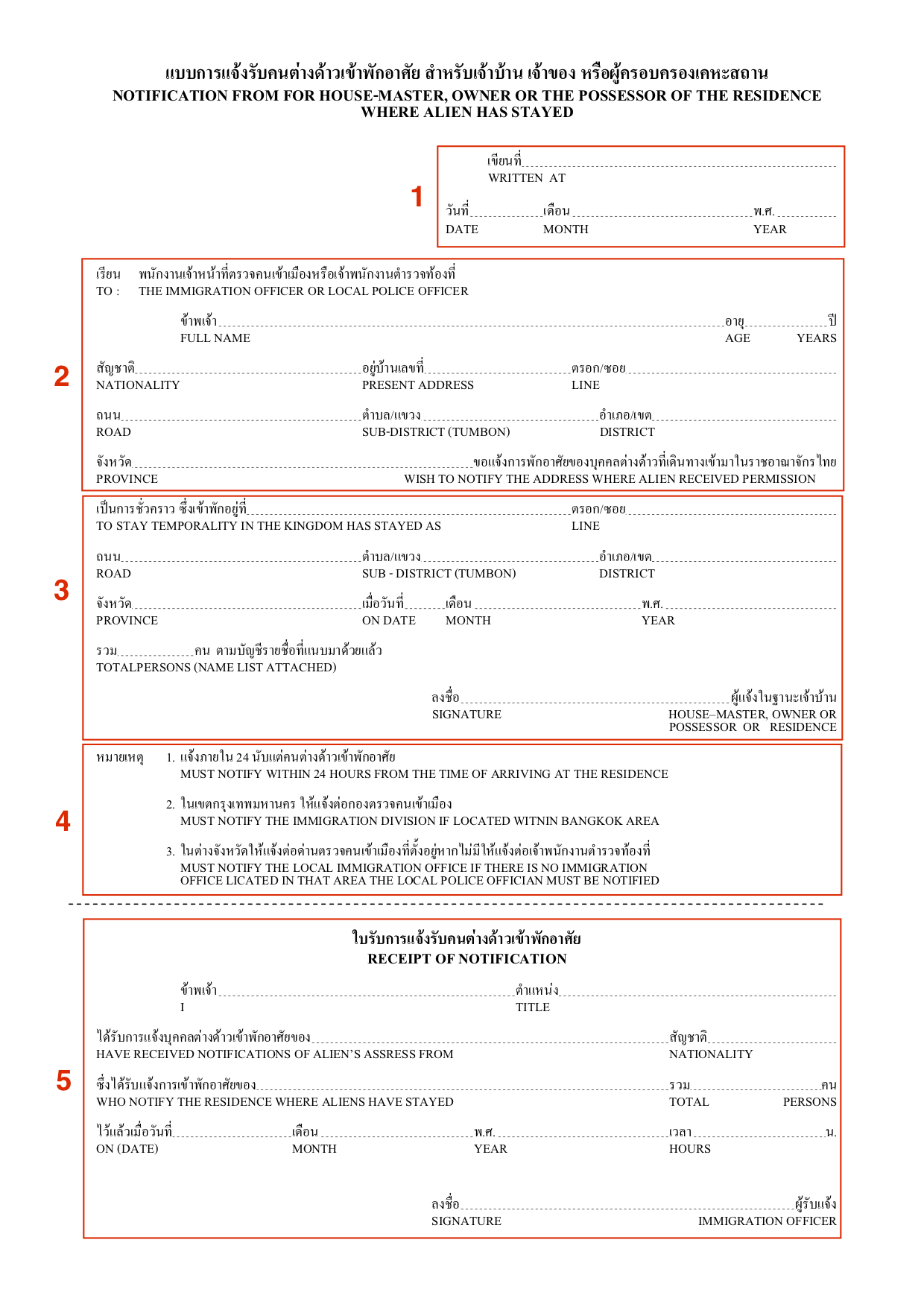
The TM.30 form is your landlord’s responsibility. They’ll need to fill this out and sign it in blue ink.
Here’s what they need to know about this form:
- Written at: This means where the owner is right now, filling in the form. They have to date the form as well.
- Owner’s address: This section is not for the address of where you’ll be staying, unless you’ll be living with the owner. This address is where the owner lives. In other words, their residence.
- Tenant’s address: This section is for the house or condo address that the owner has rented out to you.
- Notification: As mentioned at the beginning of this guide, owners are supposed to notify immigration of foreigners living at their place within 24 hours upon your arrival.
- Immigration officer’s section: Don’t touch this section. This is for the immigration officer to complete. They keep this section.
Going to the Thai Immigration Office
Once you’ve gathered all your documents, you’ll need to go to your local Thai immigration office (in Bangkok, that’s the Chaeng Wattana immigration office). To find the closest one to you, search “Thai immigration office” on Google Maps.
I would go right after lunch, at 1:00 PM. This way the morning rush has cleared out.
Getting Your Queue Number
When you get inside the immigration office, go straight to the help desk. The person working behind the desk will check your documents and then give you a queue number.
At some Thai immigration offices, you may have to get a queue number yourself from the kiosk.
If you think you’re going to need help at any time, you could always bring a Thai translator if you don’t speak Thai.
Seeing the Immigration Officer
When you get to the immigration officer’s desk or window, they’ll go through your paperwork to make sure you have all the documents and that they’re filled out correctly.
Once that’s done, you’ll get your Receipt of Notification. Ask the immigration officer to fold and staple the receipt onto the last page of your passport.
You’re free to go after that, unless you have to pay a fine (see below).
Four Ways to File a TM30
There are four ways: in person, through someone you send, by registered post, or online. The owner picks whichever suits them. Bangkok properties go through Immigration Division 1 at the Chaeng Wattana government complex. (Verified October 2026.)
- In person: Take the documents to the TM30 counter at your immigration office. In Bangkok that’s the Chaeng Wattana complex, during office days and hours.
- Through someone else: The Bureau says another person can bring the documents on the owner’s behalf. A property manager or a friend can do the trip.
- Registered post: Mail the signed form with a self-addressed 6.5 x 9 inch envelope carrying a THB10 stamp, so the office can return your receipt. Keep the registered-mail slip as proof you sent it.
- Online: Register on the Immigration Bureau TM30 system. An immigration officer checks and approves the registration, then the login details arrive by email.
On the paper form, the officer checks the details, accepts the notification and tears off the lower part for you to keep. That slip is your proof, so photograph it before it goes into your passport.
Can You File Form TM.30 Online?
Yes, you can now file Form TM.30 online. But I’d beware of all the websites that are advertising their services for a fee.
You can easily file the form yourself. To do so, visit the official Thai Immigration website and go to the TM30 online system. You’ll have to register first, and an immigration officer approves the account before your login details arrive by email.
Once you log in, fill out Form TM.30 and upload the required documents. You’ll get an approval notification sent to your email after a few days. Print the Receipt of Notification and staple it to your passport.
How Long Does Changing Your Address Take?
If you show up with the right documents, you should be done within an hour.
Because there are fewer people who show up to immigration to change their address than, say, do their 90-day check-in, you won’t have to wait very long.
Fines for Not Changing Your Address Within 24 Hours
A late TM30 can cost the house or condo owner a fine of up to THB2,000 if nobody notifies immigration within 24 hours of you moving in. Hotels face a fine of THB2,000 to THB10,000. (Verified September 2026.)
You also have your own duty as the foreigner to tell immigration when you change where you live. Skipping that can bring a fine of up to THB5,000, plus up to THB200 for every day it stays unreported.
The truth is, it’s nearly impossible for anyone to notify immigration within 24 hours of an expat moving into their residence. In fact, a lot of homeowners feel this law was set in place just to get money from them.
Also, not all homeowners will be willing to pay the fine on your behalf. This is where the catch-22 comes in. Because if they don’t pay the fine, you can’t officially change your address. So what winds up happening is that you have to pay the fine.
TM30 Penalties at a Glance
The Immigration Act sets three separate fines around a change of address. Each one falls on a different person. (Verified October 2026.)
| Who | What they missed | Maximum fine |
|---|---|---|
| House owner or landlord | No TM30 within 24 hours of your arrival (Section 77) | Up to THB2,000 |
| Hotel manager | No TM30 within 24 hours of a guest’s arrival (Section 77) | THB2,000 to THB10,000 |
| You, the foreigner | No notification of a change of residence or of your 90-day report (Sections 37 and 76) | Up to THB5,000, plus up to THB200 for each day until you comply |
These are the legal maximums. Whether the owner passes their fine on to you is a private arrangement between you and them. Agree on it before you sign the lease.
Now, on to You
That’s how you change your address at your local Thai immigration office.
As I said earlier, it’s one of the easier matters to handle while in Thailand, and as long as you have all the documents, you should be done within an hour.
Frequently Asked Questions
Do I need a new TM30 every time I move?
Yes. The owner’s duty under Section 38 starts when you arrive at a property, so each new address needs its own notification within 24 hours. Moving house also triggers your own duty to report the change of residence.
Can my landlord send someone else to file the TM30?
Yes. The Immigration Bureau lets the owner or another person on their behalf bring the documents. It also accepts registered post and its online system.
Is the TM30 the same as the 90-day report?
No. The TM30 is the owner’s notification of where you live. The 90-day report is your own notification that you’re still in Thailand. Each has its own form and its own online system.
What proof do I get after the TM30 is filed?
On a paper filing, the officer accepts the form and returns the lower part to the person who filed it. Keep it with your passport and photograph it. It’s your proof that the notification was made.
Who is liable if my hotel or Airbnb host does not file?
The law puts the duty on the hotel manager or the owner of the residence. A hotel manager faces THB2,000 to THB10,000 and a private owner up to THB2,000. So hotels normally file for their guests.
Sources Cited
- Immigration Act B.E. 2522 (1979), English translation, Samut Prakan Immigration: the 24-hour owner notification (Section 38), the foreigner’s duty to report a change of residence (Section 37), and the fines (Sections 76 and 77).
- Immigration Bureau TM30 online system: the official portal for filing the notification of residence for foreigners online.
- Immigration Bureau home page (TM30 residence notification and 90-day online notification services): the owner’s notification under Section 38, the in-person, representative, registered-post and online filing routes, the THB10 return-envelope stamp, and the separate TM47 90-day online system.
- Immigration Bureau TM47 online system: the separate online portal for the 90-day report.



 Deutsch:
 Français:
 Español: