
Learn how to apply for a Thai marriage visa, including the financial requirements, required documents, application process, renewals, and re-entry permits.
I stepped out onto the slushy streets of New York City. The wind ripped through my bones. Warm air billowed from my mouth like the steam twisting and rolling out of the metal stacks on East 52nd Street. Behind me, the Thai Consulate building. In front of me, a world of opportunity.
As far as I was concerned, it was the last winter I’d be spending in America, because in my hand was my passport, and in my passport, my Thai marriage visa. A guarantee that Thailand would be my home for at least the next 365 days.
Applying for my Thai marriage visa was the last step in my seven-year plan to move from America to Thailand. But perhaps it was the most important. So, I want to walk you through how I did it and how, since 2014, I’ve been renewing my marriage visa every year in Thailand.
By the end of this guide, you’ll know exactly which requirements you need to meet and which documents you need to show to apply for a marriage visa both inside and outside of Thailand.
Before you start: Thailand’s visa rules change often. Always confirm the current steps, fees, and documents on the official Thai e-Visa portal before you travel. Book a flexible or refundable flight and do not plan a tight return. Your approval now arrives by email, and the timing is hard to predict.
Disclaimer: Some links in this article go to our partners, and we may earn a commission if you use them. It costs you nothing extra, and we only recommend services we'd use ourselves. Read more in our Advertising Disclosure.
Contents
- Key Takeaways
- What Can You Do With It?
- Requirements
- Embassy vs Immigration: How the Money Rule Differs
- Application Process
- From Outside of Thailand
- Application Process from Within Thailand
- Re-Entry Permit
- Marriage Visa Costs at a Glance
- Extend (Renew) Your Marriage Visa
- Keeping Your Visa Active
- Translating and Legalizing a Foreign Marriage Certificate
- Do I Need to Register My Marriage in Thailand?
- Marriage Visa for Same-Sex Spouses
- What Happens If Your Spouse Passes Away?
- Alternative Options
- Overstaying
- Reapplication Process
- Frequently Asked Questions
- Can I work in Thailand on a marriage visa?
- Does my Thai spouse need a job or a certain income for me to qualify?
- Can I combine savings and income to meet the financial requirement?
- What happens to my marriage visa if I get divorced?
- Are American, British, or Australian citizens able to use the income method?
- Do I need to already be married before I apply, or can I apply while engaged?
- Can a same-sex couple get a Thailand marriage visa?
- Does my Thai spouse have to come to immigration with me?
- I'm already in Thailand on a visa exemption. Can I switch to a marriage-based Non-O without leaving?
- How long do the funds need to sit in the bank?
- Is my foreign marriage certificate accepted as it is?
- Now, on to You
- Sources Cited
Key Takeaways
- To get a marriage visa, you need to be lawfully married to a Thai citizen.
- A marriage visa allows you to stay in Thailand for 365 days a year, after which you have to reapply for another 365 days.
- In addition to a marriage certificate, you also need to show proof of the relationship, such as your child’s birth certificate and family photos.
- If you are a male married to a Thai, you must have at least THB400,000 in your Thai bank account for two months before applying, or an income of THB40,000 a month.
- You can apply for a marriage visa both from inside and outside of Thailand.


Quick requirements
- MarriageLawfully married to a Thai citizen, with a marriage certificate and proof of the relationship.
- Funds (non-Thai men)THB400,000 in a Thai bank account, seasoned 2+ months, or proof of income of THB40,000/month.
- Funds (non-Thai women)Not required for women married to a Thai man.
- Visa validity365 days per renewal; you reapply every year.
Documents to prepare (in-Thailand route)
- Personal documentsPassport, 2×2 inch photos, application form TM7, TDAC QR code/confirmation, and copies of every used passport page.
- Spouse’s Thai IDA copy of your spouse’s Thai ID card.
- Marriage certificateThai marriage certificate, or an overseas certificate translated into Thai and certified (forms ค.ร. 2 & 3 if married in Thailand, ค.ร. 22 if married abroad).
- Children’s birth certificatesThai certificates, or translated into Thai, if you have children together.
- Family photosTaken in your kitchen, living room, and bedrooms; outside your house showing the house number; and with your kids at school if applicable.
- Address proofBlue Book address page showing your spouse’s name, a hand-drawn map to your residence, and your lease or the property owner’s ID and title deed.
- Bank funds (non-Thai men only)Bank book, a bank letter showing THB400,000, and an updated passbook copy dated the day you apply, with the funds seasoned for 2 months.
- Employment documents (if working in Thailand)Work permit, employment certificate showing a salary over THB40,000/month, tax filing (Phor Nhor Dor 91), and your employer’s registration certificate (Bor Aor Jor.5).
The document list for applying from abroad varies by embassy – confirm the exact list with your local Thai Embassy before applying.
Phase A · Apply from outside Thailand
Document requirements vary by country. One example list (from the Thai Embassy in New York): airline ticket, spouse’s passport, three 2×2 inch photos, passport with 6 months’ validity, marriage certificate translated into Thai, and a bank statement showing sufficient funds.
Apply for a Non-Immigrant Type O visa based on marriage. The fee is set by each embassy. The Thai consulate in New York charges US$80 for a single-entry visa and lists no multiple-entry option for this purpose.
Processing time depends on the embassy. The New York consulate now quotes 30 to 45 business days. The visa becomes valid once approved, not when you arrive in Thailand.
The Non-O visa gives you an initial 90-day stay.
Phase B · Extend or apply within Thailand
In Bangkok, that’s the Government Complex in Chaengwattana, Building B. If your existing marriage visa is about to expire, you can apply for the new one up to 30 days beforehand.
Get your paperwork checked at the counter, then wait in Section L for an officer to call your number.
The application costs THB1,900. Come back within 30 days to collect your visa results and one-year stamp.
Phase C · Stay legal & renew
Report to immigration every 90 days to keep your visa active.
If you plan to leave Thailand and come back, get one first: THB1,000 for a single re-entry permit, or THB3,800 for a multiple re-entry permit.
Repeat the same process annually. If you don’t have THB400,000 in a Thai account, you may be able to renew at a Thai Embassy in a neighboring country instead, such as in Savannakhet, Laos.
If you registered abroad, register at your local amphoe (district office) once you’re in Thailand – otherwise you may not be able to extend your visa later.
If you need help applying for your visa, you can use a visa service from Baan Thai Immigration Solutions (sponsored).
What Can You Do With It?
A marriage visa is a renewable visa that allows you to stay in Thailand for one year with each renewal.
With this visa, you’re allowed to apply for a Thai work permit and work in Thailand for a Thai-registered company. You don’t have to apply for a work visa, but your employer must give you a work permit.
Requirements
There are two main requirements for getting the marriage visa:
- the marriage requirement
- the financial requirement (a non-Thai male married to a Thai)
Marriage Requirements
To get a marriage visa in Thailand, you need to be lawfully married to a Thai citizen. You need to show both a marriage certificate and proof of your relationship when applying for the visa.
Financial Requirements
If you are male, to qualify for a marriage visa, you also have to show THB400,000 in a Thai bank account deposited at least two months before applying. It’s the easiest way to pass the financial requirements. (Verified September 2026; US$ figures use THB33 = US$1.)
Alternatively, you need to show proof of income showing that you’re earning at least THB40,000 per month.
*You may be able to get an income affidavit from your country’s embassy showing you’ve had THB40,000 per month going into your home bank account as proof of finances. But this is not the case for American, British, and Australian expats since embassies won’t issue them. And if they do, Thai Immigration won’t accept them.
Good to know: This financial requirement applies to non-Thai men married to Thais. A non-Thai woman married to a Thai man is asked for different documents, such as the Thai husband’s certificate of employment. Check the current list with your immigration office.
Embassy vs Immigration: How the Money Rule Differs
The THB400,000 and THB40,000 figures come from the Immigration Bureau’s rules for the one-year extension of stay. The Thai embassy that issues your first Non-O visa abroad sets its own paperwork, and the wording is not identical everywhere.
The Immigration Bureau’s published criteria say the foreign husband of a Thai wife needs either an average income of at least THB40,000 a month, or THB400,000 in a Thai bank account that has stayed there for the previous two months. The same page requires the marriage to exist both in law and in fact, which is why officers ask for family photos, a house registration and a map to your home. (Verified October 2026.)
Embassies can ask for a longer track record. At the time of checking, the Thai embassies in Pretoria and Singapore both asked for a bank statement showing at least THB400,000 (or the local equivalent) held for the past three months, not two. (Verified October 2026.)
| Where you apply | Money test | How long the funds must sit |
|---|---|---|
| Immigration Bureau (one-year extension) | THB400,000 in a Thai bank, or average income of THB40,000 a month | 2 months before you apply |
| Thai Embassy, Pretoria (Non-O) | THB400,000 or equivalent | 3 months |
| Thai Embassy, Singapore (Non-O) | THB400,000 or equivalent (SGD16,000 quoted) | 3 months |
The Immigration Bureau’s money test is written for the foreign husband of a Thai wife. If you are a foreign wife married to a Thai husband, the checklist used by Bangkok Immigration instead asks for your husband’s certificate of employment, signed off by his department head and no more than a month old. (Verified October 2026.)
Good to know: Before you move money, check your own embassy’s page. The balance period, the fee and the document list are set per embassy, and some now take the whole application through the Thai e-Visa site.
Application Process
Getting a marriage visa starts with a Non-Immigrant Type O visa based on marriage, issued by the Thai consulate in your home country (that’s what I did in NYC), which initially allows a 90-day stay in Thailand.

Once you’re in Thailand, you can then apply for an extension of stay based on marriage to a Thai national, which is valid for one year.
Alternatively, you can change status at an immigration office inside Thailand. You file form TM.86 if you are on a tourist visa, or TM.87 if you entered visa-exempt, and pay a THB2,000 fee. Then you apply for the one-year extension.
From Outside of Thailand
If you’re coming to Thailand from your home country, and you’re married to a Thai citizen, you can apply for a marriage visa at the Thai Embassy in your country.
You will first get a Non-Immigrant Type O visa based on marriage that lasts for 90 days. After that, you can extend to a one-year marriage visa in Thailand.
Applying
The process to get my marriage visa in NYC was easy and my wife didn’t have to be there. Here’s how I did it.
Documents
In New York City, here’s a list of documents the Thai Embassy asked me for.
- airline ticket
- Thai spouse’s passport
- three 2×2 inch passport photos
- passport with six months validity
- marriage certificate translated into Thai
- bank statement showing “sufficient funds”
Because different embassies ask for different documents, and because different countries have different agreements with Thailand, contact your local Thai Embassy for their list of required documents.
Cost
The fee is set by each embassy. The Thai consulate in New York charges US$80 for a single-entry marriage visa and lists no multiple-entry option for this purpose.
Time
Your visa doesn’t go into effect when you arrive in Thailand. It goes into effect when the Thai Embassy approves your paperwork. So, I went to the Thai Embassy in New York City about three weeks from our departure date, because I wanted my visa to start as close as possible to my Thailand arrival date.
Depending on where you get your visa, it could take anywhere from two days to two weeks. When I applied for my marriage visa in New York City, it took about two weeks for the embassy to approve my paperwork. The consulate now quotes 30 to 45 business days, so apply well ahead.
How to Fill Out the Thai eVisa Marriage Visa Application Form (Filled Example)
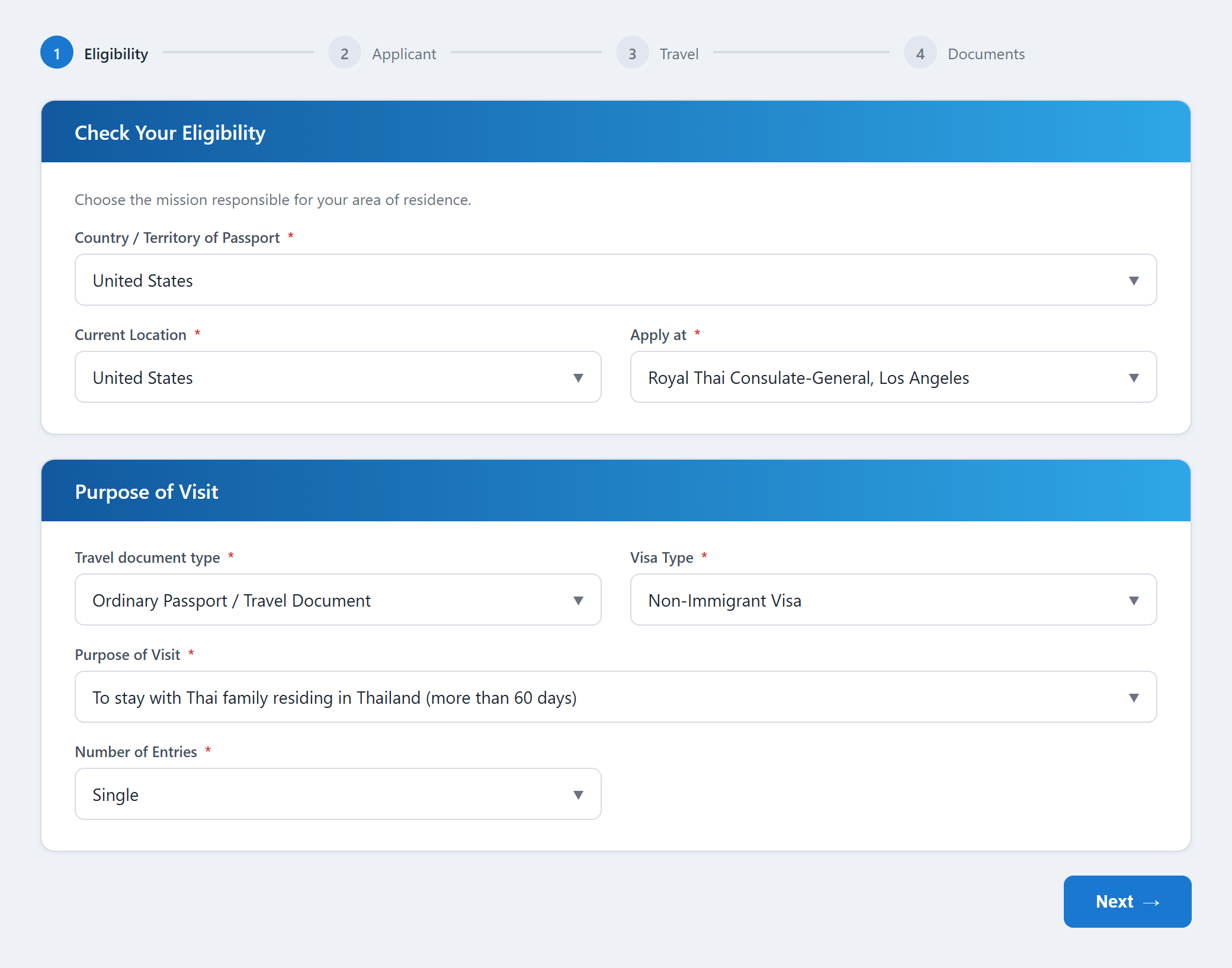
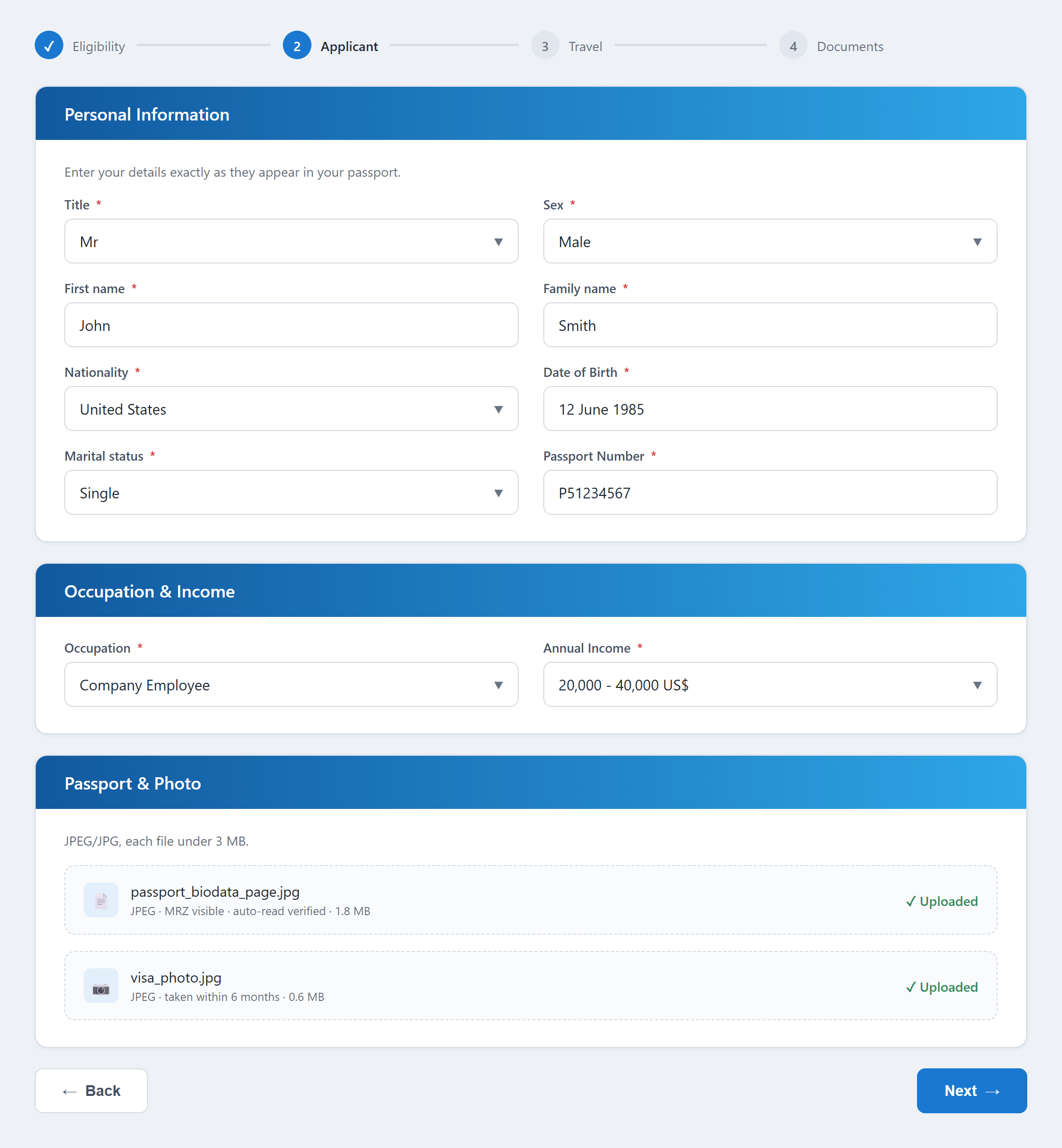
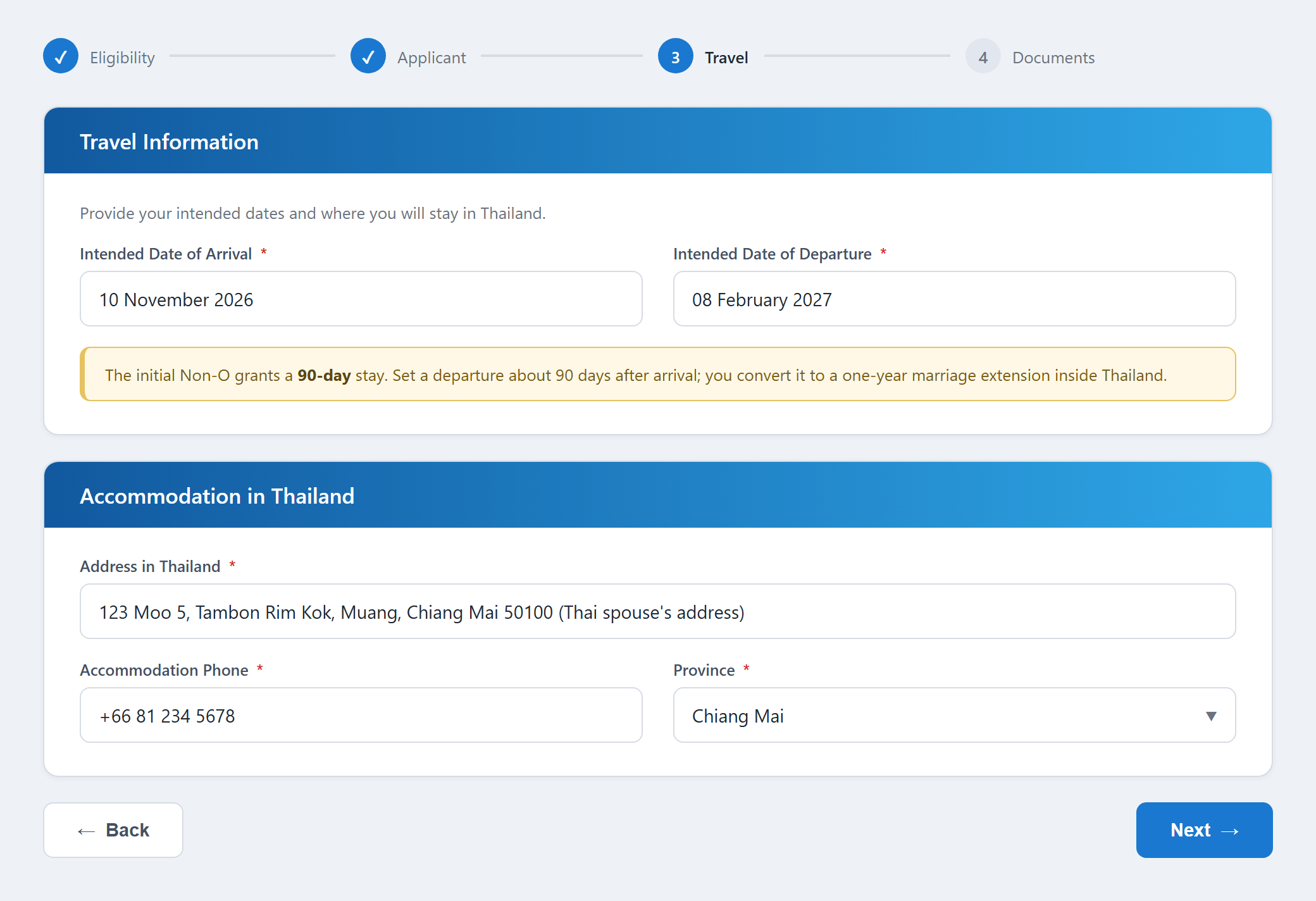
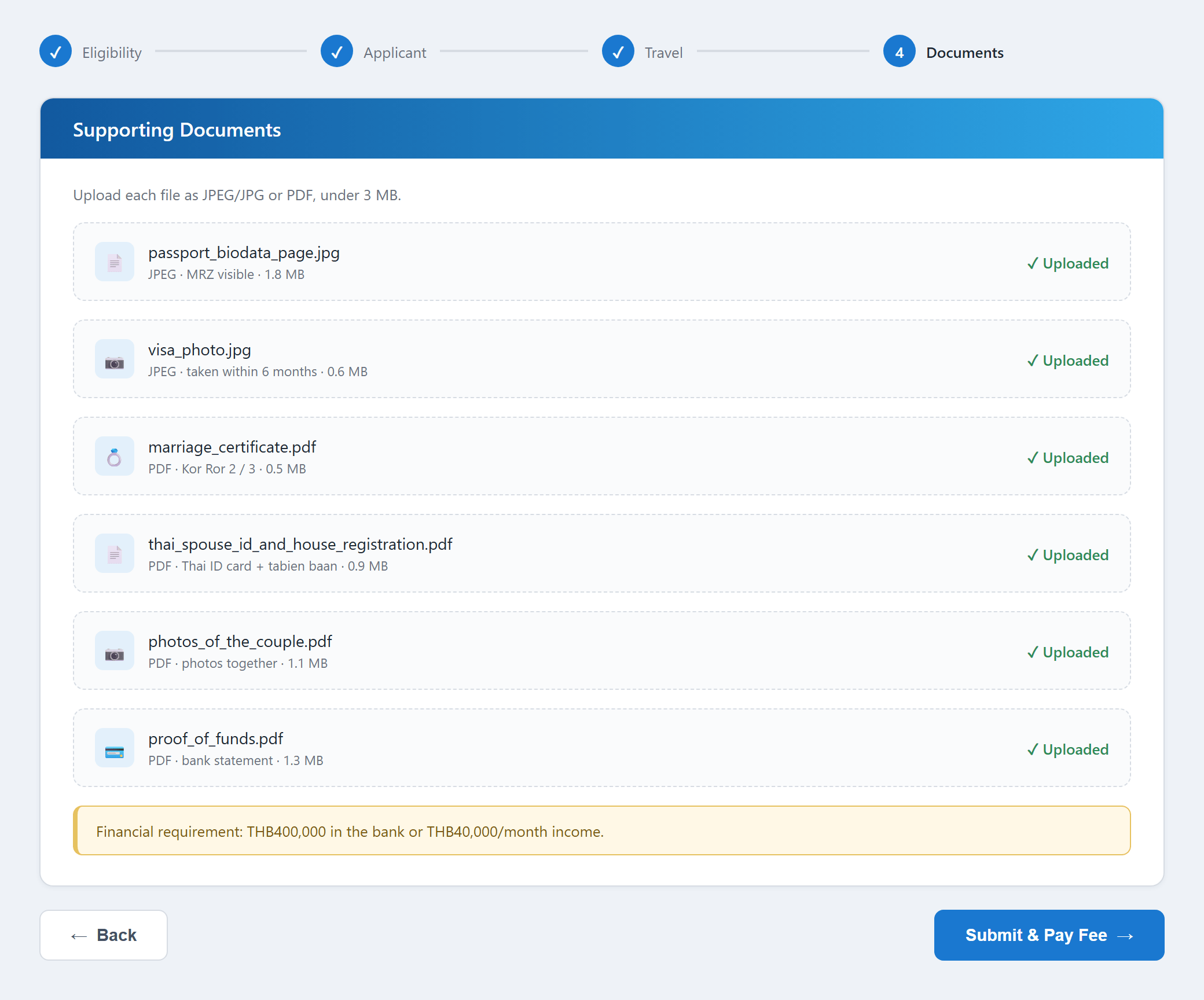
When you apply from abroad, the whole application is done on the eVisa website in four steps.
Step 1: Check eligibility and select the visa
Set Visa Type to Non-Immigrant Visa and Purpose of Visit to “To stay with Thai family residing in Thailand (more than 60 days)”. This is the initial 90-day Non-O you later convert to a one-year marriage extension in Thailand.
Step 2: Applicant information
Enter your personal and passport details, set your occupation and income, and upload your passport data page and a recent photo.
Step 3: Travel and accommodation
Add your arrival date and a departure about 90 days later, and your address in Thailand, which is usually your Thai spouse’s home.
Step 4: Supporting documents
Along with your passport and photo, upload your marriage certificate, your Thai spouse’s ID card and house registration, photos of the two of you together, and a bank statement (THB400,000 in the bank or THB40,000 per month in income).
Application Process from Within Thailand
If you are in Thailand, you can apply for the marriage visa at your local immigration office directly.
In case your marriage visa issued in your home country is going to expire, you can apply for a new visa inside of Thailand thirty days before your original visa expires.
Applying
To apply for your marriage visa, go to your local immigration office.
If you are in Bangkok, go to the Government Complex in Chaengwattana. Track down Building B by following the blue pathway on the road at the complex. At the end of the road, you’ll see a megalith surrounded by a moat. That’s where you want to go.
In the far left corner of the building, on the first floor, you’ll find the Immigration Office. Enter the office and go to the counter so they can check your paperwork. If you’ve done this before and are sure you have everything, go straight inside and get your queue number.
You’ll wait in Section L for an officer to call your number. Be sure to have all the documents listed below. For the most recent list, check the Immigration Bureau’s website. I have to warn you though — the website’s in need of an update, and some sections may not work.
Documents
Here’s a list of documents you need to get a marriage visa inside Thailand.
Personal document
- passport
- 2×2 inch photos
- an application form – form tm7 (download)
- Thailand Digital Arrival Card (TDAC) QR code or digital confirmation
- copies of every used page of your passport
Proof of relationship
- copy of spouse’s Thai ID card
- Thai marriage certificate or overseas marriage certificate*
- form ค.ร. 22 (if married overseas)
- forms ค.ร. 2 and 3 (if married in Thailand)
- Thai children’s birth certificates or children’s birth certificates translated into Thai
- family photos (you, your spouse, and children) at your house
- pictures taken in your kitchen, living room, and bedrooms
- pictures taken in front of your house with your house number showing
- photos with you and your kids at school, if applicable
- copy of Blue Book Thai address page with spouse’s name
- hand-drawn map showing how to get to your Thai residence form the nearest major highway
- copy of your lease if renting a place; copy of owner’s ID and property deed/title
Proof of income (non-Thai men only)
- bank book
- a letter from a Thai Bank showing THB400,000 in savings**
- copy of your bank book’s most recent updated page showing the THB400,000. It must be deposited two months before the application date***
- copy of your bank book’s front page with your name and account number
Additional document if you work in Thailand
- work permit
- employment certificate that clearly states that your monthly salary is over THB40,000 a month
- annual tax filing report (Phor Nhor Dor 91)
- your employer’s business registration certificate and a list of shareholders (Bor Aor Jor.5) certified within six months.
*You can get your Thai marriage certificate at any district office in Thailand.
If you do not have a Thai marriage certificate, you may need to get your marriage certificate translated into Thai. You then have to bring the translated certificate to the Department of Consular Affairs in Chaengwattana to have it approved and stamped.
Once the DCA approves your translated marriage certificate, you can take it to the district office in the city you live in, and they will print for you a certified Thai marriage certificate.
**KrungThai Bank was the only bank willing to let me open an account under my name on my existing marriage visa from the Thai Embassy in New York City.
***When you copy your bank book, make sure the date of your last transaction is on the day you’re going to apply for your visa. So, withdraw or deposit a few hundred baht to show some activity on that day. But make sure you have the THB400,000 required balance.
If you can read Thai, or your Thai spouse is willing to put in some legwork for you, MFA also has a visa page covering the Non-O issued abroad.
Cost
It costs THB1,900 for the marriage visa application.
Time
You will be asked to come back within 30 days to receive your visa results and get your one-year stamp.
Re-Entry Permit
If you want to leave Thailand and you plan on returning, make sure you get a Thai re-entry permit.
To leave and return one time, you’ll have to pay THB1,000 for your single re-entry permit. If you plan on leaving and returning multiple times, you’ll have to pay THB3,800 for your multiple re-entry permit.
You also have an option to get a multiple re-entry permit immediately after you apply for a marriage visa.
Marriage Visa Costs at a Glance
Between the embassy visa, the extension, and the re-entry permit, it’s easy to lose track of what you’re actually paying for. Here’s every official fee in one place.
- Non-Immigrant O visa from a Thai embassy abroad: set by each embassy, for example US$80 for a single entry at the New York consulate.
- Changing visa status inside Thailand (if you’re converting an existing tourist or other visa to Non-O based on marriage, rather than arriving with one already): THB2,000.
- One-year extension of stay (the annual renewal at Thai immigration): THB1,900.
- Re-entry permit: THB1,000 for single entry, or THB3,800 for multiple entry.
All four figures are confirmed on the Immigration Bureau’s own fee schedule (see Sources Cited). (Verified September 2026.)
Extend (Renew) Your Marriage Visa
Each year, you’ll repeat the same embassy or immigration-office application described in this guide to extend your marriage visa.
If you don’t have THB400,000 to show in a Thai bank account, you may be able to renew your visa at a Thai Embassy in a neighboring country.
I have friends who go this route. And they’ve told me if you go to the Thai Embassy and drop off your paperwork in the morning, they’ll give it back to you by the next evening. But if you’re booking a round-trip flight, I’d leave a few days for some breathing room.
A popular place to renew your Thai Marriage Visa is Savannakhet, Laos. It is only a short plane ride away from Thailand and has a Thai Embassy that asks for the same documents required for an in-Thailand application.
Keeping Your Visa Active
To keep your marriage visa active, you need to do 90-day check-ins at immigration, stay married to your spouse, and reapply every year through the same embassy or immigration-office process described in this guide.

Translating and Legalizing a Foreign Marriage Certificate
If you married outside Thailand, the paper your home country gave you is not enough on its own. Thai authorities want it translated and certified before they treat it as proof of marriage.
Bangkok Immigration’s checklist for a Non-O based on marriage says documents such as the Kor Ror 22 family status record and a letter certifying your marital status must be translated into English. They must then be certified by your own embassy or consulate and by the Legalization Division of the Ministry of Foreign Affairs. (Verified October 2026.)
The Legalization Division is part of the Department of Consular Affairs. It publishes a separate guide for legalizing documents when a Thai marries a foreigner abroad and records the marriage on form Kor Ror 22, and its page links to an online queue booking system.
Embassies abroad have their own wording. The Pretoria embassy asks for documents issued by non-Thai authorities to be certified by the foreign ministry of the issuing country first. The Singapore embassy asks for a marriage certificate in another language to be translated into English and certified by the issuing country’s embassy. (Verified October 2026.)
- Order matters: get the translation done first, then your embassy’s certification, then legalization at the Ministry of Foreign Affairs.
- Keep spare originals: Immigration asks to see originals and keeps copies, and you repeat the process every year unless you register the marriage in Thailand.
Do I Need to Register My Marriage in Thailand?
When you first apply for a Thai marriage visa from outside Thailand, you don’t necessarily need to register your marriage in Thailand, assuming that:
- You registered your marriage abroad
- You have your marriage certificate translated into Thai
- You have it certified by the relevant authorities
However, once you are in Thailand, you should register your marriage at your local amphoe, or district office.
If you don’t do this, you might not be able to extend your marriage visa in Thailand later.
Also, after registering your marriage in Thailand, you’ll get a Thai marriage certificate. This makes future visa renewals easier since you won’t have to translate and certify your foreign marriage certificate again.
Marriage Visa for Same-Sex Spouses
Thailand’s marriage equality law came into force on 23 January 2025. It amended the Civil and Commercial Code so that marriage is a partnership between two people rather than a man and a woman, and it lets same-sex couples register at district offices and at Thai embassies and consulates abroad. (Verified October 2026.)
The marriage visa depends on a lawful marriage to a Thai national, so a registered same-sex marriage is the starting point for the same application. The Immigration Bureau’s published criteria ask for a marriage that exists in law and in fact, with proof of the relationship.
What the Bureau has not published, as far as we could find, is how its money test works for same-sex couples. The written rule still refers to a foreign husband married to a Thai wife, so it does not say which financial rule an officer applies to two husbands or two wives. (Verified October 2026.)
- Before you apply: ask your local immigration office which financial test it will apply to you, and get the answer in writing if the officer will give it.
- If you can, prepare for the stricter test: having THB400,000 seasoned in a Thai account for two months covers the stricter reading.
- Foreign-registered marriages: the same translation and legalization steps apply.
What Happens If Your Spouse Passes Away?
If your spouse passes away, immigration won’t renew your marriage visa when it expires. But if you have children, you can switch your visa to an อุปการะบุตรไทย, or uboganabut Thai Visa. There’s no official name for the visa. But I like to call it the “Take Care of Thai Kids Visa.” Some may call it a guardian visa.
If you plan to stay in Thailand permanently, it’s a good idea to plan for getting Thailand permanent residence in advance.
Alternative Options
If you aren’t legally married to a Thai citizen, you can always get a Thailand Privilege Visa.
If you have Thai kids, you can apply for a dependent visa. All the requirements are exactly the same, except you can deposit the THB400,000 into your Thai account as close as the day before you apply.
Overstaying
If there’s anything you don’t want to do when it comes to marriage visas, it’s to overstay your visa. If you overstay your visa, you can be jailed and blacklisted from the country.
A neighbor of mine got caught doing this and was banned from Thailand for 10 years.
Related article: Thailand Overstay: Rules, Fines, and Penalties
Reapplication Process
The reapplication process for overstaying your visa is the same as when you apply for or renew your visa. But you’ll have to pay the fine for overstaying your visa. They’ll give you separate paperwork to fill out. You’ll have to sign and agree to their terms, and you’ll only know those terms if you can read Thai.
Frequently Asked Questions
Can I work in Thailand on a marriage visa?
Yes. The Non-O based on marriage lets you apply for a Thai work permit and work for a Thai-registered company. The visa itself doesn’t authorize work; your employer still has to secure the work permit before you start.
Does my Thai spouse need a job or a certain income for me to qualify?
No. The THB400,000 bank balance or THB40,000-a-month income test applies to the foreign spouse’s own finances, not the Thai spouse’s job or salary. The money test applies to a foreign husband’s own finances. If you are a foreign wife, Bangkok Immigration’s checklist asks for your Thai husband’s certificate of employment instead.
Can I combine savings and income to meet the financial requirement?
Thai Immigration’s own checklist lists the THB400,000 bank balance and the THB40,000-a-month income as two separate, either/or options. It doesn’t describe a blended or pro-rated calculation. If your finances sit between the two, confirm with your local immigration office before applying, since documentation practices can vary by office.
What happens to my marriage visa if I get divorced?
The visa is tied to the marriage, so once it ends, immigration won’t renew the extension at your next annual date. The Immigration Bureau’s criteria require the marriage to exist both in law and in fact, so a separation can also put an extension at risk before the divorce is final. You’d need to switch to a different visa category you qualify for, such as a retirement visa if you’re 50 or older. Speak to a Thailand-based immigration lawyer as soon as divorce proceedings start rather than waiting for your extension date.
Are American, British, or Australian citizens able to use the income method?
In practice, often not. American, British, and Australian embassies don’t issue the income affidavit Thai Immigration wants, so most applicants from these countries rely on the THB400,000 bank balance option instead.
Do I need to already be married before I apply, or can I apply while engaged?
You need a registered marriage certificate, Thai or foreign (properly translated and certified), before you can apply. Being engaged or in a long-term relationship doesn’t qualify you for this visa category.
Can a same-sex couple get a Thailand marriage visa?
You can marry a Thai national of the same sex in Thailand since 23 January 2025, and the marriage visa is based on a lawful marriage to a Thai national. The Immigration Bureau’s written financial rule still names a foreign husband and a Thai wife, so confirm with your local office which test it applies to you before you apply. (Verified October 2026.)
Does my Thai spouse have to come to immigration with me?
For the one-year extension, yes. The Immigration Bureau’s criteria say the applicant and the Thai spouse must appear in person to give a statement, and Bangkok Immigration’s checklist says both must appear every time. An embassy application abroad follows that embassy’s own list, so check its page. (Verified October 2026.)
I’m already in Thailand on a visa exemption. Can I switch to a marriage-based Non-O without leaving?
Immigration’s checklist for a Non-O based on a Thai spouse includes a form (TM.87) for people who entered without a visa and want to apply for a Non-Immigrant visa, with an application fee of THB2,000. A Thai consulate abroad will not issue a visa to someone who is already in Thailand, so this change happens at the immigration office. Check the current stay period on your arrival stamp first, because the exemption period changed in September 2026. (Verified October 2026.)
How long do the funds need to sit in the bank?
The Immigration Bureau’s rule is two months before you apply for the extension. Some Thai embassies ask for three months of balance for the Non-O issued abroad, including the embassies in Pretoria and Singapore at the time of checking. Check the page of the embassy you will use. (Verified October 2026.)
Is my foreign marriage certificate accepted as it is?
No. It needs a translation and certification, and Bangkok Immigration’s checklist lists certification by your embassy and by the Legalization Division of the Ministry of Foreign Affairs. Registering the marriage at a Thai district office gives you a Thai certificate, which saves you repeating this every year.
Now, on to You
Despite what you read online, applying for or renewing your marriage visa is a straightforward process. And as long as you have all the documents and financial requirements, you shouldn’t have any issues.
And remember, this guide only scratches the surface of applying for or renewing your marriage visa. For other questions about qualifications, the application process, financial documents, and re-entry processes, it’s best to seek a reliable legal adviser.
Sources Cited
- Immigration Bureau, fee schedule: THB1,900 extension application, THB2,000 single-entry Non-Immigrant visa, re-entry permit THB1,000 single or THB3,800 multiple.
- Immigration Bureau, extension of stay (family of a Thai national): lawful and de facto marriage, THB400,000 held two months or THB40,000 monthly income, in-person statement from applicant and Thai spouse.
- Immigration Bureau, Non-O checklist for the spouse of a Thai citizen: change of status from a tourist stamp or visa exemption, translation and certification of foreign marital documents, and the Thai husband’s employment certificate.
- Government Public Relations Department, Equal Marriage Law: in force 23 January 2025; marriage defined as a partnership between two people; registration at districts and Thai embassies abroad.
- Department of Consular Affairs, Legalization: legalization of documents, including the guide for marriages with foreigners and the Kor Ror 22 record.
- Royal Thai Embassy, Pretoria, Non-Immigrant O (spouse): marriage certificate and THB400,000 balance for the last three months.
- Royal Thai Embassy, Singapore, Non-Immigrant O (Thai spouse): THB400,000 maintained for the last three months; certification of foreign documents.
- Royal Thai Consulate-General, New York, visa types and fees: US$80 single-entry Non-O to stay with Thai family; processing time.


 Deutsch:
 Français:
 Español: