From time to time, you may need to have your document legalized in Thailand. Some may call it as a MFA certificate.
The process may seem like a headache, but it can be easier than you think.
Let’s take a look at how you can do it in Thailand.
Disclaimer: Some links in this article go to our partners, and we may earn a commission if you use them. It costs you nothing extra, and we only recommend services we'd use ourselves. Read more in our Advertising Disclosure.
Contents
- Key Takeaways
- What is it?
- When do you need it?
- Documents Commonly Legalized in Thailand and Where to Start
- How to do it?
- Where to Do It
- What Time Should I Go There?
- Should I Use a Translation Agency?
- Is It the Same as Notary Public?
- Is It the Same as Apostille?
- Thailand's Apostille Convention Accession: Where Things Actually Stand
- FAQ
- Is an "MFA certificate" the same thing as document legalization?
- Does my document need to be certified by an embassy before or after the MFA legalizes it?
- Does the receiving country need to do anything after Thailand's MFA legalizes my document?
- Can someone else legalize a document on my behalf?
- Does Thailand's accession to the Apostille Convention change anything right now, in 2026?
- Do business documents, like company registration papers, need to be legalized the same way?
- Will I still need legalization for a country that hasn't joined the Apostille Convention?
- Now, on to You
Key Takeaways
- Only the Ministry of Foreign Affairs (MFA) — through its Department of Consular Affairs (DCA) — can legalize documents in Thailand. No other office can do this.
- Before legalizing, translate your document into Thai or English; the MFA will not accept documents in other languages unless they are certified first.
- Book your appointment online through the Thailand Consular website before visiting, as several offices do not accept walk-ins.
- The fee for legalization is THB200 per document (as of 2026), and you can pick up the legalized document on the same day.
- Document legalization and apostille are different processes: apostille is accepted directly in countries that signed the Hague Convention, while legalization is used for all others.
- Six offices around Thailand handle legalization: Bangkok (main office), Pattaya, Chiang Mai, Ubon Ratchathani, Songkhla, and Phuket.


What is it?
The whole idea is similar to apostille, which is about authenticating your document so that it can be recognized when you need to use it overseas.
For example, if you want to use a document from Thailand overseas, you may need to have it legalized.
On the other hand, if you need to use your overseas document in Thailand, you may need to have it legalized as well.
When do you need it?
Normally, an embassy or government office in Thailand may ask for it for government-issued documents such as house registration, marriage certificate, and divorce certificate.
For example, if you want to marry in Thailand, you need to get an affirmation of marital status from your embassy. Or if you want to apply for a marriage visa in Thailand, you need to have your marriage certificate from your home country legalized.
After that, you need to have it translated into the Thai language and legalized, so that you can use it for obtaining a marriage certificate in Thailand.
Documents Commonly Legalized in Thailand and Where to Start
Most people land on this page because of one specific document, not a general interest in the process. Here’s how the most common ones map to the guide you probably need next.
| Document | Typical reason to legalize it | Related guide |
|---|---|---|
| Birth certificate | Registering a foreign-born child’s Thai citizenship, or applying for their Thai passport | Thai citizenship guide, child passport guide |
| Marriage certificate or affirmation of freedom to marry | Marrying in Thailand, or applying for a Thai marriage visa | Getting married in Thailand, Thai marriage visa |
| Divorce decree | Remarrying in Thailand, or settling custody and property matters | Divorce in Thailand for foreigners |
| Educational degree or transcript | Applying for a Thai work permit | Thailand work permit guide |
| Police clearance or criminal record certificate | Work permit, long-term visa, or citizenship applications | Thailand work permit guide, Thai citizenship guide |
| Company registration documents (affidavit, shareholder list) | Setting up a Thai company, or opening a corporate bank account abroad | Thailand company registration guide |
Thai-issued documents headed overseas (a Thai marriage or divorce certificate, for example) go through the exact same MFA process described below before they’re sent on to whatever comes next on the receiving end, which can include a further step at that country’s own embassy in Bangkok — see the FAQ below.
How to do it?
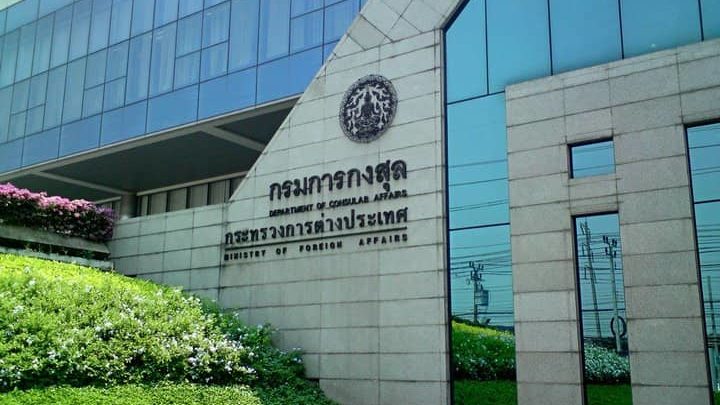
Only the Ministry of Foreign Affairs (MFA) can legalize your document in Thailand. It’s done by the Department of Consular Affairs (DCA).
Here’s what you need to do.
Translate Your Document
The first step to legalize a document is to have it translated into either Thai or English, as required by the organization you need the document for.
For example, if you want to register a marriage in Thailand, you need to have your personal document translated into Thai and then legalize it.
On the other hand, if you want to use your Thai document outside of Thailand, you then need to translate it into English and then legalize it.
Please note that the MFA can only legalize Thai or English documents. If your original document is in other languages, you need to have it translated and certified first, before you can legalize it.
Book an Online Queue
The next step is to make an online queue at the Thailand Consular website.
There you can choose a place, date, and time you want to go.

This is important since certain consular offices do not accept walk-ins.
Prepare Document
Here’s the document you need for document legalization:
- An original document. If it’s from overseas, it needs to be certified by your embassy first.
- A translated document that is certified correct.*
- A power of attorney with a signed copy of your passport (only if you send someone to do it on your behalf).
If you translate the document yourself, you can certify it yourself. If you use a translation agency, they will do it for you.
Visit the Department of Consular Affairs
When you visit the DCA to legalize a document, here’s what you need to do:
- Fill out a legalization application form. The form can be picked up there.
- Go to an information counter to get a queue number.
- Submit your document.
- Pay the fee.
Translation Check
After that, you need to wait for the DCA officer to check your translation.
During this process, you should expect a few revision requests. It can be from typos or using incorrect terms.
For example, an officer may want you to use a specific term on your translated document.
Even if you use a translation agency, this may still happen since terms can change all the time based on the officer you meet on that day.
Once it’s fixed, resubmit the document and wait.
Pick Up Document
The processing time depends on your options.
If you choose an express option, you can pick it up on that day.
If it’s a regular option, you can pick it up within 3 business days. Or you can have it sent to you by Thailand Post (60 baht).
Please note that the MFA will only certify the original document by stamping it. They do not certify the content or the translation of your content.
Fees
There are two government fees involved in document legalization:
- Legalization fee – 200 baht for the regular option and 400 baht for the express option per document.
- Translation check fee – 200 baht per document.
For example, if you have your affirmation of marital status legalized and choose the express option, you need to pay 600 baht in total.
If you hire an agent or a translation agency to do it on your behalf, they normally charge around 1,000 baht per document.
Where to Do It
You can visit any of these locations to legalize your document.
Please note that it’s a government office, so you need to dress politely. This means no shorts and slippers.
Bangkok
Department of Consular Affairs
Open Monday – Friday (except public holidays)
Hours: 08:30 – 15:30
Service available by online appointment only
Address: 123 Chaeng Watthana Road, Lak Si, Bangkok 10210, Consular Department Building, Floor 3
Telephone: 09 – 1723 – 3604
Pathum Wan Leglization Division
Open Monday – Friday (except public holidays)
Hours: 10:00 – 16:30
Service available by online appointment only
Address: Central World, Floor 6, Rama I Road, Pathum Wan, Pathum Wan District, Bangkok 10330
Pattaya
Pattaya Temporary Passport Office
Open Monday – Friday (except public holidays)
Hours: 09:00 – 15:30
Service available for walk-ins (document owners must submit in person) and online appointments
Address: Central Pattaya Shopping Center, Floor 4
Telephone: 038 – 119 – 638
Chiang Mai
Chiang Mai Temporary Passport Office
Open Monday – Friday (except public holidays)
Hours: 09:00 – 16:00
Address: Central Chiangmai Airport, Floor 5
Telephone: 053 – 112 – 748
Ubon Ratchathani
Ubon Ratchathani Temporary Passport Office
Open Monday – Friday (except public holidays)
Hours: 08:30 – 12:00 and 13:00 – 15:00
Service available for walk-ins
Address: Ubon Ratchathani Provincial Hall Building, Floor 1, West Wing, Ubon Ratchathani Province
Telephone: 045 – 344 – 581 to 82
Songklha
Songkhla Temporary Passport Office
Open Monday – Friday (except public holidays)
Hours: 08:30 – 14:30
Service available for walk-ins
Address: Temporary Passport Office, Songkhla, Laem Son On Road, Bo Yang, Mueang, Songkhla 90000
Telephone: 074 – 326 – 510
Phuket
Phuket Temporary Passport Office
Open Monday – Friday (except public holidays)
Hours: 09:00 – 15:30
Service available for walk-ins and online appointments
Address: Central Phuket Festival, Floor B
Telephone: 085-911-4193, 076-222-080 to 81
What Time Should I Go There?
If you plan to do it yourself, you should go to the consular office early in the morning. This is to make sure that you can revise and resubmit your document before the office closes.
Should I Use a Translation Agency?
In our opinion, it’s much more convenient to use a translation agency.
After translating your document, a translation agency can go there and legalize the document on your behalf.
They normally charge a 1,000 baht fee on top of the cost of translation.
Is It the Same as Notary Public?
While it’s similar, it’s not the same.
To put it in simple terms, a notary public is normally done by a law firm to ensure that the document is a “true copy” of the original document.
On the other hand, a legalized document is done by the Ministry of Foreign Affairs to make this document able to be legally usable in other countries.
Is It the Same as Apostille?
It is similar. However, since Thailand is not a member of the Hague Apostille Convention, you cannot use an apostilled document in Thailand.
In the same way, you cannot apostille a document here as well.
However, Thailand has since formally acceded to the Apostille Convention: it deposited its instrument of accession on 30 June 2026, and the Convention enters into force for the country on 28 February 2027. (Verified September 2026.) A later section breaks down that timeline and what changes once it takes effect.
Thailand’s Apostille Convention Accession: Where Things Actually Stand
Thailand’s move toward the Apostille Convention has three separate milestones, and it’s easy to mix them up if you’re reading older news. Here’s where things stand:
- 9 December 2025 — Thailand’s Cabinet approved accession to the Convention.
- 30 June 2026 — Thailand formally deposited its instrument of accession with the Netherlands, the Convention’s depositary. This is the step that makes accession official, not just approved.
- 28 February 2027 — the Convention enters into force for Thailand.
Until 28 February 2027, nothing changes in practice. Documents still need full legalization at the Department of Consular Affairs the way this guide describes, whether they’re headed overseas or coming into Thailand from abroad. An apostille stamp from another member country still won’t be accepted here, and Thailand still can’t issue one.
Once the Convention takes effect, the plan is for documents exchanged with other member countries to need only a single apostille stamp from the Department of Consular Affairs, replacing the multi-step legalization process for those countries specifically. Documents headed to or from a country that hasn’t joined the Convention will still need full legalization, the same as today. The MFA hasn’t yet published detailed implementation guidelines, so if your document deadline falls anywhere close to early 2027, plan for the current legalization process and treat any apostille option as a bonus if it arrives in time.
FAQ
Is an “MFA certificate” the same thing as document legalization?
Yes. “MFA certificate” is just a common shorthand for the same process this guide describes: the Ministry of Foreign Affairs, through its Department of Consular Affairs, stamping a document to certify it for use in another country (or for a foreign document to be used in Thailand). There’s no separate “MFA certificate” service to look for.
Does my document need to be certified by an embassy before or after the MFA legalizes it?
Before. If your document originated overseas, your home country’s embassy (or the relevant government office back home) needs to certify it first. The MFA in Thailand legalizes the document after that, and only after it’s been translated into Thai or English.
Does the receiving country need to do anything after Thailand’s MFA legalizes my document?
Sometimes, yes. Some countries require their own embassy in Bangkok to add a further stamp on top of the MFA’s legalization before they’ll accept the document. This isn’t universal, so check with the embassy or government office you’re ultimately submitting the document to before you assume the MFA stamp alone is enough.
Can someone else legalize a document on my behalf?
Yes. You’ll need a power of attorney, along with a signed copy of your passport, authorizing that person (or a translation agency acting for you) to submit and collect the document at the Department of Consular Affairs. This is the same document mentioned earlier under “Prepare Document.”
Does Thailand’s accession to the Apostille Convention change anything right now, in 2026?
Not yet. Thailand deposited its instrument of accession on 30 June 2026, but the Convention doesn’t take effect for Thailand until 28 February 2027. Until then, full legalization through the process described in this guide is still required.
Do business documents, like company registration papers, need to be legalized the same way?
Yes, the process is the same regardless of whether the document is personal or business-related. Company affidavits, shareholder lists, and similar registration documents go through the same translation, appointment, and MFA legalization steps as a birth or marriage certificate.
Will I still need legalization for a country that hasn’t joined the Apostille Convention?
Yes, and this won’t change once the Convention takes effect for Thailand either. Apostilles only work between two countries that are both members. For any country outside the Convention, full legalization stays the required route regardless of what changes for Thailand’s other document exchanges.
Now, on to You
While it may sound complicated, it’s actually easy to legalize your document in Thailand.
If you don’t want to do it yourself, the key is to just find a good translation agency that can translate and legalize your document at the same time.



 Deutsch:
 Français:
'/%3E%3Cpath%20fill='%23b2b2b2'%20d='M241%20382q0%2016%2017%2026%2017%2011%2042%2011t42-11q16-11%2017-26V269H241'/%3E%3Cpath%20fill='%239f7e00'%20d='M241%20379q0%2014%208%2023%209%209%2021%209%2014%200%2021-9%209-9%209-23V269h-59'/%3E%3Cpath%20d='M241%20339v-70h59v110q0%2014-9%2023l-6%205v-68h-15v72q-8%200-14-4v-68zm59%2040c0%2022%2015%2032%2029%2032%2021%200%2030-18%2030-32v-40h-59'/%3E%3Cpath%20fill='%239f7e00'%20d='M266%20277v5h2v12h-3v-5h2v-5h-9v5h2v5h-4v9h3v18h-5v10h34v-10h-5v-18h3v-9h-4v-5h2v-5h-9v5h2v5h-3v-12h2v-5zm42%20101q0%2010%206%2017%206%206%2015%207%2010-1%2016-7%206-7%206-17v-29h-43'/%3E%3Ccircle%20fill='%230044ad'%20cx='329.5'%20cy='372'%20r='6'/%3E%3Cellipse%20fill='%230044ad'%20cx='300'%20cy='340'%20rx='16'%20ry='21'/%3E%3C/svg%3E) Español:
Español: