Before you start: Thailand’s visa rules change often. Always confirm the current steps, fees, and documents on the official Thai e-Visa portal before you travel. Book a flexible or refundable flight and do not plan a tight return. Your approval now arrives by email, and the timing is hard to predict.
Thailand offers several tourist visa options, from a 30-day visa exemption to single and multiple-entry visas. This guide covers which one fits your trip, what they cost, and how to extend your stay at immigration.
If you’re planning your trip to Thailand and trying to figure out which Thailand tourist visa you’ll need, then you’ve landed on the right page.
In this guide, you’ll find out which tourist visa is right for you, the requirements for getting a tourist visa, how to apply for and extend your tourist visa, and lots of other useful tidbits.
Contents
Key Takeaways
- Thailand has several tourist visa options, including visa-exempt stamps, visas on arrival, single-entry tourist visas, multiple-entry tourist visas, the Destination Thailand Visa, and the Thailand Privilege Visa.
- If you’re coming to Thailand for a short trip, a visa-exempt stamp is usually enough, as long as your country is eligible.
- If you want to stay in Thailand for up to 90 days without leaving the country, get a single-entry tourist visa.
- If you plan to travel in and out of Thailand many times, get a multiple-entry tourist visa.
- In most cases, you can apply for a Thailand tourist visa online through the Thai E-Visa website.
- You should always have a passport valid for at least six months, proof of onward travel, and proof of funds when coming to Thailand.
- You can usually extend your tourist visa or visa-exempt entry once for another 30 days, but the final decision is up to the immigration officer.
- Don’t abuse visa-exempt stamps, apply for too many back-to-back tourist visas, or overstay your visa. These can raise red flags with Thai Immigration.
- You don’t need to hire a visa agent for a tourist visa. It’s one of the easiest Thai visas to apply for by yourself.

Quick requirements (single-entry tourist visa)
- PassportValid for more than 6 months.
- Proof of onward travelA return flight ticket; bus, train, or van tickets don’t count.
- Proof of fundsTHB20,000 cash per person, or THB40,000 for a family.
- Visa feeTHB1,900, paid online.
Documents to prepare (for extending your stay)
- PassportValid for at least six more months.
- Photo4cm × 6cm, taken within the last six months.
- Passport copyYour information page and latest entry stamp.
- TM.7 formCompleted application form, picked up at the immigration office.
- Local address & phone numberYour address and phone number in Thailand.
- Extension feeTHB1,900.
A missing TM30 receipt (proof of your registered address) is the most common reason people get turned away – bring it along with the documents above.
Phase A · Apply for your visa (online, before you travel)
Register on the Thai E-Visa website.
Submit your passport, proof of onward travel, and proof of funds.
THB1,900 for a single-entry tourist visa, paid online.
You should receive it within a few days. Print it out and bring it with you.
Phase B · Arrive in Thailand
Fill in the free TDAC online before you arrive, then show the emailed QR code at immigration.
You’ll be given an initial 60 days in the country, starting on the day you enter.
Phase C · Extend your stay (at Thai immigration)
The whole process usually takes about 3 hours; less than 15 minutes if there’s no queue.
Bring the items above and pay the THB1,900 extension fee.
Most travelers get another 30 days, but the officer may grant only 7. Extensions are always at the immigration officer’s discretion.
If you need help applying for your visa, you can use a visa service from Baan Thai Immigration Solutions (sponsored).
What is it?
A Thailand tourist visa lets non-Thais come to Thailand for the purpose of traveling, visiting friends and family, getting medical treatment, or attending meetings, conferences, seminars, and similar events.
The amount of time you can stay in Thailand on a tourist visa depends on which type of visa you have, but typically, you’ll get either 30, 60, or 90 days before extensions.
How Many Types are There?
In general, you have four different options with Thailand tourist visas: visa-exempt stamp, visa on arrival, single-entry tourist visa, and multiple-entry tourist visa. Visa-exempt stamps and visas on arrival are only available for residents of certain countries.
Visa-exempt Stamp
A visa-exempt stamp, or tourist visa waiver, allows you to stay in Thailand for 15 to 90 days for the purpose of traveling without having to make a visa in advance.
The duration of stay depends on your nationality.
- If you are from Myanmar, you can stay in Thailand for 45 days with a visa-exempt stamp.
- If you are from the USA, Europe, Australia, Canada, India, Japan, or one of 54 other places on the list, you get 30 days with a visa-exempt stamp from 15 September 2026. That is down from 60 days, cut by a Ministry of Interior announcement published in the Royal Gazette on 31 August 2026. Stamps issued before 15 September stay valid to their printed date. You can read what the cut means for long-stay visitors in our guide on the end of the 60-day free pass.
- If you are from Mauritius or Seychelles, you get 15 days, also from 15 September 2026.
- If you are from Brazil, Chile, South Korea, or other nations with a bilateral agreement, you can stay in Thailand for 90 days with a visa-exempt stamp. Those agreements are separate instruments and the September 2026 cut does not touch them.
Check Wikipedia for a full list of countries that can enter Thailand without having to make a visa.
Visa on Arrival
From 15 September 2026, visa on arrival is available to nationals of three countries only: Azerbaijan, Belarus and Serbia. It gives a 15-day stay, costs THB2,000 in cash baht, and is issued when you travel to Thailand by air. To qualify, you must show proof of onward travel dated no later than 15 days from the date you enter Thailand. Until 14 September the older 31-country list still applies. Our visa on arrival guide covers what dropped nationalities should do instead.
Bus, train, or van tickets with no fixed return date are not considered proof of onward travel.
Single-entry Tourist Visa
If you want to stay in Thailand for up to 90 days, you can get a single-entry tourist visa (SETV). With this visa, you’ll be given an initial 60 days in the kingdom, starting on the day you enter Thailand. After which, you can extend for another 30 days.
Normally, a tourist visa will be available for 90 days after your visa is approved. You must enter Thailand before the ENTER BEFORE DATE on your visa.
If you don’t, your visa will expire. If you leave Thailand while on a single-entry tourist visa, it will also expire, unless you get a re-entry permit.
Multiple-entry Tourist Visa
If you want to stay in Thailand for more than 90 days, getting a multiple-entry tourist visa (METV) is the way to go.
With this visa, you can exit and enter Thailand as many times as you’d like during the visa’s six-month validity. Since you’re allowed to come and go as many times as you’d like, you can get a total of 270 days on the visa.
Unlike with single-entry tourist visas, you don’t have to get a re-entry permit when leaving Thailand on your multiple-entry tourist visa. But you have to apply for the multiple-entry tourist visa at a Thai embassy in your country.
The Royal Thai Consulate General in Melbourne is an exception. They let non-Australians apply for multiple-entry tourist visas.
The Destination Thailand Visa
The Destination Thailand Visa is a visa aimed at digital nomads, which allows you to live in Thailand for 5 years. You can get this visa by meeting the following requirements:
- Having a minimum balance of THB500,000
- Having proof of being a digital nomad or taking a class such as Muay Thai, cooking, and so on
While it’s basically a digital nomad visa, it’s still officially considered a tourist visa. Read our guide to the Destination Thailand Visa to find out more.
Thailand Privilege Visa
The Thailand Privilege Visa is a privilege visa in Thailand. Although it is for those who want to stay in Thailand long-term, it’s considered a tourist visa.
It lets you stay in Thailand from five to 20 years if you can pay the application fee and don’t have a criminal background.

Which Tourist Visa Type is for Me?
Here’s a quick summary to help you decide:
- Visa-exempt Stamp: Anyone planning a short trip to Thailand
- Visa on Arrival: Anyone from an eligible country traveling to Thailand by air for a short stay of up to 15 days
- Single-entry Tourist Visa: Anyone who wants to stay in Thailand for up to 90 days without leaving the country
- Multiple-entry Tourist Visa: Anyone who wants to stay in Thailand for more than 90 days or plans to travel in and out of the country multiple times
- Destination Thailand Visa: Digital nomads or anyone who wants to live in Thailand long-term while working remotely or taking classes
- Thailand Privilege Visa: Retirees or wealthy individuals who want to live in Thailand long-term without working
What are the Requirements?
Except for the DTV and the Privilege Visa, there are three main requirements for tourist visas in Thailand. You’ll need them for a visa application. Even if you come to Thailand with a visa exemption, you may still need to show them:
- A passport: It should be valid for more than 6 months. Some may say they were able to enter Thailand with a passport valid for less than 6 months, but they were just testing their luck.
- Proof of onward travel: This can be a return flight ticket. Overland travel tickets by bus, train, or van, and tickets with no fixed return date don’t count.
- Proof of funds: THB20,000 cash per person or THB40,000 for a family.
It’s a good idea to always have these when coming to Thailand. In general, an immigration officer won’t ask for them unless they see suspicious activity in your passport. However, if you don’t have these proofs, you might be denied entry.
Also, while it’s not always necessary, don’t forget to get travel insurance in case you get sick or injured in Thailand.
An Application Process
The application process for a Thailand tourist visa depends on the country you’re in. It’s a straightforward process. In most cases, you can apply online through the E-Visa system by:
- creating an account
- uploading all required documents
- paying the visa fee online
You should expect to receive an electronic visa within a few days. After that, print it out and bring it with you to Thailand.
If the E-Visa system isn’t available in your country, you will need to contact the nearest Thai Embassy or Consulate.
If it’s a visa on arrival, you can apply for it at the airport when you arrive in Thailand.
No matter which option you choose, you now also need to fill in the free Thailand Digital Arrival Card (TDAC) online before you arrive. It replaced the old paper arrival card. Recent visitors say it takes only a few minutes, and you just show the emailed QR code at immigration.
How to Fill Out the Thai eVisa Tourist Visa Application Form (Filled Example)
The whole application is done on the eVisa website in four steps. Here is each screen, filled in with example details.
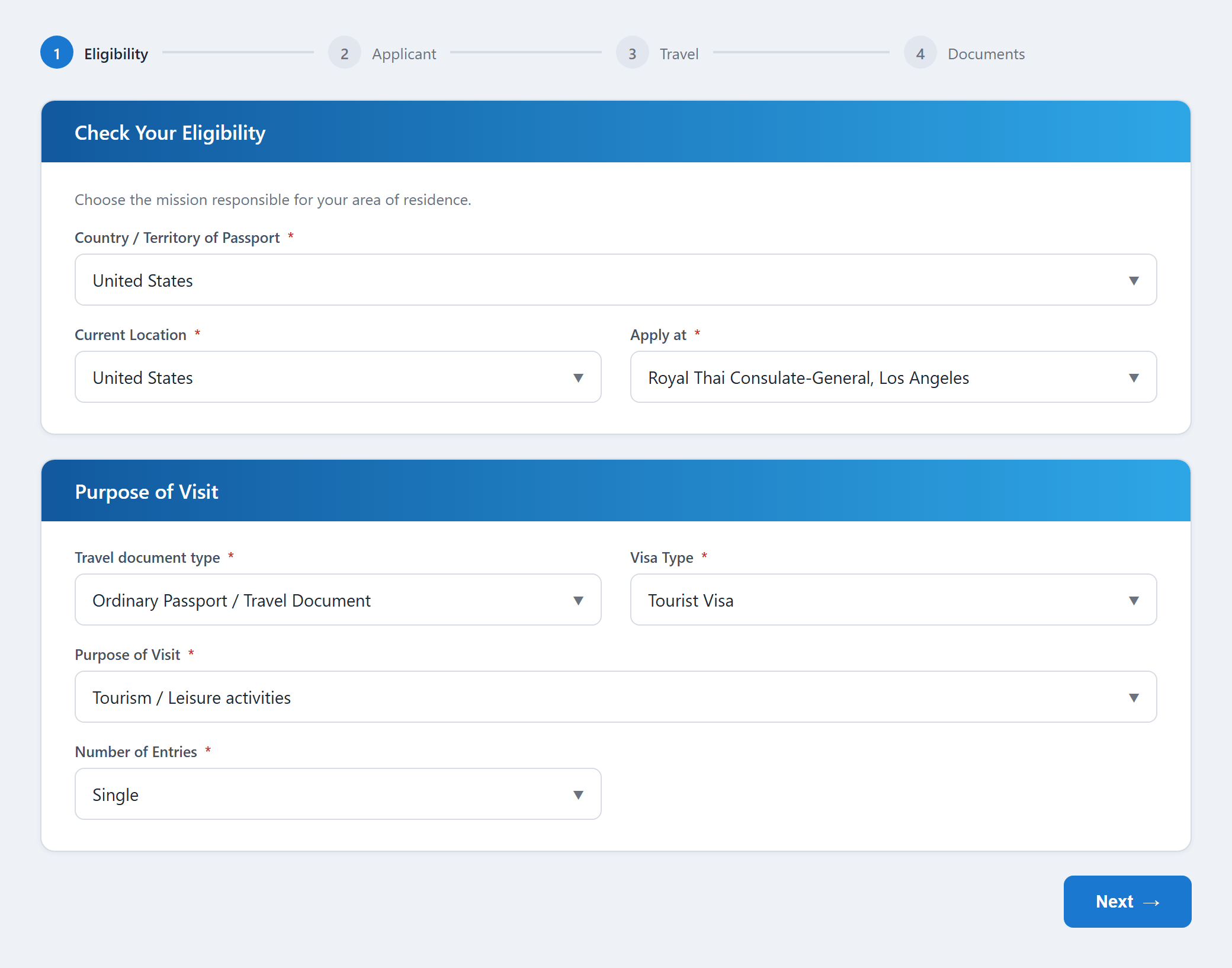
Step 1: Check eligibility and select the visa
Pick your passport country, current location, and the Thai embassy or consulate for your area. Set Visa Type to Tourist Visa, Purpose of Visit to “Tourism / Leisure activities”, and Number of Entries to Single.
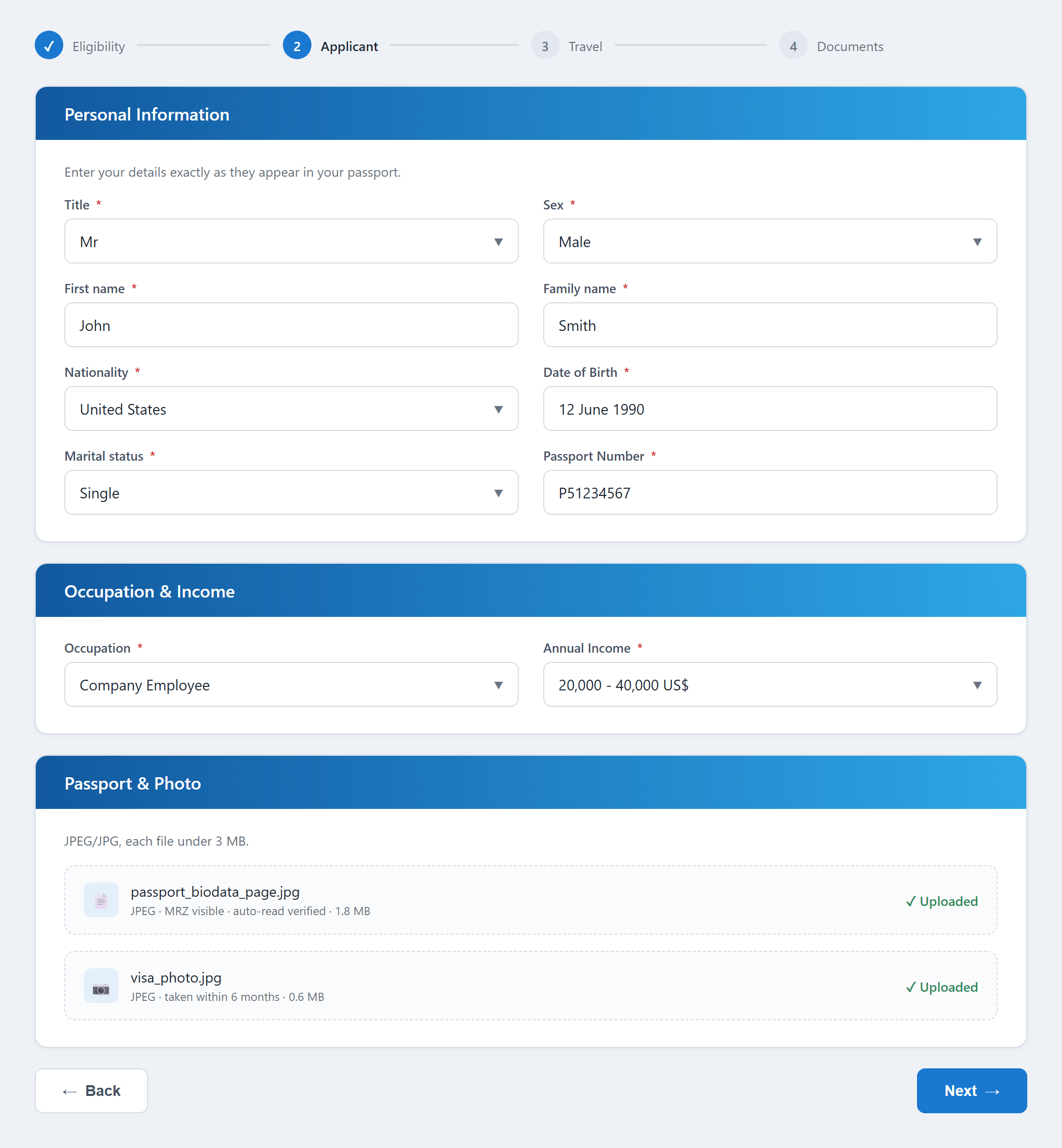
Step 2: Applicant information
Enter your personal and passport details, set your occupation and income, and upload your passport data page and a recent photo.
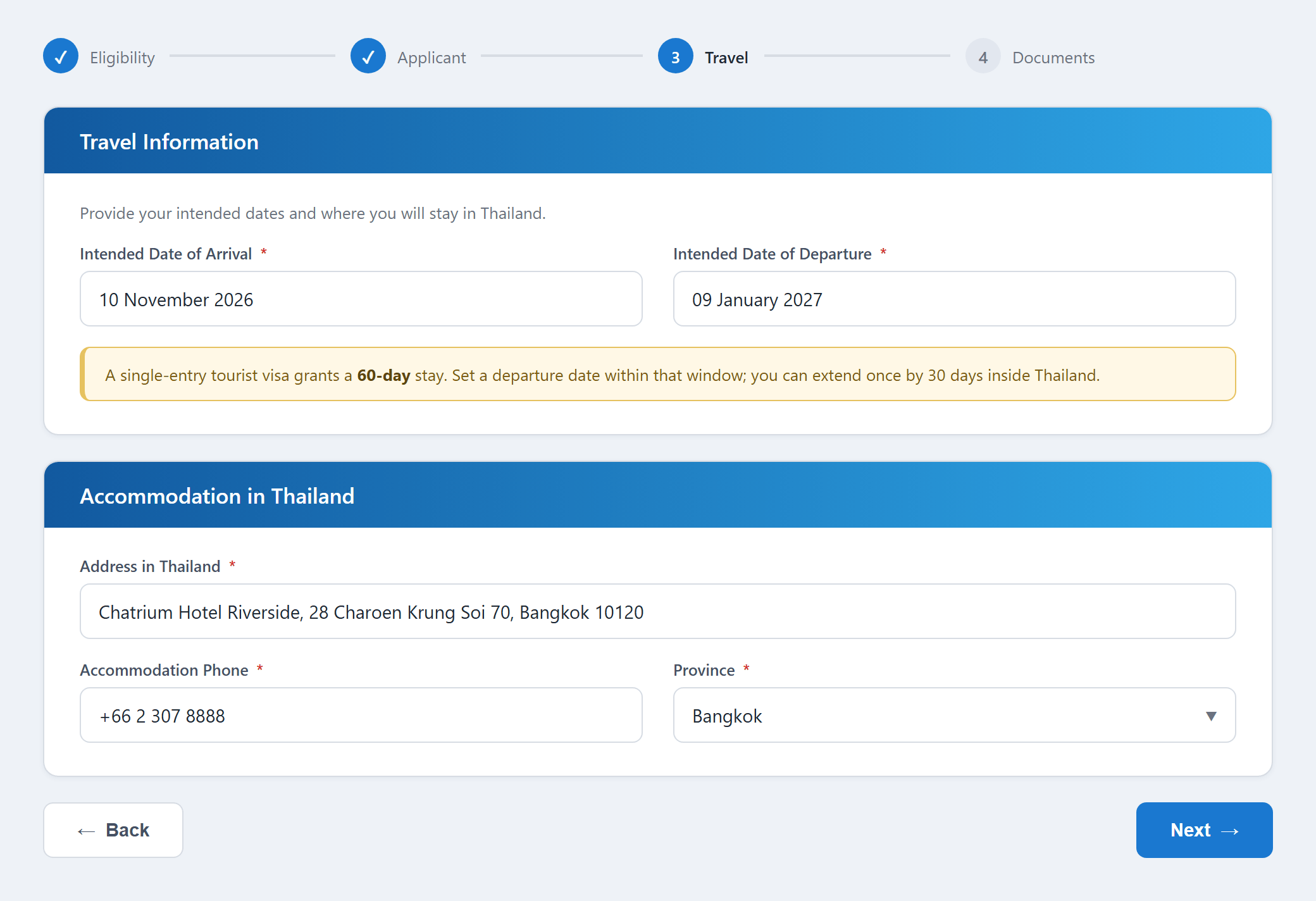
Step 3: Travel and accommodation
Add your arrival date and a departure within the 60-day stay, plus the address and phone number of your hotel or accommodation.
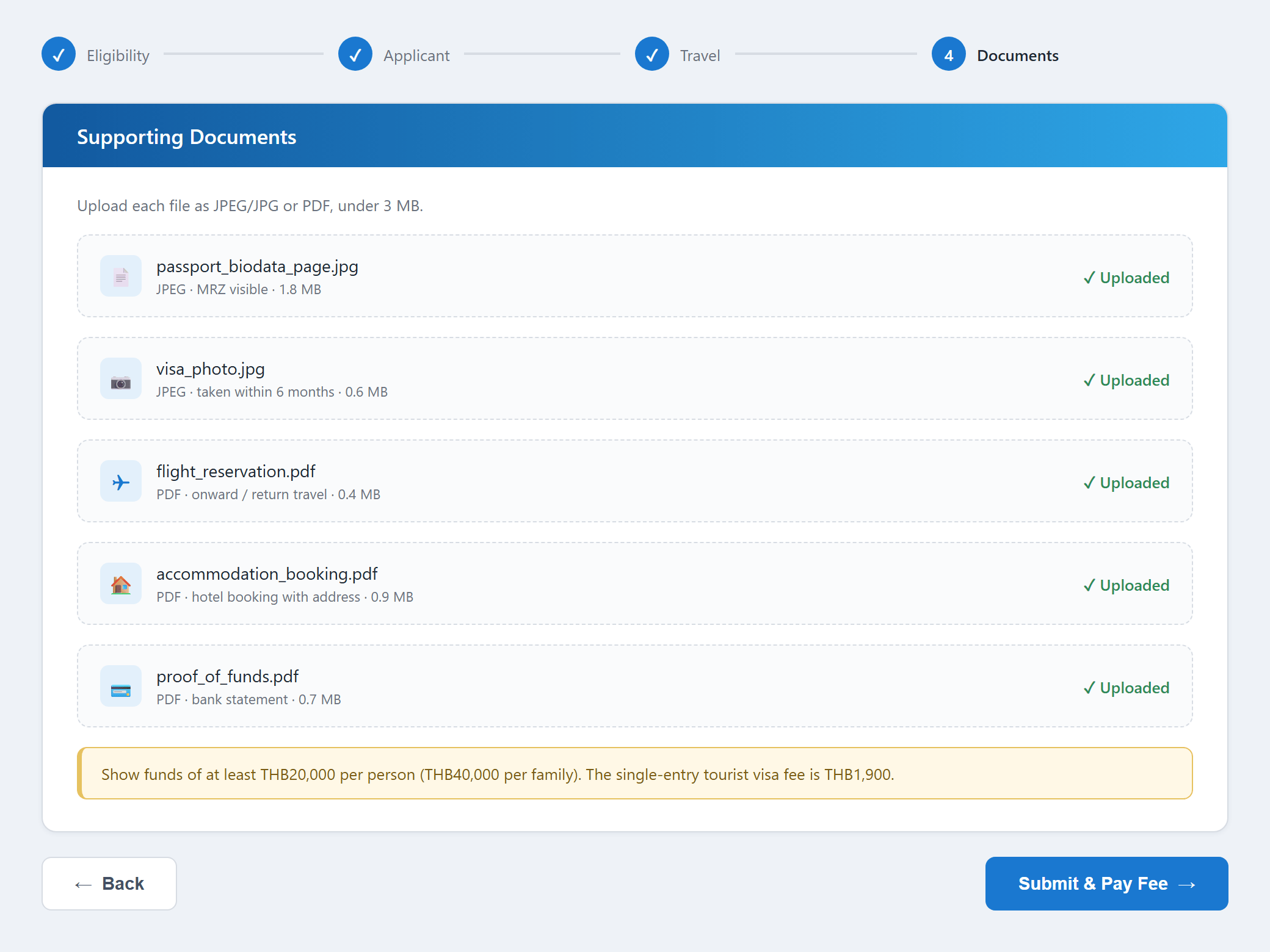
Step 4: Supporting documents
Upload your passport page, photo, an onward or return flight, your accommodation booking, and proof of funds of at least THB20,000 per person (THB40,000 per family). The single-entry tourist visa fee is THB1,900.
How Much Does It Cost?
The cost of your Thailand tourist visa will depend on which country you’re from.
On average, though, you’ll usually pay:
- THB2,000 for a visa on arrival
- THB1,900 for a single-entry tourist visa
- THB5,600 for a multiple-entry tourist visa
This depends on your currency and exchange rates.
Getting an Extension of Stay
You can usually extend your tourist visa or visa-exempt entry once for an additional 30 days.
Here’s what you need to do:
- Go to the nearest immigration office. Here’s a list of most of them.
- Prepare the following documents:
- A passport valid for at least six more months
- A 4cm x 6cm photo, taken in the last six months
- A copy of your passport information page and latest entry stamp
- A completed TM.7 application form, which you can pick up at the immigration office
- Your local address and phone number in Thailand
- THB1,900 for a visa extension fee
The whole process normally takes around 3 hours. If there’s no queue, it can take less than 15 minutes.
Travelers who have extended recently share a couple of tips. Booking an appointment slot on the Immigration Bureau website can turn a long wait into a short one, especially at the busy Chaeng Wattana office in Bangkok. They also say a missing TM30 receipt, the form that reports your Thai address, is the most common reason people get turned away, so bring it with your other documents.
Also, the 30-day extension isn’t guaranteed. In some cases, immigration officers may grant only a 7-day extension instead. The final decision is at the discretion of the immigration officer. If you’re denied a visa extension, immigration officials may give you an ‘Extension Denied Stamp,’ which will usually give you 7 extra days anyway.
Tip: Most immigration offices in Thailand open from 8:30am to 4:30pm. And most offices stop handing out queue numbers after 3:00pm. Get there before 2:00pm if you want to handle your visa extension in one day.
What are Some Restrictions?
Despite popular belief, you can’t do anything and everything with a Thailand tourist visa. Here are a few important restrictions.

Abusing Visa-exempt Stamp
Because some foreigners abuse visa-exempt stamps for border bouncing, Thai Immigration now pays closer attention to frequent entries.
Arriving by air, there is no numerical cap in the rules, but immigration officers do look at your overall travel pattern. For example, entering Thailand every month, even for short stays, may raise questions.
This doesn’t mean you’ll be banned from entering Thailand. But officers may ask why you’re coming so often and may request proof of onward travel or financial support.
Crossing by land, the limit is written into the rules: two visa-exempt entries per calendar year, restated in the announcement published on 31 August 2026. Malaysian, Bruneian, Indonesian and Singaporean nationals are exempt from the cap. People who bounce across crossings like Mae Sai or Aranyaprathet every month to reset their stamp say officers there spot the pattern fast.
In the end, your entry depends on the immigration officer’s decision based on your passport history. As long as you follow the rules and don’t show suspicious travel patterns, you usually shouldn’t have major problems.
Applying for Back-to-Back Single-Entry and Multiple-Entry Tourist Visas
If you apply for back-to-back single-entry tourist visas, you will raise red flags with Thai Immigration officers. In general, you shouldn’t have more than three to five tourist visas in your passport at any given time.
But even if you get a new passport, immigration officers can verify the number of times you’ve applied for a tourist visa. And if you try to beat the system by extending your tourist visa for 30 days by doing a border run, and then repeat the process, expect immigration officers to question you.
Again, you may not be violating any immigration laws, but not getting the right visa for your long-term stay in Thailand could make immigration officers wonder whether you’re in Thailand for tourism or work.
Overstaying Your Visa
If you overstay your visa in Thailand, you’ll have to pay THB500 per day of overstay, capped at THB20,000.
- If you overstay by only a few days, you can usually pay the fine at the airport after passing through exit immigration.
- If you have overstayed and still want to stay in Thailand, go to an immigration office immediately to sort things out.
- If you overstay in Thailand for more than three months, you may be blacklisted from Thailand for one year. The longer the overstay, the longer the ban.
Also, if you are caught overstaying during a random check by a police officer or immigration officer, you could be detained or blacklisted.
So, to put it simply: don’t overstay in Thailand. Be a good tourist. Read our guide on how to deal with overstaying your visa in Thailand to find out more.
Changing a Tourist Visa to Another Visa Type
To change from a tourist visa to another type of visa, you usually need to leave Thailand and return with the correct visa.
For example, many people stay in Thailand on a tourist visa while looking for a job or setting up a company. Once they get a job, they usually need to leave Thailand, apply for the correct visa at a nearby Thai consulate or embassy, and return with that visa.
Do I Need to Hire a Visa Agent?
No, you don’t need to. In fact, a tourist visa is one of the easiest visas to apply for. In most cases, everything is now done online through the Thai E-Visa website.
In my opinion, it’s even easier to do it yourself than to use an agent.



 Deutsch:
 Français:
 Español: