Whether you’re launching a startup or you’ve already set up a company, finding an office for rent in Bangkok can be challenging.
To get the best deal possible, you need to think about location, size, and price.
- Location: You want to make sure your office is in a convenient location so you, your employees, and your clients can get there without having to worry about navigating the city streets.
- Size: You want to make sure your office has enough space, not just for your current employees, but for when your company grows.
- Price: And you need your office to be within your budget since it’ll be your biggest expense each month.
This article is written based on our experience running a business in Bangkok to help you find an office for your company, no matter how big or small. It lists all types of offices available in Bangkok, including locations, costs, and other related procedures.
Contents
- Key Takeaways
- Office Types
- Lease, Serviced Office, Coworking, or Virtual Office: How to Choose
- Location
- Prices
- Office Grades and What's Really Included in the Rent
- Office Expenses
- Finding an Office
- Leases
- Security Deposits
- What a Foreign-Owned Company Needs to Know Before Signing
- Moving
- Now, on to You
- Frequently Asked Questions
- What's the real difference between renting an office and using a serviced office in Bangkok?
- What is a Grade A office building in Bangkok?
- What's usually not included in the price per square metre I'm quoted?
- Do landlords in Bangkok offer a rent-free fit-out period?
- How much registered capital do I need to sponsor a foreign employee's work permit?
- Can a BOI-promoted company skip the usual capital and staff-ratio test for work permits?
- Can I register a Thai company using a coworking membership?
- How much notice do I need to give before moving out of an office lease?
Key Takeaways
- Bangkok has four types of office spaces: home offices, traditional office buildings, serviced offices, and virtual offices. Each suits a different kind of business.
- Home offices start around THB15,000 a month for a two-story space, but they’re usually far from public transport and harder for expats to manage on their own.
- Office buildings in Sathon, Siam, and Sukhumvit are the most popular choice for expats. You get BTS or MRT access, building security, and admin support, though you pay more per square meter.
- Serviced offices bundle everything into one monthly fee and are quick to set up, making them a practical option if you want to skip the hassle of a traditional lease.
- A virtual office gives you a registered business address without physical space, which is enough for company registration if you don’t need staff on site.
- Most landlords require two to three months’ security deposit plus first month’s rent upfront. Read the contract carefully before signing.
- When you move offices, you must update your company address with the Department of Business Development, the Revenue Department, and the Social Security Office, and revise work permits for all foreign employees.

Office Types
When it comes to renting an office in Bangkok, you have four choices:
- home offices
- office buildings
- serviced offices
- virtual offices
Before deciding what office type is best for you, look first at the needs of your business.
Space: If you need a lot of space, going with a home office can be a good idea. Home offices are cheap and come in a variety of sizes. But they take time to maintain – which makes it an unpopular option for expat business owners unless they have a good Thai partner.
Location: If you need an office in the city, an office building is a good choice. These are most popular with expats running businesses in Thailand. And they’re a lot easier to manage.
Convenient: If you want to pay one price every month and don’t want to deal with expenses coming with a traditional office, a serviced office is a good choice. They’re easy to set up and becoming more popular nowadays.
A virtual office is an option if you’re just starting a company that doesn’t need a physical address.
You can use any type of office for registering a company in Thailand.
Let’s take a look at each office type.
Home Offices
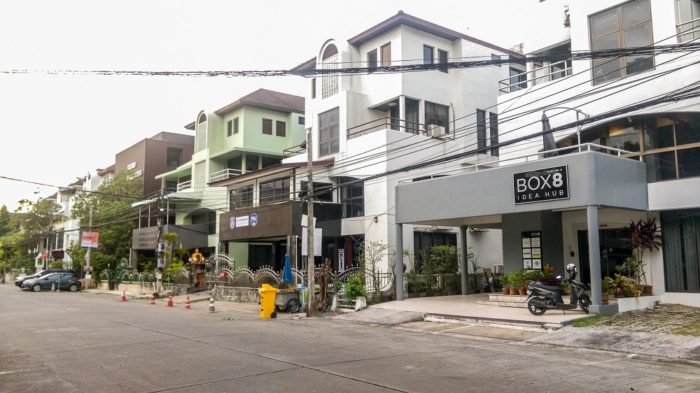
As the name implies, you rent a house and turn it into an office. This is a popular method for Thais who run small- to medium-sized businesses.
Home offices are so popular that many new residential developers build homes just for these purposes. Some of these developers are:
You can find home offices on the outskirts of Bangkok where the land is cheaper.
Pros
- Price: The best part about home offices is the price. You can find a two-story house with room for ten workers for 15,000 baht a month. But for the same price for a room in an office building, you’d get a thirty-five square-meter office big enough for a few people.
- Working Hours: Unlike offices inside office buildings, you’re not limited to working hours. Whether evenings, weekends, or holidays, you can run your business anytime you like.
- Events: You can also use your home office for any special events your company hosts.
Cons
- Getting around: Home offices tend to be located inside a Soi, getting around is a challenge. The only way to get around might be buses and songthaews or motorcycle taxis.
- Recruitment opportunities: Because of the location, it might make it hard to find employees since they might not want to do all that traveling to get to work.
- Maintenance: It’s also harder to manage a home office. Because you’re using a house, there are more things for you to take care of as opposed to if you were renting an office in the city. And you won’t have a maintenance team to help you.
If you’re interested in renting a house and turning it into a home office, it’s important to ask the homeowner if it’s okay first. Not everyone is willing to have their houses used as businesses.
Some residential areas won’t let you turn a house into an office as well. So be sure to check with the management team after you get the okay from the homeowner.
Office Buildings
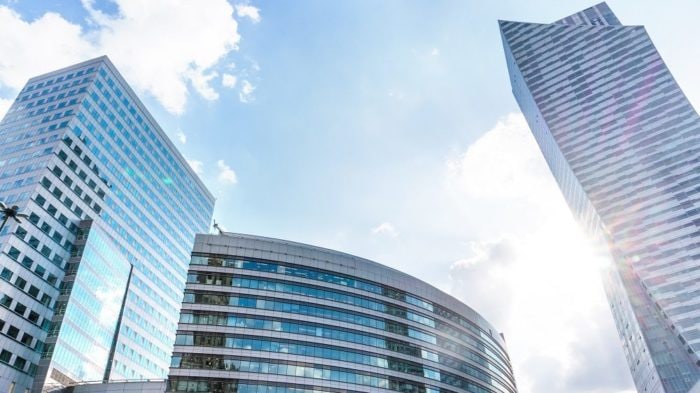
This is the most popular choice for expats doing business in Bangkok. You can find countless office buildings in business districts like Siam, Sathon, and Sukhumvit.
Office buildings are becoming more popular, even for corporations. Some corporations take up whole floors, come with extra security clearance, pay for public utilities themselves.

Some office buildings are owned by one person, while others are owned by many people—like condos.
Pros
- Location: The best part about office buildings is their location. In most cases, you can reach them after a short walk from the BTS or MRT. This means you could attract more employees and clients.
- Admin Support: When you rent at an office building, you’ll have support from the building admin. They can help you with any problems related to the building or find you a maid or handyman.
- Security: New office buildings also have good security systems. They have teams of security guards and CCTVs in the building. And you can get in only with an access card. With older buildings, they still have a team of security guards, but access cards nor CCTVs might be lacking.
Cons
- Price: The downside to office buildings is their size and price. You can spend over 35,000 baht a month for a fifty-square-meter office. For the same price, you can get the three-story home office.
- Internet Connection: This is only for older buildings. They might not support fiber-optic internet, making ADSL, which is slow and expensive, your only choice.
[business_directory title=”” category=”office-rental-services” location=”thailand”]
Serviced Offices
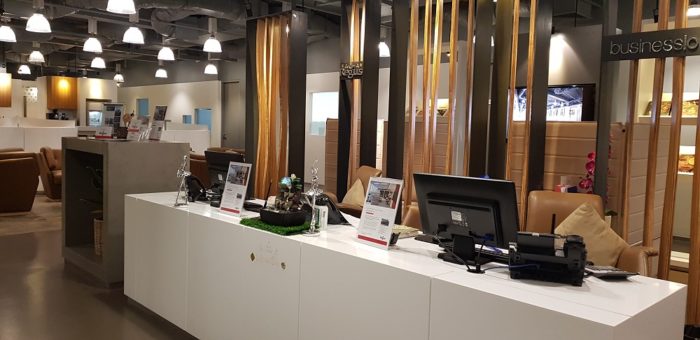
Serviced offices are fully-furnished offices whose monthly prices include facilities and utilities. You can find these offices in many buildings throughout Bangkok. The serviced office providers take an office building and separate it into private offices with one to ten workstations.
Pros
- Superb convenience: If you rent a serviced office, you can bring your laptop and start working the same day. Internet, phone, copy machine, fax, and drinks are ready to go. This means you don’t need to handle any office-related matters yourself, which decreases the costs, accounting work, and challenges involved with renting an office in Bangkok.
- Mail handling: Service offices also come with a reception team that can take care of anything you need with the office space. This includes taking care of your mail and welcoming your guests.
Cons
- Price: Services are the most convenient but tend to be the most expensive choice.
Find out more in our guide to serviced offices in Bangkok.
Virtual Offices
We live in a time when we can work from home and never have to show up at an office. You can do all your communicating and collaborating online. This is where virtual offices come into play.
Virtual offices are the newest form of office. They’re not like physical offices that you show up to work at every day. You get a virtual office only if you need an address to register your company or a place to have mail sent.
This choice is suitable for startup companies with a few employees who work from home.
Not all companies can use a virtual office. As soon as your company makes over 1.8 million baht per year, you must do your VAT registration at the Revenue Department. And to get your VAT registration, you need pictures of the inside and outside of your office.
Virtual offices are advertised by serviced office providers. So with virtual office packages, you get a few hours to use a meeting room for those times you want to bring your staff together.
You can find out more on our virtual office guide.
Lease, Serviced Office, Coworking, or Virtual Office: How to Choose
The four office types above solve different problems, and the right one depends on where your company is right now, not just on price. A conventional lease, whether it’s a home office or a room in an office building, gives you full control over the space and no cap on how many people you can hire into it. A serviced office, a coworking desk, or a virtual office get you working sooner with less commitment, usually at a higher cost per person.
| Option | Cost Basis | Typical Commitment | Who Fits It Out | Best For |
|---|---|---|---|---|
| Conventional lease (home office or office building) | Rent quoted per square metre a month, separate from furniture, utilities, and management fees | One to three years is standard; hard to find a lease under a year | You furnish and maintain the space yourself | Established or fast-growing companies that want full control and no cap on headcount |
| Serviced office | One bundled monthly fee, roughly THB12,000 to THB85,000 depending on workstations and building | Many providers rent month to month; company-registration packages usually ask for a longer term | The provider furnishes and maintains the space | Registered companies that need a private, lockable office fast, without managing utilities or furniture |
| Coworking space | Day passes or a hot-desk membership, priced per provider rather than per square metre | Flexible, from a single day to a rolling monthly plan | None required, you use shared desks and meeting rooms | Freelancers and small teams that don’t need a registered Thai company address |
| Virtual office | Roughly THB900 to over THB5,000 a month depending on the package | Basic mail-only plans can be short-term; a package used for DBD or VAT registration usually needs at least a year | None, there’s no desk to furnish | Companies that only need a registered address and mail handling while staff work elsewhere |
If you’re deciding between a serviced office, coworking, and a virtual office specifically, our serviced office guide breaks down that three-way comparison in more depth. Our virtual office guide covers pricing, providers, and what’s needed for company registration. The rest of this guide focuses on the fourth option: signing a conventional lease yourself.
Location
After deciding what type of office you want to rent, you should look at a suitable location for your office. Each location has its own pros and cons.
Here are the main areas you should look into when renting an office in Bangkok:
- Business Districts
- Suburbs
- Outskirts
Let’s take a look at each one a bit closer.
Business Districts
Sukhumvit, Silom, Sathorn, and Ratchada are business districts in Bangkok. They are full of office buildings that play host to many of Bangkok’s companies.
If you go to these areas during the week, you’ll see many office workers walking to work, eating meals, and talking about business deals.
Business districts are the most convenient area to rent an office, not only in terms of convenience because of the nearby buses, BTS, and MRT, but also because they have many places to live, eat, and work.
Sukhumvit
Sukhumvit is a mix of business and tourist districts. There are office buildings, shopping malls, and tourist attractions in the area.
This is why Sukhumvit is one of the most crowded areas in Bangkok—day and night with lots of condo for rent.
Although Sukhumvit is the name of the road from Bangkok to the Thailand-Cambodia border, Bangkokians know Sukhumvit as the area between BTS Asok to BTS Thong Lo.
Siam, Chidlom, Ploenchit, Ekkamai, Phakhanong, Onnut, and other areas along the BTS Sukhumvit line are also a part of Sukhumvit. But we tend to call them by their district names instead.
You’ll have plenty of choices for new and old offices on Sukhumvit. Office prices in this area are among the highest in Thailand.
As soon as you step off the BTS, you’ll see many office buildings. Some are a few steps away or even connected to the BTS/MRT stations, including:
- Interchange 21
- Exchange Asok Tower
- Glas Haus Building
If you walk along Asok or Thong Lo, you’ll see many office buildings as well.

Despite the heavy traffic, these two areas are the most convenient, having many forms of transportation nearby like buses, BTS, MRT, and even boats.
Sukhumvit is also considered central Bangkok. This makes commuting more convenient for you and your workers, no matter where everyone lives.
This area is also full of places to eat and shop. There are street food stalls and famous department stores like:
- Terminal 21
- Emporium
- Emquartier
- Emsphere
Silom – Sathorn
Although tourists might visit Silom – Sathorn for the famous Patpong Night Market, Silom – Sathorn is a business district in Bangkok. So it’s another popular area for renting offices.
These two areas are also close to the One-Stop Service Center, which is convenient if your company is promoted by Board of Investment.
Silom and Sathorn are one BTS station away from each other. You’ll find a lot of new offices for rent in these areas.
The transportation is great, too, with many BTS and MRT stations nearby. In Sathorn, you have BTS stations:
- Surasak
- Chong Nonsi
- MRT Lumphini Station
In Silom you’ll find:
- BTS Sala Daeng Station
- MRT Silom Station
The iconic Chong Nonsi skywalk is the center of the business zone in the Silom – Sathorn area.
It connects huge office buildings in all four corners of the intersection, including:
- Sathorn Square
- Empire Tower
- Bangkok City Tower
- Sathorn Nakorn Tower
The best part about Silom – Sathorn is the number of banks in the area. The headquarters of Bangkok Bank and Standard Chartered are there.

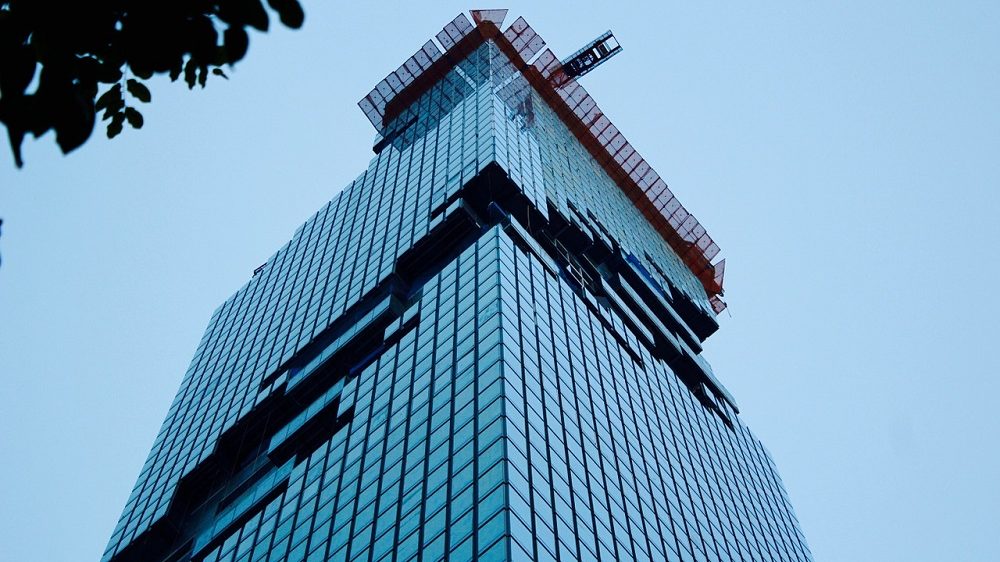
Ratchadapisek
Ratchadapisek is a mix of offices and condos. You’ll find office buildings along the MRT line in every station, from Rama 9 station to Ratchadapisek station.
The average office price in Ratchadapisek is cheaper than in Silom, Sathorn, and Sukhumvit. But you get similar facilities.
Noteworthy office buildings in Ratchadapisek are:
- G Tower at MRT Rama 9 Station
- AIA Capital Center at MRT Thailand Cultural Center Station
- Muang Thai – Phatra Complex at MRT Sutthisan
Our previous office at Forum Tower is also near the MRT Huai Kwang station.
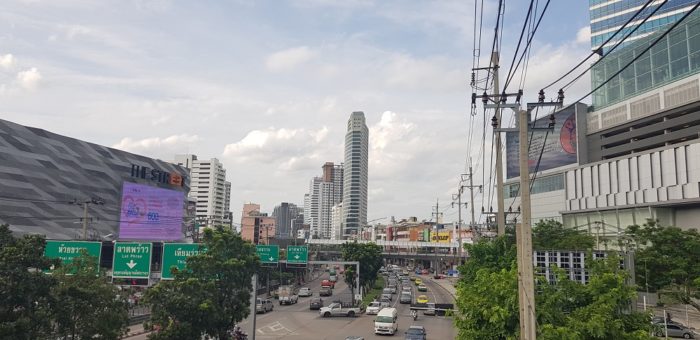
And once you walk inside the small roads off Ratchadapisek, you’ll see many condos.
It’s a great place to live: renting a condo is cheap, commuting with the MRT is easy, and shopping is convenient since there are many markets and department stores nearby.
Suburbs
You can find office buildings and home offices inside suburbs like:
- Lad Prao
- Sapan Kwai
- Wongwian Yai
These are residential areas, but you’ll find some home offices there too. They are also in a convenient location since the BTS and MRT pass by those areas.
Although limited in office choices, you can find offices in buildings like:
- SJ Infinite One Business Complex
- Phromphan Building
Outskirts
These areas include Bangkapi, Ramkhamhaeng, Nawamin, and Minburi. They are like the suburbs but have fewer home offices and office buildings.
But in some out-of-town locations, you’d be surprised to find a lot of companies there. There are many real estate projects built for home offices.
For example, you’ll find over thirty companies inside the real estate housing project Town in Town in Ramkhamhaeng.
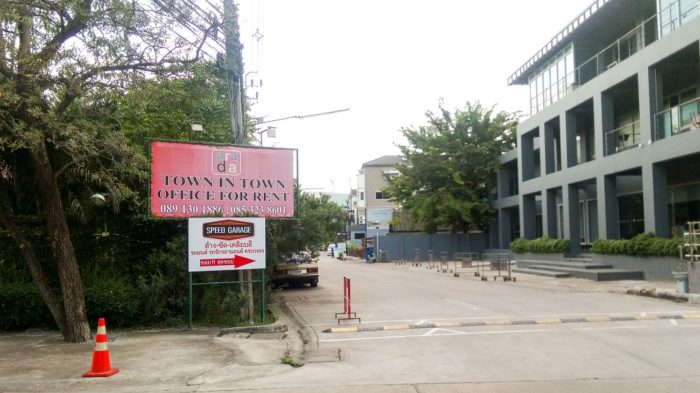
These areas are like smaller versions of business districts, but are filled with home offices rather than office buildings.
Transportation is challenging if you rent an office in these areas. Sometimes, one bus passes by these areas, so motorcycle taxis become the main mode of getting around.
Also, many of your workers would want to bring their own vehicles, which can result in not having enough parking spaces.
Prices
Office rental prices depend on many things, including:
- location (is it in the business district or not?)
- age (is it a new building or the old building?)
- convenience (is it close to shopping malls or BTS/MRT?)
- facilities (security system, maid, handyman, and so on)
Rental office prices per month are calculated by price per square meter.
Here’s the average price per square meter for popular office buildings in Bangkok. Prices can vary based on room type and may change over time, so it’s best to double-check with the building’s juristic office.
| Area | Building | Price/Sqm. |
|---|---|---|
| Asoke | Ocean Tower 2 Asoke | 900 baht |
| Asoke | Singha Complex | 1,400 baht |
| Asoke | Q.House Asoke | 750 baht |
| Asoke | Asoke Tower | 660 baht |
| Chatuchak | Shinawatra Tower 3 | 680 baht |
| Chatuchak | SJ Infinite One Business Complex | 850 baht |
| Ratchadapisek | Muang Thai-Phatra Complex | 850 baht |
| Ratchadapisek | The Ninth Tower Grand Rama 9 | 1,000 baht |
| Ratchadapisek | AIA Capital Center | 1,100 baht |
| Phaholyothin | Rasa Tower | 700 baht |
| Ploenchit | Ploenchit Tower | 950 baht |
| Ploenchit | Ploenchit Center | 950 baht |
| Ploenchit | Amarin Tower | 1,400 baht |
| Sathorn | Q.House Lumphini | 850 baht |
| Sathorn | AIA Sathorn Tower | 1,050 baht |
| Sathorn | Sathorn Square | 1,200 baht |
| Silom | Silom 19 Building | 800 baht |
| Sukumvit | Emporium Tower | 1,200 baht |
| Sukumvit | Bhiraj Tower | 1,600 baht |
| Srinakarin | Modernform Tower | 600 baht |
| Wireless Road | 208 Wireless Road Building | 1,200 baht |
Office Grades and What’s Really Included in the Rent
The price table above shows a real spread, from about THB600 to THB1,600 per square metre a month across the buildings listed. Most of that gap comes down to a building’s grade, not just its neighborhood.
Grade A, B, and C Buildings
Bangkok’s commercial real estate market, like most major cities, sorts office towers into grades. No landlord advertises their building as Grade C, so it helps to know what actually separates the tiers.
- Grade A: Newer towers with modern fire and life-safety systems, backup power, and fast lift service, usually connected to or a short walk from a BTS or MRT station. These sit at the top of the price table above.
- Grade B: Solid, well-maintained buildings that are a bit older or set back further from the nearest station. Rent runs lower, and the trade-off is usually building age and slower lifts at peak hours rather than a worse location.
- Grade C: Older stock, sometimes without upgraded air conditioning or fiber-ready cabling. These are the cheapest per square metre, and the ones most likely to leave you with the ADSL internet workaround mentioned in Office Expenses below.
Ask about the building’s age, its fire safety certificate, and whether fiber internet is already wired in before you sign. Those three questions tell you more about the real grade than the listing does.
How Rent Is Actually Quoted
The price per square metre you’re quoted is usually the base rent alone. It typically doesn’t include the management fee, air-conditioning surcharge, or parking charge that show up as separate monthly line items, covered with their own current figures in Office Expenses below.
Ask for the all-in monthly total before comparing two buildings on price per square metre alone. A cheaper headline rate in an older building can end up costing about the same once service charges are added.
Fit-Out Periods
Some Bangkok landlords offer a rent-free period before your lease clock starts, giving you time to install partitions, cabling, and furniture before you’re paying for space you can’t use yet. This is more common on larger leases in newer buildings than on small offices, and the length is negotiable rather than fixed. Raise it during lease negotiation rather than assuming it comes standard.
Office Expenses
Rent isn’t your only expense for running a business. You still have to pay for electricity, water, telephone, internet, parking spaces, administrative fees, and maids. If you break something, you’ll also need to find a handyman, which will increase your cost of doing business.
You might also have to pay for toiletries, cleaning supplies, and snacks and coffee for your employees.
If you rent a home office, you have to take care of anything that happens inside the office. You’ll need to find your own maids, handymen, security guards.
Although renting an office in an office building is more expensive, you’ll have an administrative team to take care of almost anything that happens. And they have a list of any service providers you’ll need.

Because of the expenses involved in renting an office, many business owners prefer to rent serviced offices. They pay one price, which includes electricity, water, drinks, handymen, maids, furniture, and office maintenance costs.
The only thing serviced offices wouldn’t cover would be computers, printers, shredders, and other electronics you own.


Take a look at the table below to see what kind of expenses you need to pay for, according to office type.
| Expenses | Home Office | Office Building | Serviced Office | Virtual Office |
|---|---|---|---|---|
| Maid | ✓ | ✓ | × | × |
| Internet and Telephone | ✓ | ✓ | * | * |
| Electric and Water | ✓ | ✓ | × | × |
| Furniture | ✓ | ✓ | × | × |
| Management Fees | ✓ | ✓ | × | × |
| Maintenance Fees | ✓ | ✓ | × | × |
| Parking Spaces | ✓ | ✓ | × | × |
| Other | ✓ | ✓ | × | × |
*These may be included in the office price depending on your package.
Maid
If you rent a home office or office building, you’ll need to find a maid to handle the upkeep. You can hire either a full-time or a part-time maid.
You could add a full-time maid to your payroll as an employee. The average salary for a full-time maid is 15,000 baht a month.
In addition to having her clean your office, you can ask your maid to pay water, electricity, and internet bills, social security, buy stuff for your office, update bank passbooks, and buy food for your employees.
In Thailand, maids are also good sources of info. They know lots of local service providers that you might’ve never heard of before. They know where to find movers, handymen, and much more.
You can also get a part-time maid and have her clean the office once a day. They cost 400 baht to 500 baht an hour.
One strategy you can use to find a maid is by asking other maids if they know anyone looking for work.
You can even ask the cleaning staff from your apartment building. They have their own community and should be able to refer you to a maid.
You can also find a maid online through websites like Mindhomeservice, Ayasan, and Seekster.
If your office is in an office building, talk to the management team and let them find a maid for you. You can also ask a full-time maid there and hire her to clean your office outside of her working hours.
Internet and Telephone
There are many internet providers in Thailand. And some of them, such as TRUE, AIS, and NT, offer both internet and telephone service packages.
If they don’t, you can get a separate office number from NT Public Company Limited. They are the biggest telephone service providers in Thailand.
To install the internet, the first thing you should check is the area of coverage for each provider. While there aren’t any major differences in terms of price, speed, and quality, you might be out of their area of coverage.
If you rent an office in the office building, you need to check with the management team. The building might have a contract with a certain internet company, making them the sole internet provider of the building.
Also, some office buildings, especially old ones, might not have a cable internet system installed, leaving ADSL internet as your only choice.
Internet packages for corporations are cheaper than internet packages for individuals. They come with higher speeds and more free calls per month. But the internet speed can be different based on the time of a day.
Below are the starting rates for corporate landline internet packages in Thailand as of March 2026.
| Provider | Price per Month | Internet Speed | Phone Number |
|---|---|---|---|
| True | 799 | 500 mbps | 1 office number and a free phone call for 200 baht per month |
| AIS | 599 | 500 mbps | 1 office number and a free phone call for 50 minutes per month |
| 3BB | 500 | 500 mbps | N/A |
Electric and Water
The cost of electricity and water is similar to the costs of electricity and water for an apartment rental. You get the bill from the government organization and have to pay it every month.
In modern office buildings, you might instead get the bill from the management team. And you’ll need to pay them.
In addition, if that building uses central air, they will charge you a specific cost for the air conditioner at 40 baht to 50 baht per square meter on average each month.
Furniture
Serviced offices are the only offices that come with furniture. For other types of offices, you’ll need to buy furniture.
Officemate and IKEA are the two recommended places. As the name implies, Officemate has everything you need for your office: office supplies, appliances, and furniture.
There are two IKEAs here in Bangkok with office furniture available.
Management Fees
If you rent a home office or an office inside an office building, you might have to pay management fees every month.
The cost of management fees is around 10% of the rental price and should be in the range of 20 baht to 50 baht per square meter each month.
In many cases, management fees are already included in lease prices.
Maintenance Fee
Unless it’s a serviced office, you’re responsible for the cost of replacing light bulbs, fixing water leaks, and changing batteries for security doors.
Parking Spaces
Parking spaces are available for office buildings. You should get a free parking space for every 100 square meters of office space.
For example, if your office size is 100 square meters, you get one parking space. If it is 200 square meters, you get two parking spaces.
If you want more parking spaces, you might be able to pay for extras for at least a few thousand baht per month.
Other
Other expenses include snacks, coffee, drinks, toilet paper, soap, and maintenance costs if you break something.
Finding an Office
The first place you can look for offices is property websites. These websites will list offices, pictures, location, prices, and other significant info.
Some places to look online are:
Property websites are mainly run by real estate agents. And contact details found on websites will lead you to agents instead of property owners.
Real estate agents in Thailand don’t charge you. Instead, they make their living by charging real estate owners a commission.
If you don’t want to use an agent, but you want to get the most of the website, you can write down the offices you like and walk in to check them out.
All office buildings and serviced offices have management teams. They’ll show you the offices that are available and how much they cost.
On the other hand, if you want to look at a home office, it’s necessary to make an appointment.
You can also walk around the MRT or BTS stations in the areas you’re interested in. You might find a place for cheaper than you’d find online.
Leases
You’re normally locked into office rental leases for one to three years. For longer leases, you’ll need to tell the Department of Lands and pay a 1.1% fee for the total amount of your lease throughout the lease.
Lease prices may increase by a small percentage once the lease is up.
It’s pretty difficult to find a lease for under a year. This choice is available for serviced offices, which you can even find one-month leases for.
Property owners must be prepared and have them checked by their legal team. The info on leases includes lease length, cost, deposit, other expenses, and regulations.
You should look over your leases or find yourself a lawyer to look at it for you. You’ll pay a few thousand baht but you’ll get peace of mind knowing no unexpected legal problems will pop up.
Security Deposits
The standard deposit for office rentals is two to three months. And you’ll have to pay one month rent in advance. So the total amount you’ll have to pay upfront for your lease is three to four months.
You should get your security deposit at the end of your lease. But in many cases, you’ll only get part of it back. The property owner may keep some of your security deposit to clean, renovate, or repair any damage in the office.
What a Foreign-Owned Company Needs to Know Before Signing
Whatever office type you choose, its address becomes your company’s registered address with the Department of Business Development, and with the Revenue Department once your company crosses the VAT registration threshold mentioned above. Get the address right before you sign. Changing it later means notifying three government bodies and updating every foreign employee’s work permit, covered in Moving below.
The Capital and Staff Ratio Behind a Work Permit
A work permit isn’t tied to how much office space you rent. It’s tied to your company’s paid-up capital and its ratio of Thai to foreign staff.
- Standard companies: need at least THB2,000,000 in paid-up capital for each foreign employee they sponsor, plus four Thai employees for every foreign employee (two if the foreign employee is married to a Thai national). Trade representative and regional offices work to a lighter 1:1 ratio.
- BOI-promoted companies: skip this capital and staff-ratio test. A Board of Investment promotion certificate lets you bring in foreign specialists through the BOI’s own process instead, one more reason it’s worth checking BOI promotion before you lock in an office and a hiring plan.
None of this is based on floor area. If a landlord or agent tells you that you need a certain number of square metres per foreign staff member, that’s not a rule that exists. Confirm any staffing plan against your accountant or the Department of Employment before you size your office around it.
Moving
The process of renting an office in Bangkok isn’t done after you sign a contract. There are a few more steps you’ll need to take to move in and out.
Moving In
When moving in, you need to let the following three government organizations know:
- Revenue Department in your area fifteen days BEFORE moving in
- Department of Business Department in your area within fifteen days AFTER moving
- Social Security Office within fifteen days
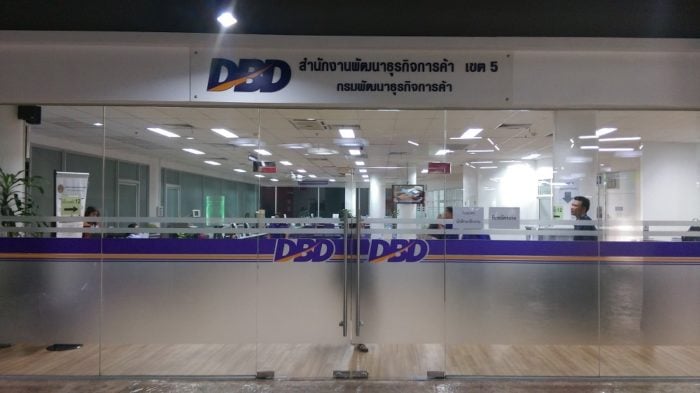
After that, you’ll have to tell the Board of Investment (if they promote your company), banks, any utilities you’re using, and your clients.
And you’ll also have to change the company address in your work permit and the work permits of each of your foreign employees.
Moving Out
You must let the landlord know three to four months in advance before moving out.
After you move out, the landlord or the management team will send you an invoice for the renovation costs. Landlords will deduct these costs from your security deposit.
When we moved out from our office in 2015, the landlord deducted 7,000 baht from our security deposit and spent it on renovating, cleaning, and painting.
You still have to tell all three government organizations mentioned in the Moving In section that you’re leaving. And then change your address with banks and utilities.
Moving Your Company
When it comes to moving your company, you have two choices:
- freelance movers
- professional movers
Freelance movers have pickup trucks and offer moving services for extra money on their free time.
Since moving isn’t their main career, they don’t have regular team members. Instead, they ask their friends, family, or anyone else they can find to help them.
Because of this, there’s no guarantee for any damage occurred during the move. You can ask them to help you disassemble the furniture but don’t expect the furniture will turn out the same when they try to reassemble it.
To find freelance movers, go to a residential area near your office and look at electric poles, walls, or even songthaews, and you’ll find their advertisements. You can also ask maids or motorcycle taxis.
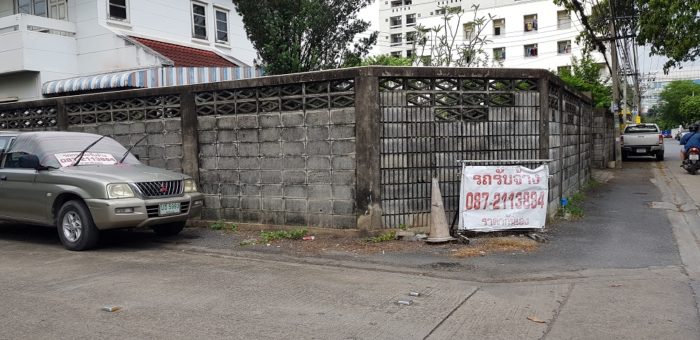
You can bargain for prices with freelance movers. Prices, though, start at 1,500 baht on average.
If you have a lot of things to move, it’s a better idea to hire a professional moving company.
There are many shipping companies available in Thailand, such as Boonma and JWD
These moving companies, coming with packing and unpacking services, have experienced teams, suitable tools, and safety measures in place to minimize possible damage from the move.
Now, on to You
Finding an office for rent in Bangkok is an important step to starting your business. But it takes special care to pick the right office for your company’s needs.
With many choices available in Bangkok, consider each option thoroughly before making your decision.
Also, renting an office space is only one part of the process to incorporate your company. To read more on starting a business in Thailand, check out our Thailand company registration guide.
Frequently Asked Questions
What’s the real difference between renting an office and using a serviced office in Bangkok?
A conventional lease gives you a bare or lightly finished space that you furnish and maintain yourself, usually on a one- to three-year term. A serviced office bundles the space, furniture, and utilities into one monthly fee with a shorter commitment. See our serviced office guide for the full breakdown, including coworking and virtual office options.
What is a Grade A office building in Bangkok?
Grade A describes a newer tower with modern fire and life-safety systems, backup power, and fast lift service, usually connected to or close to a BTS or MRT station. Grade A buildings sit at the top of the price range shown in the Prices table above.
What’s usually not included in the price per square metre I’m quoted?
The headline rent is normally the base rent alone. Management fees, air-conditioning surcharges, and parking charges are typically billed separately each month, at the figures covered in Office Expenses.
Do landlords in Bangkok offer a rent-free fit-out period?
Some do, mainly on larger leases in newer buildings, to give you time to install partitions and furniture before the lease clock starts. It isn’t automatic or standardized, so raise it during negotiation rather than assuming it’s included.
How much registered capital do I need to sponsor a foreign employee’s work permit?
Under the standard route, a Thai company needs at least THB2,000,000 in paid-up capital for each foreign employee it sponsors, plus four Thai employees for every foreign employee (two if the employee is married to a Thai national).
Can a BOI-promoted company skip the usual capital and staff-ratio test for work permits?
Yes. A company holding a Board of Investment promotion certificate can bring in foreign specialists through the BOI’s own process instead of the standard immigration ratio and capital test.
Can I register a Thai company using a coworking membership?
Generally, no. A coworking membership is usually an open shared space you join by the day or month, without the paperwork needed to register a company address there. A serviced office or a virtual office are the usual options if you need a registered address.
How much notice do I need to give before moving out of an office lease?
Tell your landlord three to four months before you plan to move out. That gives them time to prepare the unit and settle any renovation costs against your security deposit.


 Deutsch:
 Français:
 Español: