
Over the years, I’ve spent a lot of time editing articles for Thailand Starter Kit.com about the importance of getting health insurance in Thailand – but never did I expect to find myself in a position where I’d need it most.
To be honest, I didn’t always have health insurance. I was one of those expats in Thailand who always paid out of pocket because healthcare – even at private hospitals in Bangkok – is affordable to an extent.
But my thoughts on this have changed in recent years, mostly due to an unforeseeable medical emergency that left me one organ lighter (more on this later) and a subsequent diagnosis that changed my life.
In this guide, I’m going to tell you why I finally decided to buy medical coverage as an expat in Thailand and what happened the first time I had to use it. Along the way, I’m going to make note of my mistakes and what you should do to avoid making similar ones when vetting insurance companies.
Disclaimer: Some links in this article go to our partners, and we may earn a commission if you use them. It costs you nothing extra, and we only recommend services we'd use ourselves. Read more in our Advertising Disclosure.
Contents
- Some Good-to-Knows Before We Get Started
- Why I Finally Decided to Get Health Insurance in Thailand
- My Criteria for Picking the Right Health Insurance Company
- The Somewhat Funny, Somewhat Frustrating Onboarding Process
- Using My Health Insurance in Thailand for the First Time
- Bangkok International Hospital
- Follow-Ups at Chulalongkorn Hospital
- Lessons Learned
- Where I’m at Today
- My Final Thoughts About Health Insurance in Thailand
- How Direct Billing Works vs. Pay-and-Claim Reimbursement
- Standard Exclusions and Waiting Periods to Check Before You Buy
- What Documentation a Thai Hospital Claim Needs
- Frequently Asked Questions
- What's the difference between direct billing and reimbursement for health insurance in Thailand?
- Why would an insurer refuse to guarantee payment right away?
- Does Thai health insurance cover pre-existing conditions?
- What documents do I need to claim a hospital bill in Thailand?
- Can I use private health insurance at a public hospital in Thailand?
- Is it worth using an insurance broker instead of buying a policy directly?
Some Good-to-Knows Before We Get Started
Throughout this guide, I refer to my insurance company as “the insurance company” instead of by name. I value transparency, so I was torn about not revealing the name to you. But you have to remember that in Thailand, laws work differently. I don’t want to be sued for publicly defaming a corporation.
Secondly, I think it would be unfair of me to mention the company because A) they have plenty of positive reviews and satisfied clients, and B) in the end they made good on their mistakes.
Lastly, I never want to be the guy who influences which insurance company you pick or don’t pick. I’d rather share my mistakes and wins so that you can use those when searching for your own coverage.
With that out of the way, let’s dive in.
Why I Finally Decided to Get Health Insurance in Thailand
For the first eight years of my life in the country, I paid for all of my healthcare costs out of pocket. After all, I was lucky enough to never have any major medical emergencies in Thailand. That worked until 2022, when I needed sudden surgery.
In December of that year, I started getting stomach pains to the point where I couldn’t sleep. Then, one night, the pain intensified and I could no longer stand upright. I stumbled to a local private hospital in Bangkok where the doctors ran some tests. They told me that my gallbladder was infected and that I’d need to have it removed immediately. The cost? Upward of THB300,000.
I wanted to buy myself some time to see if the pain would go away, so I asked for some painkillers and went home. That night, by around 2:00 AM, I was on the floor in the fetal position in agonizing pain. A family member then recommended that I go to the public government hospital, Chulalongkorn, instead.
I called a taxi and was at the emergency room in 30 minutes. Upon seeing my level of discomfort, the doctors put me on intense painkillers, ran some tests, and confirmed that my gallbladder needed to be removed. For the surgery and four days in the hospital, it would only cost THB85,000 – less than a third of what the private hospital wanted to charge. (Verified September 2026.)
I signed all the papers on the line and the next day they put me under and removed my gallbladder.
Soon, life was back to normal. But with my gallbladder now sitting in a landfill somewhere in Bangkok (the doctor’s words, not mine), I realized that I wasn’t getting any younger. In fact, had anything more serious occurred, it could’ve taken an even bigger chunk of my savings.
I decided it was time to get health insurance in Thailand, and the decision saved my bank account from being drained even further two years later. I’ll get into why this was the case, but first I want to touch on what I was looking for in coverage.
My Criteria for Picking the Right Health Insurance Company
My requirements for health insurance in Thailand were fairly simple. I wanted:
- An affordable annual premium
- No deductibles
- No claims filing process
- A few million Thai Baht in annual coverage
- Full coverage for cancer treatment (my greatest fear since I lost my father to the disease when he was just 36 years old)
I also didn’t want or need a full-on global expat health insurance plan because I’ve only travelled back to the United States once in the last 10 years. But I did want coverage in Thailand (obviously) and around Asia, where I often travel with my family.
One company I came across checked all the boxes.
They offered a plan that would give me THB5 million in annual coverage for in-patient care in Thailand and in most other countries around Asia, except for Hong Kong and Singapore. I’d pay no deductibles and wouldn’t be responsible for covering any upfront medical bills or going through any tedious claims processes.
As a 43-year-old male, the insurance premium would cost me THB44,000 for the year, with a 3 percent increase upon renewal every year depending on whether I hit the next age bracket. It wasn’t the best health insurance in Thailand, but it also wasn’t the worst or cheapest either. It sounded like a great deal for what I needed, so I signed up.
As you can tell, my vetting process wasn’t a lengthy one, and that is where I made my first major mistake when buying health insurance in Thailand. I say this because I experienced many issues from day one. I should’ve asked more questions, but it’s easy to look back and say that now.
The Somewhat Funny, Somewhat Frustrating Onboarding Process
When I contacted the health insurance company, I was put in touch through LINE with a company representative. She then walked me through the onboarding process, which included me filling out a form listing all my pre-existing conditions and prior surgeries — gallbladder included.
After I paid for my annual premium, she told me that my policy and insurance card would be mailed out that week. She also told me that moving forward, she would be my point of contact for any of my insurance needs. Indeed, the policy and card arrived in the mail shortly thereafter. But upon closer inspection, I noticed that my health insurance card listed another person’s name.
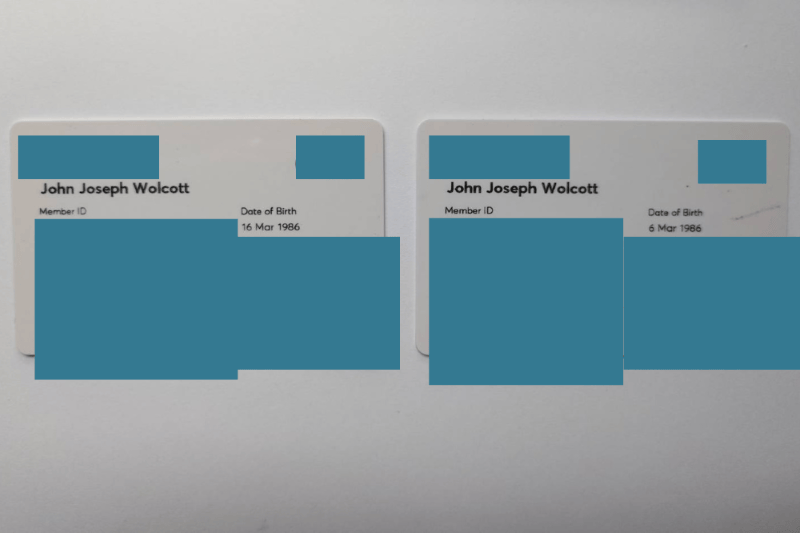
I told my rep about this, she apologized, and the company sent out another card a week later. When I received the second card, I noticed that my name was correct but both my birthday and policy number were incorrect. Once again, I reached out to my rep, she apologized profusely, and they sent a third card. This time, it contained all the correct info.
Although frustrating, this little incident gave me some quality material to use with my neighbors. That said, I would only realize later on that this was the first sign of the insurance company’s lack of organization and professionalism.
Using My Health Insurance in Thailand for the First Time
When I signed up for health insurance, I never planned to use it unless absolutely necessary. After all, I didn’t want the company refusing me coverage for something serious because I made too many minor claims early on. Plus, the insurance company offered me a discount on my annual premium if I didn’t make a claim for the entire year. But there came a point when I really did need to use it.
Visiting the Doctor
Eighteen months after I signed up for health insurance, I started getting headaches on the right side of my face. For a week straight, every morning I’d wake up to these unexplainable pains shooting down from my temple to my jaw. When I stood up, I’d get dizzy. I figured this warranted a trip to the doctor.
I went to a local private hospital to see a neurologist. After a short consultation, he said it sounded like I had nerve damage called trigeminal neuralgia. He wanted to confirm that this was causing the headaches, so he ordered me to stay in the hospital to undergo monitoring for the dizziness and get an MRI.
I gave the hospital my insurance card, they called my insurance company, and that was when I hit a brick wall.
Being Denied Health Coverage
That day, the health insurance company told the hospital staff that if I was admitted to the hospital, they wouldn’t cover my stay or any of the associated fees.
They said that since it was my first time trying to use the insurance, they’d have to check the nearest 10 hospitals to make sure I never went to any of them complaining about headaches. If my background check came back clear, only then would they cover me. This check, according to the insurance company, would take at least five days.
You can imagine how frustrated I was, having never used my insurance after having it for over a year and a half only to discover that none of these background checks were done during the underwriting process. I’d also have to sit through five more days of head pains and dizziness until they sorted this out.
Then I remembered about my personal insurance rep. I began sending her messages on LINE, but she failed to respond even though it was during business hours. I looked at her profile more closely, and in the little message section underneath her name, it said she was on maternity leave. To this day, a year after the incident at the time of writing this, I still haven’t heard back from her.
Because of this, when you’re vetting insurance companies, I’d ask who is not only going to be your rep, but also your back-up rep should something happen to your original insurance rep. The last thing you want is for your rep to go silent on you the day you need him or her most.
Pushing Back
I left the hospital and told a few friends what happened, and they all said the same thing — call the insurance company and push back on the issue. My friends reminded me that I’m paying for health insurance and not accident insurance, and that I was entitled to coverage, especially for my symptoms.
Once on the phone with the insurance company, to my amazement, they told me I was no longer covered. They said my policy had expired five months ago. You can imagine how confusing this whole situation was getting. There I was, jolts of pain shooting down my face, holding an insurance card showing that my policy was still in effect, being told I had no coverage.
At once, I asked to speak to a manager. I was transferred and the next person found my correct information. But they continued to deny me coverage until all their background checks on me came back clear. I kept asking them why this wasn’t done during the underwriting process, and they told me this was just the way it went with expat health insurance. When someone uses it for the first time, a background check needs to be done.
“Even with shooting pains down the right side of my face and dizziness?” I asked them. I told them that if I fell down and was injured because of this, I’d hold them liable. Then I hung up.
Getting Help From the Resident Doctor
Roughly 10 minutes after I hung up the phone, I got a call from the insurance company’s resident doctor. He asked me to walk him through my symptoms. After listening intently, he said he’d email a form to the hospital stating that the insurance company would cover me, but that if they found any pre-existing conditions in the meantime, I’d have to pay for the medical fees out of pocket. I returned to the hospital, and when I got there I signed the paper and was admitted for blood work, monitoring, and an MRI.
The Incidental Finding
Fast forward a day later and I met with the doctor, who at this point had the results of my MRI. He showed me images of my nerves and commented that I didn’t have trigeminal neuralgia. There was nothing in the MRI that was causing headaches or dizziness on the right side of my head.
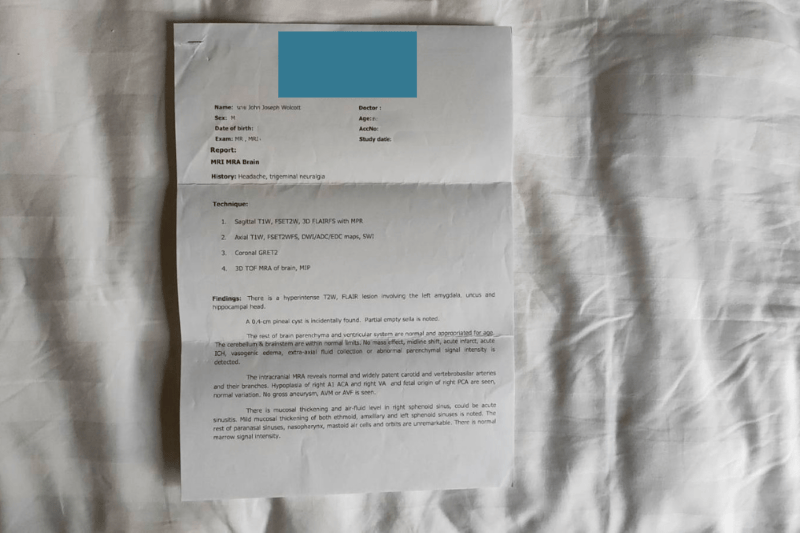
“But,” he said, “you see this.” I looked closer as he pointed to the scan of the left amygdala on my hippocampus. “You have a lesion on your brain. This isn’t normal.” My heart sank into my stomach.
I asked him if it was serious, and he said he couldn’t tell because their MRI wasn’t high-grade. I’d have to go to a hospital with a Tesla Model 3 MRI. He told me I don’t have to go ASAP, but I should go soon.
After being discharged, I called my insurance company’s resident doctor to explain the situation to him. He said he’d set me up with an appointment at Bangkok International Hospital and their top-rated neurological team on my behalf. It was then that I began noticing how accommodating this man was, as he seemed to be the only person willing to help from the insurance company.
Bangkok International Hospital
I met with the neurologist at Bangkok International Hospital, and she confirmed that I did indeed have an abnormal lesion on my brain. She asked me to come back the following day so they could run three tests: bloodwork, a lumbar puncture, and an MRI. She said this was the most logical way to rule out cancer. The next day, I arrived at the hospital with an overnight bag mentally preparing myself for the worst possible outcome.
About 20 years prior, I lost one of my best friends to brain cancer. During his last weeks, we watched helplessly as he began losing his cognitive functions day by day. He could no longer string together even the most basic sentences. Although I’ll always remember the good times we shared together, there’s still a part of me that can’t shake the image of him succumbing to the disease in his final days. I began to fear that my daughters would have to watch me go through the same thing.
However, when I was admitted to the hospital, the insurance company once again couldn’t guarantee me coverage as they were still in the process of doing their background checks on me. So I had to sign another paper saying that I’d pay the medical fees if this was a pre-existing condition.
I don’t want to keep repeating myself, but you can now see why asking questions ahead of time is so important. There is nothing worse than needing medical treatment while the uncertainty of whether your insurance will cover you is lingering over your head. It increases your stress levels 10-fold.
Undergoing Medical Tests
On day one, I had a lot of bloodwork done, which, after a few hours, came back clear. That same day I had an MRI, but the results wouldn’t be in until the next morning. The following day I woke up to the news that the neurologist cancelled my lumbar puncture — a good sign I assumed.
Getting the Results
Around noon time on day two, the neurologist burst into my hospital room. “Great news,” she said. “It’s not cancer.” My entire body sunk into itself. “But,” she continued, “you have a rare benign brain tumor.” She began to describe it with numbers and acronyms while showing me neon images of my abnormal brain cells on a computer screen.
But just because it wasn’t cancerous didn’t mean I was in the clear. The doctor was afraid that if it grew, I’d start having seizures. She offered me seizure medicine, but because I’d never had seizures before and this was an incidental finding I refused the medication.
After she left, a brain surgeon came in to speak with me. He said that although it was an incidental finding, he didn’t want me driving, swimming, or riding a bicycle anymore. He said it would be too risky. Needless to say, my world was turned upside down as I did each of these three things on a weekly — if not daily — basis. I asked him if he could take the tumor out, but because of the location, it would affect my ability to make short-term memories. The risk wasn’t worth the reward.
They asked me to come back in six months for a follow-up MRI to see if or by how much the tumor grew.
Being Discharged from the Hospital
When it was time to be released from the hospital, I didn’t expect the process to go smoothly with the insurance company because of what they had put me through over the last few days. And my suspicions were correct.
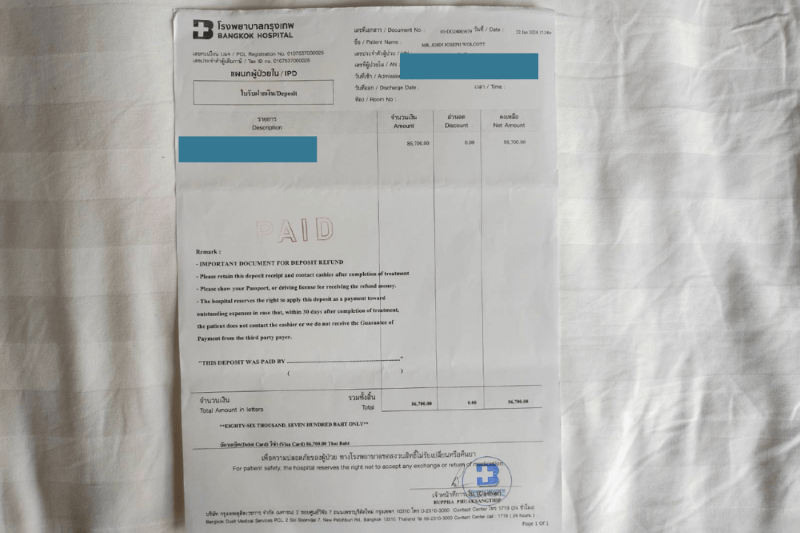
Although the hospital was ready to release me, they said they couldn’t do so until the health insurance company gave them a response about whether they’d pay the bill. For hours we waited to hear something, and for hours we heard nothing.
It got to the point where if they didn’t respond, I’d be charged for another night’s stay. So, I decided it would be best to pay the bill out of pocket, go home, and hopefully hear some good news from the insurance company later that evening.
After paying the bill of nearly THB100,000 (so much for not having to pay out of pocket), I left the hospital and began walking back to the parking lot. As I was about to get into my car, I got a call from the hospital. They told me the insurance company agreed to cover the bill. The hospital reimbursed my money, and I finally went home.
In the end, the insurance company covered the entire bill except for an extra plate of pad Thai I ordered — fair enough.
Follow-Ups at Chulalongkorn Hospital
Six months after the brain tumor diagnosis, I decided to go to Chulalongkorn Hospital for my follow-up MRI. I didn’t go back to Bangkok International Hospital only because I didn’t have out-patient coverage and I didn’t want to spend THB25,000 on an MRI.
Yes, I probably could’ve asked to be admitted again overnight as many people do and many doctors recommend just to get coverage. But I didn’t want to take advantage of having insurance, just in case. Plus, it was slightly over THB10,000 for an MRI at Chulalongkorn, which I thought was reasonable.
At Chulalongkorn, I met with a neurologist who worked during the day at Bumrungrad and on some evenings at Chulalongkorn. So it was like visiting a doctor at a private hospital for the cost of seeing a doctor at a government hospital.
They did the MRI, and the results showed no growth of the tumor. The doctor told me I could go back to life just as I had been living it — driving, swimming, biking, and all. He also told me there was only a very small chance I could have seizures, but it wasn’t likely. The only thing necessary from that moment forward would be yearly MRIs to monitor the tumor. And this is where I stand until this day.
Lessons Learned
After purchasing health insurance in Thailand and using it for the first time, there is plenty I learned. There is also plenty I’d do differently, especially in the beginning stages of vetting insurance companies. I would’ve asked a lot more questions, and I believe you should do the same.
When you’re going through the process of finding a suitable insurance company, ask them what the underwriting process entails. Also, ask them what will happen the first time you use your insurance. Will they need to do background checks on you on the spot? If so, how long will it take? What happens in the event of an emergency? Will they still need to do background checks?

Also, you might want to work with a good insurance broker, someone who will fight for you to get coverage when you need it most. As I didn’t have a broker, I had to fight directly with the insurance company myself, which added a lot of stress to an already stressful situation.
Where I’m at Today
After my brain tumor diagnosis, life has gone on, although at times I do experience a little anxiety over the unknowns of what could happen in the future. As for the insurance company, I am still with them to this day, because now I really do have an underlying condition and it would be hard to find new coverage elsewhere.
I’ve also had to renew my insurance since the diagnosis, but I’m happy to report that the insurance company didn’t raise my premiums for making any claims. I did, however, get my premium bumped up because of the 3 percent age-based increase. (Verified September 2026.)
My Final Thoughts About Health Insurance in Thailand
As it stands, I don’t regret getting health insurance as an expat in Thailand. It was one of the smartest financial decisions I’ve made, and it still offers me peace of mind knowing I’m covered not if, but when, life’s medical emergencies arise.
I only wish I asked the insurance company more questions beforehand. This way, I’d know roughly what would happen the first time I used my coverage. In the end, though, the insurance company covered all my medical bills. And their resident doctor really went above and beyond with helping me get the coverage I not only needed, but was paying for.
How Direct Billing Works vs. Pay-and-Claim Reimbursement
Thai hospitals settle an insured bill one of two ways. Knowing which one your policy uses, and what each one asks of you at admission, helps you avoid delays or a refused guarantee of payment at check-in.
Direct Billing (Cashless Admission)
With direct billing, the hospital bills your insurer instead of you. For a planned admission, the hospital typically sends your diagnosis and estimated cost to the insurer and waits for a guarantee of payment before treatment starts. For genuine emergencies, hospitals usually treat first and sort out the paperwork after.
- Works only at network hospitals. Your insurer needs an existing direct-billing agreement with that specific hospital, not just a general policy that “covers” Thailand.
- Can still be delayed or refused. If it’s your first claim, or the insurer wants to confirm a condition isn’t pre-existing, they can hold the guarantee of payment while they check.
- Public hospitals use it too. Government hospitals that see a lot of foreign patients, Chulalongkorn among them, will also coordinate directly with an insurer for eligible cases, though the process can move slower than at a private hospital with a dedicated insurance desk.
Pay-and-Claim Reimbursement
If direct billing isn’t available, whether that’s because the hospital isn’t in the insurer’s network, the guarantee of payment doesn’t come through in time, or your plan simply isn’t a cashless one, you pay the hospital yourself and claim the money back afterward.
- You need the full amount upfront. Some hospitals ask for a deposit before admission and settle the balance at discharge, so budget for the higher end of the estimate.
- Keep every original document. Insurers generally want the original itemized invoice and receipt, not a photo or a copy, so ask the hospital’s billing desk for the full paperwork before you leave. See the documentation checklist below.
- Reimbursement timing varies by insurer. Ask this directly when you’re comparing plans, since it isn’t usually printed on the policy summary.
Standard Exclusions and Waiting Periods to Check Before You Buy
Most of the friction in a Thai health insurance claim traces back to something the policy excluded or delayed from day one. These are the categories worth asking about line by line before you sign, not after.
- Pre-existing conditions. Almost every insurer asks you to declare prior conditions and surgeries on the application. Ask exactly how they treat what you declare: excluded outright, covered after a set period with no new symptoms, or covered with a higher premium. Get the answer in writing, not from a sales call.
- General waiting periods. Most policies won’t pay a claim made in the first few weeks after the policy starts, and some conditions carry a longer wait than others. Ask for the exact number of days for illness versus accidents, since accidents are typically covered from day one.
- Maternity. Rarely included in a standard plan and usually sold as a separate add-on with its own waiting period, often measured in months rather than weeks. If you’re planning a family in Thailand, check this before you need it. Our guide to giving birth in Thailand covers costs and hospital choice in more depth.
- Dental. Almost always excluded from a general health plan. Routine dental work in Thailand is affordable enough out of pocket that most expats skip a dental add-on entirely, but check if that’s your plan.
- Outpatient cover. Some plans only cover inpatient (admitted) treatment, which is what left me paying out of pocket for a follow-up MRI rather than filing a claim. If outpatient visits, scans, and prescriptions matter to you, confirm it’s on the plan and not a separate rider.
None of this replaces asking your own insurer for their exact wording, since exclusions vary by company and by plan tier. For a broader rundown of what tends to trip people up when comparing plans, see our guide on what expats get wrong with health insurance in Thailand.
What Documentation a Thai Hospital Claim Needs
Whether you’re filing a reimbursement claim or the insurer asks for records to confirm a condition isn’t pre-existing, hospitals and insurers in Thailand generally want the same core paperwork.
- Original itemized invoice. A full breakdown of charges, not just a total. Ask the hospital’s billing or insurance desk for this specifically before you leave.
- Official receipt. Proof you paid, matching the invoice amount.
- Medical report or diagnosis summary. A doctor’s written summary of the diagnosis and treatment, which most hospitals will issue on request, sometimes for a small fee.
- Your insurer’s claim form. Filled out and signed; most insurers post this as a downloadable PDF.
- Copy of your passport and insurance card. Standard identity verification on most claim forms.
- Bank account details. For the reimbursement transfer, if you’re paying and claiming back rather than using direct billing.
Ask for all of this at the hospital before you’re discharged. It’s far easier to request a document while you’re still standing at the billing counter than to call back and track it down later. If you’d rather have someone else chase the paperwork on your behalf, an insurance broker can usually handle the claim submission for you. For a sense of what treatment costs if a claim is delayed or denied and you’re covering it yourself in the meantime, see our guide to the cost of healthcare in Thailand.
Frequently Asked Questions
What’s the difference between direct billing and reimbursement for health insurance in Thailand?
Direct billing means the hospital bills your insurer directly and you don’t pay upfront, provided the hospital is in the insurer’s network and the insurer confirms coverage. Reimbursement means you pay the hospital yourself and claim the money back afterward, usually by submitting the original invoice, receipt, and a claim form.
Why would an insurer refuse to guarantee payment right away?
Most commonly because it’s the policyholder’s first claim and the insurer wants to confirm the condition isn’t pre-existing, or because the diagnosis needs more information before they’ll commit to the cost. Ask any insurer you’re considering exactly how this works and how long it typically takes before you sign up.
Does Thai health insurance cover pre-existing conditions?
It depends entirely on the insurer and the plan. Some exclude a declared pre-existing condition permanently, some cover it after a waiting period with no new symptoms, and some cover it at a higher premium. Get the exact policy on this in writing before you buy, not from a sales conversation.
What documents do I need to claim a hospital bill in Thailand?
Generally the original itemized invoice, an official receipt, a medical report or diagnosis summary from the doctor, your insurer’s claim form, and a copy of your passport and insurance card. Request all of it from the hospital’s billing desk before you’re discharged.
Can I use private health insurance at a public hospital in Thailand?
Often, yes. Public hospitals that see a lot of foreign patients can coordinate directly with insurers for eligible cases, though the process can move slower than at a private hospital with a dedicated insurance desk. Confirm with both the hospital and your insurer beforehand rather than assuming.
Is it worth using an insurance broker instead of buying a policy directly?
A broker can help you compare plans, decode the exclusions, and push on your behalf when a claim stalls, which matters most exactly when you’re least able to deal with it yourself. It doesn’t cost you the policy price difference, since brokers are typically paid by the insurer, not the client.


 Deutsch:
 Français:
'/%3E%3Cpath%20fill='%23b2b2b2'%20d='M241%20382q0%2016%2017%2026%2017%2011%2042%2011t42-11q16-11%2017-26V269H241'/%3E%3Cpath%20fill='%239f7e00'%20d='M241%20379q0%2014%208%2023%209%209%2021%209%2014%200%2021-9%209-9%209-23V269h-59'/%3E%3Cpath%20d='M241%20339v-70h59v110q0%2014-9%2023l-6%205v-68h-15v72q-8%200-14-4v-68zm59%2040c0%2022%2015%2032%2029%2032%2021%200%2030-18%2030-32v-40h-59'/%3E%3Cpath%20fill='%239f7e00'%20d='M266%20277v5h2v12h-3v-5h2v-5h-9v5h2v5h-4v9h3v18h-5v10h34v-10h-5v-18h3v-9h-4v-5h2v-5h-9v5h2v5h-3v-12h2v-5zm42%20101q0%2010%206%2017%206%206%2015%207%2010-1%2016-7%206-7%206-17v-29h-43'/%3E%3Ccircle%20fill='%230044ad'%20cx='329.5'%20cy='372'%20r='6'/%3E%3Cellipse%20fill='%230044ad'%20cx='300'%20cy='340'%20rx='16'%20ry='21'/%3E%3C/svg%3E) Español:
Español: