
Every registered company in Thailand must file withholding tax returns (PND 3 or PND 53) monthly and issue Withholding Tax Certificates to vendors. Rates for services, rent and advertising run from 1% to 5%, and some payments are higher.
In Thailand, registered companies are required to file withholding income tax returns for services purchased from individuals or juristic persons. Rates for services, rent and advertising run from 1% to 5%. Dividends and some payments to foreign companies are taxed at higher rates.
Withholding Income Tax returns need to be filed monthly within 7 days or 15 days after the end of the month in which the assessable income is paid, with the PND 3 form being filed for individuals and PND 53 for juristic persons that service your company.
Read on to find out more about filing withholding income tax returns and how you can submit the PND 3 and PND 53 for entities that service your company in Thailand.
Disclaimer: Some links in this article go to our partners, and we may earn a commission if you use them. It costs you nothing extra, and we only recommend services we'd use ourselves. Read more in our Advertising Disclosure.
Contents
- Key Takeaways
- What Is It?
- Who Needs to File It?
- How to Prepare PND 3 and PND 53
- Withholding Income Tax Rate
- Withholding Tax Rates for Dividends, Interest, and Royalties
- Withholding Tax When Paying a Foreign Company
- Withholding Tax on Payments to Companies Outside Thailand (PND 54)
- Lower Your Rate to 1% with e-Withholding Tax
- Worked Example: One Month of Withholding Tax
- Supporting Documents for PND 3 and PND 53
- How to File PND 3 and PND 53
- Issuing Withholding Tax Certificates
- What a Withholding Tax Certificate (50 Tawi) Must Show
- Can I File it Myself?
- How to Pay Tax
- How to Claim Withholding Income Tax Refunds?
- When to File Your PND 3 and PND 53
- Late Fines
- Exemption
- Frequently Asked Questions
- What is the standard withholding tax rate on dividends in Thailand?
- How much withholding tax applies to interest paid to a Thai company?
- What withholding tax rate applies to royalty payments in Thailand?
- Do freelancers and individual landlords withhold tax from payments they receive?
- What withholding tax rate applies when paying a foreign company for services?
- Can a double tax agreement reduce Thailand’s withholding tax rate?
- Is withholding tax the same as VAT?
- Does withholding tax apply to prize money or promotional giveaways?
- What are the PND 3 and PND 53 deadlines in October to December 2026?
- What is PND 54 and when do I use it?
- How is the surcharge for late withholding tax calculated?
- Do I withhold tax on hotel and restaurant bills?
- Do I still need to send a certificate if I pay through e-Withholding Tax?
- Now, on to You
- Sources Cited
Key Takeaways
- Every registered company in Thailand must file PND 3 (for individual vendors) or PND 53 (for juristic person vendors) each month, regardless of company size.
- The filing deadline is the 7th of each month for paper submissions, extended to the 15th when filing online through the Revenue Department e-filing portal.
- Withholding tax rates depend on the service type: 3% for most services, 1% for transportation, 2% for advertising, and 5% for rent.
- You do not need to withhold when the value of the agreement is under THB1,000. An agreement worth THB1,000 or more is subject to withholding even if you pay it in smaller instalments.
- If you pay a vendor the full amount without withholding, you are liable to pay the withheld tax yourself, plus any applicable interest.
- You must issue three copies of the Withholding Tax Certificate for each transaction: copies 1 and 2 go to the vendor, copy 3 stays with your company.
- Classifying vendors correctly as individuals or juristic persons from the start prevents filing errors and amended returns later.
- An accountant who knows the Thai Revenue Department system can handle monthly filings, liaise with officers in Thai, and keep your company in compliance for a modest fee.


What Is It?
The PND 3 is the Withholding Income Tax Return form for individuals, and the PND 53 is the Withholding Income Tax Return form for companies.
The way withholding tax works in Thailand is that your company deducts the withholding tax from payments for entities that service your company. For example, if an individual translator charges you 1000 THB, you are liable to deduct 3% withholding tax (30 THB) from the payment which will be filed in the PND 3 form by the 7th or the 15th of the following month. (Verified September 2026.)
Your company must pay the 3% tax to the Revenue Department along with filing the PND 3, and mail or provide two copies of the Withholding Tax Certificate to the individual, who will be able to use this form to claim tax refunds for withholding tax when they file their Thai income tax return in March of the following year.
You need to file the correct form (PND 3 or PND 53), recording the filing status of the entity that serviced you – and paying the appropriate percentage of withheld tax according to the service – to the Revenue Department within 7 days or 15 days after the end of the month if you have a registered company, regardless of the size of the business.
Who Needs to File It?
Companies in Thailand must withhold the designated percentage of taxes from their vendors when making payments for different types of services.
Payments to overseas vendors are also liable for withholding tax if they meet certain criteria.
A local accountant can help you with the filing process at the end of each month.
Learn More:
- How to Register a Company in Thailand, Step by Step
- Get the Right Company for Accounting Service in Bangkok, Thailand
How to Prepare PND 3 and PND 53
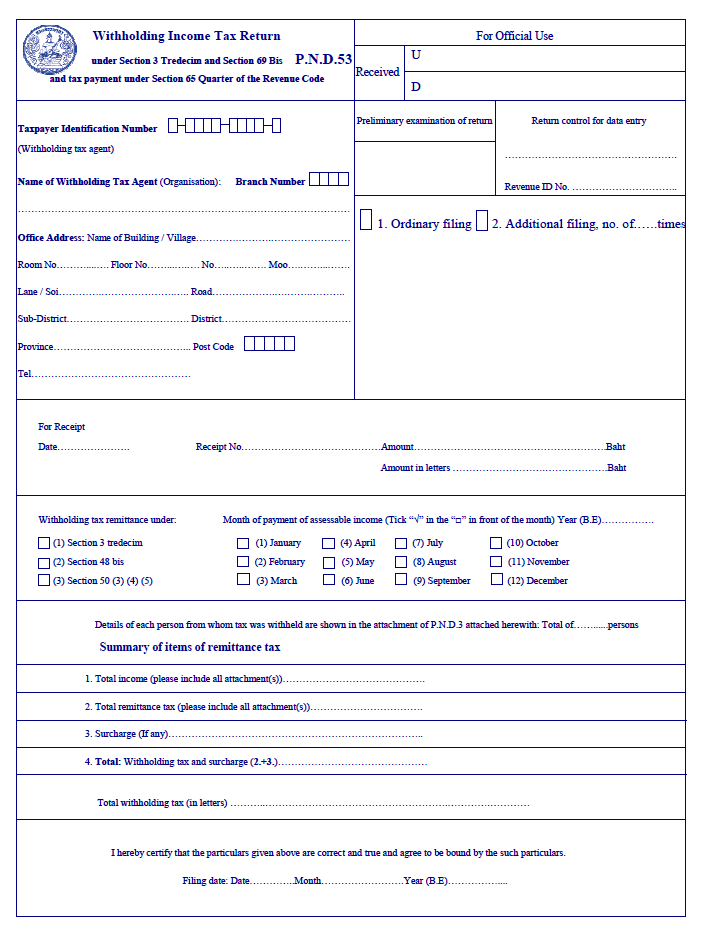
You can get an English copy of the PND 3 form, PND 53 form and Withholding Tax Certificate from the Revenue Department website.
Within the PND forms, you need to list out information about the amount paid for the service, month in which it was paid, and tax ID of the entity that serviced your company.
PND 3 forms are issued for payments made to vendors who are individuals, and PND 53 forms are issued for payments made to vendors who are juristic persons who serviced your company during the past month.
Withholding Income Tax Rate
Rates of withholding taxes vary according to the type of service and are taxed at a percentage of the vendor’s service fees:
- Most types of services – 3% (legal services, accounting services, repairs, cleaning, construction, etc)
- Transportation – 1%
- Advertising – 2%
- Rent – 5%
Related article: An Expat’s Guide to Finding Work in Thailand
Withholding Tax Rates for Dividends, Interest, and Royalties
Beyond service fees and rent, Thai companies also withhold tax on payments like dividends, interest, and royalties. These rates are set by the Revenue Department and apply when a Thai company makes the payment:
- Dividends: 10% when paid to an individual shareholder. Dividends paid to another company follow narrower rules, so ask your accountant before you withhold.
- Interest paid to a resident company: 1%, rising to 10% if the recipient is an association or foundation.
- Royalties: 3%, also rising to 10% for associations and foundations.
- Prize money and promotional giveaways: 5%.
Withholding Tax When Paying a Foreign Company
Service and professional fees paid to a foreign company follow a different rate depending on whether that company has a permanent branch in Thailand:
- With a Thai branch: withheld at the same 3% rate as a domestic company.
- Carrying on business in Thailand but with no permanent branch: withheld at 5%.
- Not carrying on business in Thailand at all (an overseas vendor): withheld at 15% under Section 70 and filed on PND 54.
Rates on other payment types to nonresident or foreign-company payees can differ further, and may be reduced under one of Thailand’s double tax agreements. Check the relevant treaty on the Revenue Department’s DTA pages, or confirm with a licensed Thai tax advisor before applying a rate to a cross-border payment.
Withholding Tax on Payments to Companies Outside Thailand (PND 54)
The 3% service rate above applies to companies that do business in Thailand. If you pay a foreign company that does not carry on business in Thailand, such as an overseas software licensor or consultant, Section 70 of the Revenue Code applies instead. (Verified October 2026.)
- Rate: the Revenue Department has ruled that service fees and software licence fees paid to such a company are withheld at 15%.
- Form: you report and pay on PND 54, officially the “Withholding Tax and Profit Remittance Return under Sections 70 and 70 Bis”.
- Deadline: within 7 days after the end of the month of payment. The Revenue Department lists PND 54 together with PND 1, 2, 3 and 53 in its online filing extensions, so e-filing gives you until the 15th.
- Treaty relief: a double tax agreement can lower the rate for some payment types, such as royalties. The Revenue Department publishes the treaty rates by country.
Keep the PND 54 copy and the payment receipt. Your foreign vendor needs them if they want to claim a credit for the Thai tax in their home country.

Lower Your Rate to 1% with e-Withholding Tax
You can lower the rate you withhold by paying your vendors through the e-Withholding Tax system. When you pay this way, your bank deducts the tax at the moment of payment and sends it to the Revenue Department for you.
The main draw is the rate. Payments that normally need 3%, 2%, or 5% are all withheld at just 1% when you go through e-Withholding Tax. That leaves more cash in your business, since less of each payment is held back.
It also cuts your paperwork. The bank handles the filing and the certificate for those payments, so you skip the monthly PND 3 or PND 53 for them.
On 16 June 2026, the Cabinet approved extending this reduced 1% rate to 31 December 2027. (Verified October 2026.)
There is a bonus for companies too. If you invest in the e-Withholding Tax or e-Tax Invoice and e-Receipt systems, you can deduct twice the actual cost against your corporate income tax, also through the end of 2027.
Worked Example: One Month of Withholding Tax
Say your Thai company makes four payments in September 2026. The table shows what you withhold, what the vendor receives, and which return the tax goes on. The amounts ignore VAT to keep the maths simple.
| Payment | Vendor type | Amount (THB) | Rate | Withheld (THB) | Return |
|---|---|---|---|---|---|
| Freelance translator | Individual | 20,000 | 3% | 600 | PND 3 |
| Advertising agency | Thai company | 50,000 | 2% | 1,000 | PND 53 |
| Office rent | Individual landlord | 30,000 | 5% | 1,500 | PND 3 |
| Courier fees | Thai company | 8,000 | 1% | 80 | PND 53 |
You pay out THB104,820 to the four vendors and hold back THB3,180 for the Revenue Department. THB2,100 goes on the PND 3 (translator and landlord) and THB1,080 on the PND 53 (agency and courier).
For September payments, the paper deadline is 7 October 2026 and the online deadline is 15 October 2026, according to the Revenue Department’s filing calendar. (Verified October 2026.) Each vendor also gets a Withholding Tax Certificate showing the amount you held back. If you used e-Withholding Tax for the translator, the 3% would drop to 1% (THB200).
Before you agree a rent figure, see what to check before signing a rental contract, since the 5% is deducted from every rent payment your company makes.
How the Late Surcharge Is Calculated
Section 27 of the Revenue Code adds a surcharge of 1.5% per month, or part of a month, on the tax you failed to remit. It runs from the day after the deadline until the day you pay, and it cannot exceed the tax owed. The Revenue Department has stated that the law gives no way to waive or reduce it. (Verified October 2026.)
Using the example above, if you pay the THB3,180 twenty days after the online deadline, that is one part-month, so the surcharge is THB47.70 (1.5% of THB3,180). The separate fine of up to THB2,000 for filing late (Section 35) can come on top unless you can show force majeure.
Supporting Documents for PND 3 and PND 53
To prepare the PND 3 and PND 53 for each month, you need to send all of the following to your accountant:
- Copies of ID cards of individual vendors who serviced your company
- Company name, address and taxpayer identification number for companies that serviced your company
- Invoices from services performed for your company in the past month
After that, the accountant will fill out the PND 3 and PND 53 forms and send it to the Revenue Department, along with issuing copies of the Withholding Tax Certificate to each of the entities that serviced your company for them to file for tax refunds during their annual tax return filing.
How to File PND 3 and PND 53
There are two ways you can file the withholding tax forms. You can file it on paper at your local Revenue Department, or you can e-file it through the E-Filing website.
You just need to choose the PND 3 or PND 53 form and file it digitally.
After that, you can save the file to your company for a record. It is suggested to save your company tax documentation for a minimum of five years. For a broader overview of corporate tax obligations, see our guide to PND 50 (corporate income tax).
If your company does not yet have a username and password for e-filing, you can use this website to fill out the Por. Or. 01 request for e-filing.
If you use an accountant to open your company and register for VAT, they may have already created an account for you.
E-filing is much more convenient, and most companies have shifted to e-filing already.
Learn More:
- Taxes You Have to Deal with as a Business Owner in Thailand
- General: How Long Should You Keep Company Documents?
Issuing Withholding Tax Certificates
Issue a Withholding Tax Certificate to the vendor at the time you withhold the tax, in three copies for each payment.
Withholding Tax Certificates can be filled in and printed via most Thai accounting software, or a booklet of blank Withholding Tax Certificates can be purchased from local stationery stores and filled in manually for issuance to vendors.
Copies 1 & 2 are given to the vendor – one is to be attached with the income receiver’s tax return, and the other is to be kept by the income receiver as a reference. Copy 3 is to be kept by the income payer (your company) as a record.
What a Withholding Tax Certificate (50 Tawi) Must Show
The Withholding Tax Certificate is issued under Section 50 Bis of the Revenue Code, and Thai accountants call it the 50 Tawi (หนังสือรับรองการหักภาษีเงินได้ ณ ที่จ่าย). For the service, rent and advertising payments covered in this guide, the certificate must be issued immediately every time you withhold tax. (Verified October 2026.)
The Revenue Department’s English form has these fields:
- Payer: your company’s name, address and tax ID.
- Vendor: the person or company you withheld from, with their name, address and tax or ID number.
- Return reference: the sequence number on your PND 3 or PND 53 and a tick for the form type.
- Payment details: the type of income, the date paid, the amount paid and the tax withheld.
- Payer’s method: whether you withheld at source, paid every time, paid one time or another arrangement.
- Signature: the payer’s signature, the issue date and the company seal.
The form carries its own warning. A payer who fails to issue the certificate faces a fine of up to THB2,000 under Section 35. When you pay through e-Withholding Tax, the bank issues the electronic record to you and the vendor, so there is no paper certificate to fill in.
Can I File it Myself?
Although it’s possible to do it yourself, it’s better to hire an accountant to prepare and file the monthly PND 3 or PND 53 forms and issue Withholding Tax Certificates for your company, to prevent any penalty for filing incorrect information.
The accountant can also help you talk with a Revenue Department officer when they have any questions with the form – which is really helpful unless you can speak Thai fluently.
Learn More: The Complete Guide to Learning Thai Online And Available Courses

Rather hand this to someone? Expat Tax Thailand helps expats here with tax advice and filing, and has over 350 five-star reviews from expats. You get a free consultation and a free Thai tax filing guide. Talk to Expat Tax Thailand (Sponsored)
How to Pay Tax
After you file the PND 3 and/or PND 53 forms, you can pay withholding tax directly to a local Revenue Department, make a bank transfer, or though a QR payment.
How to Claim Withholding Income Tax Refunds?
You can claim your withholding tax refund yearly along with the filing of the annual tax return through the E-filing website to recover all of your withheld income.
To do it, you must submit all Withholding Tax Certificate copies received from customers to the Revenue Department. The total amount from all Withholding Tax Certificates submitted will be issued as a tax refund.
There are three options for receiving a withholding income tax refund: it can be in cash (if they file it at a local Revenue Department), via bank transfer, or they get a tax credit for tax filing.
You can combine the withholding tax amount with your annual tax return. If the total tax owed is more than the amount of income withheld, you must pay additionally. But if the amount tax owed is less than the amount of income withheld, you can request a tax refund.
Learn More:
- Increase Your Chances of Getting Tax Refunds
- When and How to File Taxes as a Business Owner in Thailand
When to File Your PND 3 and PND 53
The following deadlines for monthly withholding tax returns apply to any payer, whether the company is Thai or foreign:
- PND 3: Within the 7th day of each month if paper filing
- PND 53: Within the 7th day of each month if paper filing
Currently the Revenue Department provides a grace period until the 15th of each month if filing withholding tax forms online. (Verified September 2026.) However, this policy is only being extended on an annual basis, so make sure to check for any policy updates on filing deadlines each new fiscal year.
Late Fines
It is important to complete the Withholding Income Tax Returns on time to avoid penalties, and accurately to prevent having to file amended returns.
There are severe penalties for not filing company taxes according to schedule as follows:
- The penalty for filing each form late (or not filing at all) for the month is a fine of up to THB2,000, plus a surcharge of 1.5% per month or part of a month on the tax owed, capped at the amount of the tax. Exceptions will only be made in case of a force majeure.
- Any person who deliberately fails to submit the required forms in order to avoid paying taxes is liable to imprisonment for a term not exceeding 1 year or a fine not exceeding 200,000 THB, or both.
Additionally, because the law requires you to withhold the tax and submit it to the Revenue Department by the 7th of the following month (or the 15th if filing online), if you pay any vendors fully and fail to withhold the tax, you will have to pay the tax yourself. (Verified September 2026.)
Learn More:
- Taxation in Thailand: 6 Common Mistakes
- Get the Right Company for Accounting Service in Bangkok, Thailand
Exemption
You do not need to withhold tax when the value of the agreement is less than THB1,000. If the agreement is THB1,000 or more, you withhold even if you pay it in instalments below THB1,000. (Verified October 2026.)

For example, if you hire a freelance translator and it costs you THB999, you don’t need to withhold tax and can pay the translator in full.
If you hire the same translator again, the new job is a separate agreement, and it is tested on its own value.
However, if you have a long-term contract with that freelancer worth THB1,000 or more, you withhold on every payment, even small ones.
Frequently Asked Questions
What is the standard withholding tax rate on dividends in Thailand?
Dividends paid to an individual shareholder are withheld at 10%. Dividends paid to a company are withheld only in some cases, for example a foreign company doing business in Thailand, and a Thai limited company holding at least 25% of the payer is outside the rule. The payer files this through the standard withholding tax return process.
How much withholding tax applies to interest paid to a Thai company?
Interest paid to a resident Thai company is withheld at 1%. If the recipient is an association or a foundation, the rate rises to 10%.
What withholding tax rate applies to royalty payments in Thailand?
Royalties are withheld at 3% when paid to a company. Payments to associations or foundations are withheld at 10%.
Do freelancers and individual landlords withhold tax from payments they receive?
No. Withholding tax is deducted by the person or company making the payment, not the recipient. A freelancer or landlord receives the net amount after tax has been withheld and remitted by their client or tenant. This is separate from their own personal income tax.
What withholding tax rate applies when paying a foreign company for services?
It depends on whether the foreign company has a permanent branch in Thailand. With a branch, the rate matches the domestic 3%. A foreign company carrying on business in Thailand without a branch is 5%, and an overseas vendor that does not carry on business in Thailand is 15%, filed on PND 54.
Can a double tax agreement reduce Thailand’s withholding tax rate?
In some cases, yes. Thailand has double tax agreements with a number of countries that can lower the standard rate on certain cross-border payments. Confirm the specific treaty terms with the Revenue Department or a licensed tax advisor.
Is withholding tax the same as VAT?
No. Withholding tax is an advance deduction on income tax, credited against the recipient’s final bill. VAT is a separate consumption tax reported through a different filing. See our guide to VAT registration.
Does withholding tax apply to prize money or promotional giveaways?
Yes. Prizes and promotional giveaways are withheld at 5%.
What are the PND 3 and PND 53 deadlines in October to December 2026?
Paper returns are due by the 7th of the month, and online returns get until the 15th. The Revenue Department’s calendar shows 15 October 2026, 16 November 2026 (the 15th is a Sunday) and 15 December 2026 for online filing. The paper deadline for December moves to 8 December 2026 because the 7th is a public holiday. (Verified October 2026.)
What is PND 54 and when do I use it?
PND 54 is the return for tax you withhold under Section 70 when you pay a foreign company that does not carry on business in Thailand. The Revenue Department has ruled a 15% rate for service fees and software licence fees. You file within 7 days after month end, or by the 15th online.
How is the surcharge for late withholding tax calculated?
It is 1.5% of the unpaid tax for each month or part of a month, counted from the day after the deadline. The surcharge cannot exceed the tax itself. A fine of up to THB2,000 for late filing can apply as well.
Do I withhold tax on hotel and restaurant bills?
No. The Revenue Department’s 3% service rule specifically excludes hotel accommodation and restaurant charges. Life insurance premiums paid to a Thai insurer are also outside it, and they carry their own 1% rate.
Do I still need to send a certificate if I pay through e-Withholding Tax?
The bank issues the electronic record to you and your vendor when it receives the payment. It then sends the data and the tax to the Revenue Department within 4 business days, and the Revenue Department issues you an electronic receipt.
Now, on to You
Handling company accounting in Thailand – filing withholding tax returns and issuing Withholding Tax Certificates – can be complex, especially if you don’t speak Thai. Become aware of the tax returns you are liable to file as a business owner, and don’t fall prey to common accounting mistakes.
Remember that with the help of local accounting firms who know the ins and outs of the Thai accounting system and are experienced in dealing with the Thai Revenue Department, you can stay in compliance with little to no headache even without a large accounting budget.
Sources Cited
- Thai Revenue Department, Corporate Income Tax (withholding tax rates): https://www.rd.go.th/english/6044.html
- Revenue Departmental Order No. Tor Por 4/2528 (English): withholding rates by payment type, the THB1,000 rule and the 7-day remittance rule.
- Revenue Code, Sections 14 to 27 (English): the 1.5% per month surcharge in Section 27.
- Revenue Code, Sections 28 to 37 (English): fines and penalties in Sections 35 and 37 Bis.
- Revenue Code, Sections 38 to 64 (English): certificate issuance under Section 50 Bis.
- Withholding Tax Certificate form (English): fields and the three-copy layout.
- PND 54 form (English): the return for Section 70 payments to foreign companies.
- Revenue Department ruling of 3 June 2551 (Section 70) and ruling of 12 June 2545: 15% withholding and PND 54 for payments to foreign companies.
- Revenue Department online filing deadline, 15 October 2026: online deadline for PND 1, 2, 3, 53 and 54.
- Revenue Department press release 14/2569: Cabinet extension of the 1% e-Withholding Tax rate and the double deduction to 31 December 2027.
- Revenue Department press release 5/2564: how e-Withholding Tax works, including the 4-business-day remittance.


 Deutsch:
 Français:
 Español: