
The PND 50, also referred to by some as the Corporate Income Tax (CIT) 50, is a tax return form that needs to be filed annually by companies and juristic partnerships in Thailand.
Read on to find out more about annual corporate income tax returns and how you can submit the PND 50 for your company in Thailand.
Disclaimer: Some links in this article go to our partners, and we may earn a commission if you use them. It costs you nothing extra, and we only recommend services we'd use ourselves. Read more in our Advertising Disclosure.
Contents
- Key Takeaways
- What Is It?
- Who Needs to File It?
- PND 50 vs. PND 51: What's the Difference
- How to Prepare PND 50
- Corporate Income Tax Rate
- Supporting Documents for PND 50
- How to File PND 50
- Can I File it Myself?
- How to Pay Tax
- How to a Get Tax Return
- When to File Your Annual Income Tax Return
- Where PND 50 Sits in Your Company's Filing Calendar
- Late Fines
- What if I Need to Close the Company?
- Now, on to You
- Frequently Asked Questions
- Do I still need to file PND 50 if my company made no profit?
- Is PND 50 the same as personal income tax?
- Does a newly registered company file PND 50 in its first year?
- Does a BOI-promoted company still need to file PND 50?
- I already filed PND 51 six months ago. Do I still need to file PND 50?
- What happens if I file PND 50 late?
- Who actually submits PND 50, me or my accountant?
Key Takeaways
- Every company or juristic partnership registered in Thailand must file a PND 50 form annually with the Revenue Department, regardless of company size.
- Corporate income tax is charged at 20% of net profit, but SMEs with paid-up capital under THB 5 million pay 0% on the first THB 300,000 and 15% on profits up to THB 3 million.
- Companies pay corporate tax twice per accounting period: the half-year PND 51 form and the annual PND 50.
- The filing deadline is within 150 days of your accounting period end date, which for most companies falls in May.
- You can file online through the Revenue Department e-filing portal, which most companies have already switched to.
- Hiring an accountant is strongly recommended since the form is complex, penalties apply for incorrect filings, and the Revenue Department communicates in Thai.
- Keep all company tax records for at least five years after filing.


What Is It?
The PND 50 is an Annual Income Tax Return for Companies or Juristic Partnerships. You need to file it every year to the Revenue Department if you have a registered company, regardless of the size of the business.
Corporate income tax must be paid twice per accounting period using the Half-Year Income Tax Filing Form (PND 51) and Annual Corporate Income Tax Filing Form (PND 50).
Who Needs to File It?
Corporate Income Tax (CIT) is a direct tax levied on registered companies in Thailand, which includes legal entities or partnerships operating in Thailand or operating elsewhere but earning certain types of income in Thailand.
Related: How to Register a Company in Thailand, Step by Step
The following types of companies are liable to file the PND 50:
- Any company, juristic partnership, or joint venture incorporated under Thai law
- Foundations or associations carrying on revenue-generating business in Thailand (there are some exemptions for charities and foundations under Section 47 (7) (b) of the Revenue Code)
- Companies or juristic partnerships incorporated under foreign laws and carrying on business in Thailand or other places including Thailand, including cases where an employee, an agent or a go-between carries on your business and generates income or profits in Thailand
There are special exemptions on corporate income tax for BOI companies.
BOI companies must prepare the Por 1-2549 Application form for Exercising Corporate Income Tax Exemption Rights and Benefits for the Accounting Year, which must be audited by an external auditor before delivery to the Revenue Department and BOI.
A local accountant can help you with the auditing process.
Learn More: How to Set Up a 100% Foreign-Owned BOI Company in Thailand
PND 50 vs. PND 51: What’s the Difference
Thai companies file two corporate income tax forms every year, not one, and they cover different things. Here’s how they compare.
| PND 50 | PND 51 | |
|---|---|---|
| Full name | Annual Corporate Income Tax Return | Half-Year Corporate Income Tax Return |
| Covers | Your company’s actual net profit for the full accounting period | An estimate of net profit for the first six months of the period |
| Deadline | Within 150 days of the last day of the accounting period | Within two months of the last day of the first six months of the accounting period |
| Based on | Audited financial statements | Your own estimate of full-year profit |
| How it’s used | The final tax bill for the year | A prepayment; what you pay is credited against the PND 50 bill |
Neither of these is the same as PND 90 or PND 91, the personal income tax returns individuals file on their own earnings. PND 50 and PND 51 apply to the company as a separate legal entity. Company directors and employees still file their own personal returns separately, on their own personal income.
How to Prepare PND 50
You can get an English copy of the PND 50 form from the Revenue Department website.
Within the form, you need to list out information from your financial statements, including the company’s net profit, which is the sum of total revenues minus total deductible expenses.
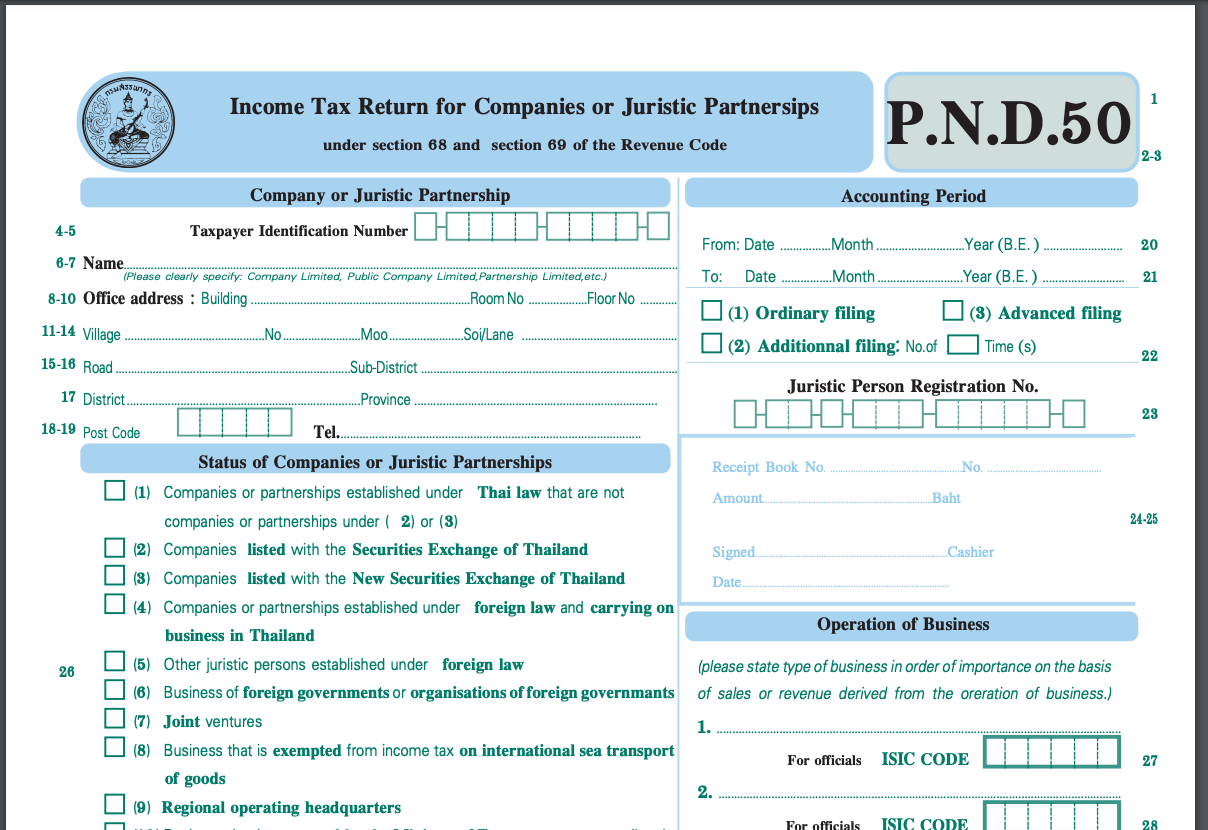
You will also need to list out non-deductible expenses, including but not limited to personal expenses and gifts or expenses that lack sufficient supporting documents (for example, missing invoices or receipts).
Corporate Income Tax Rate
Corporate income is taxed at 20% of the company’s net profit. (Verified September 2026.)
However, if the company is categorized as a Small and Medium-sized Enterprise (SME) with paid-up capital not exceeding 5 million Thai baht and/or revenues not exceeding 30 million Thai baht for the fiscal year, the tax rates are as follows:
- Net profit ≤ THB 300,000 – Taxed at 0%
- Net profit of THB 300,000 – 3,000,000 – Taxed at 15%
- Net profit ≥ THB 3,000,000 – Taxed at 20%
At the end of the form, you need to fill out the total amount of tax you need to pay or return.
Supporting Documents for PND 50
To prepare the PND 50, you need to send all of the following to your accountant:
- Form PND51 submitted in the same year
- Financial statements (Profit and loss statement, Statement of financial position, Statement of changes in equity, and Notes to financial statements)
After that, the accountant will fill out the PND 50 and send it to the Revenue Department.
How to File PND 50
There are two ways you can file the PND 50. You can file it on paper at your local Revenue Department. Or you can e-file it through the E-Filing website.
You just need to choose the PND 50 form and file it digitally.

After that, you can save the file to your company for a record. It is suggested to save your company’s tax documentation for a minimum of five years.
If your company does not yet have a username and password for e-filing, you can use this website to fill out the Por. Or. 01 request for e-filing.
If you use an accountant to open your company and register for VAT, they may have already created an account for you.
E-filing is much more convenient, and most companies have shifted to e-filing already.
In addition, you can also file other types of corporate tax through this website as well, such as the half-year tax return (PND 51).
Learn More:
Can I File it Myself?
Although it’s possible to do it yourself, it’s better to hire an accountant to prepare and file the PND 50 form for your company, as the format to document expenses on the form is very complex, to prevent any penalty for filing incorrect information.
The accountant can also help you talk with a Revenue Department officer when they have any questions with the form – which is really helpful unless you can speak Thai fluently.
Learn More: The Complete Guide to Learning Thai Online And Available Courses
How to Pay Tax
After you file the PND 50 form, you can pay tax directly to a local Revenue Department or make a bank transfer.
How to a Get Tax Return
To get a tax return, there are three options: it can be in cash (if you file it at a local Revenue Department), via bank transfer, or get a tax credit for tax filing next month.
Learn More:
Increase Your Chances of Getting Tax Refunds
When to File Your Annual Income Tax Return
The following deadlines for corporate income tax filing apply to companies incorporated under Thai law:
- PND 50: Within 150 days from the last day of an accounting period or within the month of May. (Verified September 2026.)
- PND 51: Within 2 months from the last day of the 6-month accounting period or within the month of August (excepting the company’s first accounting period which has a duration of less than twelve months).
Learn More:
When and How to File Taxes as a Business Owner in Thailand
Where PND 50 Sits in Your Company’s Filing Calendar
PND 50 isn’t the only recurring tax filing a Thai company handles. Here’s the full-year picture, assuming a standard 12-month accounting period.
| Frequency | Form | What it covers |
|---|---|---|
| Monthly | PND 1 / PND 3 / PND 53 (withholding tax) | Tax withheld from employee salaries and payments to suppliers, remitted within 7 days of payment under Section 52 of the Revenue Code |
| Once, mid-year | PND 51 (half-year return) | Estimated tax on the first six months of profit, due within 2 months of the 6-month mark |
| Once, year-end | PND 50 (annual return) | Actual tax on full-year net profit, backed by audited financial statements, due within 150 days of the fiscal year end |
A VAT-registered company also files monthly VAT returns (PP30) on top of this. And separately from the Revenue Department, the Department of Business Development (the company registrar) has its own annual deadline for submitting the same audited financial statements after your shareholders approve them at the AGM. That’s a distinct filing from PND 50, on its own timeline, and your accountant or auditor should track both together rather than treating them as one task.
Late Fines
It is important to complete the Annual Income Tax Return on time to avoid penalties, and accurately to prevent having to file amended returns.
There are severe penalties for not filing company taxes according to schedule as follows:
- Criminal fines of up to 2,000 baht for filing overdue forms:
- 1,000 baht for a delay of seven days or less after 150 days from the end of the accounting period
- 2,000 for a delay of more than seven days after 150 days from the end of the accounting period
- A criminal fine of 2,000 baht for not submitting financial statements
- An interest rate of 1.5% per month (a fraction of a month is counted as 1 month) applies on overdue corporate income tax. (Verified September 2026.)
Learn More: Taxation in Thailand: 6 Common Mistakes
What if I Need to Close the Company?
In the event that you close down your company, you need to file the following forms to notify the Revenue Department to remove the company from their system. Otherwise, they will continue to send you reminders for filing corporate income tax:
- Lor. Por 10.3
- Liquidator’s ID card or passport
- Company affidavit with closed status
Learn More: Get the Right Company for Accounting Service in Bangkok, Thailand
Now, on to You
Handling company accounting in Thailand – filing annual tax returns and half-year tax returns – can be complex, especially if you don’t speak Thai. Become aware of the tax returns you are liable to file as a business owner, and don’t fall prey to common accounting mistakes.
Remember that with the help of local accounting firms that know the ins and outs of the Thai accounting system and are experienced in dealing with the Thai Revenue Department, you can stay in compliance with little to no headache, even without a large accounting budget.
Frequently Asked Questions
Do I still need to file PND 50 if my company made no profit?
Yes. Every company or juristic partnership registered in Thailand must file PND 50 annually regardless of whether it made a profit, a loss, or had no activity at all. A nil return is still a return.
Is PND 50 the same as personal income tax?
No. PND 50 is corporate income tax, filed by the company as a legal entity. Personal income tax uses different forms (PND 90 and PND 91), filed by individuals on their own income. A company director filing PND 50 for the business still has to file their own separate personal return.
Does a newly registered company file PND 50 in its first year?
Yes, based on its first accounting period, which can run shorter than 12 months depending on when the company registered. The 150-day deadline still counts from the last day of that first period, not from the calendar year.
Does a BOI-promoted company still need to file PND 50?
Yes. BOI promotion can exempt some or all of a company’s profit from corporate income tax, but the company still files PND 50 every year. It’s how the exemption gets applied and recorded, alongside the Por 1-2549 form.
I already filed PND 51 six months ago. Do I still need to file PND 50?
Yes, they’re two separate filings. PND 51 is a mid-year estimate and prepayment. PND 50 is the actual year-end reconciliation against your audited results. What you paid with PND 51 is credited against your PND 50 bill, it doesn’t replace it.
What happens if I file PND 50 late?
You become liable for the criminal fines and the monthly surcharge on unpaid tax that apply for late filing. Filing late and filing incorrectly are both worth avoiding, which is the main reason most companies use an accountant for this form.
Who actually submits PND 50, me or my accountant?
In practice, a licensed Thai accountant or auditor prepares and files it on the company’s behalf, working from your financial statements. The company (and its directors) remain legally responsible for the filing being accurate and on time, which is why most businesses treat this as a professional service rather than a DIY task.



 Deutsch:
 Français:
'/%3E%3Cpath%20fill='%23b2b2b2'%20d='M241%20382q0%2016%2017%2026%2017%2011%2042%2011t42-11q16-11%2017-26V269H241'/%3E%3Cpath%20fill='%239f7e00'%20d='M241%20379q0%2014%208%2023%209%209%2021%209%2014%200%2021-9%209-9%209-23V269h-59'/%3E%3Cpath%20d='M241%20339v-70h59v110q0%2014-9%2023l-6%205v-68h-15v72q-8%200-14-4v-68zm59%2040c0%2022%2015%2032%2029%2032%2021%200%2030-18%2030-32v-40h-59'/%3E%3Cpath%20fill='%239f7e00'%20d='M266%20277v5h2v12h-3v-5h2v-5h-9v5h2v5h-4v9h3v18h-5v10h34v-10h-5v-18h3v-9h-4v-5h2v-5h-9v5h2v5h-3v-12h2v-5zm42%20101q0%2010%206%2017%206%206%2015%207%2010-1%2016-7%206-7%206-17v-29h-43'/%3E%3Ccircle%20fill='%230044ad'%20cx='329.5'%20cy='372'%20r='6'/%3E%3Cellipse%20fill='%230044ad'%20cx='300'%20cy='340'%20rx='16'%20ry='21'/%3E%3C/svg%3E) Español:
Español: