
I first came to Thailand to train Muay Thai in 2007. The landscape of the sport was different. The internet hadn’t yet entrenched itself into the sport. And finding gyms, developing connections, and understanding the who’s, what’s, why’s, and how’s were so much more difficult.
I decided to come to the country because I’d never been abroad, and Muay Thai was a vehicle for me to travel and expand my horizons. It was difficult picking a gym though as little information could be found about the many camps in Thailand at the time. Overcoming that challenge relied on a lot of footwork and trial and error.
When I moved out here, years after my first visit, the world had changed and picking out a gym was easier. I had experience on my side, along with an increasing wealth of information from online sources. Making the choice to join the gym I’m currently at was a good and rewarding decision that has worked strongly in my favor. I’ve been at the gym for two plus years and plan to stay there indefinitely.
Contents
Key Takeaways
- Decide upfront whether your goal is fighting or fitness: fight gyms tend to have a spartan environment focused on repetition, while fitness gyms have more structured instruction and better facilities.
- Fitness gyms cluster along Sukhumvit and near BTS or MRT stations for easy access; fight gyms are more spread out across the city and often have on-site accommodation.
- Know your style and body type before choosing a gym: tall fighters do well in muay khaos (knee clinch), stocky fighters in muay mots (punching power), and medium-built fighters in muay fimeus (technical style).
- Thai Muay Thai gyms are someone’s home and workplace, not just a training facility, so basic respect for the space and the trainers is expected from day one.
- Most Bangkok Muay Thai gyms charge around THB300 to THB400 per session or THB7,000 to THB10,000 per month for daily training.
- Trial a few gyms before committing to a monthly plan: the quality and teaching style of the trainers matters more than the equipment or monthly fee.

What You’re Going to Learn
In this guide you’re going to learn how to pick a Muay Thai gym based on your style and needs, some dos and don’ts to exercise around the gym, and the costs and locations of popular Muay Thai gyms in Bangkok.
Fighting Versus Fitness
The two major distinctions for Muay Thai are fighting and fitness. The two areas overlap at many gyms but often have different emphases. Training for fighting is labor intensive and drives athletes to peak condition. That means athletes need to take care of themselves with rest and exercise. Many gyms that train fighters have an austere, no frills environment where boxers learn by repetition.
In comparison, fitness geared courses have instructors break things down for their students and have nicer facilities. For example, fighter gyms have boxers continually kick, with occasionally instructing them to “kick harder.” Fitness gyms have students break down their kicks: “first step out at a forty-five degree angle, rotate your hip, swing your arm” and so on.
Understanding the difference between fighting and fitness will help you pick a gym. Some people are motivated for fitness, others because they want to test their skills in the ring. While others are interested in the sport for cultural reasons. Whatever your reason, it’s important to understand what’s driving you to get to the gym.
Knowing the types of gyms available helps you make informed choices and helps you understand how to achieve your goals. Many fitness gyms have trained successful fighters and some fighter gyms have excellent exercise programs. But most gyms are geared one way or the other.
Location
If you’re going to do it, you got to get to it. Fitness gyms can be found along Sukhumvit, the major thoroughfare of Bangkok. This makes it easier for students to get to them. Other fitness gyms are located close to the BTS or MRT.
Fight gyms, in contrast, are spread throughout the city and will not be as easily accessible. Fight gyms have accommodations on site so you can stay at the gym instead of traveling every day.
Picking a gym in an ideal location helps you plan your daily routine. There are a variety of questions you have to ask yourself when deciding on a gym. Do you live in the heart of the city? Do you want to stay there? Do you want to get out of the city? Do you want to avoid traffic? Does your daily commute take you close to a gym? Do you want be in the more remote parts of Bangkok?
Getting to the gym requires dedication. Part of your daily exercise is getting there. Having a gym that is easy to travel to helps you get that exercise. Knowing gym locations helps you make an informed choice about what gym options are available.
And if you’re looking for more than just Muay Thai gyms in Thailand, be sure to check out our complete guide to Muay Thai in Thailand.
Click on the blue markers on the map to find out which Muay Thai fitness or fighting gym is closest to you.
Style and Needs
Muay Thai gyms will specialize in one of many styles: muay khaos, or knee fighters, muay mots, or heavy handed punches, and muay fiemus or technical fighters.
Each gym will be suited best for certain body types and temperaments. Tall fighters are muay khaos because they get more leverage in the clinch. Short, squat fighters are muay mots because they are able to generate more power from their cores for devastating punches. Medium built fighters, muay fimeus, often rely on their technical abilities to outpoint their opponents.
Understanding your body, style, and needs helps you pick the best Muay Thai gym for you in Bangkok. Gyms will often specialize in one area of the fight game. Knowing what style of fighters a gym produces will help you pick a gym that favors your strengths or can help you improve on your weaknesses.
Dos and Don’ts Around the Gym
Gyms in Thailand are homes and workplaces. Thai trainers and fighters live on site. It is important for new students to remember that they are entering someone’s home. There isn’t a clear separation between professional and personal life in Thailand. The culture of the gym is part of the way the gym runs. Navigating the culture effectively will get you the most out of your training.
Here are some dos and don’ts to follow around the gym:
Do
✓ show respect at the gym
✓ keep yourself clean
✓ exercise patience
✓ show up on time
✓ speak the language
✓ dress accordingly
Don’t
× spar too hard
× train while sick
× touch people on the head
× point with your feet
× show up drunk or high
× lose your temper
What to Bring to Your First Class
Most gyms don’t expect a fully kitted-out beginner. A few things are worth having before you show up, and a few things the gym will usually cover.
- Workout clothes: shorts and a t-shirt or tank top move the best; Muay Thai shorts are common but not required for a first class.
- A water bottle: sessions run hot, and most gyms don’t sell water on site.
- A towel: training floors and mats get sweaty fast.
- Bare feet: Muay Thai is trained barefoot, so there’s no need to buy training shoes.
- Hand wraps: worth owning a pair once you’re training regularly, though most gyms rent them for a small fee.
- Gloves: gyms typically have loaner gloves for a first visit or a small rental fee; buy your own once you know you’ll keep training.
Skip buying gear before your first session. Try a class or two, see which gym and style fits, then invest once you know you’re sticking with it. If Muay Thai becomes a regular part of living in Bangkok, buying your own gloves and wraps pays off quickly.
What to Expect at Your First Class
A typical beginner session runs somewhere between one and two hours, and most gyms fold new students straight into the group class rather than running a separate orientation.

Here’s the usual shape of a first class:
- Warm-up: skipping rope, light jogging, or shadow boxing to get the body moving.
- Basics: stance, guard, the jab and cross, and the roundhouse kick, broken down step by step.
- Pad work: a trainer holds focus mitts or Thai pads and calls combinations for you to throw. This is the core of most classes and where a lot of the learning happens.
- Bag work or drilling: repeating combinations on a heavy bag to build muscle memory.
- Cool-down: light stretching to close the session.
Expect to sweat through your shirt and feel it in your legs the next day. That’s normal, and it fades within a couple of weeks of regular training.
On cost, a single drop-in class generally falls in the same range as the per-session figures in the table below, and most gyms will let you try one class before asking you to commit to a package.
Costs
Below is a breakdown of different training costs. Although I’ve done my best to gather all the prices, it’s always best to check directly with the gym as prices and packages do change. Another thing to keep in mind, with one-month training packages that include room and board, meals are usually included in the price.
| Gym | Single Session | Double Session | One Month | One Month w/Room |
|---|---|---|---|---|
| Chuwattana | 500 baht | 1,000 baht | inquire | na |
| Eminent Air | 500 baht | 800 baht | 18,000 baht | 38,000 baht |
| FA Group | 500 baht | 800 baht | 11,000 baht | 19,500 baht |
| Ingram | 500 baht | inquire | inquire | inquire |
| Rithirit | 500 baht | inquire | 9,000 baht | inquire |
| Kaewsamrit | 500 baht | inquire | 15,000 baht | 45,000 baht |
| Khongsittha | 550 baht | inquire | inquire | 28,000 baht |
| Kiatphontip | 400 baht | 600 baht | inquire | 30,000 baht |
| Luktupfah | 400 baht | 800 baht | inquire | 28,000 baht |
| Master Toddy’s | 500 baht | 800 baht | inquire | 62,800 baht |
| Sangmorakot | inquire | 800 baht | 14,000 baht | inquire |
| Sitsongpeenong | 600 baht | 1,000 baht | 18,000 baht | 58,500 baht |
Bangkok Muay Thai Gyms
I’ve provided a list of some of the top gyms in Bangkok. Each gym has its own unique attributes. These characteristics will help you fulfill your needs. Skim through the list to find out which gyms are best for you to achieve your goals.
Chuwattana
The famed Chuwattana gym is located in the heart of Chinatown. Tucked away on a side alley, the gym was notoriously difficult to find in the days before the internet. The gym is well known for producing excellent boxers and has made a number of champions, including Lamsongkram, a Rajadamnern and WMC champion, and Jomthong, a multiple time belt holder at Rajadamnern. Pad holding is geared toward the Chuwattana style—slick boxing.
Training at Chuwattana begins at 6:30am and runs until 8:30am. Afternoon training begins at 3:30pm and finishes at 6pm.
Contact Chuwattana
Eminent Air
Named after an air conditioning company, Eminent Air is located in Western Bangkok near BTS Phunawitti. The gym specializes in technical fighters and has had solid foreign and Thai boxers come out of the gym. Jomhod Eminent Air is their most popular fighter, but they have also had Satanfaa, Soren Mongkongtong, Melissa Ray, and Ognen Topic.
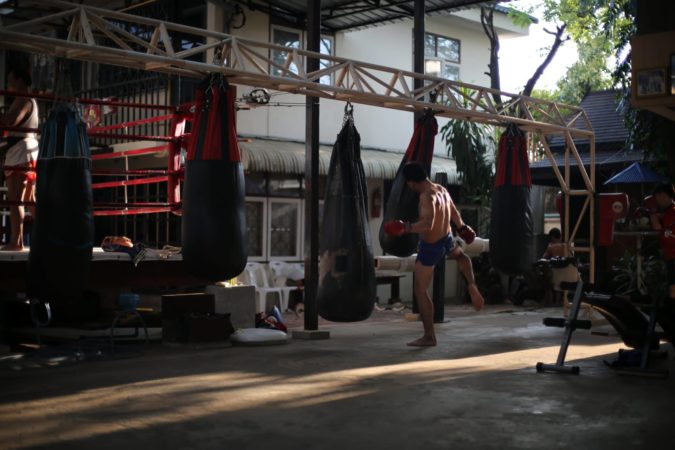
Morning training begins at 7:30am and goes to 9:30am. Afternoon training begins at 3:30pm to 5:30pm.
Contact Eminent Air
FA Group
FA Group is known as a clinch and knee gym. Their success has been seen with fighters such as Petchboonchu FA Group and Yothin FA Group. The gym is located behind Channel 7 Stadium, in the Mo Chit area of Bangkok.
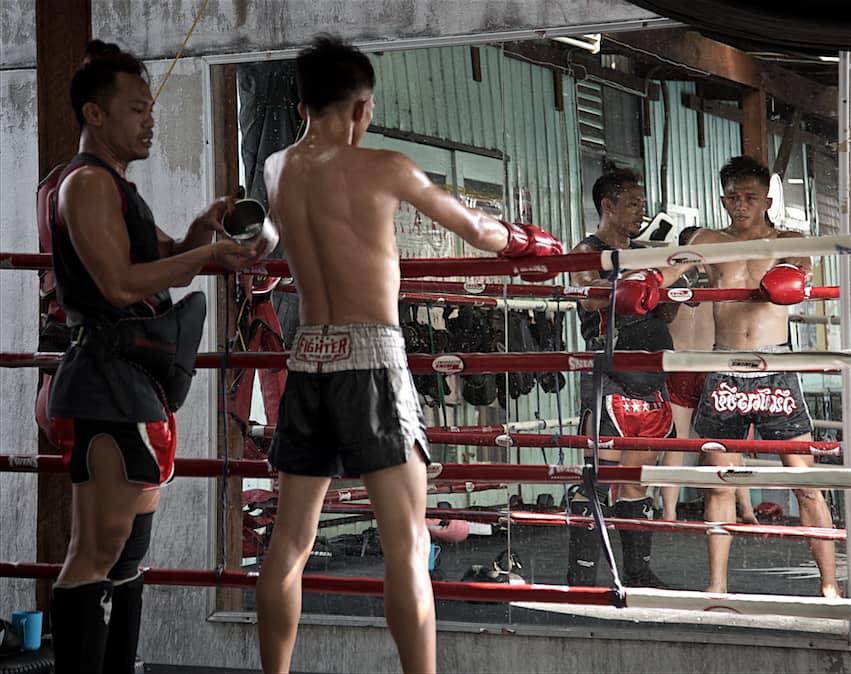
Morning training begins at 6:30 am with a run through Chatuchak park. The boxers return to the gym and train until 9:30 am. Afternoon training begins at 3:00pm and runs until 5:30pm. Afternoon sessions include an hour long clinch program followed by pad work, bag work, and running. The gym offers beginner exercise classes from 6:00pm to 8:30pm.
Contact FA Group
Ingram
Owned by Japanese expat Hideki Suzuki, Ingram is close to BTS Thong Lor, at the intersection of Rama 4 and Sukhumwit Soi 36. The gym produced Jos Rodrigues Mendonca, a former Rajadamnern belt holder. Other fighters include Sagapetch Ingram, Daosaming Ingram, and Rungthong Ingram.
The training is regimented at Ingram. Every session is the same with a morning run at 7:30am followed by pad work, bag work, sparring, and exercises. Morning training ends at 9am. The afternoon session goes from 3pm to 6pm. Afternoons will include clinching and every other day is boxing sparring.
Contact Ingram
Rithirit Gym Academy
Located close to MRT Ratachadapisek, Rithirit Gym was rebranded from Jitti Gym. It is one of the first Muay Thai gyms to open to foreigners. In the past, Liam Harrison and Jordan Watson, two of the UK’s best fighters, trained out of there. Now the gym does not have as many high profile fighters. It has a few foreign fighters but caters to people coming to work out.
Training here will mainly be pad work and bag work with occasional sparring and clinching with fellow students. Training in the morning begins at 9am and ends at 11am. Afternoon sessions run from 1pm to 9pm.
Contact Rithirit Gym
Kaewsamrit
Kaewsamrit is one of the older gyms in Bangkok. The gym is located in Western Bangkok in Nonthaburi. It has created several notable Thai and foreign fighters, including Anuwat Kaewsamrit, the Iron Hands of Siam, and Juan Mario Juan Martin. Currently the gym is a mix of Thais and foreigners. Kaewsamrit is a very boxing oriented gym and fighters will often have precise punching.
Training starts at 6am with a 10- to 12-kilometer run followed by pad work, bag work, and conditioning. Afternoon training starts at 3:30pm. Pad work includes one or two rounds of boxing and elbow work.
Contact Kaewsamrit
Khongsittha
Owned by Thai superstar Matthew Deane, Khongsittha is a fitness Muay Thai gym in Ladprao. The large-scale facility is new, clean, and foreign friendly. The gym targets fitness enthusiasts and regularly hosts workout camps. Students from around the world fly into the gym to train and take in the culture of Thailand. They don’t have many active fighters besides their strength and conditioning coach, Richi Alvarez, who is a regular fighter on Max Muay Thai.
The gym is open Tuesday to Sunday, with morning training beginning at 8am and ending at 10am. Training resumes in the afternoon from 4:15pm to 5:45. Training involves pad work, bag work, group exercises, and light clinching and sparring.
Contact Khongsittha
Kiatphonthip
Kiatphonthip is located in the Sala district of Western Bangkok, close to Mahidol University. The original gym was opened 16 years ago in Southern Thailand. But a second branch was opened in Sala in 2008, and is run by Muay Thai journalist and commentator, Rob Cox. The gym has produced a good stable of fighters including Jompop Kiatphonthip, Samingprai Kiatphonthip, and Samsamut Kiatchongkao. All have ranked at the top stadiums in Thailand. The large gym has a good balance of foreigners and Thais. Training caters to all levels.
Morning sessions begin at 7am with a long run. Then back to the gym for bag work, strength and conditioning, and other exercises. Afternoon sessions include boxing sparring three times a week.
Contact Kiatphonthip
Luktupfah
Luktupfah is run by Master Woody and is located along On Nut Road in Eastern Bangkok. Master Woody is the President of the World Muaythai Organization, Kru Muaythai Association, and World Muayboran Federation. Master Woody’s daughter, Jade Sirisompan, manages the gym and speaks fluent English.
The gym is large and spacious. Morning training begins at 6:30am with a long run followed by shadowboxing, conditioning, and clinching. The session ends at 9am. Afternoon sessions begin at 3:30pm with a short run. Day-to-day lessons vary with some days focused on technical learning and others on power. Normal pad work follows. The session ends at 6:30pm. Luktupfah offers Muayboran, Krabi Krabong, and Kru certificates. They have connections to several stadiums and can get foreigners fights.
Contact Luktupfah
Master Toddy’s Muay Thai Academy
Master Toddy’s gym is located off Sukumwit Soi 107 near Bearing BTS. The gym is medium-sized and includes some of Toddy’s trademark Cobra punching mitts. There is no afternoon training on Saturdays. The academy offers a variety of other courses including Krabi Krabong and Muay Boran. The first is a Thai derived martial arts system using weapons. Muay Boran is the name for the Thai martial art that developed into the ring sport of Muay Thai.
Morning training begins at 7:30am and ends at 9:30am. Afternoon training goes from 4pm to 6pm.
Contact Master Toddy’s
Sitsongpeenong
Located in Eastern Bangkok, Sitsongpeenong is one of the best known Muay Thai gyms in Thailand. It has produced several high quality international fighters including Sittichai Sitsongpeenong and Manachai Sitsongpeenong. The facilities are large and modern. The upstairs exercise area has two large rings. The gym also has a game room. Training is separated between Thais and foreigners.
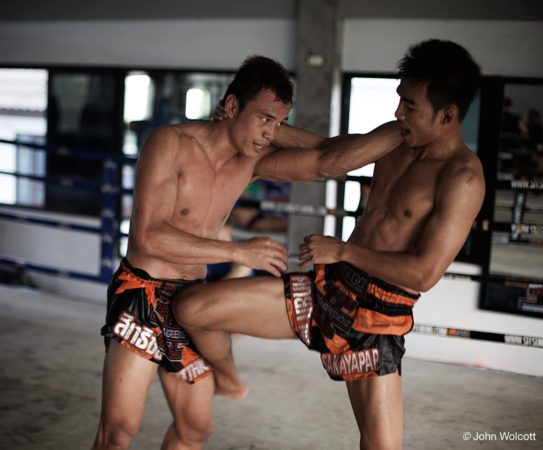
The training is dynamic, with sprinting and strength and conditioning in the mornings. Morning training begins at 5:30am and ends at 7:30am. Afternoon training begins at 2pm and ends at 5pm.
Contact Sitsongpeenong
Frequently Asked Questions
How much does Muay Thai training cost in Bangkok?
A single drop-in session runs in the low hundreds of baht at most gyms, with monthly packages working out cheaper per session. See the cost table above for a gym-by-gym breakdown, and confirm current rates directly with the gym since packages change.
Do I need experience to join a Muay Thai gym in Bangkok?
No. Fitness-oriented gyms in particular are set up for complete beginners, with trainers who break down technique step by step. Fight gyms can also take beginners, though the pace and culture lean more toward serious training.

Should a beginner choose a fight gym or a fitness gym?
Start with a fitness gym if your goal is exercise and learning the sport. Fitness gyms tend to have more structured instruction, better facilities, and easier access near the BTS or MRT, and they overlap with the wider options for staying fit in Bangkok. Move toward a fight gym later if you want to train more seriously or compete.
Are gloves and hand wraps provided?
Most gyms have loaner gloves and wraps for a first visit, sometimes for a small rental fee. Buy your own pair once you’ve decided to keep training.
What should I wear to a Muay Thai class in Bangkok?
Shorts and a t-shirt or tank top work fine. Training is done barefoot, so there’s no need for training shoes.
How many days a week should a beginner train?
Two to three sessions a week is a sustainable starting point. It’s enough to build the habit and see progress without burning out before the technique starts to click.
Final Thoughts
Choosing a gym is never an easy process. This list of resources makes it easier to find what you want and need. Take the first step and contact the gym. Take the next step and go.


 Français:
 Español:
 Deutsch: