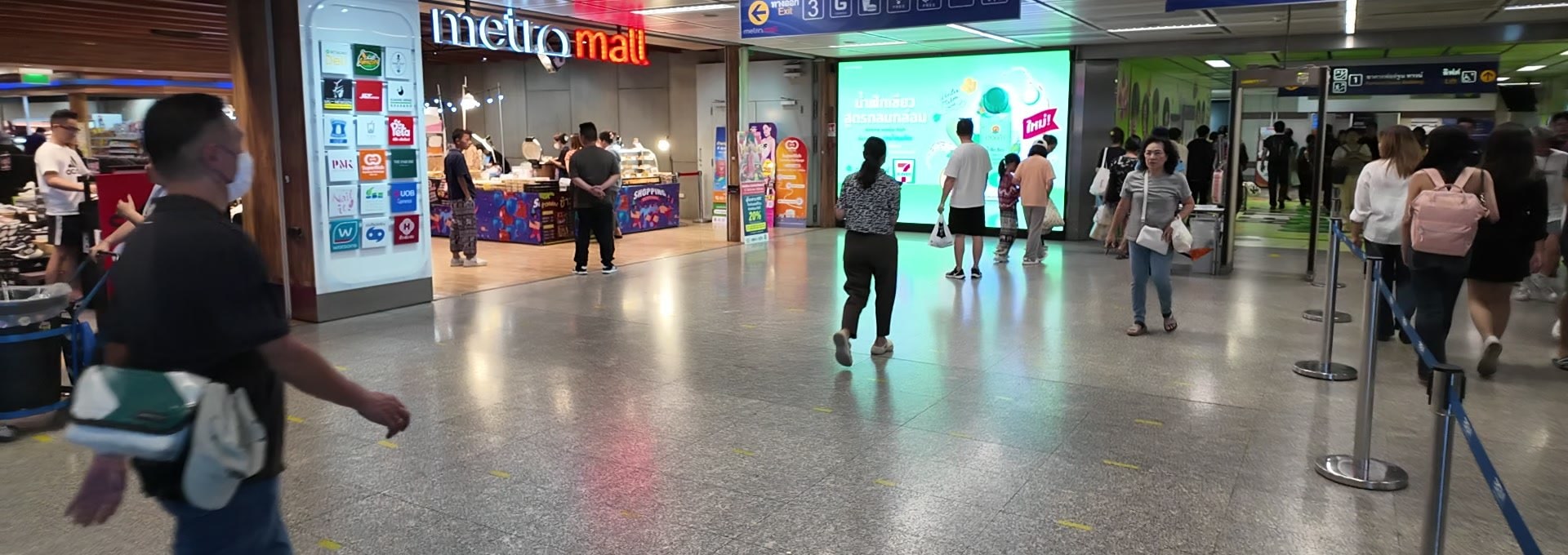
The MRT is Bangkok’s metro, and an adult trip on the Blue Line costs THB17 to THB44. You can pay by tapping a contactless Visa or Mastercard credit card at the gate, or buy a single-journey token from the station machine.
If the BTS is the train most expats live on, the MRT is the one that stitches the rest of Bangkok together. The Blue Line loops under the middle of the city and out across the river, the Purple Line heads north into Nonthaburi, and two monorails, the Yellow and the Pink, run out to the eastern and northern suburbs. We like it a lot. It’s clean and it’s fast, and underground, Bangkok’s traffic stops being your problem.
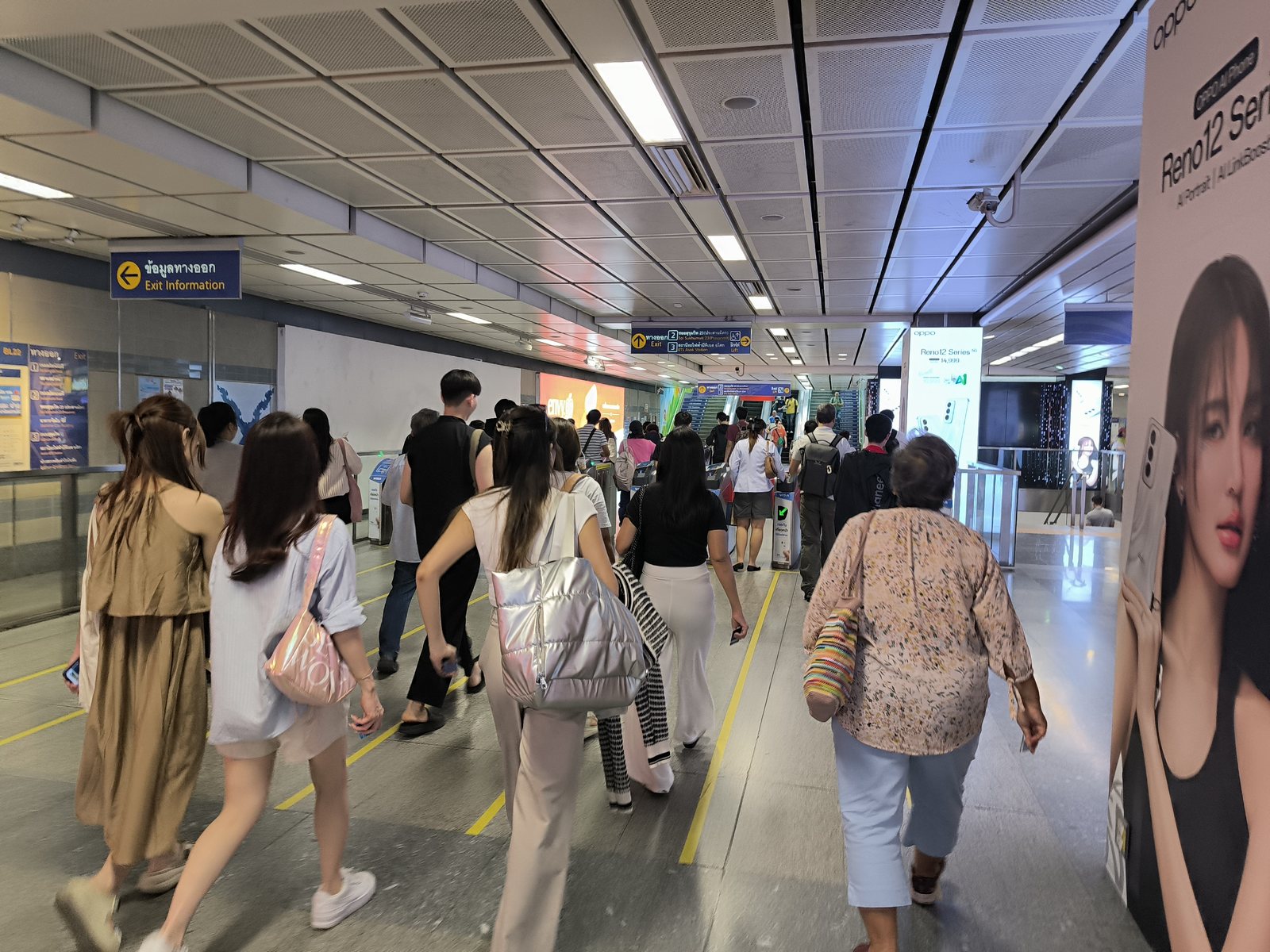
Rush hour is another story. Trains get very packed in the morning and evening, and on the busiest stretches you’ll be shoulder to shoulder with what feels like half of Bangkok’s office workers. Bring patience, and leave the big backpack at home if you can.
Then there’s the bit before the train. MRT stations sit on the main roads, so unless your condo is right next to one, you’re looking at a fair walk in the heat, or a motorcycle taxi down a small soi. Once you’re on board, though, nothing in this city beats it when the roads are jammed.
Below is everything you need to ride the MRT in Bangkok: the four lines, fares, tokens, what happened to the old MRT cards, paying with a bank card, and where to change to the BTS.
Disclaimer: Some links in this article go to our partners, and we may earn a commission if you use them. It costs you nothing extra, and we only recommend services we'd use ourselves. Read more in our Advertising Disclosure.
Contents
Key Takeaways
- An adult trip costs THB17 to THB44 on the Blue Line and THB14 to THB42 on the Purple Line, depending on distance.
- Tap a contactless Visa or Mastercard credit card at the gate, and use the same card to get out.
- The old MRT and MRT Plus stored-value cards stopped working on 1 June 2026, and you can get the balance back in cash until 31 December 2027.
- Foreigners can’t use the Mangmoom EMV card yet.
- Tokens still work on the Blue and Purple lines, but a QR ticket is expected to replace them from 1 January 2027.
- Children up to 120 cm tall ride the Blue and Purple lines for free.
- Change to the BTS at five Blue Line stations, including Sukhumvit for Asok and Si Lom for Sala Daeng.
- Don’t eat or drink on the train.


What Is the MRT?
The MRT is Bangkok’s Mass Rapid Transit network: four open lines built under the Mass Rapid Transit Authority of Thailand (MRTA) and run by private operators. Bangkok Expressway and Metro (BEM) runs the Blue and Purple lines. The Yellow and Pink monorails have their own operators, Eastern Bangkok Monorail (EBM) and Northern Bangkok Monorail (NBM). You don’t need to remember any of those names. What the split changes for you is which tickets and cards work where.
The Blue Line was Thailand’s first underground metro, and when someone in Bangkok says “take the MRT”, it’s almost always the one they mean. The other three run on elevated tracks.
The MRT and the BTS Skytrain are separate systems with their own gates and fares, so a trip that uses both means tapping out of one and paying again on the other. Yes, it’s annoying.
Who rides it? Office workers heading for Sukhumvit and Si Lom, weekend shoppers bound for Chatuchak Weekend Market, and plenty of expats living along Ratchadaphisek and Lat Phrao roads.
Pros and Cons
For crossing central Bangkok, we’d pick the MRT over a taxi on most trips, as long as you can handle a crowd and a walk.
Pros
- It’s clean and fast
- The underground Blue Line doesn’t care how bad the traffic is up top
- You can tap a contactless credit card at the gate, so there’s no card to buy or top up
- The longest adult trip on the Blue Line costs THB44
- You can change to the BTS at seven stations across the network
Cons
- Trains get very packed in the morning and evening rush
- Getting to the station, which often means a sweaty walk or a motorcycle taxi down a small soi
- Changing to the BTS means paying a second fare
- The BTS Rabbit card doesn’t work on the Blue and Purple lines
- Foreign debit cards aren’t on the Blue and Purple lines’ list of accepted cards
MRT Lines and Stations
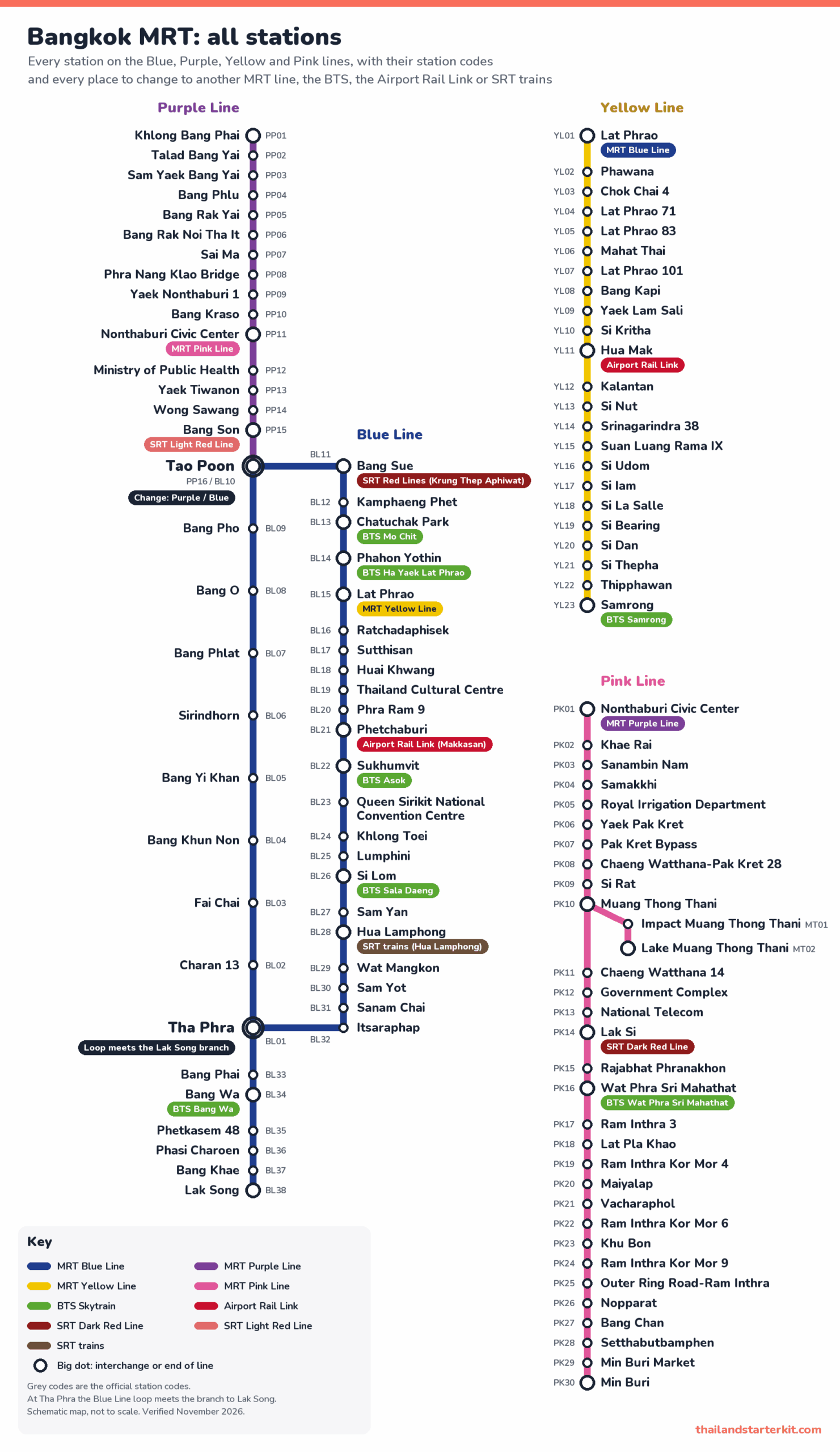
The MRT has four open lines, the Blue, Purple, Yellow and Pink, and the Blue Line is the one you’ll use most. The map below shows every station and every place to change trains, and it’s worth a screenshot before your first trip.
Blue Line
The Blue Line is a 48 km loop with 38 stations, and it’s the MRT line most expats and visitors use. Start at Tao Poon and it runs through Bang Sue and Chatuchak Park, down the Ratchada stretch past Huai Khwang, Thailand Cultural Centre and Phra Ram 9, then on to Sukhumvit, Lumphini, Si Lom and Hua Lamphong. Chances are your condo or your office sits near one of those.
From Hua Lamphong it heads west through Wat Mangkon, Sam Yot, Sanam Chai and Itsaraphap to Tha Phra. Tha Phra is the junction, and it’s where people get muddled. From there the loop carries on north through Charan 13 and Bang Pho back to Tao Poon, and a branch runs west through Bang Wa to Lak Song. The section between Hua Lamphong and Bang Sue is underground, and most of the western side is elevated.
Purple Line
The Purple Line is a 23 km elevated line with 16 stations, from Khlong Bang Phai in Nonthaburi to Tao Poon, where you change to the Blue Line. It follows Rattanathibet Road, crosses the river near Phra Nang Klao Bridge and comes down Tiwanon Road. Nonthaburi Civic Center is the stop for the Pink Line. If you live out in Nonthaburi, this is your way into town.
Yellow Line
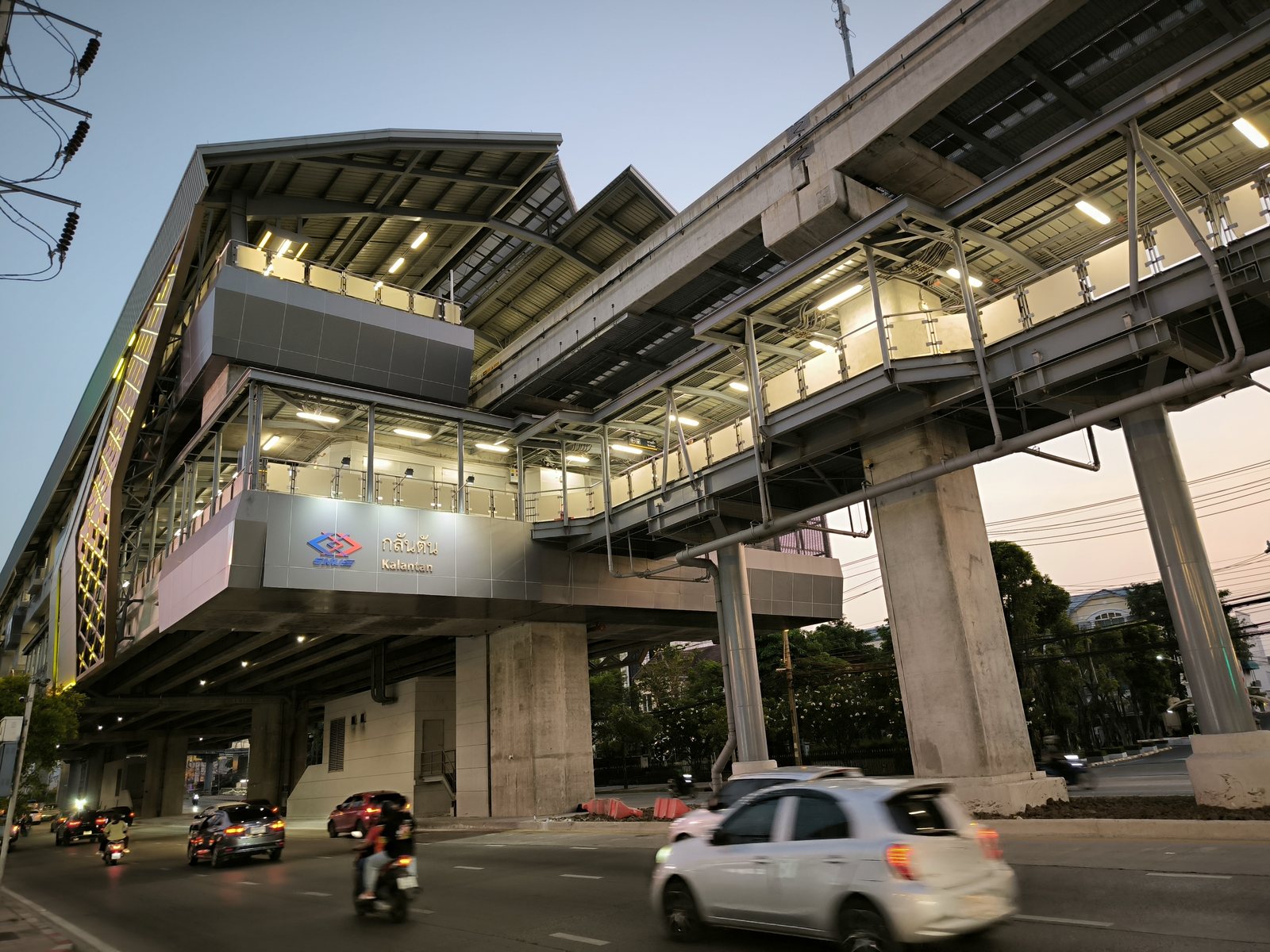
The Yellow Line is a 30.4 km monorail with 23 stations, opened on 3 July 2023, and it’s a big help if you live out east. It starts at Lat Phrao on the Blue Line, runs east along Lat Phrao Road to Bang Kapi, then turns south down Srinagarindra Road to Samrong, where it meets the BTS Sukhumvit Line. Hua Mak is the stop for the Airport Rail Link.
Pink Line
The Pink Line is a 34.5 km monorail with 30 stations on its main line, opened on 31 December 2023. It runs from Nonthaburi Civic Center on the Purple Line along Chaeng Watthana Road and Ram Inthra Road to Min Buri. A short branch from Muang Thong Thani serves two more stations, Impact Muang Thong Thani and Lake Muang Thong Thani.
Plenty of foreigners ride the Pink Line for one stop, Government Complex, the station for the immigration office on Chaeng Watthana Road. Our guide on getting to Chaeng Wattana immigration covers the walk from the station.
Orange Line (Not Open Yet)
The Orange Line isn’t open yet, so you won’t need it for a while. MRTA’s project page puts the opening of the eastern section, 17 stations from Thailand Cultural Centre to Min Buri (Suwinthawong), at January 2028.
How to Ride the MRT
To ride the MRT, tap your bank card or token on the gate reader, take the train toward your stop, and tap the same card again on the way out. A token goes into the slot on the exit gate instead. Easy.
Getting Through the Gates
Each token or card covers one person, so you can’t wave your friends through on your card. Everyone needs their own. Look for the contactless symbol on the gate, take your card out of your wallet first, and tap only that one card.
Use the same card to get in and out. Tap in with one card and out with another, and each card can be charged up to the maximum fare, which is an expensive way to learn the rule. On the Pink Line, the bank card readers sit beside the swing gate in front of the ticket office.
Finding the Right Platform
Check the direction on the platform sign before you go down. The Blue Line is a loop, so it’s easy to end up going the long way round, and you won’t notice until the station names stop looking familiar. Stand to the side of the doors and let people off first. At rush hour, don’t be surprised if the first train has no room for you. The next one is usually only a few minutes behind.
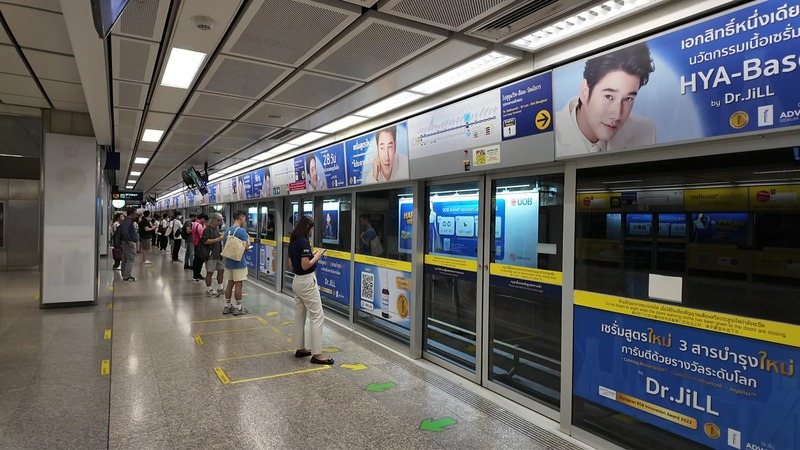
Getting Off
You can stay inside the paid area for up to 180 minutes on one trip, which is plenty unless you nod off and ride the loop. Go over, or lose your token or card inside, and you pay the maximum fare. (Verified November 2026.) Walked in by mistake? Walk back out at the same station within five minutes and you aren’t charged.
Went further than your token covers? No drama. Pay the difference at the ticket office before you leave.
Pick your exit before you go up. The exit signs list the streets and buildings each exit leads to, and the wrong one can add a long, sweaty walk, or a hunt for a motorcycle taxi on the wrong side of a big road.
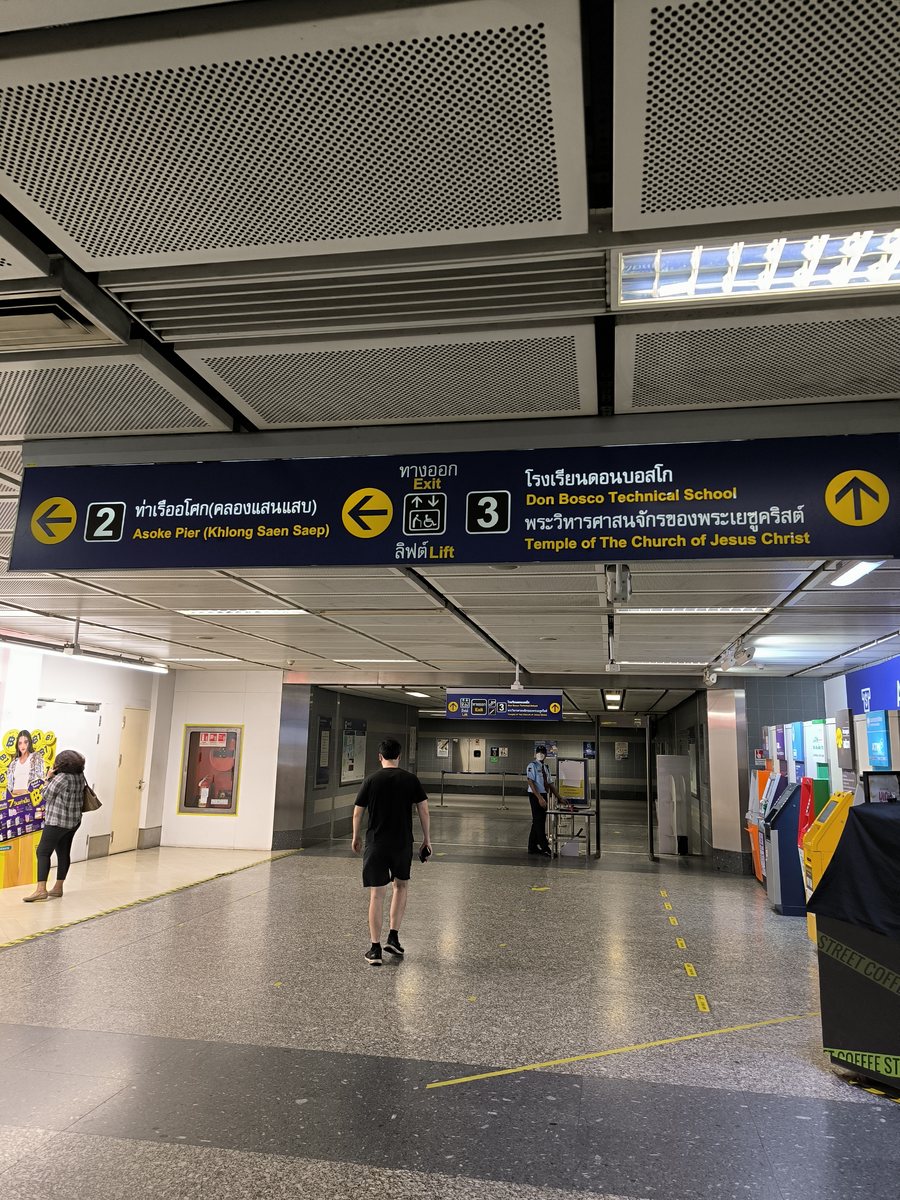
Rules and Fines
Riding without a valid ticket, or using one so the full fare isn’t paid, can cost up to 30 times the maximum fare, and staff can confiscate the ticket. (Verified November 2026.) Using someone else’s student or senior card counts too, so borrowing a Thai friend’s senior card isn’t the bargain it looks.
The rest is mostly common sense. The Ministerial Regulation that covers the MRT also bans:
- Smoking, or lighting anything
- Spitting, or dropping gum or rubbish anywhere except a bin
- Writing on or damaging anything in the system
- Leaning on or blocking the train doors or platform doors
- Bicycles and animals, unless staff give permission (guide dogs are allowed)
BEM’s safety notes also rule out pets and shoes with wheels on the Blue and Purple lines.
Fares
MRT fares are set by distance: THB17 to THB44 for an adult on the Blue Line and THB14 to THB42 on the Purple Line, under rates in force since 3 July 2026. (Verified November 2026.) The Yellow and Pink monorails each charge THB15 to THB45.
| Line | Adult fare per trip | Children who ride free |
|---|---|---|
| Blue Line | THB17 to THB44, by distance | Up to 120 cm tall |
| Purple Line | THB14 to THB42, by distance | Up to 120 cm tall |
| Yellow Line | THB15 to THB45, by distance | Up to 90 cm tall |
| Pink Line | THB15 to THB45, by distance | Up to 90 cm tall |
Thai citizens aged 60 and over pay half fare on all four lines, and disabled passengers who show a government disability card ride free. The senior discount needs Thai nationality, so foreign retirees pay the adult fare, however grey the hair.
Some good news if you change between MRT lines: at an interchange station, you pay the entry charge only once. Change from the Purple Line to the Pink Line at Nonthaburi Civic Center within 30 minutes on the same bank card, and the THB15 entry fee is refunded to the card afterwards.
Until 30 November 2026, Purple Line travel on a contactless bank card or EMV card is capped at THB40 a day for adults, with anything over the cap refunded to the card. Nice if you commute from Nonthaburi, while it lasts. For exact fares between two stations, use the BEM fare calculator.
Tickets
A single-journey token is the simplest way to ride the Blue and Purple lines without a bank card. It’s a small black plastic disc that looks a bit like a poker chip, and it’s valid only on the day you buy it, from the station where you bought it.
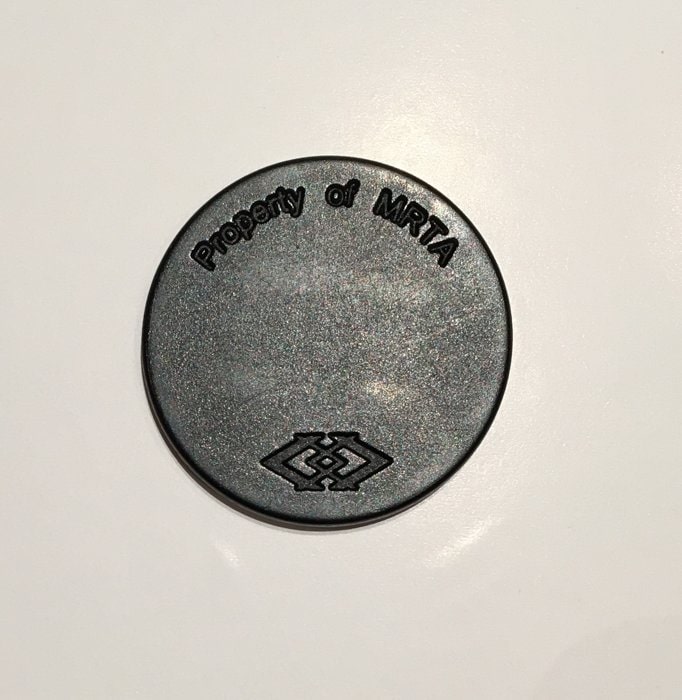
The ticket machines take THB1, THB5 and THB10 coins and THB20, THB50 and THB100 notes, and they give change in coins only. Feed one a THB100 note for a short trip and you’ll walk away jingling. To buy a token:
- Pick your destination station on the screen.
- Pay with coins or notes.
- Take the token and your change.
The ticket office sells tokens too, and it’s where you get child and senior tokens. Bought one and changed your mind? Take it back to the ticket office for a cash refund.
Tokens are on their way out. MRTA expects to stop using them from 1 January 2027 and switch single-journey riders to a QR ticket that you scan at the gate. (Verified November 2026.) That date is a target, so check the machines when you arrive.
Tickets on the Pink and Yellow Lines
The Pink and Yellow lines sell their own single-journey tickets from the station machines, which take a QR code payment from a banking app as well as coins. Skytrain regulars get a small win, because they also take the BTS Rabbit card, and you can add value to a Rabbit card at their machines (banknotes only) or ticket offices, which are open from 06:00 to 24:00.
Cards
The old MRT and MRT Plus stored-value cards stopped working on the Blue and Purple lines on 1 June 2026, and that includes the student and senior versions and any trip passes on them. (Verified November 2026.) Top-ups had already ended on 1 April 2026, so if you still have one in a drawer, it won’t open a gate. It’s now a souvenir with money on it.
You can still get your money back. Take the card to the ticket office at any Blue or Purple Line station by 31 December 2027, show your ID, and staff refund the remaining balance and the card deposit in cash.
Mangmoom EMV Card
The Mangmoom EMV card is MRTA’s prepaid EMV card for the MRT, and foreigners can’t use it yet. (Verified November 2026.) The card has to be linked in the Paotang app, and Paotang only accepts Thai nationals.
For Thai residents, it costs THB200 at Blue and Purple Line ticket offices (a THB100 fee plus THB100 of travel value) until 31 December 2026, down from THB250. It works on all four MRT lines.
MRT EMV Card
BEM also sells its own prepaid MRT EMV card, which works on the Blue, Purple and Yellow lines. You register it in the Bangkok MRT app, whose identity check asks for a national ID card or passport, and top it up in the app by scanning a QR code with a Thai banking app (free) or through other channels that charge a fee.
We couldn’t confirm whether ticket offices will issue one to a foreigner, so ask first. Honestly, a credit card does the same job with far less paperwork.
Rabbit Card
The BTS Rabbit card works on the Pink and Yellow lines, but not on the Blue and Purple lines. BEM’s ticket conditions for those two lines list tokens, MRT cards and bank cards, and the Rabbit card isn’t one of them. Confusing, we know. If you already carry a Rabbit for the Skytrain, our BTS guide covers how to buy and top it up.
Paying Without Cash
Tapping a contactless bank card at the gate is the easiest way for a foreigner to ride the MRT, and it became the main way to pay on the Blue and Purple lines when the old cards ended on 1 June 2026. (Verified November 2026.) Look for the contactless symbol on the card and on the gate. If your card has it, you can forget about tokens and ticket machines altogether.
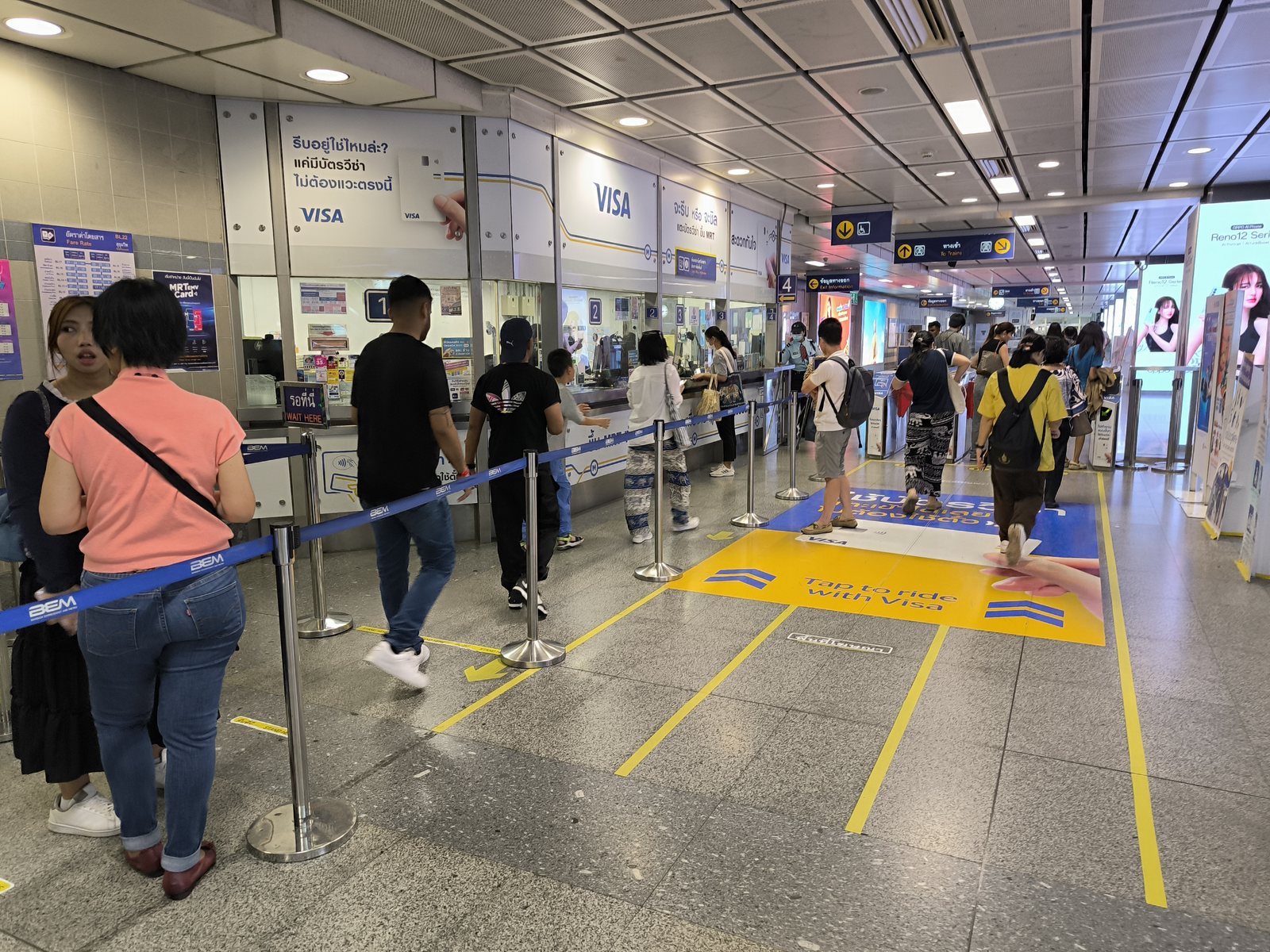
On the Blue and Purple lines, BEM accepts:
- Credit cards: Visa or Mastercard from any bank, Thai or foreign, plus a list of Thai-issued UnionPay cards
- Debit cards: Visa or Mastercard from Krungthai, Krungsri, Kasikornbank, SCB and UOB only
- Prepaid cards: including BigPay and the prepaid cards of several Thai banks
The Pink Line also takes Visa, Mastercard and UnionPay debit cards issued abroad. On the Blue and Purple lines, bring a credit card, or a debit card from one of those five Thai banks, which is one more reason to open a Thai bank account.
Tip: Tap the same card in and out, and keep it apart from your other cards. A reader that picks up the wrong card can leave you with two half-finished trips, each charged up to the maximum fare.
Think you’ve been overcharged? Register your card on mangmoomemv.com to check your trips and fares for the last 60 days and dispute a wrong charge.
Operating Hours and Frequency
The Blue Line runs from 06:00 to midnight every day, and the Purple Line from 05:30 to midnight on weekdays and 06:00 to midnight at weekends and on public holidays. (Verified November 2026.) The Yellow and Pink lines run from 06:00 to midnight daily.
| Line | Service hours | Peak hours | Train every |
|---|---|---|---|
| Blue Line | 06:00 to 24:00 daily | 07:00 to 09:00 and 16:30 to 19:30 | 4 minutes or less at peak, 7 minutes or less otherwise |
| Purple Line | 05:30 to 24:00 Monday to Friday; 06:00 to 24:00 weekends and public holidays | 06:30 to 08:30 and 17:00 to 19:30 | 6 minutes or less at peak, 9 minutes or less otherwise |
| Yellow Line | 06:00 to 24:00 daily | Published on the EBM timetable page | Published on the EBM timetable page |
| Pink Line | 06:00 to 24:00 daily | Published on the NBM timetable page | Published on the NBM timetable page |
Check the last train for your station before a late night out, unless you fancy a taxi home. The BEM fare calculator shows the first and last trains for each Blue and Purple Line station. For the monorails, check the timetables on the Yellow Line and Pink Line websites.
For questions, the MRT Information Service Center (Blue and Purple lines) is on 0 2624 5200, from 07:00 to 20:00 on weekdays and 08:00 to 17:00 at weekends. The Pink and Yellow lines share a call centre on 0 2617 6000, open daily from 06:00 to 24:00.
Transferring to the BTS and Other Lines
You can change from the MRT to the BTS at seven stations, to the Airport Rail Link at two, and between MRT lines at three. Every change to another system means tapping out and paying a new fare, and the BTS gates don’t take bank cards. Keep a Rabbit card handy, or buy a BTS ticket.
Changing Between MRT Lines
- Tao Poon: Blue Line and Purple Line in one building, with the Blue Line platforms on the third floor and the Purple Line on the fourth
- Lat Phrao: Blue Line and Yellow Line, via exit 4 of the Blue Line station
- Nonthaburi Civic Center: Purple Line and Pink Line, via exit 1B of the Purple Line station
Changing to the BTS
- Chatuchak Park (Blue) and BTS Mo Chit, via exit 3
- Phahon Yothin (Blue) and BTS Ha Yaek Lat Phrao, via exit 4
- Sukhumvit (Blue) and BTS Asok, via exit 3
- Si Lom (Blue) and BTS Sala Daeng, via exit 2
- Bang Wa (Blue) and BTS Bang Wa, via exits 3 and 4
- Wat Phra Sri Mahathat (Pink) and the BTS Sukhumvit Line
- Samrong (Yellow) and the BTS Sukhumvit Line
Airport Rail Link and SRT Trains
- Phetchaburi (Blue) and Makkasan on the Airport Rail Link, via exit 1
- Hua Mak (Yellow) and the Airport Rail Link, via exit 1
- Bang Sue (Blue) and Krung Thep Aphiwat Central Terminal for the SRT Red Lines, via exit 3
- Lak Si (Pink) and Lak Si station on the SRT Dark Red Line, via exit 1
- Bang Son (Purple) and Bang Son station on the SRT Light Red Line
- Hua Lamphong (Blue) and Bangkok Railway Station (Hua Lamphong), via exit 2
Sukhumvit is the change most expats use, and our guide to living in Asok covers the area around it. For trains to Suvarnabhumi and Don Mueang, see our Bangkok airport transfers guide.
MRT Etiquette
MRT etiquette mostly comes down to taking up less space and making less noise, and the Ministerial Regulation that governs the system backs most of it up. (Verified November 2026.) Thai riders are patient, but a few habits get you stared at fast.
- Wear your backpack on your front. A bag on your back swings into people every time you turn. Hold it in front or put it at your feet, and keep big luggage out of the way. The regulation bans bringing on anything too big or heavy to handle yourself, or that gets in other passengers’ way.
- Don’t eat or drink on the train. Finish that iced coffee before you board. The regulation bans food and drink on board, and alcohol anywhere outside the places set aside for it.
- Keep your voice down. Causing annoyance to other passengers is banned, and playing music or using anything noisy needs staff permission.
- Keep your feet off the seats. Standing on seats, putting your feet up or sleeping across them is banned, and anything strong-smelling has to be sealed.
How seriously do Thais take the noise rule? In July 2026 a video of a group of foreign teenagers shouting in a BTS carriage near Sala Daeng spread across Thai social media. A Thai passenger who asked them to quieten down later filed a complaint at Samre Police Station, and the group’s tour agency apologised. It happened on the Skytrain, but the same carriage would get the same reaction on the MRT.
Tip: If someone asks you to be quieter, lower your voice and say sorry. Nobody on the train will take your side for arguing.
Next Steps
For your first ride, keep it simple and tap a contactless credit card at the gate, or buy a token from the machine. If you live here and still have an old MRT card, dig it out and take it to a Blue or Purple Line ticket office for a cash refund before 31 December 2027.

Most trips across the city mix the MRT and the BTS, and our guide on how to take the BTS in Bangkok covers the Skytrain side. For places no train reaches, our guide on how to take a bus in Bangkok walks through the buses, and getting around Bangkok covers taxis and boats too.
Still choosing where to live? Get as close to a station as your budget allows. You’ll thank yourself every hot afternoon. The Bangkok neighborhood map shows the areas, and our guides to Lat Phrao, Rama 9 and Chaeng Watthana cover three MRT neighbourhoods in detail.
Frequently Asked Questions
How much does the MRT cost in Bangkok?
An adult trip costs THB17 to THB44 on the Blue Line, THB14 to THB42 on the Purple Line, and THB15 to THB45 on the Yellow and Pink lines, depending on distance.
Can I pay for the MRT with a credit card?
Yes. Tap a contactless Visa or Mastercard credit card from any bank, foreign banks included, at the gates on all four MRT lines. Debit cards are fussier. On the Blue and Purple lines, they only work if they’re from Krungthai, Krungsri, Kasikornbank, SCB or UOB.
Does the Rabbit card work on the MRT?
The Rabbit card works on the MRT Pink and Yellow lines, but not on the Blue and Purple lines. On those two, use a contactless bank card or a token.
What happened to the MRT stored-value card?
The MRT and MRT Plus stored-value cards stopped working on 1 June 2026. You can get the remaining balance and deposit back in cash at a Blue or Purple Line ticket office until 31 December 2027.
What time does the MRT close?
MRT service hours end at midnight on all four lines, and the BEM fare calculator shows the last train from each Blue and Purple Line station. The Blue Line opens at 06:00, and the Purple Line at 05:30 on weekdays.
Do children ride the MRT for free?
Children up to 120 cm tall ride the Blue and Purple lines for free, and children up to 90 cm ride the Yellow and Pink lines for free.
Where can I change from the MRT to the BTS?
Change at Chatuchak Park for Mo Chit, Phahon Yothin for Ha Yaek Lat Phrao, Sukhumvit for Asok, Si Lom for Sala Daeng and Bang Wa for Bang Wa, all on the Blue Line. The Pink Line meets the BTS at Wat Phra Sri Mahathat and the Yellow Line at Samrong.
Sources Cited
- BEM, MRT route map: Blue and Purple line length, station count, service hours and train frequency, Tha Phra junction, Tao Poon interchange.
- BEM, Blue Line stations and Purple Line stations: station names and codes.
- BEM, Tao Poon, Bang Sue, Chatuchak Park, Phahon Yothin, Lat Phrao, Phetchaburi, Sukhumvit, Si Lom, Hua Lamphong, Bang Wa and Nonthaburi Civic Center stations: exits and connections to the BTS, Airport Rail Link, SRT and other MRT lines.
- MRTA, Yellow Line and Pink Line: length, station count, opening dates, operators, service hours and connections.
- MRTA, Orange Line (eastern section): planned opening in January 2028, 17 stations.
- NBM, Pink Line route map and EBM, Yellow Line route map: station names and codes, exits to the SRT Dark Red Line at Lak Si and the Airport Rail Link at Hua Mak.
- SRT Electrified Train, Red Line: Purple Line connection at Bang Son and Blue Line connection at Krung Thep Aphiwat.
- BTS Skytrain, Route map: BTS connections at Wat Phra Sri Mahathat and Samrong.
- MRTA, Blue Line fare regulation 2026 and Purple Line fare regulation 2026: fares from 3 July 2026, free travel for children up to 120 cm and disabled passengers, half fare for Thai citizens aged 60 and over, single entry charge on transfers.
- MRTA, Yellow Line fare regulation and Pink Line fare regulation: fare tables, free travel for children up to 90 cm, senior and disability rules.
- BEM, Ticket Issuing Conditions for the MRT Blue Line: tokens, accepted ticket types, MRT EMV card, 180-minute limit, five-minute rule, lost ticket and fare evasion charges.
- BEM, Issuing ticket: ticket machine coins and notes, change in coins, how to use tokens at the gate.
- BEM, Discontinuation of MRT and MRT Plus cards: end of top-ups on 1 April 2026, end of use on 1 June 2026, cash refunds until 31 December 2027, accepted debit and prepaid cards.
- MRTA, EMV contactless press release (27 February 2026): full switch to EMV from 1 June 2026, tokens expected to be replaced by QR tickets from 1 January 2027, bank cards accepted on all four MRT lines.
- MRTA, Ticket FAQ: Mangmoom EMV card price, lines covered and the Thai-nationals-only Paotang requirement.
- BEM, EMV Contactless: accepted credit, debit and UnionPay cards, how to tap, trip history and disputes.
- BEM, MRT EMV Card: registration in the Bangkok MRT app with a national ID card or passport, top-up channels and fees.
- BEM, Card FAQs: THB40 daily cap on the Purple Line until 30 November 2026.
- NBM, EMV card on the Pink Line: cards accepted including foreign debit cards, card readers at the swing gates, THB15 transfer refund from the Purple Line.
- NBM, Pink Line timetable and EBM, Yellow Line timetable: Rabbit cards and single-journey tickets, QR payment at machines, ticket office hours.
- MRTA, Ministerial Regulation on safety and order in the MRT system (2004, unofficial translation): bans on food and drink, smoking, spitting, annoying other passengers, feet on seats and leaning on doors; bicycles, animals and noise need permission.
- BEM, Safety tips: no pets, bicycles or wheeled shoes on the Blue and Purple lines.
- Thairath English: complaint filed at Samre Police Station after the July 2026 BTS noise row.
- Nation Thailand: tour agency apology.