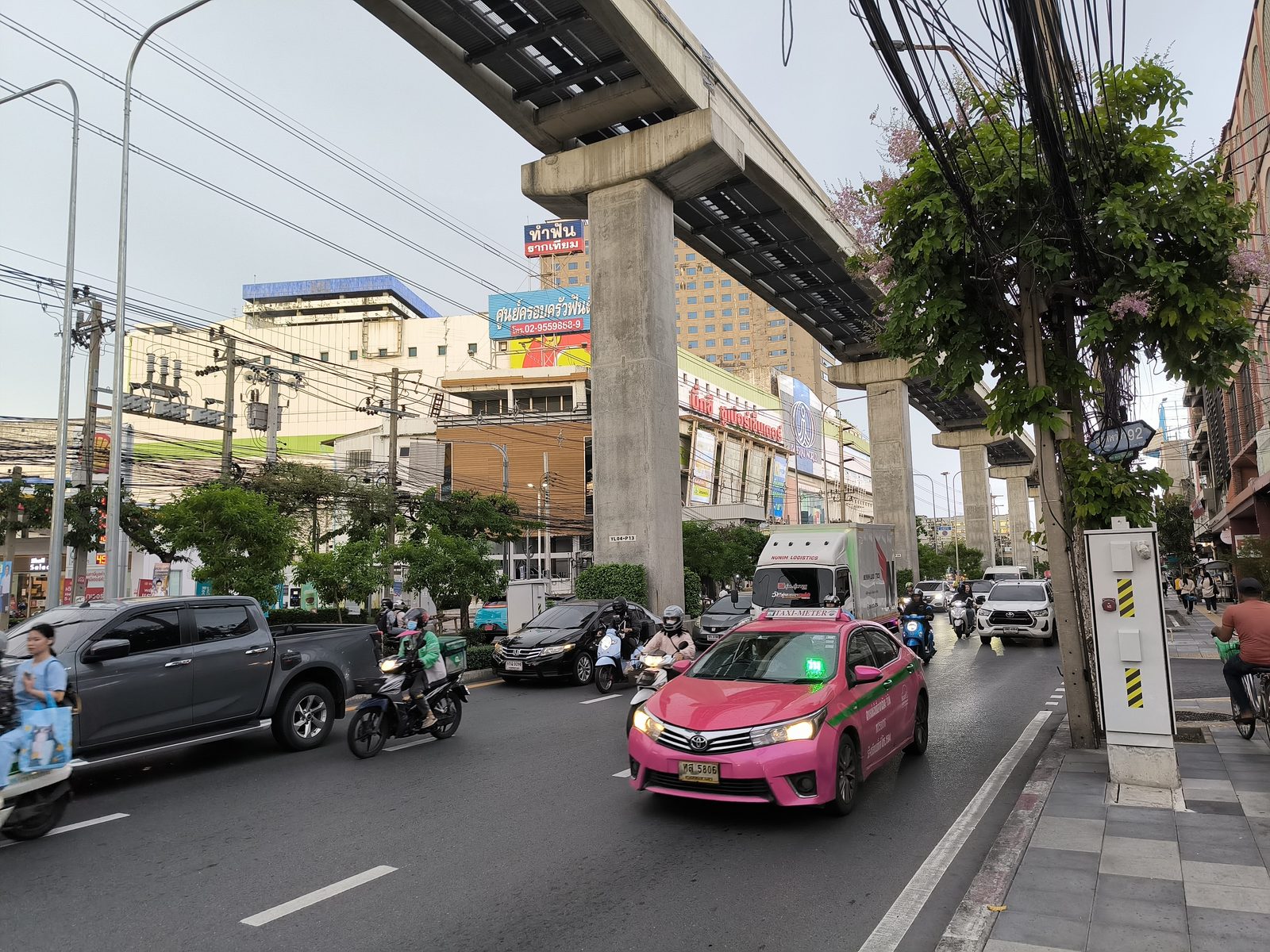
Lat Phrao is the long, local stretch of Lat Phrao Road east of the Ratchada junction, under the MRT Yellow Line. Rents are low and the signs are in Thai. It suits families and budget expats who want space and can live with the traffic.
The name confuses everyone, because Lat Phrao Road doesn’t run through Lat Phrao district. It starts in Chatuchak, crosses Huai Khwang and Wang Thonglang, and ends at Bang Kapi.
This guide covers the middle of that road, from the Ratchada junction out past the Yellow Line stops, plus the Chokchai 4 side. Expect food stalls at the soi mouths and a monorail running overhead.
It covers where the area starts and ends, what a flat costs, where to eat, how the trains and floods work, and how it compares with Ratchada and Chatuchak.
Disclaimer: Some links in this article go to our partners, and we may earn a commission if you use them. It costs you nothing extra, and we only recommend services we'd use ourselves. Read more in our Advertising Disclosure.
Contents
- Key Takeaways
- Thailand Starter Kit Rating
- Location
- Pros and Cons of Living in Lat Phrao
- What Daily Life Looks Like in Lat Phrao
- Lat Phrao Cost of Living at a Glance
- Accommodation in Lat Phrao
- Dining Out in Lat Phrao
- Drinking in Lat Phrao
- Groceries in Lat Phrao
- Central Ladprao and the Long Lat Phrao Road
- Transportation Options for Lat Phrao
- Flooding in Lat Phrao
- Healthcare in Lat Phrao
- International Schools in Lat Phrao
- Parks in Lat Phrao
- Other Standout Venues and Features
- Lat Phrao vs. Ratchada vs. Chatuchak
- Should You Live in Lat Phrao?
- Frequently Asked Questions
- Sources Cited
Key Takeaways
- Lat Phrao is a budget pick, with rents below Ratchada and Chatuchak.
- A one-bedroom typically asks roughly THB9,000 to THB16,000 a month. Older apartment rooms in the sois go lower.
- The MRT Yellow Line runs along Lat Phrao Road from 6 a.m. to midnight, and the Blue Line at the Lat Phrao interchange puts Asok about 19 minutes away.
- The risk of a big flood is higher here. Lat Phrao Road flooded from the Ratchada junction to Bang Kapi in 2026, while the Chokchai 4 side stayed dry that year but went under in 2011.
- Very few foreigners live here, so daily life runs in Thai.
- There’s almost no park. Chatuchak Park is two Blue Line stops from the interchange.
- Ladprao General Hospital (200 beds) sits on Lat Phrao Road, and Paolo Hospital has a branch at Chokchai 4.
- Nearby international schools are mostly early-years campuses. The full-age ones are about 3 km away.

Location
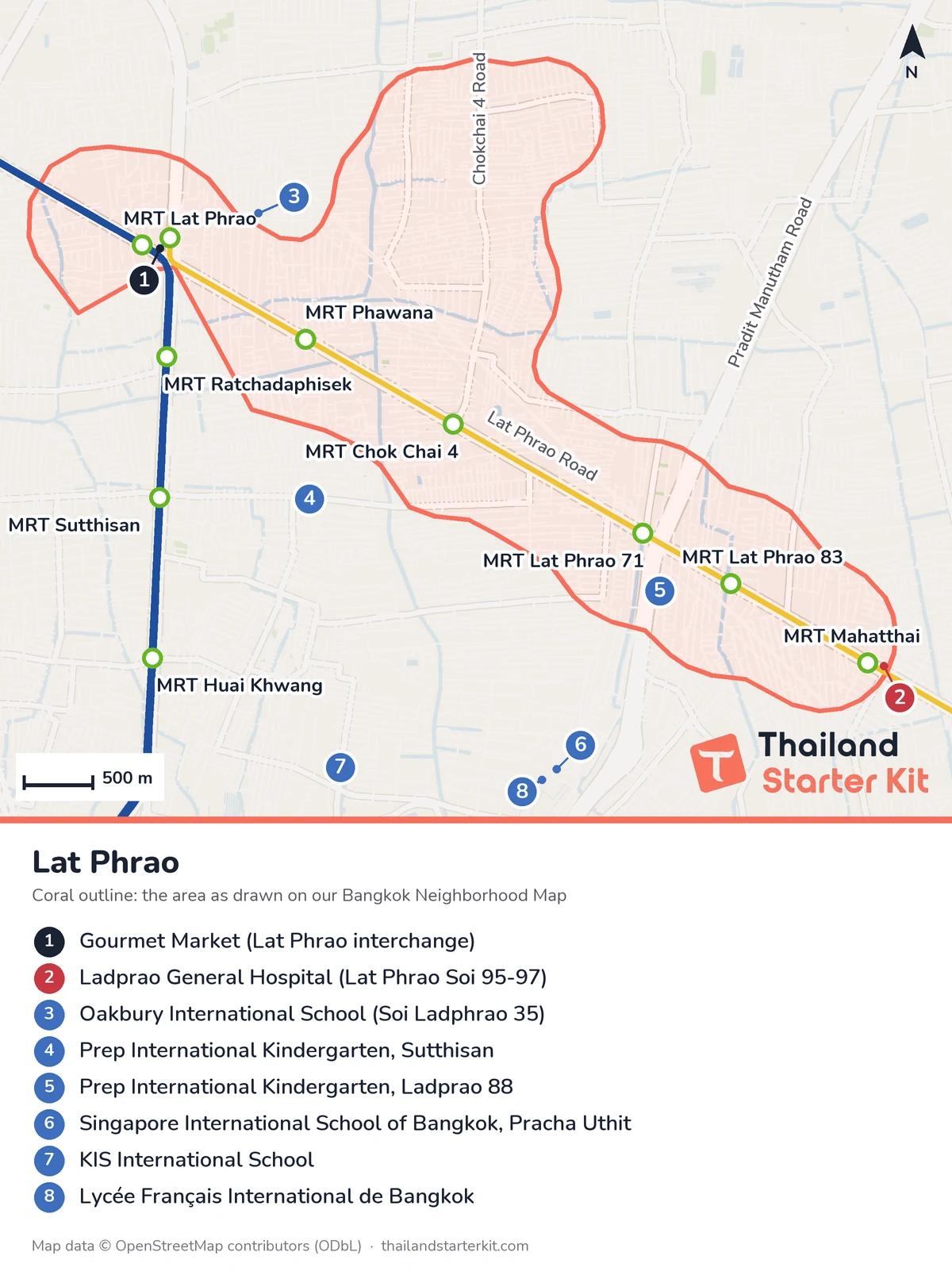
In this guide, Lat Phrao means Lat Phrao Road from the MRT Lat Phrao interchange east to Mahatthai, plus Chokchai 4 Road to the north. Signs and listings also spell it Ladprao or Lad Phrao.
That’s six Yellow Line stops, with the monorail overhead the whole way. From west to east, they are:
- Lat Phrao (interchange with the MRT Blue Line)
- Phawana
- Chok Chai 4
- Lat Phrao 71
- Lat Phrao 83
- Mahatthai
Most of it sits in Wang Thonglang district. The Chokchai 4 side belongs to Lat Phrao district, and the interchange itself is in Chatuchak.
Tip: Lat Phrao district and Lat Phrao Road are different things. Check the district on any listing, because flood records and prices follow the district.
The western edge is the Ratchada junction. One stop before it on the Blue Line is MRT Ratchadaphisek, where our Ratchada guide ends and Lat Phrao begins.
One Blue Line stop west of the interchange is Phahon Yothin, near the Ha Yaek Lat Phrao junction with Central Ladprao and Union Mall. Those belong to Chatuchak, which we cover separately.
Past Mahatthai, the Yellow Line carries on through Lat Phrao 101 to Bang Kapi, where the road ends.
Read more: Living in Bangkok suburbs.
Pros and Cons of Living in Lat Phrao
Lat Phrao’s big wins are cheap rent and a monorail at your door. The big costs are rush-hour traffic and rain that sits on the road after a storm.
Pros
- Low rents: Lat Phrao is the budget option, below Ratchada and Chatuchak.
- Two train lines: The Yellow Line runs along the road, and a covered passage links its western terminus to the Blue Line.
- Thai street food everywhere: Stalls line the road and spill into the sois, and Chokchai 4 has an evening food market.
- Family-sized housing: Townhouses and large older condos turn up on the sois at rents central Bangkok can’t match.
- Hospitals close by: Ladprao General Hospital is on the road itself, and Paolo Hospital has a branch at Chokchai 4.
Cons
- Traffic: Lat Phrao Road is one of the city’s heavy corridors, and every soi feeds straight into it. At rush hour, nothing on it moves fast.
- Floods: Street flooding is routine in heavy rain, and the risk of a big flood is higher.
- Few Western restaurants and groceries: Very few foreigners live here, so English menus are rare.
- Almost no parks: For a proper walk, you’ll ride to Chatuchak Park.
- Thin nightlife, no coworking: There’s no coworking space, and a night out usually means Ratchada.
What Daily Life Looks Like in Lat Phrao
Daily life in Lat Phrao runs on the Yellow Line and cheap Thai street food, with traffic noise never far away.
On a weekday, the monorail is running by 6 a.m. You grab rice or noodle soup from a stall at the mouth of your soi for roughly THB50 to THB70, while the motorbike taxis wait for their first fares.
Then you ride to the Lat Phrao interchange and walk the covered passage past Gourmet Market to the Blue Line. Asok is about 19 minutes from there.
Down on Lat Phrao Road, rush hour crawls. From the platform, you’ll see why the train is the main attraction.
On the way home, you pick up groceries at Gourmet Market in the station passage, then ride the Yellow Line back out to your stop.
By late afternoon, the stalls at Chokchai 4 are setting up. After dark, office workers and families stand at the carts working out dinner.
Don’t leave it late, since vendors start packing up after 9 p.m. If you miss them, Som Yot keeps serving rice soup into the small hours.

Saturday starts slowly. There’s almost no green space near home, so you ride the Blue Line two stops to Chatuchak Park, where the weekend market draws the crowds.
On Sunday, Thai families head one Blue Line stop west to Central Ladprao, which opens at 10 a.m. Go at opening time. By mid-afternoon, it’s a mistake.
In the rainy season, you plan around the sky. After a heavy storm, shallow water can cover parts of the road, and BMA’s 2025 records mostly show 10 to 20 centimeters.
On those days, you stay in or take the train.
Lat Phrao Cost of Living at a Glance
A one-bedroom condo in Lat Phrao asks roughly THB9,000 to THB16,000 a month, below both Ratchada and Chatuchak. Our cost of living in Bangkok guide has the city-wide picture.
| Item | Typical cost |
|---|---|
| Studio condo near a Yellow Line station | THB6,000 to THB11,000 a month |
| One-bedroom condo near a Yellow Line station | THB9,000 to THB16,000 a month |
| Two-bedroom condo or large older apartment | THB14,000 to THB26,000 a month |
| Older apartment room in a soi | THB4,000 to THB7,000 a month |
| Townhouse in a soi | THB18,000 to THB40,000 a month |
| Street-stall rice dish or noodle soup | Roughly THB50 to THB70 a plate |
| Yellow Line trip, full route | THB15 to THB45 a trip (2023 approved fares) |
A flat a few minutes’ walk from a Yellow Line station usually costs more than one deep in a soi. The same layout also gets pricier with height, a view and furniture.
Read more: Bangkok apartments and condos.
Accommodation in Lat Phrao
Housing in Lat Phrao is mostly older condos, apartment blocks and townhouses down long sois, with newer condos tending to sit near the Yellow Line stations. We haven’t named buildings, because we couldn’t check listings for this guide.
Modern but Small Condos
Newer condos near the Yellow Line stations are mostly studios and one-bedrooms. Expect roughly THB9,000 to THB16,000 for a one-bedroom within a few minutes’ walk of a station.
Walk from the building to the platform before you sign, ideally at midday. A unit that looks close on the map can mean a long, hot walk along Lat Phrao Road.
Bigger, Older, Affordable Condos
An older condo deeper in a soi gets you the most space for the money. Two-bedrooms typically run THB14,000 to THB26,000, which works for couples who want a spare room.
Check the lift and the parking, and ask whether the ground floor has flooded. The flood section below explains why that matters here.
Townhouses and Gated Communities
Townhouses are the main option for families, at roughly THB18,000 to THB40,000 a month. Ask about gated projects on the Chokchai 4 side, and check the district on the listing.
Supply is small, and walking the lanes often beats searching online. Our guide to finding houses in Bangkok explains how.
Budget Options
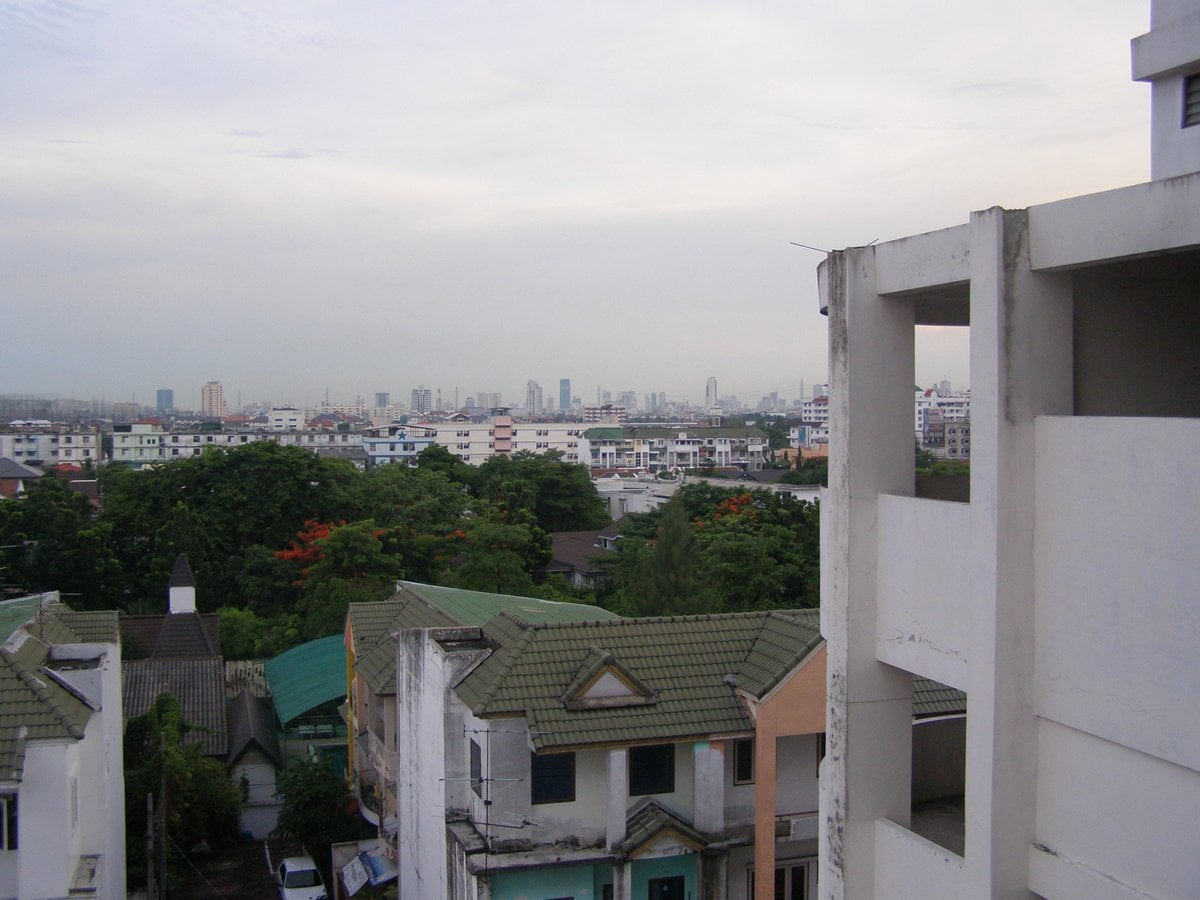
Older apartment blocks in the sois have the cheapest rooms, from roughly THB4,000 to THB7,000 a month. You’ll get a smaller unit and a walk to the station. The walls are thin, so expect to learn your neighbor’s TV schedule.
These blocks suit budget expats who spend their days elsewhere. Ask about the water and electricity rates before you pay a deposit.
Dining Out in Lat Phrao
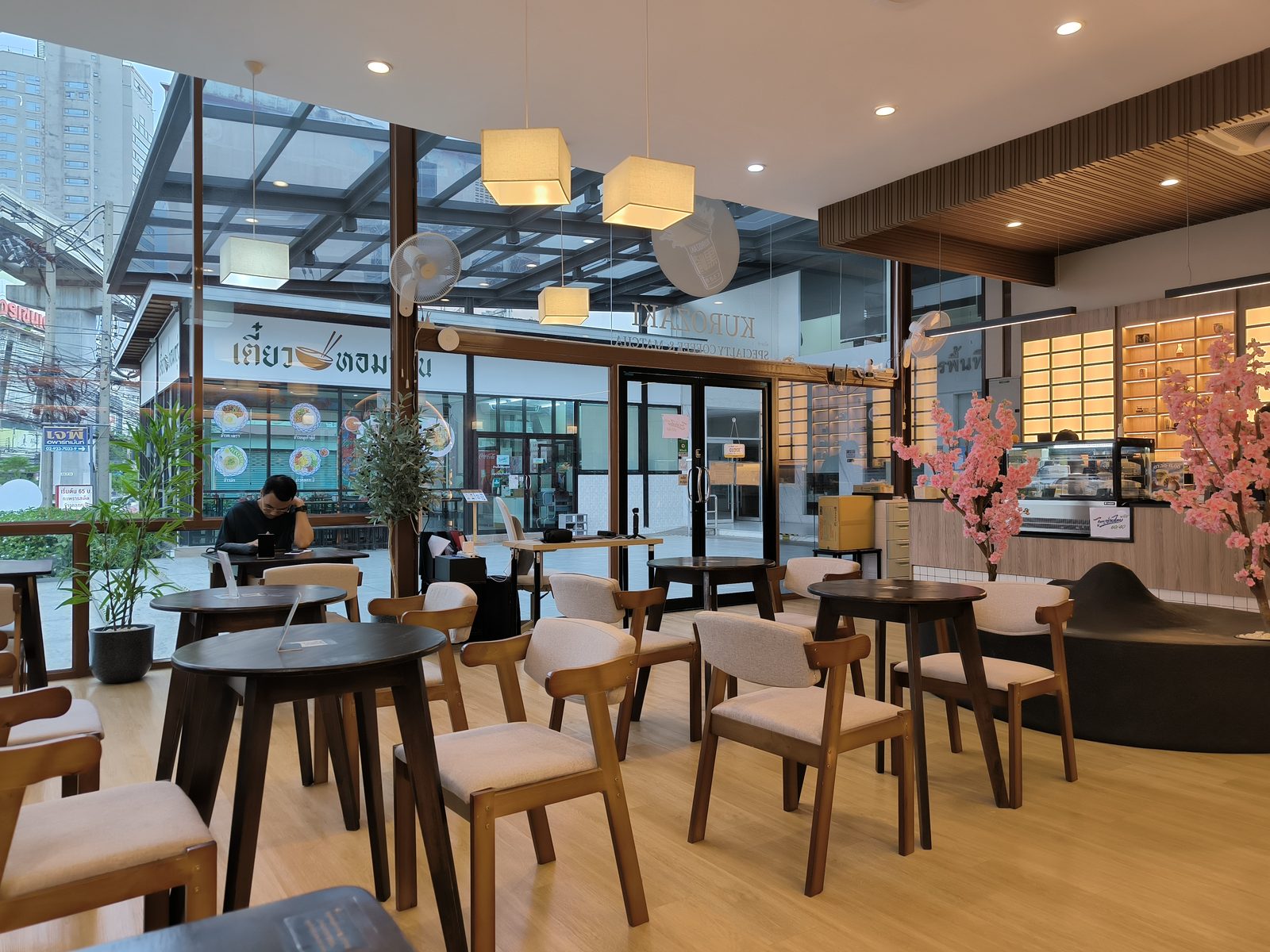
Food in Lat Phrao means street stalls and old Thai-Chinese restaurants, priced for the people who live here. Menus are mostly in Thai, so pointing works, and nobody minds.
Street Food
A plate of rice with stir-fried meat, grilled pork skewers or a bowl of noodle soup costs roughly THB50 to THB70. Stalls line Lat Phrao Road and spill into the sois, busiest at breakfast and again after work.
The best-known cluster is Chokchai 4, an evening street-food market. Take the Yellow Line to Chok Chai 4 station and follow the crowd.
A 2014 food-writer visit had stalls opening around 4 to 5 p.m. A November 2025 review describes it as an after-work stop where vendors start packing up after 9 p.m., so go early.
Popular Dining Spots
Lat Phrao’s best-known sit-down places are old Thai-Chinese family restaurants on Chokchai 4. Both of these had fresh reviews on Wongnai, Thailand’s main restaurant-review app, in 2026.
- Tong Peng: An old Chinese restaurant on Chokchai 4 Road, known for roast duck and crispy pork, with dim sum and buns sold out front. Reviewers put it at roughly THB101 to THB250 a head.
- Som Yot Khao Tom Rop Duek: A late-night rice-soup restaurant on Chokchai 4 Soi 72, open from late afternoon into the small hours. Expect roughly THB251 to THB500 a head.
For a sit-down meal in English, most residents ride to Ratchada. Check recent reviews before you cross town for any place.
Read more: Best restaurants in Bangkok.
Drinking in Lat Phrao
Nightlife in Lat Phrao is local Thai bars and late street food, and there aren’t many of either. For a proper night out, most people take the Blue Line to Ratchada.
Late nights here look more like a bowl of rice soup at Som Yot after 11 p.m. than a cocktail bar. Nobody dresses up.
The Yellow Line runs until midnight. After that, you’re on a taxi, Grab or a motorbike taxi.
Groceries in Lat Phrao
Grocery shopping in Lat Phrao is Thai-style, with Big C, Foodland and Gourmet Market among the grocers in the area. Imported food is harder to find than in Ari or Ekkamai.
Fresh Markets
There are a couple of markets in the area, and the Chokchai 4 evening market sells prepared food. Most residents also buy produce from street vendors and soi stalls.
Supermarkets
Gourmet Market sits in the passage between the Blue Line and Yellow Line stations at Lat Phrao. You walk past it changing trains, so the after-work shop happens almost by accident.
BMA’s flood list also names a Big C on Lat Phrao Road near Khlong Chan, and Foodland is among the area’s grocers. Convenience stores cover the sois in between.
Read more: How to save on groceries at Thai supermarkets.
Central Ladprao and the Long Lat Phrao Road
Lat Phrao Road starts at the junction beside Central Ladprao and Union Mall in Chatuchak, then runs southeast through Huai Khwang and Wang Thonglang to Bang Kapi. The Yellow Line now follows most of it overhead, above traffic that crawls at rush hour.
Central Ladprao and Union Mall
Central Ladprao is a seven-story mall at 1691 Phahon Yothin Road, open daily from 10 a.m. to 10 p.m. It opened in 1983, and a skywalk links it to BTS Ha Yaek Lat Phrao. (Verified October 2026.)
Union Mall sits next door at 54 Soi Chom Phon 1. It has eight floors and about 1,240 booths and shops, with skywalks from MRT Phahon Yothin and BTS Ha Yaek Lat Phrao.
From Lat Phrao, both are one Blue Line stop west of the interchange. Weekday mornings are easy. Weekend afternoons are not.
The Yellow Line Along the Road
The MRT Yellow Line is a 30.4-km elevated monorail with 23 stations, and it runs daily from 6 a.m. to midnight. (Verified October 2026.)
It starts at the Ratchada and Lat Phrao junction, runs along Lat Phrao Road to Bang Kapi, then turns south onto Srinagarindra Road. The corridor below is one Wikipedia calls heavily congested.
Yellow Line stations opened in stages in 2023. The Blue and Yellow lines have different operators, so there’s no interchange inside the paid areas and no shared farecard.
A covered skywalk and passage connect the two stations instead.
Chokchai 4 at Night
Chokchai 4 is Lat Phrao’s evening food street. Stalls set up in the late afternoon, and by dark you can find Thai street food of nearly every kind.

Office workers stop on the way home and carry dinner back to the condo. Later on, the old restaurants and the late-night rice-soup places take over.
Go hungry, and go early. Hours and stall lineups change, so check a recent map review before you plan a night around it.
The Numbered Sois and Their Traffic
Lat Phrao Road’s side streets are numbered outward from the Phahon Yothin end. Oakbury sits on Soi 35, Prep’s campus on Soi 88 and Ladprao General Hospital at Soi 95 to 97.
Three Yellow Line stations also take their names from Sois 71, 83 and 101.
Every one of those sois empties onto the same road, and the Yellow Line was built to skip that traffic. Pick a soi close to a station, or plan on motorbike taxis. Drive yourself and you’ll queue at rush hour.
Transportation Options for Lat Phrao
Getting around Lat Phrao means two MRT lines, the Yellow Line along the road and the Blue Line at the Lat Phrao interchange. Asok is about 19 minutes away, Silom 28 and Siam 30.
Read more: Transportation in Bangkok.
MRT Blue Line
The MRT Blue Line runs daily from 6 a.m. to midnight. (Verified October 2026.) From Lat Phrao, heading toward Hua Lamphong, the stops run:
- Ratchadaphisek
- Sutthisan
- Huai Khwang
- Thailand Cultural Centre
- Phra Ram 9
- Phetchaburi, where you change for the Airport Rail Link
- Sukhumvit, where you change for the BTS
The other direction takes you to Phahon Yothin and Chatuchak Park. The station has a park-and-ride building for 2,100 vehicles.
MRT Yellow Line
The Yellow Line is the train you’ll use most, running from Lat Phrao east to Bang Kapi and on to Samrong. At Hua Mak, it connects with the Airport Rail Link.
The fares approved in 2023 run THB15 to THB45 a trip, by distance. Check the current fare at the station, and keep a separate card, since the Yellow Line doesn’t share one with the Blue Line.
Motorbike Taxis
Most soi mouths have a motorbike taxi stand, and on a long soi it’s often quicker than walking to the Yellow Line. Settle the fare before you get on, and ask for a helmet.
Taxis and Grab
Taxis and ride-hailing apps work well here outside rush hour. When it pours, prices jump and drivers get picky.
Buses
Buses run along Lat Phrao Road and cover spots the trains miss. They’re cheap and slow, and our guide to taking a bus in Bangkok explains how they work.
Boats
We found no commuter boat stop in the area, so boats aren’t part of daily life here.
Flooding in Lat Phrao
Lat Phrao has a higher risk of a big flood. In 2026, Lat Phrao Road flooded from the Ratchada junction to Bang Kapi. The Chokchai 4 side stayed dry that year but flooded in 2011.
Heavy rain is the everyday problem. Lat Phrao district has one of the highest numbers of street-flood spots in Bangkok, and many aren’t fully fixed yet. Sois off Chokchai 4, Wang Thonglang and Lat Phrao Road itself often get shallow water after a big storm.
This is rain pooling on the roads, and the river doesn’t come into it. The soi your building is on, and where its car park sits, matter more than the district. Check both before you sign.
Our Bangkok flood-free neighborhoods guide has the district-by-district ratings.
Healthcare in Lat Phrao
Lat Phrao has two private hospitals in the corridor, Ladprao General on the road itself and Paolo Hospital at Chokchai 4, with more within about 5 km. See our guide to private hospitals in Bangkok for the wider picture.
Hospitals
Ladprao General Hospital is about 3.8 km from the area’s center, near the east end of the stretch.
- Ladprao General Hospital: A private hospital with 200 beds at 2699 Lat Phrao Road, between Soi 95 and Soi 97. Founded in 1990.
- Paolo Hospital Chokchai 4: A private hospital in the Bangkok Dusit Medical Services (BDMS) group, with 169 beds in its main building and two annex buildings. It holds Thai hospital accreditation.
- Phyathai Phahonyothin Hospital: 670/1 Phahon Yothin Road, about 5.0 km away. Open since 1972, with 220 beds.
- ViMUT Hospital: Phahon Yothin Road, about 5.2 km away, with an emergency center and an international services page.
We couldn’t confirm English-language services at Ladprao General or Paolo Chokchai 4. Call before you go, or ask whether an interpreter is available. Paolo’s booking line is 1772.
Clinics
Small clinics line Lat Phrao Road, but we couldn’t confirm specific English-speaking ones for this guide. Use a hospital’s outpatient department for a first visit, then ask the doctor for referrals.
Dentists
We couldn’t confirm a specific dental clinic in the area for this guide. Our Bangkok dentists guide lists clinics and chains with train access.
Veterinarians
There’s at least one vet in the area, but we couldn’t confirm its details. Our Bangkok veterinarians guide lists clinics by neighborhood.
International Schools in Lat Phrao
Lat Phrao has two early-years international campuses within about 2 km, and the full-age schools are about 3 km away. Our international schools in Bangkok guide has the full list.
- Oakbury International School: Soi Ladphrao 35, about 2.0 km away. UK Early Years and Key Stage 1 curriculum.
- Prep International Kindergarten: Two campuses, Sutthisan (about 1.6 km) and Ladprao 88 (24 Soi Ladprao 88, about 2.2 km). EYFS and Montessori programs.
- Singapore International School of Bangkok, Pracha Uthit campus: About 3.1 km away. Ages 2 to 18.
- KIS International School: About 3.1 km away. A full IB school.
- Lycée Français International de Bangkok: About 3.1 km away. French curriculum through the Brevet and Baccalauréat.
Families with older kids usually commute by car or school bus. For lower fees, see our guide to affordable English-language schools in Bangkok.
Parks in Lat Phrao
Lat Phrao has almost no park, and the nearest big one is Chatuchak Park, two Blue Line stops from the interchange. It covers nearly 75 acres and opens from 4:30 a.m. to 10 p.m.
Queen Sirikit Park (open 5 a.m. to 8 p.m.) and Wachirabenchathat Park sit right beside it. Our Bangkok parks guide covers the whole cluster.
On weekday mornings, the cluster belongs to retirees and joggers. Saturdays bring the crowds from the weekend market at the south gate.


Other Standout Venues and Features
The Lat Phrao interchange has a park-and-ride building for 2,100 vehicles, which helps if you drive to the Blue Line.
Coworking is scarce, so remote workers use cafes or ride the Blue Line to Ratchada or Chatuchak.
Chatuchak Weekend Market is two Blue Line stops from the interchange, beside the park cluster. It’s the area’s big weekend outing for clothes, plants and household goods.
Lat Phrao vs. Ratchada vs. Chatuchak
Lat Phrao is best for the lowest rents, Ratchada for nightlife and offices, and Chatuchak for parks and the weekend market. Lat Phrao and Chatuchak both carry a higher flood risk, while Ratchada rates low.
| Factor | Lat Phrao | Ratchada and Huai Khwang | Chatuchak and Mo Chit |
|---|---|---|---|
| Big-flood risk | Higher (Lat Phrao Road flooded in 2026) | Low | Higher (flooded in 2011 and severely affected in 2026) |
| Rail | MRT Blue plus MRT Yellow | MRT Blue only | BTS, MRT Blue and Red Line |
| Price level | Budget | Value | Mid |
| Travel to Asok | About 19 minutes | About 11 minutes | About 22 minutes |
| Travel to Siam | About 30 minutes | About 25 minutes | About 19 minutes |
| To Suvarnabhumi Airport | About 41 minutes | About 32 minutes | About 43 minutes |
| To Don Mueang Airport | About 36 minutes | About 38 minutes | About 19 minutes |
| Best known for | Yellow Line, street food, low rents | Night markets, offices, nightlife | Parks and the weekend market |
| Green space score (out of 5) | 2 | 2 | 5 |
| Family score (out of 5) | 3 | 2 | 3 |
| Retiree score (out of 5) | 3 | 2 | 4 |
| Business score (out of 5) | 2 | 4 | 3 |
Pick Lat Phrao if rent and space matter most and you’re fine with Thai-language street life. It’s the cheapest of the three and the only one with the Yellow Line.
Pick Ratchada if you want nightlife, offices and a quicker ride to Asok. Our Ratchada guide covers the night markets and Blue Line stations, and it rates low for big floods.
Pick Chatuchak if parks and the weekend market matter most. You get more green space and the BTS, with a flood record similar to Lat Phrao’s.
Should You Live in Lat Phrao?
Lat Phrao suits people who want more space for less money and don’t mind ordering dinner and agreeing motorbike-taxi fares in Thai.
- Families: A good fit for space and rent, especially with toddlers, thanks to Oakbury and Prep’s Ladprao 88 campus. Older kids face a school commute, and the roads flood.
- Couples: Two-bedrooms at THB14,000 to THB26,000 give you a spare room for what a one-bedroom costs in Ratchada.
- Budget expats: The strongest case. Rooms from THB4,000 and street plates at THB50 to THB70 stretch a small budget.
- Retirees: Costs are low and hospitals are close, but the traffic makes walking along the main road a chore.
- Nomads and business people: There’s no coworking and no office district here, so Ratchada or Chatuchak fits better.
To compare with other neighborhoods, read our guides to Phrom Phong, Phra Khanong, On Nut and Bang Na.
Frequently Asked Questions
How much is rent in Lat Phrao?
A one-bedroom condo in Lat Phrao rents for roughly THB9,000 to THB16,000 a month. Studios run THB6,000 to THB11,000, and two-bedrooms THB14,000 to THB26,000.
These are rough asking ranges from public listings seen in 2026, and they swing by building and distance from the station.
What is the nearest station to Lat Phrao?
The MRT Yellow Line runs along Lat Phrao Road, and MRT Lat Phrao connects it to the Blue Line. In this guide, the Yellow Line stops are Lat Phrao, Phawana, Chok Chai 4, Lat Phrao 71, Lat Phrao 83 and Mahatthai.
Is Lat Phrao the same as Ladprao?
Yes, Ladprao and Lad Phrao are alternate spellings of Lat Phrao. Lat Phrao Road and Lat Phrao district are different, though, because the road mostly runs through Wang Thonglang.
Does Lat Phrao flood?
Lat Phrao’s risk of a big flood is higher, and its roads flood in heavy rain. Lat Phrao Road flooded from the Ratchada junction to Bang Kapi in 2026. Check your soi and car park before you sign.
Is Lat Phrao good for families?
Lat Phrao works for families who want space and low rent. Oakbury and Prep’s Ladprao 88 campus are within about 2 km for young kids, but full-age international schools are about 3 km away.
See the international schools guide before you choose.
Is Lat Phrao safe?
Lat Phrao is generally considered a residential, local area. The usual Bangkok risks apply, including motorbikes on the pavement and dark sois late at night. Our Is Bangkok safe? guide covers the city-wide picture.
How do I get from Lat Phrao to the airports?
For Suvarnabhumi, take the Yellow Line to Hua Mak and change to the Airport Rail Link, or take a taxi (roughly 40 minutes in light traffic). For Don Mueang, a taxi takes roughly 35 minutes.
Our Bangkok airport transfers guide has the options.
Can you live in Lat Phrao without a car?
Yes, if you live near a Yellow Line station. Between the trains, motorbike taxis and Grab, most residents don’t need one. A car helps with school runs and trips outside the corridor.
Is Lat Phrao cheaper than Ratchada?
Yes. Lat Phrao is in the budget price tier and Ratchada in the value tier. Ratchada gets you nightlife and a faster ride to Asok, while Lat Phrao gets you bigger flats.
Sources Cited
- Mass Rapid Transit Authority of Thailand (MRTA), MRT Yellow Line: route, 23 stations, 30.4 km length and daily operating hours.
- MRTA, Blue Line: daily operating hours and the park-and-ride building at Lat Phrao.
- Bangkok Post, Cabinet sets Yellow Line ticket prices: fare range of THB15 to THB45 (June 2023).
- Central Ladprao: address, opening hours and opening year.
- Ladprao General Hospital, about: address, 200 beds and founding year.
- BDMS, healthcare business at a glance (August 2026): Paolo Hospital Chokchai 4 bed counts and annex buildings.
- Healthcare Accreditation Institute, Paolo Chokchai 4 Hospital: private hospital with HA accreditation and its official website.
- Phyathai Phaholyothin Hospital: address, founding year and bed count.
- ViMUT Hospital: emergency center and international services.
- Oakbury International School: location and curriculum.
- Prep International Kindergarten: campus addresses and programs.
- Singapore International School of Bangkok: Pracha Uthit campus age range.
- KIS International School: IB programs and age range.
- Lycée Français International de Bangkok: French curriculum and examinations.
- Wikipedia, Lat Phrao Road: where the road starts, the districts it crosses and its history.
- Wikipedia, Lat Phrao MRT station: Blue and Yellow Line stations and the link between them.
- Wikipedia, Union Mall: size and opening year.
- Time Out Bangkok, Union Mall: address and skywalk access.
- Migrationology, Chokchai 4 street food market: an evening market with stalls opening around 4 to 5 p.m. (2014 visit).
- Wongnai, Chokchai 4 Market: November 2025 review of the evening market and its packing-up time.
- Wongnai, Tong Peng Chokchai 4: location, dishes and price per head (review dated March 2026).
- Wongnai, Som Yot Khao Tom Rop Duek: Chokchai 4 Soi 72 location, late-night hours and price per head (reviews dated 2026).
- Bangkok Metropolitan Administration (BMA): flood-point and flood-record datasets, 2021 to 2026, used for the flood section.