

Parts of Thailand flood every rainy season, not just in bad years. Nan is underwater again this week. Here’s what actually causes it, how the warning system works, and what to do when it happens near you.
When you live in Thailand, flash flooding is one of the things you’ll face regularly. It happens in many parts of the country, especially during monsoon season between June and September.
In some places, flash flooding is little more than an annoying traffic jam. In others, it causes serious damage, like what just happened in Nan province, where flooding affected over 67,000 people. Many lost their homes, and some lost their lives.
It’s a bad week for Nan, but not an unusual one for Thailand. Certain streets in Bangkok or Pattaya flood every year without a major storm. The North gets hit by flash floods most Augusts. The Gulf coast has its own separate flood season that most of the country never sees. Where you live in Thailand determines a lot more about your flood risk than most people realize before they sign a lease.
Contents
- Key Takeaways
- When Monsoon Season Hits Each Region
- Where Flooding Actually Happens
- How to Check a Neighborhood's Flood History Before You Move There
- Staying Informed: Warnings, Alerts, and Emergency Numbers
- Preparing Your Home Before the Rain
- Road and Motorbike Safety During Flooding
- Health Risks After Flooding
- Insurance and What It Actually Covers
- If Your Area Floods: What Happens Next
- Tips When Dealing with Flooding in Thailand
- Frequently Asked Questions
- Sources Cited
Key Takeaways
- Rainy season officially started May 15, 2026, and runs into mid-October across the North and Central regions, but the Gulf coast (Koh Samui, Koh Phangan) has its own wet season from October to December.
- Bangkok sits less than a meter above sea level and is still sinking in places, which is why certain streets flood every year regardless of what’s happening elsewhere.
- GISTDA’s Check Nam app lets you look up a specific area’s flood history before you sign a lease.
- The T-Alert Cell Broadcast system pushes warnings straight to your phone, no app or registration needed, as long as your phone software is reasonably current.
- The DDPM’s 24-hour hotline is 1784.
- Riding a motorbike through standing water wrecks more bikes and sends more people to the hospital than almost anything else during flood season.
- Leptospirosis and melioidosis, both spread through contaminated floodwater, killed over 100 people in Thailand in the first seven months of 2026.
- Most standard car and home insurance in Thailand doesn’t cover flood damage automatically.


Where things stand, 21 September 2026: the DDPM has every province on alert, Bangkok included, for heavy rain, flash floods, landslides and rough seas, and flagged 14 provinces where small and medium reservoirs are already running above 80% capacity. The Department of Mineral Resources logged four landslides and two flash floods on 20 September across Phetchabun, Surat Thani, Mae Hong Son and Chiang Mai. Check TMD before you travel through any of those areas.
When Monsoon Season Hits Each Region
The Thai Meteorological Department (TMD) declared the official start of the 2026 rainy season on May 15. That’s the usual start of the rainy season for the North, Central Thailand, and Bangkok.
The rains build through May and June, sometimes ease off for a dry spell in late June, then run through mid-October, with August and September carrying the highest flood and landslide risk.
Southern Thailand runs on a different clock.
The Andaman coast (Phuket, Krabi) roughly follows the same southwest monsoon as the rest of the country. The Gulf coast doesn’t. Koh Samui and Koh Phangan get soaked by the northeast monsoon instead, which picks up moisture over the South China Sea and dumps it on the east coast from October through December, with November usually the wettest month.
Anyone planning a move to Koh Samui should be checking that calendar, not the May-to-October window everyone else in the country uses.
| Region | Wet season | Peak risk months |
|---|---|---|
| Bangkok, Central Thailand | May to mid-October | August, September |
| The North (Chiang Mai, Chiang Rai, Nan) | May to mid-October | August, September |
| Andaman coast (Phuket, Krabi) | May to October | September, October |
| Gulf coast (Koh Samui, Koh Phangan) | October to December | November |
Where Flooding Actually Happens
Let’s take a look at areas that get flooded regularly.
Bangkok’s Low-Lying Geography
Bangkok sits no more than a meter above average sea level, roughly on par with the Netherlands, and parts of the city are still sinking by up to two centimeters a year from groundwater extraction and the weight of construction on soft clay.
These areas flood regularly:
- Sukhumvit Road: sits close to mean sea level, which is why it’s usually one of the first roads to go under in a heavy downpour.
- The Lat Phrao intersection and the MRT stations at Lat Phrao, Phahon Yothin, and Chatuchak Park: these show up on the risk list every year.
- Srinakarin Road: another low-lying stretch that floods in the same heavy downpours.
None of that makes Bangkok unsafe to live in. Ask around and most expats will tell you street flooding here is a couple of hours of inconvenience, not a disaster: the drains clear, traffic thins out, and life goes back to normal by evening.
The exception is when heavy rain coincides with a high tide on the Chao Phraya River. That combination is what produces the slower, more serious floods that actually make the news.
The Flash-Flood-Prone North
What happened in Nan this week is the pattern that repeats across northern Thailand almost every August: a monsoon trough combines with a strong southwest monsoon, dumps heavy rain onto mountainous terrain, and the water reaches low-lying towns faster than it can drain away. TMD issued ten separate warnings for the North and upper Northeast between August 17 and 21 alone, and GISTDA flagged roughly 3,900 square kilometers of the region at risk, with Phayao and Lamphun on alert alongside Nan.
These areas flood regularly:
- Nan town: Wiang Sa, Mueang Nan, and Phu Phiang districts take the brunt of it, including the low-lying streets around the old town and Wat Phumin.
- Chiang Mai’s riverside strip: Night Bazaar, Chang Klan Road, and the Warorot and Muang Mai markets are the first to go under when the Ping River breaches its banks, along with the Nong Hoi and Pa Dat neighborhoods a bit further out.
Chiang Mai has been through this before, and the pattern there is fairly consistent: whoever lives near the Ping River gets hit, and whoever lives a few streets back on higher ground barely notices. During past flooding, residents leaned on real-time updates from neighbors and community groups to figure out which roads were actually passable, more than on any official channel.
The Southern Gulf Coast’s Own Season
Because the Gulf coast runs on the northeast monsoon instead, southern Thailand has its own separate flood-watch period that has nothing to do with what’s happening up north. DDPM warned six southern provinces of flash floods and rough seas back in June 2026, months before the North’s usual season even started.
These areas flood regularly:

- Hat Yai: sits in bowl-shaped terrain between mountains and Songkhla Lake, and the U-Taphao Canal that funnels water through the city center is a big part of why the whole metro area floods almost every year.
- Nakhon Si Thammarat: the low-lying districts of Cha-uat, Pak Phanang, and Chian Yai flood most often, along with Mueang district around the city center.
There’s no single “Thailand flood season.” There are several, and they don’t overlap.
How to Check a Neighborhood’s Flood History Before You Move There
Flood history is worth checking before you sign a lease, whether you’re picking a Bangkok neighborhood, settling into Chiang Mai, or renting a house anywhere else.
There are three tools that you can use:
- GISTDA runs a public flood tracking platform built on satellite imagery from its own Thaichote and THEOS-2 satellites
- Check Nam mobile app from GISTDA shows both current flood extent and past events for a given area.
- If you’re specifically looking at Bangkok, the BMA runs its own drainage dashboard with real-time canal water levels and flooded-road reports, which is more useful for a single street than the national GISTDA data.
Beyond the apps, the low-tech checks still matter.
Ask the landlord or agent directly whether the building or soi has flooded in the past five years, and look for the physical tells: a raised door threshold, sandbags stored somewhere on-site, water stains on ground-floor walls, or a building that sits noticeably higher than the street outside. A search for the soi or subdistrict name alongside “น้ำท่วม” (flood) in Thai will often turn up local coverage that never shows up in an English search.
Good to Know: elevation alone doesn’t tell the whole story. A ground-floor unit on a high-elevation street can still flood if it sits below street level or backs onto a canal, so treat elevation maps as a starting point, not a final answer.
Staying Informed: Warnings, Alerts, and Emergency Numbers
There are a few ways to stay informed about flash flooding before and while it happens.
TMD Warnings
TMD issues numbered warning bulletins whenever severe weather is expected, covering everything from heavy rain and flash flood risk to high waves and tropical storm tracking. During the Nan flooding, its warnings ran sequentially from roughly number 158 to 167 for the year, each one updating the affected provinces and expected rainfall as the situation moved.
They’re published in English, and they’re the most reliable source for what’s actually happening with the weather, well ahead of news coverage. This is also my go-to website for checking weather forecasts.
T-Alert Cell Broadcast
Thailand’s Cell Broadcast emergency alert system, branded T-Alert, went live in a nationwide test on January 20, 2026, run by the DDPM alongside the Digital Economy and Society Ministry, the telecoms regulator, and the major mobile carriers.
It pushes a loud alert and an automatic message directly to phones within seconds. It had already seen real use before that nationwide test, first for flooding in Loei province back in May 2025, and it’s since been used for floods, border security incidents, and bad air quality days.
T-Alert has one real limitation: it mainly tells you after something is already happening, not before. For advance warning, TMD’s bulletins are still the better source.
Most expats who’ve had it go off seem to like it. It works on both iOS and Android, and it’s loud enough to notice even on silent. The first test alert caused some confusion, but the general reaction since has been to want it expanded to more hazards, not fewer, including severe air pollution spikes.
Tip: if your phone is a few years old or running an outdated operating system, check now whether it supports Cell Broadcast rather than finding out during an actual emergency.
The DDPM 1784 Hotline
The Department of Disaster Prevention and Mitigation runs a 24-hour hotline at 1784 for reporting emergencies and requesting help during floods, landslides, and other disasters. The LINE account @1784DDPM is often the easier route if your Thai isn’t strong enough for an emergency phone call, since you can type or send photos instead.
Preparing Your Home Before the Rain
Most flood damage to a home traces back to the same handful of preventable problems.
If you’re on a ground floor in a known flood-prone street, keep a few sandbags on hand and know where to buy more locally; many Bangkok district offices hand them out free during warning periods. Raise power strips, electronics, and anything irreplaceable off the floor. Keep your passport, visa documents, and property paperwork in a waterproof folder you can grab in a hurry rather than buried in a drawer somewhere.
It’s also worth finding out whether your condo or house actually has working drainage before you need it. Ask your building management what their flood response plan is, not just whether one exists on paper.
And pack a basic go-bag: a change of clothes, any daily medication, a phone charger, and some cash, since ATMs and card readers don’t always work through a power outage.
Road and Motorbike Safety During Flooding
Most expats in Thailand end up on a motorbike sooner or later, and this is the part that matters most for them. Water in the engine can stall a bike and cause damage that’s expensive or impossible to fix, especially if someone tries to restart it while it’s still flooded.
On a rental, that can mean personally covering repair costs well beyond the deposit. Depth is also nearly impossible to judge from the seat: a stretch of road that looks ankle-deep can be hiding an open drain cover, a pothole, or a spot where the road surface has simply washed away.
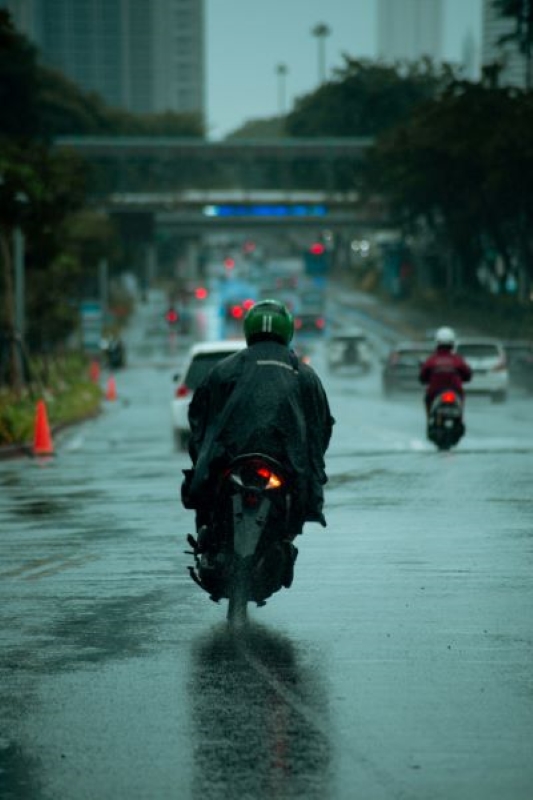
Low sois, especially around Sukhumvit, can go from dry to knee-deep in the time it takes to order food. What was passable ten minutes ago might not be now. If you’re already caught in rising water, the move is to get off and walk the bike to higher ground rather than trying to push through: a stalled engine you walk out is a repair bill, a stalled engine you forced through deep water is often a write-off.
The same logic applies to cars, with a bigger margin for error. Don’t drive through water you can’t see the bottom of, and turn around if it’s above your wheel hubs.
Read more: How to Safely Ride a Motorcycle During Rainy Season in Thailand
Health Risks After Flooding
Leptospirosis and Melioidosis
Thailand’s Department of Disease Control (DDC) recorded 2,190 cases of leptospirosis between January 1 and July 21, 2026, with 30 deaths. Over the same stretch, it logged 1,654 cases of melioidosis, with 77 deaths. Both are bacterial infections picked up from contact with soil or water that’s mixed with sewage or animal waste, which is exactly what floodwater is.
The DDC’s advice comes down to a few habits:
- skip walking barefoot through floodwater or mud
- wear rubber boots and gloves if you have to work in an affected area
- cover any open cut with a waterproof bandage before you’re exposed, and wash thoroughly afterward
A high fever, muscle pain, calf tenderness, or trouble breathing after wading through floodwater is worth a doctor’s visit, and worth mentioning the exposure specifically rather than assuming it’s a normal cold or flu. Both conditions respond well to early treatment.
Dengue
Standing water left behind after a flood is also exactly what Aedes mosquitoes need to breed, and dengue cases climb every rainy season, especially in a dense city like Bangkok. Emptying anything holding still water around your home within a few days of a flood, plant saucers, buckets, roof gutters, makes more of a difference than it sounds like it should.
Insurance and What It Actually Covers
Here’s a general look at how insurance handles flood damage in Thailand. This is general guidance, not advice for your specific policy: plans vary a lot between insurers, so confirm the details with your own policy document or in writing with your broker.
Vehicle Insurance
Thailand’s compulsory motor insurance (por ror bor) covers third-party injury, not damage to your own vehicle.
Flood damage to a car or motorbike only gets covered if you’ve bought voluntary comprehensive insurance on top, and even then it’s worth checking whether flood damage is included, excluded, or capped separately from ordinary collision coverage. Policies vary more on this than people expect.
Property Insurance
Home and condo insurance in Thailand often applies a flood sub-limit rather than covering the full value of the building or its contents.
Before the rain starts, not after, it’s worth confirming what’s actually insured, the water depth that triggers a payout, your deductible, and whether temporary accommodation is covered if the place becomes unlivable.
Case Study: expats who’ve filed flood claims describe two very different experiences.
Some got a fast, straightforward payout. Others got denied or delayed, usually because the policy never explicitly covered natural disasters, or because some piece of paperwork, visa status included, wasn’t in order.
Reading the flood-specific fine print before the season starts beats reading it for the first time after your street is underwater.
If Your Area Floods: What Happens Next
The government’s response to Nan is a decent preview of what to expect if your own area gets hit hard. Within days of the flooding starting on August 17, the affected area, 7 districts, 42 subdistricts, 356 villages, 23,827 households, was under a 24-hour disaster command center, with damage surveys wrapped by August 26 and an initial THB6,700 per household for immediate needs like kitchenware, clothing and bedding targeted for completion by September 1. A separate, larger payment followed for housing damage itself: under an August 25 Cabinet resolution, Nan households got a flat THB9,000 per household, with the first 15,215 households paid starting September 8.
Local authorities and the DDPM typically handle the immediate response, rescue, evacuation, temporary shelter, before moving into a damage assessment period and then compensation payments. Foreigners generally get the same emergency assistance and shelter access as Thai residents during an active disaster. Eligibility for longer-term compensation programs can vary, and it’s worth confirming with your local district office (amphoe) if it ever applies to you, but in most cases, don’t expect the payout to cover the full cost of what you lost.
Read more: Emergencies in Thailand: What to Do and Who to Call
Tips When Dealing with Flooding in Thailand
If you take away nothing else from this guide, these are the habits worth building before the next heavy rain:
- Turn on Cell Broadcast alerts and know TMD’s website before the rain starts, not during it.
- Check your area’s flood history with GISTDA’s Check Nam app or, in Bangkok, the BMA’s drainage dashboard, before you sign a lease.
- Keep sandbags, a go-bag, and your passport and visa documents somewhere waterproof and easy to grab.
- Never ride a motorbike through standing water. Get off and walk it if you’re caught in rising water.
- Confirm your car and home insurance actually cover flood damage before the season starts, not after.
- Save 1784 and the LINE account @1784DDPM in your phone now, while you don’t need them.
Frequently Asked Questions
Here are some frequently asked questions about flooding in Thailand.
When is flood season in Thailand?
Mid-May to mid-October for most of the country, including Bangkok and the North, with August and September the riskiest months. The Gulf coast (Koh Samui, Koh Phangan) runs on its own separate October-to-December wet season.
How do I get official flood warnings if I don’t speak Thai?
TMD publishes its bulletins in English, and T-Alert Cell Broadcast supports multiple languages including English. There’s nothing to register for; it reaches any compatible phone automatically.

Does renters insurance in Thailand cover flood damage to my belongings?
Usually not without an add-on or a specific flood sub-limit. Ask your insurer directly before the rainy season starts, not after a flood has already happened.
Is it safe to ride a motorbike during heavy rain in Thailand?
Riding in rain itself is manageable if you’re careful. Riding through standing or flowing water isn’t: water in the engine can cause serious damage, and depth is genuinely hard to judge from the seat.
What number do I call in a flood emergency in Thailand?
1784, the DDPM’s 24-hour hotline. The LINE account @1784DDPM works too, and is often faster if you need to send a photo.
Sources Cited
- Thai Meteorological Department: 2026 rainy season declaration and monsoon timing
- Department of Disaster Prevention and Mitigation: 1784 hotline
- GISTDA (Geo-Informatics and Space Technology Development Agency): flood monitoring, Check Nam app, August 2026 North flood risk data
- Nation Thailand: PM Anutin’s August 23, 2026 Nan flood relief order and household figures
- Department of Disease Control: 2026 leptospirosis and melioidosis case data
- Pattaya Mail: T-Alert Cell Broadcast nationwide test, January 2026
- Nation Thailand: Nan flood extent by district, August 2026


 Français:
 Español:
 Deutsch: