

A Power of Attorney lets someone handle paperwork in Thailand while you’re away. Here’s how to draft, sign, and use one without wasting money on the wrong document.
A visa extension falls due the same week a family emergency puts you on a plane home. Immigration doesn’t accept “my father is in the hospital” as a reason to miss the appointment, and you can’t be in two countries at once.
That’s the week people wish they had a Power of Attorney, and it’s the week it’s too late to get one. The whole point of a POA is that you sign it while you’re still around and able to sign things.
This guide covers what a POA actually does in Thailand, the difference between a general and a special one, how to draft and sign one, and where it will and won’t save you a trip to a government office.
Disclaimer: Some links in this article go to our partners, and we may earn a commission if you use them. It costs you nothing extra, and we only recommend services we'd use ourselves. Read more in our Advertising Disclosure.
Contents
- Key Takeaways
- What Is a Power of Attorney in Thailand?
- Common Uses for Expats
- General Power of Attorney and Special Power of Attorney
- How to Draft a Power of Attorney
- Signing a Power of Attorney From Abroad
- Using Your Power of Attorney
- Power of Attorney Versus a Simple Letter of Authorization
- Key Limits and Common Mistakes
- Where to Get Help
- FAQ
- Can I use a Power of Attorney to skip an immigration appointment entirely?
- Does a Power of Attorney need to be in Thai?
- How much does a Power of Attorney cost in Thailand?
- Can my spouse or partner act as my agent?
- What happens if my agent misuses the Power of Attorney?
- Do I need a new Power of Attorney every time I travel?
Key Takeaways
- A Power of Attorney lets someone act for you in Thailand without you being present, for things like Land Department transactions, bank matters, and some Immigration paperwork.
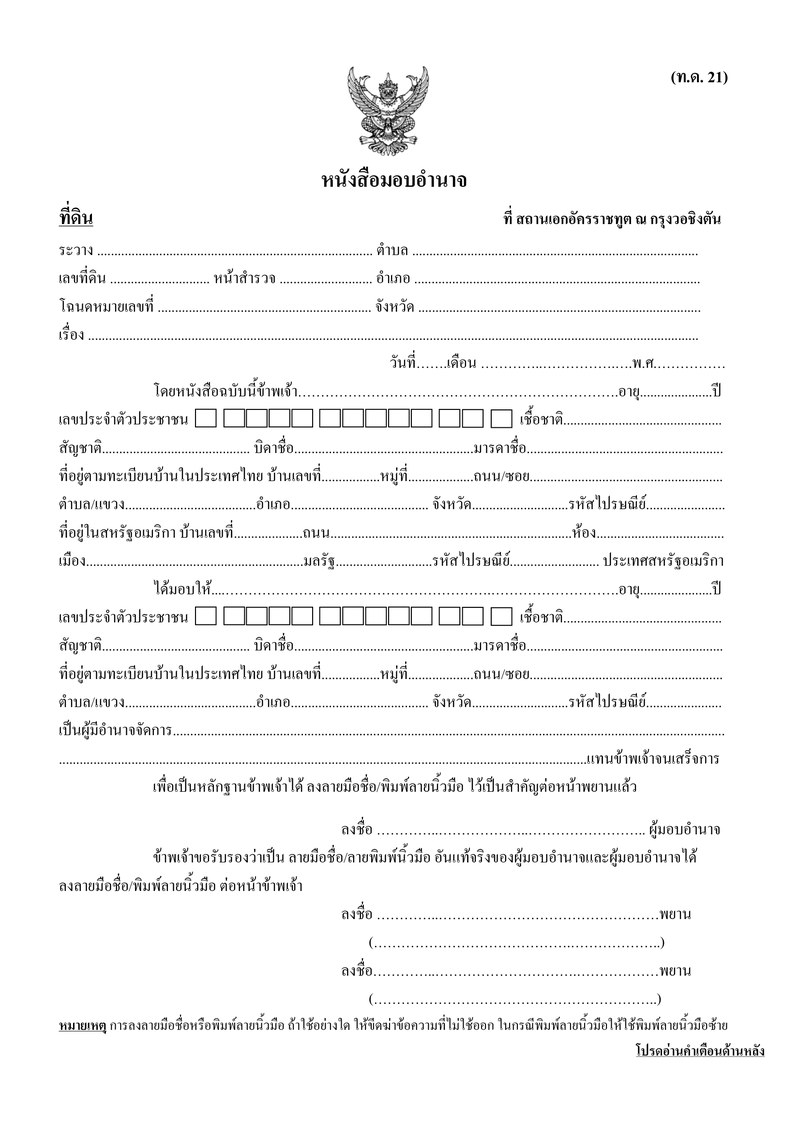
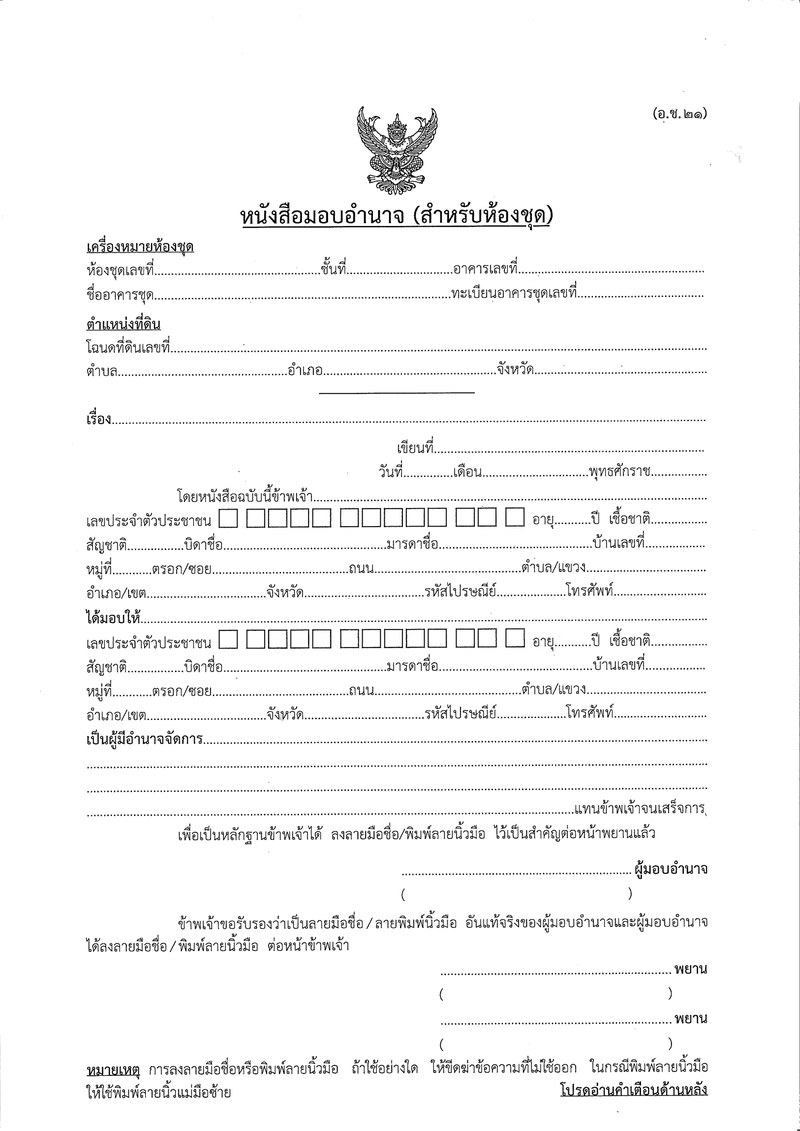
- Thailand has no single national POA form. The Land Department alone uses three, depending on the property type: Tor.Dor.21, Tor.Or.4, and A.C.21.
- Narrow beats broad. A Special Power of Attorney gets accepted where a General one gets refused.
- Signing from abroad means notarization plus legalization by a Royal Thai Embassy or Consulate, because Thailand doesn’t accept the Hague Apostille.
- A POA becomes void the moment you lose legal capacity, so it’s no substitute for incapacity planning.
- Going through an embassy abroad commonly takes several weeks, so start early if you’re working against a property deadline.
- Simple matters like a 90-day report often need only a basic letter of authorization, not a full notarized POA.


What Is a Power of Attorney in Thailand?
A Power of Attorney is a legal document where you, the principal, give another person, your agent, the authority to act on your behalf for specific matters. In Thailand, a POA lets your agent file paperwork at Immigration, sign at the Land Department, or handle a bank transaction, without you being physically present.
Thailand doesn’t have a single national POA form the way some countries do. What you use depends entirely on where you’re taking it.
The Thai legal system treats a POA less as a general concept and more as a specific instruction tied to one government office or one type of transaction. That distinction shapes almost everything else in this guide.
Common Uses for Expats
The honest answer to “do I need a POA” is that most expats go years without one and are fine. But a handful of situations come up often enough that having one ready, even unused, is worth the one-time cost:
90-Day Address Reporting
If you hold a long-stay visa, Thailand requires a 90-day report confirming your current address.
You can authorize someone to file it if you’re traveling when it falls due, as long as they bring your original passport, the completed TM47 form, and a written authorization.
Visa Extensions and Work Permit Renewals
Some immigration offices accept a proxy for straightforward paperwork, though many require the applicant in person, especially for extensions tied to marriage or retirement.
This varies by office, so confirm before you rely on a POA here.
Property Transactions
This is where a POA earns its keep. If you’re buying a condo in Thailand or selling one from abroad, a POA lets your lawyer sign the transfer at the Land Department without you flying back.
Bank Matters
Opening certain accounts, closing an account, or handling a transaction while you’re overseas.
Banks are the strictest counter you’ll deal with. Many will only act on their own in-house template, and the ones that do accept your document often want particular phrases inside it before they’ll honor it.
So ask your branch two things before you draft anything: whether they have a form of their own, and if not, exactly what wording they need to see. Write it their way rather than yours.
Buying or Selling a Car
Vehicle ownership transfers happen at the Department of Land Transport, and both the buyer and the seller are supposed to be there. A POA is what lets one side skip it.
In practice this is one of the most common uses expats run into, because dealers and second-hand car shops routinely handle the transfer for you and need your authority to do it. The same applies in reverse when you sell and the buyer wants the paperwork done without you.
Use the department’s own POA form here rather than writing your own. It pairs with the transfer request form, and you’ll need a signed copy of your ID or passport with it.
Company and Tax Filings
Business owners often keep a standing POA with their accountant or company secretary to sign routine company paperwork and Revenue Department filings, rather than chasing a director’s signature on every form.

Tip: Notice what’s missing from that list. A POA won’t let someone get married for you, won’t let someone give evidence in court for you, and generally won’t substitute for your presence at an immigration interview. It’s a tool for paperwork and transactions, not for anything that requires you personally.
General Power of Attorney and Special Power of Attorney
Thai POAs come in two broad flavors, and picking the wrong one is the single most common mistake foreigners make with this document.
General Power of Attorney
A General Power of Attorney grants your agent authority over a wide range of your affairs: banking, contracts, property, business operations, whatever you write into it. It sounds convenient, and in countries with a strong tradition of broad POAs it often is.
In Thailand it’s the option that causes the most friction. Banks, the Land Department, and Immigration are all cautious about open-ended authority, and they’ll often refuse to act on a general POA that isn’t tied to a specific transaction.
A document saying your agent can “manage all my affairs” gives a Thai clerk nothing concrete to check against, and Thai officials want something concrete.
Special Power of Attorney
A Special Power of Attorney limits your agent’s authority to one clearly defined act: sell this specific condo unit, file this specific 90-day report, sign this specific bank form. It’s what Thai government offices and banks expect to see, and what most lawyers here draft by default unless you push for something broader.
Read more: Finding a lawyer in Bangkok
How to Draft a Power of Attorney
Before you write anything, or pay anyone to write anything, check whether an official form already exists for what you need.
Where the government publishes a form, that form is the document the office expects to see, and a lawyer-drafted alternative saying the same thing in better English will usually be refused at the counter.
Matters That Have an Official Form
Land transactions are the clearest case. The Ministry of Foreign Affairs publishes three official Land Department forms, and which one you need depends on the property:
- Land with a title deed: Tor.Dor.21
- Land without a title deed: Tor.Or.4
- Condominium unit: A.C.21
Vehicles work the same way. The Department of Land Transport has its own power of attorney form, separate from the transfer request form that the sale itself uses. Pick both up at any DLT office, or download them from the department’s website.
They’re not interchangeable, and the Land Office will reject the wrong one. All three are in Thai script, so have someone who reads Thai fill them in with you.
For a 90-day report, immigration has its own form, TM47, which your agent submits alongside your passport and a written authorization. You can pick it up at any immigration office or download it from the Immigration Bureau website.
What the Official Form Tells You to Do
The Land Department form carries a set of warnings on its second page that are worth following even when you’re drafting something else. They tell you a lot about what gets a document rejected:
- State the matter and the authority clearly: buying, selling, mortgaging, and any special conditions.
- Don’t fill the form in using different handwriting or different coloured ink. If it’s typed, type all of it on the same machine.
- If anything is crossed out or added, note how many words were changed and initial every one of those spots.
- Never sign before the form is completely and correctly filled in.
Matters With No Official Form
Banks, company filings, tax filings, and most day-to-day errands have no published government form.
Where nothing official exists, you’re drafting from scratch, and the document has to do the work the official form would have done. Include:
- Both parties in full: your full name and passport number, your agent’s full name and Thai ID or passport number.
- The exact act being authorized: name the transaction, the property, the account, the amount, or the office involved. “Handle my affairs in Thailand” is the fastest way to get a document rejected.
- A time limit or an end condition: the document should say when the authority stops.
- Date, place, and signatures: yours, your agent’s, and the witness or witnesses.
- A Thai version: a Thai office reads Thai. An English-only document is likely to be turned away even when its contents are correct.
Additional Documents
A POA on its own is rarely enough. You’ll need a copy of your passport attached, and a copy of the ID card of the person you’re giving the power to is required, a Thai ID card for a Thai agent or the passport page for a foreigner.
Bring the originals as well where you can. Offices frequently want to see the original passport next to the copy, which is why an agent filing your 90-day report carries your actual passport rather than a photocopy.
Witnesses
A POA in Thailand needs at least one witness who signs the document. If you sign with a thumbprint instead of a signature, you need two witnesses rather than one.
The official forms are built for this, with two witness lines printed at the bottom. Fill both where you can, since a second witness costs nothing and removes an argument later.
The witness signs to confirm they saw you sign, so they need to be in the room when you do it. Anyone can act as a witness as long as they aren’t the agent you’re giving the power to, and they should print their name under the signature rather than leaving an initial.
How to Certify a Copy
Photocopies in Thailand aren’t accepted as loose paper. Each copy gets certified by the person it belongs to, and the convention is the same everywhere:
- Write “certified true copy” across the copy, or รับรองสำเนาถูกต้อง in Thai.
- Sign underneath it and print your name, then add the date.
- Write the purpose on the copy too, for example “for use with the Land Department only” or “for 90-day report only”.
- Write across a blank part of the page rather than over the photo or the machine-readable strip, so the details underneath stay legible.
That purpose line is the part people skip, and it’s the part that protects you. A signed passport copy with no stated purpose can be reused for something you never agreed to, and you’ve just handed it to someone along with a document authorizing them to act for you.
Using a Lawyer Versus Doing It Yourself
In most cases you can do this yourself. The official forms are free, they’re already drafted, and filling one in correctly is a careful afternoon rather than a legal project. Paying someone to hand you a form you could have downloaded is the most common waste of money on this topic.
The time a lawyer genuinely earns their fee is when you’re hiring them to do the thing, not to write the document. If a firm is running your visa application, your company filings, or your condo transfer, the POA is simply the instrument that lets them act, and it comes as part of that engagement.
So the question isn’t “should I pay someone to draft a POA”, it’s “am I hiring someone to handle this matter at all”. If you are, the POA comes with the job. If you aren’t, download the form.
Powers of Attorney in Thailand are also subject to stamp duty, so budget a small additional cost on top of any lawyer’s fee.
What It Costs
| Route | Typical cost | Notes |
|---|---|---|
| Simple letter (90-day report, DIY) | Free to minimal | No lawyer needed, just the correct authorization letter and passport copy |
| Official form, filled in yourself | Free, plus stamp duty | The normal route for land, condo, and 90-day report matters |
| POA prepared as part of hiring a firm | Usually folded into the fee for the matter | Applies when the firm is running your visa, company, or property transfer anyway |
| Signed and legalized abroad through a Thai Embassy | US$15 per document in Washington DC, and it varies by mission | Add local notary fees and, in some countries, a federal authentication step, plus several weeks of processing |
Signing a Power of Attorney From Abroad
If you’re not in Thailand when you need to sign, the process gets longer, but it’s routine.
Notarization
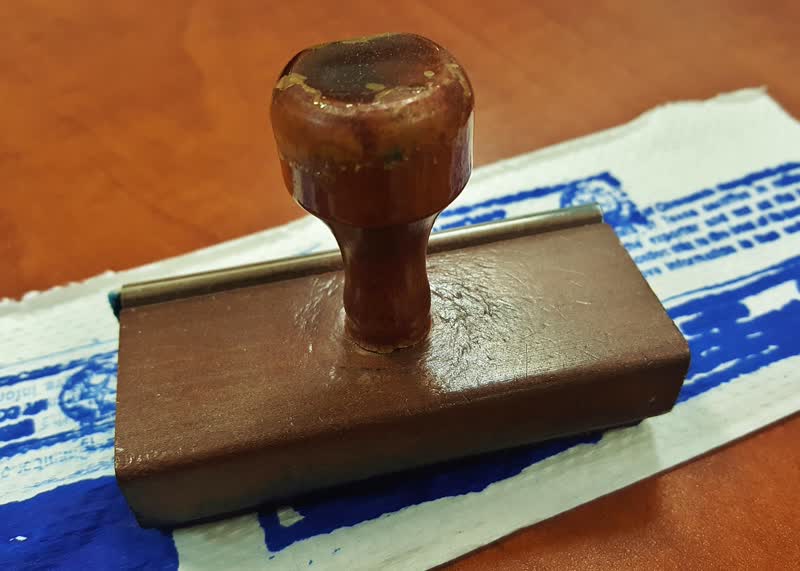
You’ll need to sign the POA in front of a notary public in your home country, or at a Royal Thai Embassy or Consulate if one runs a notarial service where you live.
The Royal Thai Embassy in Washington DC, for example, requires applicants to sign a separate “Notary Public for Signature Certification” form in front of a notary before the embassy will legalize it.
Thai Embassy or Consulate Legalization
Thailand isn’t part of the Hague Apostille Convention, so an apostille alone won’t work here, unlike documents headed to most of Europe. After notarization, the document needs to be legalized by a Royal Thai Embassy or Consulate.
Some countries add a step first. In the United States, missions typically require federal authentication from the Department of State before they’ll legalize the document themselves.
Tip: Check your specific embassy’s website before you start, because requirements and fees differ by mission. The Royal Thai Embassy in Washington DC charges US$15.00 per document to certify a signature on a Power of Attorney, plus return postage, and quotes 21 business days excluding weekends and official holidays. That’s roughly a month of calendar time, which is longer than most people expect when they’re racing a deadline.
Processing Time
Budget several weeks, not days, if you’re doing this from outside Thailand. If you know in advance you’ll need a POA, for a condo sale or a family visa application or anything else with a fixed date on it, start the embassy process as early as you reasonably can.
Using Your Power of Attorney
Once signed, a POA doesn’t expire on a fixed schedule the way a visa does. It generally stays valid until the task it covers is done, until you revoke it in writing, or until you die or lose legal capacity, whichever comes first.
For a narrow Special Power of Attorney tied to one transaction, that usually makes it functionally single-use. Your lawyer signs the condo transfer, and the document has done its job.
To cancel a POA before its task is done, revoke it in writing and notify your agent and any office holding a copy, particularly a bank or the Land Department. An unrevoked POA sitting in someone else’s hands is a real risk if the relationship with your agent sours.
Power of Attorney Versus a Simple Letter of Authorization
Not every situation needs a formal, stamped, notarized Power of Attorney. For something low-stakes a plain letter of authorization is often enough, and insisting on a full POA wastes time and money. Match the document to the stakes:
Letter of authorization: A signed letter stating what you’re authorizing someone to do, usually paired with a copy of your passport. Fine for collecting a parcel, picking up documents, or in some cases filing a 90-day report.
Formal Power of Attorney: Required whenever money, property, or a legal signature is on the line, and always required at the Land Department. If you’re unsure, ask the specific office what they’ll accept before you pay a lawyer to draft something they might not need.

Key Limits and Common Mistakes
A Power of Attorney becomes void automatically if you become legally incapacitated. This surprises people who assume a POA is a substitute for incapacity planning, the way it can be in some other countries.
In Thailand it works the other way around: the moment you lose legal capacity, the POA stops working, precisely when a family member might need it most. Long-term incapacity planning is a separate conversation with a lawyer.
Beyond that, four mistakes come up again and again:
Writing it too broadly: A catch-all POA is the version most likely to be turned away at a bank counter or Land Office window. Narrow and specific gets accepted; vague gets questioned.
Using the wrong form: Tor.Dor.21, Tor.Or.4, and A.C.21 aren’t interchangeable, and neither are the various bank-specific templates.
Skipping legalization when signing abroad: A POA notarized in your home country but never legalized by a Thai Embassy or Consulate generally won’t be accepted in Thailand.
Assuming a POA guarantees in-person exceptions: Immigration offices vary in what they’ll accept from a proxy, and some procedures still require you to show up whatever paperwork your agent carries.
Where to Get Help
Start with the office itself. Whoever will receive the POA, the Land Office, your bank branch, your local immigration office, is the one deciding whether to accept it, so ask them which form they want before you ask anyone else. That call is free and settles most of the uncertainty in this guide.
Hire a lawyer when you want a lawyer’s service, not when you want a piece of paper. If a firm is handling your visa, your company, or your property transfer, the POA is part of that work. If you’re only after the document, you don’t need them.
When you do want a firm for the underlying matter, our guides to law firms in Bangkok and law firms in Phuket are a reasonable starting point.
FAQ
Can I use a Power of Attorney to skip an immigration appointment entirely?
Sometimes, for routine paperwork like a 90-day report, but not reliably for visa extensions or anything involving an interview. Confirm with the specific office first.
Does a Power of Attorney need to be in Thai?
Land Department and most government forms are in Thai, sometimes with an English version alongside. A document only in English, without the correct Thai form, is likely to be turned away.
How much does a Power of Attorney cost in Thailand?
A narrow POA drafted by a Thai lawyer is generally inexpensive, often a modest flat fee plus stamp duty. Signing and legalizing one from abroad adds notary fees and the mission’s own processing fee. The Royal Thai Embassy in Washington DC charges US$15.00 per document and quotes 21 business days, and other missions set their own.
Can my spouse or partner act as my agent?
Yes. Many expats use a Thai spouse, a trusted friend, or their lawyer. The Land Department and banks don’t require the agent to be a lawyer, only that the document is correctly drafted and, where relevant, notarized and legalized.
What happens if my agent misuses the Power of Attorney?
It’s hard to misuse an official form, which is the strongest argument for using one wherever it exists. The form is built around a single transaction and a single property, so there’s nowhere else for it to go.
If you’re drafting your own, your protection is detail. Name the account number, the title deed number, the amount, the office, and the date the authority ends. A vague POA is the one that gets misused, and it’s also the one that gets rejected at the counter, so precision works twice in your favor.
If something does go wrong, you can hold your agent accountable under Thai civil law and, in serious cases, criminal law. Proving misuse afterward is far harder than writing a document that left no room for it.
Do I need a new Power of Attorney every time I travel?
No, not if you already have one for a specific purpose that’s still relevant. A Special Power of Attorney tied to one ongoing matter, like managing a rental property while you’re based overseas, stays valid and reusable for that purpose until you revoke it or the matter is resolved.
What you shouldn’t do is treat an old POA as a general standing authorization for unrelated new business. Draft a new one for anything it doesn’t explicitly cover.


 Français:
 Deutsch:
'/%3E%3Cpath%20fill='%23b2b2b2'%20d='M241%20382q0%2016%2017%2026%2017%2011%2042%2011t42-11q16-11%2017-26V269H241'/%3E%3Cpath%20fill='%239f7e00'%20d='M241%20379q0%2014%208%2023%209%209%2021%209%2014%200%2021-9%209-9%209-23V269h-59'/%3E%3Cpath%20d='M241%20339v-70h59v110q0%2014-9%2023l-6%205v-68h-15v72q-8%200-14-4v-68zm59%2040c0%2022%2015%2032%2029%2032%2021%200%2030-18%2030-32v-40h-59'/%3E%3Cpath%20fill='%239f7e00'%20d='M266%20277v5h2v12h-3v-5h2v-5h-9v5h2v5h-4v9h3v18h-5v10h34v-10h-5v-18h3v-9h-4v-5h2v-5h-9v5h2v5h-3v-12h2v-5zm42%20101q0%2010%206%2017%206%206%2015%207%2010-1%2016-7%206-7%206-17v-29h-43'/%3E%3Ccircle%20fill='%230044ad'%20cx='329.5'%20cy='372'%20r='6'/%3E%3Cellipse%20fill='%230044ad'%20cx='300'%20cy='340'%20rx='16'%20ry='21'/%3E%3C/svg%3E) Español:
Español: