
Contents
- A Guide to Thai Grammar Books
- Thai Grammar Books at a Glance
- English Language Grammar Books
- Thai Language Grammar Books
- Choosing a Book for Your Situation
- Frequently Asked Questions
- What is the best Thai grammar book for beginners?
- Is there a free Thai grammar book?
- Are Thai grammar books worth buying if I'm already taking classes?
- Should I choose a grammar book with Thai script or one with transliteration only?
- Is A Reference Grammar of Thai by Iwasaki and Ingkaphirom good for beginners?
- Are there Thai-language grammar books useful for foreign learners?
- Where can I buy these Thai grammar books?
- What's the difference between the two most common Thai grammar books?
- Which Thai grammar book should I start with if I'm self-studying without a teacher?
- Which Thai grammar book should I use if I'm enrolled in a Thai class?
- Do these grammar books cover written Thai as well as spoken Thai?
- Should I buy a physical copy or an eBook version?
- Do any of these Thai grammar books include audio for pronunciation practice?
- What to Read Next
If you want to actually speak Thai, check out ThaiPod101. You get a full Thai course with short audio lessons, podcasts, and quizzes for every level, starting at US$8 a month. Start learning here. (Advertisement)
A Guide to Thai Grammar Books
Presented here are short introductions to Thai grammar books, both in the English language for foreign learners and Thai language books for Thai school and university students which are also useful for foreign learners with a good Thai reading ability. As these are reference books, not tutorials, they are not intended to be read from cover-to-cover, but instead used to support continued studies.
Each book overview here covers the general structure and content together with comments about any specific, notable features. However, no opinion or rating is given about their suitability for any particular learning approach which is, of course, very subjective to each learner.
The books listed here are not the only books available. I welcome comments and further suggestions on this topic which would assist us all with our continued studies.
Thai Grammar Books at a Glance
Before the full reviews below, here’s how the eight books compare on level, format, and who each one suits best.
| Book | Level | Language of Instruction | Best For |
|---|---|---|---|
| The Fundamentals of the Thai Language | Beginner | English, with Thai script and transliteration | Learners who want grammar folded into a course-style format |
| Thai: An Essential Grammar (Smyth) | Beginner to advanced | English, with Thai script and transliteration | A quick, jargon-free reference for daily use |
| Thai Reference Grammar: The Structure of Spoken Thai (Higbie & Thinsan) | Beginner to advanced | English, with Thai script and transliteration | Learners past the beginner stage who want deep coverage of spoken structures |
| Thai Reference Grammar (Noss) | Intermediate to advanced | English, transliteration only, no Thai script | A free option with a strong focus on stress, rhythm, and intonation |
| A Reference Grammar of Thai (Iwasaki & Ingkaphirom) | Advanced | English, with Thai script, transliteration, and part-of-speech analysis | Learners who want real transcribed conversations analysed word by word |
| หลักภาษาไทย (กำชัย ทองหล่อ) | Advanced, native-level reading required | Thai only | The most detailed, standard reference once your reading is solid |
| ไวยากรณ์ไทย (นววรรณ พันธุเมธา) | Advanced, native-level reading required | Thai only | A shorter, less technical alternative with chapter exercises |
| บรรทัดฐานภาษาไทย เล่ม ๑-๖ (Thai Language Institute) | Advanced, native-level reading required | Thai only | The most modern, comprehensive series, sold mainly through Suksapan Phaanit |
English Language Grammar Books
The in-print books listed here can usually be found at all large book shops in Thailand which stock foreign language books. Many online shops (both Thai and foreign) sell them too. Google Books has free previews of some and, where relevant, a link is provided.

The Fundamentals of the Thai Language
Authors: Stuart Campbell and Chuan Shaweevongs
Format: out-of-print but available online (free)
Language: English with examples in Thai script and transliteration.
While this is more of a language course than a grammar book, it does have a strong emphasis on basic grammar and outlines some key differences from English which is useful for beginners. Each topic is presented with basic vocabulary lists and example conversations. The first edition was printed in 1956 so some of the vocabulary is showing its age but the clear explanations and well structured content make this a useful book.


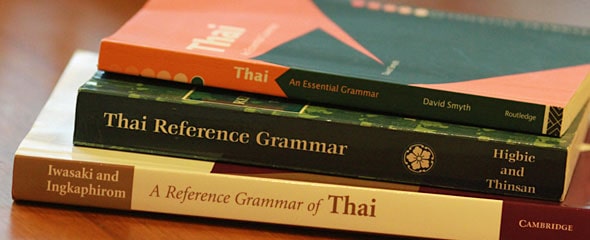
Thai: An Essential Grammar
Author: David Smyth
Formats: paperback, hardback, eBook (Kindle, PDF, ePub, Microsoft Reader)
ISBN: 978-0415226134 (paperback)
Language: English with examples in Thai script and transliteration.
Thai Reference Grammar: The Structure of Spoken Thai
Authors: James Higbie and Snea Thinsan
Format: paperback
ISBN: 978-9748304960
Language: English with examples in Thai script and transliteration.
These two books are perhaps the most commonly available grammar books for foreign learners. They’re good introductions to Thai grammar and language patterns and useful for beginners as well as advanced learners. Both are written for general learners and only use basic grammatical terminology (eg. nouns, verbs, conjunctions etc) and therefore are straight forward to read and very approachable.
Different styles of transliteration are used in each book. Smyth’s system is not too different from that developed by Mary Haas and is easy to learn for readers familiar with Haas’ works or the system used in the Thai for Beginners book. Higbie’s transliteration style is unique, using under- and over-scoring representing tones, but after the initial “what is that?” reaction, it’s quick to learn and intuitive.
Given the rising popularity of eBook readers and tablet computers, Smyth’s publisher (Routledge) deserves praise for making his work available in digital formats. However, the Kindle and ePub editions use miniature graphics files for the Thai text and some transliteration symbols so resizing the layout doesn’t work properly on all readers (the graphic files don’t resize along with the normal text). The PDF version does not have this problem. (I’ve not seen the Microsoft Reader version so can’t comment about it.)

Thai Reference Grammar
Author: Richard B. Noss
Formats: PDF (free online), paperback
ISBN: 978-1456503307 (paperback)
Language: English with transliteration (no Thai script)
Website: Thai-language.com Thai Reference Grammar PDF download.
Obviously written at a time when people didn’t worry about the health effects of smoking, this book introduces the topic of classifiers with a demonstration of how to buy cigarettes as “the yellow pack”, “those five packs”, “the big pack” etc. That’s not something found in modern books! Printed in 1964, this is an updated version of the author’s PhD dissertation so academic linguistic terminology is heavily used throughout eg. nouns are defined as “any substantive which occurs as the head of an endocentric expression”, but there are plenty of examples which help if the lingo is hard to understand. It’s perhaps unfortunate that only transliteration is used – no Thai script at all – but this is a book about spoken Thai.
One feature that stands out is the focus on stress, rhythm and intonation in spoken Thai and the transliteration (also based on Mary Haas’ system) includes symbols to represent these features. Other grammar books generally give less focus on this topic so its inclusion here is welcome.
The PDF version at the above website is free and is a scan of the original print edition. It’s mostly of good quality although there are a few faint or illegible words to be found. There are “new” editions of this book being sold online, but they seem to be identical to this PDF except for the front cover.

A Reference Grammar of Thai
Authors: Shoichi Iwasaki and Preeya Ingkaphirom
Formats: paperback, hardback
ISBN: 978-0521108676 (paperback)
Language: English with examples in Thai script, transliteration and part-of-speech analysis.
This book is also for a more academic audience. The terminology used is somewhat difficult at first if the reader is not familiar with technical linguistic terms (eg. chapter titles such as “Deontic Modal Auxiliaries”, “The Periphrastic Causative” etc), although each chapter has a short, less-technical introduction but not totally jargon free. Reading the chapter summaries first will give a clearer overview of the content and the terminology is arguably easier to understand than that used in Noss’ book.
The academic approach used to compile this book is clear from the conversational data: transcriptions of real conversations between teachers & parents, parents & children, business meetings etc. Even hesitations and repetition of words are transcribed, transliterated and analysed into parts of speech as spoken. Top marks for the analysis of real-life speech as this is something that’s not evident in the other books presented here.
The part-of-speech analysis is a feature not found in the other books in this article, although it’s common in many academic papers. For example:
นัดคงไม่มาแล้ว
nát khoŋ mây maa lɛ́ɛw
(name) may NEG come ASP
“Nat may not come any more.”

Lines 1, 2 and 4 are the Thai script, transliteration and translation respectively. Line 3 is the part-of-speech analysis showing how each word fits in the sentence: (name) denotes a persons name, NEG is a “negative marker” (“not”) and ASP is an “aspect auxiliary” (for time/tense).
However, there are a few mistakes: a few transliterations and translations are incomplete, and some incorrect spellings can be found too. But don’t let these minor negatives put you off though as this is otherwise a detailed, insightful (albeit expensive) book. The Smyth and Higbie books are great quick references for learning language structures but this one is more detailed and will often better answer the question “how does that word really work?”
Thai Language Grammar Books
These grammar books are primarily for native Thai speakers so the focus is very different from those above. The foreign language books are about second language acquisition and understanding whereas books for native speakers explain the workings of the reader’s own native language which they already use fluently in daily life.
The first two books can be found in Thai university bookshops and larger general bookshops. The บรรทัดฐานภาษาไทย books are limited in availability and details are provided separately below.

หลักภาษาไทย [The Fundamentals of the Thai Language]
Author: กำชัย ทองหล่อ
Formats: paperback, hardback
ISBN: 978-9742466350
Language: Thai
Previews: Two chapters with partial translations can be found on the thai-language.com website:
Modifiers
Parts of Speech
This book is the standard reference book of the Thai language, first printed about 60 years ago. It’s a very detailed, academic tome (540 pages) covering the evolution of the Thai script, alphabet, tones, types of words, their use (including royal vocabulary or “ratchasap”), clauses, sentences, loan words (mainly Pali and Sanskrit with limited discussion of Khmer, Chinese and English), prose and poetry.
This book has no index but the table of contents is very detailed (spanning 11 pages) and lists all chapters, sections and subsections making it quick and easy to find the right page.
This reference manual is the definitive reference book for the Thai language.

ไวยากรณ์ไทย [Thai Grammar]
Author: นววรรณ พันธุเมธา
Formats: paperback, hardback
ISBN: 974-9993276
Language: Thai
This book covers all the essentials and isn’t overly technical. It’s less detailed than หลักภาษาไทย and perhaps easier to understand while being organised in a similar manner. It starts with chapters covering word types (verbs, nouns, conjunctions etc) and then phrase and sentence construction. The book only discusses the modern Thai language as used in normal daily life so there’s limited discussion of royal vocabulary, and nothing on the language history or traditional forms of verse that are covered in หลักภาษาไทย. Plenty of examples are given throughout and there are also exercises at the end of each chapter.
Unfortunately, finding information in this book can be slow as there’s no index and the table of contents is short (one page) which lists only the chapter titles, not subsections. Also, the page headers only contain the author’s name, book title and page numbers (no chapter or section titles) so the reader must scan the pages for section headings instead.
However, this book does have a logical organisation and its non-technical approach makes it useful as both a tutorial and reference guide.

บรรทัดฐานภาษาไทย เล่ม ๑-๖ [Standard Thai, Books 1-6]
Author: Thai Language Institute, Office of Academic and Educational Standards, Office of the Basic Education Commission, Ministry of Education
Format: paperback
Language: Thai
Availability generally limited to ศึกษาภัณฑ์พาณิชย์ (Suksapan Phaanit) shops.
Branch locations can be found at suksapan.or.th and an online ordering service is available.
เล่ม ๑ ระบบเสียง อักษรไทย การอ่านคำและการเขียนสะกดคำ
Book 1 Phonology, Thai alphabet, Reading and Spelling Words
เล่ม ๒ คำ การสร้างคำและการยืมคำ
Book 2 Words, Word Construction and Loan Words
เล่ม ๓ ชนิดของคำ วลี ประโยคและสัมพันธสาร
Book 3 Types of Words, Clauses, Sentences and Discourse
เล่ม ๔ วัฒนธรรมการใช้ภาษาไทย
Book 4 Cultural use of the Thai Language
เล่ม ๕ กระบวนการคิดและการเขียนร้อยแก้ว
Book 5 The Art of Writing Prose
เล่ม ๖ ฉันทลักษณ์และขนบการเขียนร้อยกรอง
Book 6 Prosody and Patterns for Writing Verse
These recent books present a modern approach to understanding Thai for “teachers of Thai, students at secondary school level or higher and anyone interested in the Thai language”. They are written by “contemporary academic researchers and experts in the Thai language” which is evident from the bibliographies referencing many modern academic papers (from both Thai and foreign universities). By using a modern, broad base of linguistic research, the authors have developed a series of books that explain the Thai language clearly and concisely.
The vocabulary in these books is relatively straightforward and good use is made of charts and tables where appropriate. Some technical terminology has come from English and translated into Thai (eg. “socio-cultural information” translated to “ข้อมูลด้านสังคมและวัฒนธรรม”) but the English terms/phrases are also given on first use, which is helpful for foreign readers.
Footnotes are used to highlight where deviations have been made from older books such as หลักภาษาไทย (above) and its predecessor, the almost century-old work of พระยาอุปกิตศิลปสาร (not included here because it’s out-of-print). Such deviations are primarily where different terminology is used eg. the new books use คำนามวิสามัญ (proper noun) instead of วิสามานยนาม as used in the older books.
The up-to-date nature of these texts can be clearly seen in the second book (Words, Word Construction and Loan Words). The loan words chapters in the older books focus on Pali, Sanskrit and Khmer with a little Chinese and English but these newer books have extensive chapters for Pali, Sanskrit, Khmer, Chinese, Java-Malaya, and English. Likewise, in book 4 (Cultural use of the Thai Language) there are chapters on regional dialects in Thailand and modern language use in business, advertising, media, legal, religion, ceremonies, and word play/humour too.
In summary, these are well-thought out, up-to-date books with clear explanations, ample examples and a broad scope. They are likely to satisfy the most inquisitive students of the Thai language.
Choosing a Book for Your Situation
The right book depends less on which is “best” and more on how you’re studying and how much Thai you can already read.
- Self-study, no teacher: start with Thai: An Essential Grammar or Thai Reference Grammar: The Structure of Spoken Thai. Both use plain grammatical terms and include Thai script, so you’re not relying on transliteration alone.
- Enrolled in a Thai class or working with a tutor: check which transliteration system your course already uses before picking a book. Smyth’s system is close to Mary Haas’s; Higbie’s uses under- and over-scoring for tones. Matching your book to your course avoids learning two romanization systems side by side. A recommended Thai teacher or tutor can also tell you which reference they teach from.
- Your Thai reading is already solid: the three Thai-language references, หลักภาษาไทย, ไวยากรณ์ไทย, and บรรทัดฐานภาษาไทย, go further than any English-language book here, but they assume native-level literacy. If your reading isn’t there yet, build it first.
- On a budget: Noss’s Thai Reference Grammar is free as a PDF download and still covers intermediate to advanced ground, including stress and intonation that most other books skip.
None of these books replace a class or a study partner. If you’re weighing that option, a review of a real Thai language school, such as Union Language School or Thai Language Station, is a useful next read.
Frequently Asked Questions
What is the best Thai grammar book for beginners?
The article points to Thai: An Essential Grammar by David Smyth and Thai Reference Grammar: The Structure of Spoken Thai by James Higbie and Snea Thinsan as the most commonly available options, calling both approachable for beginners and advanced learners alike since they stick to basic grammatical terms like nouns, verbs, and conjunctions.
Is there a free Thai grammar book?
Yes. Richard B. Noss’s Thai Reference Grammar is available as a free PDF scan on thai-language.com. It uses transliteration only, with no Thai script, and focuses heavily on stress, rhythm, and intonation in spoken Thai.
Are Thai grammar books worth buying if I’m already taking classes?
The article frames these books as reference material, not stand-alone tutorials, meant to be dipped into rather than read cover to cover. Used that way, they support classroom study or self-study rather than replacing it.
Should I choose a grammar book with Thai script or one with transliteration only?
Both approaches appear among the recommended titles. Smyth’s and Higbie/Thinsan’s books include Thai script alongside transliteration, while Noss’s Thai Reference Grammar uses transliteration only. The choice comes down to whether you can already read Thai script comfortably.
Is A Reference Grammar of Thai by Iwasaki and Ingkaphirom good for beginners?
Not really. The article describes it as written for a more academic audience, with technical linguistic terminology and transcribed real-life conversations. It’s positioned as a deeper reference for understanding how specific words function, better suited to more advanced learners.
Are there Thai-language grammar books useful for foreign learners?
Yes, if your Thai reading ability is already solid. The article recommends หลักภาษาไทย (Fundamentals of the Thai Language) by Kamchai Thonglor, ไวยากรณ์ไทย (Thai Grammar) by Nawawan Panthumetha, and the six-volume บรรทัดฐานภาษาไทย (Standard Thai) series, all written for native Thai students rather than foreign learners.
Where can I buy these Thai grammar books?
The English-language titles are generally available at large bookshops in Thailand that stock foreign-language books, plus online retailers. The Thai-language textbooks are harder to find, mostly limited to university bookshops or, for the Standard Thai series, Suksapan Phaanit branches.
What’s the difference between the two most common Thai grammar books?
Smyth’s Thai: An Essential Grammar and Higbie and Thinsan’s Thai Reference Grammar cover similar ground for beginners and advanced learners, but use different transliteration systems: Smyth’s is close to the Mary Haas system, while Higbie’s uses distinctive under- and over-scoring to mark tones.
Which Thai grammar book should I start with if I’m self-studying without a teacher?
Thai: An Essential Grammar or Thai Reference Grammar: The Structure of Spoken Thai are the better starting points for self-study. Both use plain grammatical terms rather than academic linguistics jargon and include Thai script alongside transliteration, so you’re building script recognition from the start.
Which Thai grammar book should I use if I’m enrolled in a Thai class?
Pick the book whose transliteration system matches what your course already teaches. Smyth’s system is close to the Mary Haas romanization many courses use; Higbie’s uses distinctive under- and over-scoring for tones. Using two different systems at once slows you down rather than helping.
Do these grammar books cover written Thai as well as spoken Thai?
Not evenly. Most of the English-language books focus on spoken Thai grammar and sentence structure. For explicit writing instruction, the Thai-language บรรทัดฐานภาษาไทย series is the most direct source: Book 1 covers reading and spelling, Book 5 covers prose writing, and Book 6 covers verse, but all three assume native-level reading ability first.
Should I buy a physical copy or an eBook version?
For Smyth’s Thai: An Essential Grammar, the PDF edition is the safer eBook choice. The Kindle and ePub versions store the Thai text and some transliteration symbols as small graphics files that don’t resize with the rest of the text, which can make them hard to read on some devices. Noss’s Thai Reference Grammar is only available as a free PDF scan, so that question doesn’t apply there.
Do any of these Thai grammar books include audio for pronunciation practice?
No. Every book covered here is a text-only grammar reference, not a course with audio components. Pair one of these with a tutor, a language partner, or a dedicated listening resource for pronunciation practice.


What to Read Next
- Introduction to Thai Language Tense
- Basic Thai Grammar: How to Use Ending Particles
- How to Learn Thai Language Fast
- How to Learn Thai Language for Beginners
- How to Find Thai Language Partner
- Thai Language Book: Download 12 FREE Manee Books Online
- Thai Language Books: A Review of Available Titles
- Bookstores in Bangkok: Where to Get Your Reading Fix

 Deutsch:
 Français:
 Español: