If you have Thai children, you might qualify for a Thai family visa instead of a marriage visa. It’s easier to get and has lower financial requirements, making it a practical option for expats raising kids in Thailand.
Not many expats who have Thai children know this, but you can apply for a Thai family visa instead of a Thai marriage visa in Thailand.
The process of getting a Thai family visa is generally the same as the marriage visa, but the financial requirements aren’t as strict.
In this guide, I’ll go over what requirements you need to meet and which documents you must submit to successfully get a one-year Thai family visa. Plus I’ll cover the associated costs and offer some advice on how to keep your visa in good standing.
Before you start: Thailand’s visa rules change often. Always confirm the current steps, fees, and documents on the official Thai e-Visa portal before you travel. Book a flexible or refundable flight and do not plan a tight return. Your approval now arrives by email, and the timing is hard to predict.
Disclaimer: Some links in this article go to our partners, and we may earn a commission if you use them. It costs you nothing extra, and we only recommend services we'd use ourselves. Read more in our Advertising Disclosure.
Contents
- Key Takeaways
- What is the Thai Family Visa?
- Who Qualifies: Parent, Guardian, or Spouse
- Family Visa Vs. Marriage Visa
- Family Visa Vs. Guardian Visa
- Requirements
- Thai Family Visa Documents
- Application Process
- Thai Family Visa Costs
- From Entry Visa to One-Year Extension: How the Timeline Works
- Re-Entry Permit
- Renewing Your Thai Family Visa
- Alternative Visas
- Overstaying Your Visa
- 90-Day Check-Ins
- Thai Family Visa And Permanent Residency
- Community Tips on the Thai Family Visa
- Frequently Asked Questions
- Do I need to be married to a Thai citizen to get a Thai family visa?
- How much money do I need in my bank account for a Thai family visa?
- Can a single parent or divorced expat apply for a Thai family visa?
- How long does a Thai family visa application take to process?
- How many re-entry permits do I need if I'm traveling more than once during the year?
- Can I apply for a Thai family visa if my child was born outside Thailand?
- Does a Thai family visa let me work in Thailand?
- Now, on to You
Key Takeaways
- The Thai family visa (non-immigrant “O”) lets expats with Thai children live in Thailand for one year, renewable annually.
- Unlike the marriage visa, you only need THB400,000 in your Thai bank account the day before applying, not three months in advance.
- You don’t need to be married to a Thai citizen to qualify; having biological Thai children and supporting them financially is enough.
- Required documents include proof of parentage, family photos at your residence, Thai birth certificates, and a Thai bank letter.
- The visa costs THB1,900 plus any photocopy fees at the immigration office.
- If you travel outside Thailand, apply for a re-entry permit first or your visa will be voided when you return.
- You must complete 90-day check-ins throughout the year; missing them can result in fines of up to THB5,000.
- After holding this visa for at least three years and paying Thai taxes, you may qualify to apply for permanent residency.


Quick requirements
- Family linkYou’re the legal or biological parent of a Thai child and currently support them financially. Marriage to a Thai citizen isn’t required.
- Funds (non-Thai men only)THB400,000 in a Thai bank account, needed the day before you apply – no 3-month seasoning like the marriage visa.
- Visa feeTHB1,900 plus any photocopy fees at immigration.
- ValidityOne year, renewable annually. Three years on this visa while paying Thai taxes can open a path to permanent residency.
Documents to prepare
- PassportPhoto page plus copies of every used page.
- Photos & form TM7Two visa-sized photos and the completed TM7 application form.
- Proof of parentageThai birth certificates for your children (or foreign birth certificates translated to Thai).
- Marriage certificateIf married: Thai or overseas marriage certificate plus the related Thai registration forms.
- Family photosTaken at your residence (kitchen, living room, bedrooms, and the front of the house/condo with the house number visible), plus photos with your children at school.
- Blue Book copiesAddress page showing your spouse’s name (if married) and your Thai children’s names.
- Residence proofHand-drawn map to your home from the immigration office, plus your lease or property deed and owner’s ID. If renting, tax stamps calculated from your monthly rent are also required.
- Bank letter & bank book (non-Thai men only)Letter confirming THB400,000 in savings, plus copies of your bank book’s updated balance page and front page.
Bring two copies of each document in addition to the originals.
Phase A · Prepare your documents
You don’t need to be married to a Thai citizen – a sole parent or guardian who financially supports Thai children can apply too.
Collect birth certificates and, if married, your marriage certificate and related Thai registration forms.
Photograph every room of your home, the house number at the front, and you with your children at school.
Deposit THB400,000 in your Thai bank account and get a letter confirming the balance – no seasoning period required.
Phase B · Apply at Thai immigration
At your local immigration office, tell the service desk your purpose and take a queue number.
Hand everything to the officer at your window. If it’s all correct, pay the visa fee; if not, you may be asked to return with missing items or email them.
At the next station, you’ll take a photo with your Thai children (and spouse, if applicable), and staff will keep your passport.
It comes back stamped with a date 30 days later – that’s when you return for your results and one-year visa stamp.
Phase C · Stay compliant & renew
Leaving Thailand without one voids your visa, and you’ll have to re-enter as a tourist.
Due 90 days after you arrive in Thailand (not from your visa date). You can file online; missing a check-in can mean a fine of up to THB5,000.
There’s no separate renewal – you repeat the same document and immigration-office process annually to keep your visa active.
If you need help applying for your visa, you can use a visa service from Baan Thai Immigration Solutions (sponsored).
What is the Thai Family Visa?
The Thai family visa, which is technically the non-immigrant “O” visa for family of Thai nationals, is for expats who are raising Thai children in Thailand, whether alone or with their spouses. It gets you one year in the country, and you can renew it every year thereafter as long as you meet the requirements and submit the right documents.
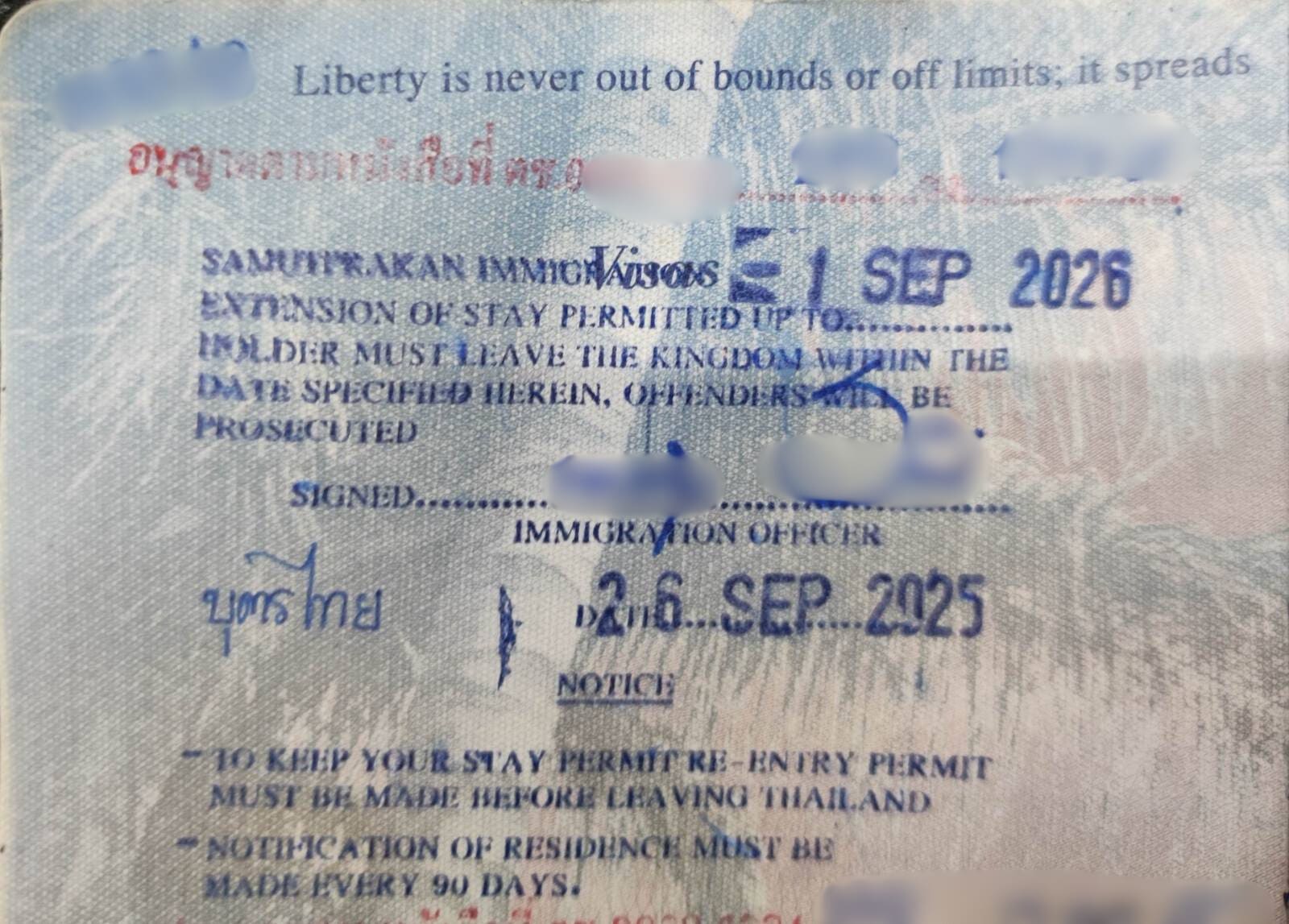
I never knew the Thai family visa option existed until a few years after I moved to Thailand in 2014. One year, I miscalculated my Thai marriage visa expiration date. When I showed up at the immigration office for a routine 90-day check-in, the officer told me my visa had expired.
That meant I had to apply for a new visa that same day or pay the THB500 per day fine and leave the country. Unprepared, I didn’t have the required THB400,000 in my Thai bank account seasoning for three months. But they said if I could show the money the next day, I could apply for a Thai family visa, which only requires you to have the 400K in your account the day before you apply, not months in advance.
So I transferred the money from the States using Wise and applied for my very first Thai family visa. I’ve been renewing this visa ever since.
Who Qualifies: Parent, Guardian, or Spouse
“Family visa” gets used loosely for three different Non-Immigrant “O” routes in Thailand, and mixing them up wastes a trip to immigration. Here’s the quick map before the detail below.
- Parent of a Thai child: you financially support a Thai son or daughter, whether or not you’re married to the child’s other parent. This is the route the rest of this guide covers.
- Spouse of a Thai national: you’re married to a Thai citizen, with or without children together. Thailand’s Marriage Equality Act took effect in January 2025, so this applies to same-sex and opposite-sex marriages alike. It’s a separate route with its own documents and financial rules, covered on our Thai marriage visa guide rather than here.
- Guardian of a non-Thai child studying in Thailand: you’re not raising a Thai child, but you’re accompanying your own non-Thai child while they attend an approved Thai school. See the Family Visa Vs. Guardian Visa section below for how this route differs.
The rest of this guide covers the parent route step by step: who qualifies, the documents to gather, and what it costs. For how the family visa compares to Thailand’s other long-stay categories, see our Thailand visa overview.
Family Visa Vs. Marriage Visa
The only real difference between the Thai family visa and the non-immigrant “O” visa based on marriage is that you must have THB400,000 seasoning in your bank account for three months before applying for the marriage visa. You can get a visa based on marriage as long as you’re married to a Thai citizen, whether you and your spouse have Thai children or not. In other words, having kids isn’t a qualifying factor.
You can get a marriage visa instead of a family visa if you have Thai kids. The choice is up to you.
Family Visa Vs. Guardian Visa
A Thai family visa is also not a Thai guardian visa. The Thai guardian visa, also a “non-immigrant “O” visa, lets you accompany your non-Thai children to Thailand if they’re studying at an approved school here in the country. What’s different about this visa is that you need to show THB500,000 in a bank account and letter from your children’s school stating that they are studying there. (Verified September 2026.)
With that out of the way, let’s look at the requirements you need to meet in order to apply for a Thai family visa.
Requirements
To apply for the Thai family visa, you must have Thai children (mixed-race, luk khrueng) and currently support them financially. Financial support can come in the way of paying for school tuition, clothes, housing, food, or other general costs of living in Thailand.
Despite the name, you don’t have to be married to a Thai citizen to apply for the Thai family visa. That is, you don’t need a complete family with mother, father, and children. In fact, I know one divorced expat who has sole custody of his Thai children and applies for this visa every year. Another expat I know never got married to the mother of his Thai daughter, but he can apply for the Thai family visa every year.
One of them did have to hire a Thai lawyer and go to Thai court to get sole custody of his children, as his Thai wife left Thailand, never returned, and wasn’t around to sign any papers for their children. So he became the sole guardian and was even allowed to apply for Thai passports on his Thai children’s behalf.
To apply for this visa, you do have to prove that you’re the parent of the children, which you’ll do by providing the right documents. I cover this in the section below.
Thai Family Visa Documents
The documents needed to apply for a Thai family visa are almost the same as those needed to apply for a Thai marriage visa. The financial requirements are a bit different though.
Instead of having to keep THB400,000 in your Thai bank account for three months before applying, you can deposit that money the day before you apply for your family visa.
Thailand’s Ministry of Foreign Affairs lists the documents you need to apply for a non-immigrant O visa, which the Thai family visa falls under. But keep in mind that it’s always best to visit your local Thai immigration office and talk to an officer in person to get their list of documents. After all, each provincial immigration office operates slightly differently.
That said, let’s look at all the documents you must submit. Keep in mind that you need two copies of each of the items below, in addition to the originals.
Personal Documents

- Passport and copies of your photo page and every used page
- Two visa-sized photos
- Form TM7 (PDF download)
Proof of Relationship to Your Thai Children
- Copies of spouse’s Thai ID card (if married)
- Thai marriage certificate or overseas marriage certificate (if married)
- Form ค.ร. 22 (if married overseas)
- Forms ค.ร. 2 and 3 (if married in Thailand)
- Thai birth certificates (or foreign birth certificates translated to Thai if your Thai child was born outside of Thailand)
- Family photos of you, your spouse (if married), and Thai children at your house
- Photos must be taken in your kitchen, living room, bedrooms, front of the house/condo with house/room number clearly showing in photos
- Photos with you and your Thai children at school
- Copies of Thai Blue Book address page with spouse’s name (if married)
- Copies of Thai Blue Book address page with Thai children’s name
- Hand-drawn map showing how to get to your Thai residence from the immigration office
- Copies of your lease (if renting), rental property owner’s ID, property deed/title
- Tax stamps from the Thai Revenue Department calculated from your monthly rental cost
- Rent x 12 months/1,000 = the amount of tax stamps you have to buy and attach to your lease
Proof of Income (non-Thai men only)
- Thai Bank letter showing THB400,000 in savings
- For the Thai family visa, the money doesn’t have to sit in your account for three months
- Copies of your bank book’s most recent updated page showing the THB400,000
- Copies of your bank book’s front page with your name and account number
Dive deeper: Opening a Thai Bank Account: A Guide for Expats and Tourists
Financial Requirements by Route
Bangkok Immigration Division 1’s own published criteria set different numbers for each of the three routes from the section above. Confirm the current figures with your own local office before applying, since documentary requirements can vary slightly by province.
| Route | Financial Requirement | Deposit Seasoning |
|---|---|---|
| Parent of a Thai child (this visa) | THB40,000/month average income, or a THB400,000 bank deposit, or a combination totaling THB400,000/year | None stated in Immigration Division 1’s published criteria for this route |
| Spouse of a Thai national (marriage visa) | Same income test, or a THB400,000 bank deposit | Deposit must show in the account for the past 2 months, per Immigration Division 1’s published criteria |
| Guardian of a non-Thai child studying in Thailand | THB500,000 bank deposit, as stated earlier in this guide | Not independently re-verified for this update; confirm with your local office |
The day-before-you-apply framing for the parent route holds up against the primary source. Immigration Division 1’s criteria list the THB400,000 (or THB40,000/month) figure for the parent route without a maintained-balance period, unlike the marriage route’s stated two-month requirement. (Verified September 2026.)
Application Process
To apply for the Thai family visa, go to your local Thai immigration office. You’ll find a service desk at most offices. Here, staff will ask what your purpose of visiting is and then give you a queue number.
You’ll have to wait for your queue number to appear on the TV screen. Once it does, go to the respective window number that appears next to your queue number on the TV screen.
Hand all your documents to the immigration officer, who will then scrutinize each one. If your documents are correct, you’ll pay the visa fee and move on to the next station. If not, he or she may ask you to come back with the missing documents or ask you to send them through email.
At the next station, you’ll take a group photo with your Thai children (and spouse) and staff will then take your passport.
Finally, you’ll have to wait to get your passport back, which should be stamped with a date 30 days from the day you applied for your Thai family visa. That date is when you must return to immigration to get your visa results and new one-year stamp in your passport.
Thai Family Visa Costs
The Thai family visa costs THB1,900 plus any photocopy fees you have to pay while at immigration. (Verified September 2026.)
From Entry Visa to One-Year Extension: How the Timeline Works
Three different “90 day” or “one year” numbers show up around this visa, and they’re easy to mix up. Here’s how the pieces fit together.
- Entry visa (90 days): if you apply at a Thai embassy or consulate before traveling, the Non-Immigrant “O” visa you receive is valid for three months, according to Thailand’s Ministry of Foreign Affairs. That gets you into the country; it isn’t the one-year family visa itself.
- Extension of stay (1 year): once you’re in Thailand, you apply at your local immigration office (see the Application Process section above) to extend that entry visa into the one-year family visa. This is the visa this guide is about.
- 90-day address reporting: unrelated to either of the above. It’s a recurring check-in due every 90 days from your arrival date, not your visa date, and it runs the whole time you hold the visa. See our 90-day reporting guide for how to file it.
- Re-entry permit: needed each time you leave Thailand during your one-year extension, or the extension is voided when you return. See our re-entry permit guide for single- vs. multiple-entry options.
Confusing the entry visa’s three-month validity with the one-year extension is the most common mix-up. If your passport only shows a 90-day stamp, that’s the entry visa. You still need to complete the extension of stay at immigration to get the full year.
Re-Entry Permit
If you plan on traveling outside of Thailand during the year, you should apply for a single- or multiple-entry permit. This lets you come and go without losing your Thai visa. If you leave Thailand without a re-entry permit, and then return to Thailand, immigration officers at the airport will void your visa and you’ll have to enter as a tourist.
Dive deeper: Thailand Re-entry Permits: How NOT to Lose Your Thailand Visa
Renewing Your Thai Family Visa
Technically, you don’t “renew” your Thai visa. You have to reapply for an entirely new visa every year. The process is exactly the same as when first applying. The only difference I’ve noticed over the years is that Thai immigration officers never check my original documents anymore. That’s probably because they’ve seen that I’ve been going there since 2014 for the same visa.
Alternative Visas
If you have Thai children and you’re looking for an alternative to the Thai family visa, you can look into the Thai marriage visa if your spouse is Thai. You also have the Destination Thailand Visa and the Thailand Elite Visa, although the financial requirements tend to be higher.
Overstaying Your Visa
Once you have your Thai family visa, take note of the expiration date. You never want to overstay your visa because you’ll have to pay a fine and possibly be prohibited from entering Thailand again for a set number of years. I know one guy who overstayed his Thai visa and remained in Thailand for months. Thai Immigration came to his condo, arrested him, and deported him. He was prohibited from returning to Thailand for 10 years.
90-Day Check-Ins
When you have a Thai family visa, you have to keep up with your 90-day check-ins. The date of your first 90-day check-in is due 90 days after you arrive in Thailand, not 90 days after you get your visa. Be mindful of this because if you miss your check-in, you will be fined up to THB5,000. In fact, more than once I had to pay THB2,000 fines because I missed my 90-day check-in dates. Nowadays, you can do it online, and Thai immigration sends you an advanced two-week notification of when it’s due.
Dive deeper: How to Do Your 90-Day Reporting in Thailand
Thai Family Visa And Permanent Residency
If you have Thai children and apply for a Thai family visa, you can eventually use that visa as a pathway to applying for Thai permanent residency. You have to apply for the family visa for at least three years in a row and pay taxes on income earned within Thailand for three years. (Verified September 2026.) That is, you must have a job in Thailand. In some cases, though, you can use your Thai spouse’s income and tax filings as “proof” that you’ve been paying taxes.
Community Tips on the Thai Family Visa
Expats on Thai-focused forums and Facebook groups consistently rate the Thai family visa as one of the more manageable long-term visa options in Thailand. Common tips shared in these communities:
- bring extra copies of every document since requirements can vary slightly between offices
- make sure your family photos are clear and recent, showing every room including the front of the property with the house number visible.
- Those dealing with sole custody situations advise carrying court orders and guardianship papers to every appointment.
The broad consensus is that as long as your paperwork is thorough and consistent year to year, immigration officers are cooperative and the process becomes routine.
Frequently Asked Questions
Do I need to be married to a Thai citizen to get a Thai family visa?
No. The family visa is based on financially supporting a Thai child, not on marital status. If you’re married to the child’s Thai parent, you can also qualify for the separate marriage visa instead, but marriage isn’t required for the family visa itself.
How much money do I need in my bank account for a Thai family visa?
Immigration Division 1’s published criteria call for an average monthly income of at least THB40,000, or a Thai bank deposit of at least THB400,000, or a combination of the two totaling THB400,000 a year. Unlike the marriage visa, no minimum seasoning period is stated for this route.
Can a single parent or divorced expat apply for a Thai family visa?
Yes. You don’t need a complete family unit of mother, father, and children. A sole parent or legal guardian who financially supports a Thai child can apply, though sole-custody situations may need extra documentation like a court order.
How long does a Thai family visa application take to process?
Around 30 days. After you submit your documents, immigration stamps your passport with a return date roughly a month out, and that’s when you go back to collect your results and your one-year visa stamp.
How many re-entry permits do I need if I’m traveling more than once during the year?
If you know you’ll leave Thailand more than once before your next renewal, apply for a multiple-entry permit rather than a single-entry one. A single-entry permit only covers you for one trip; each entry after that without a valid permit voids your visa.
Can I apply for a Thai family visa if my child was born outside Thailand?
Yes. You’ll need your child’s foreign birth certificate translated into Thai in place of a Thai birth certificate. The rest of the document list is the same regardless of where your child was born.
Does a Thai family visa let me work in Thailand?
Not by itself. Like most non-immigrant visas, the family visa authorizes your stay, not employment. If you want to work legally in Thailand, you still need a separate work permit from the Ministry of Labour, sponsored by a Thai-registered employer.
Now, on to You
As long as you meet the requirements and submit all the necessary documents, applying for a Thai family visa is a straightforward process. I’ve found that immigration officers tend to work with you rather than against you, because they know you’re here for a good reason, which is to raise your Thai children.



 Deutsch:
 Français:
'/%3E%3Cpath%20fill='%23b2b2b2'%20d='M241%20382q0%2016%2017%2026%2017%2011%2042%2011t42-11q16-11%2017-26V269H241'/%3E%3Cpath%20fill='%239f7e00'%20d='M241%20379q0%2014%208%2023%209%209%2021%209%2014%200%2021-9%209-9%209-23V269h-59'/%3E%3Cpath%20d='M241%20339v-70h59v110q0%2014-9%2023l-6%205v-68h-15v72q-8%200-14-4v-68zm59%2040c0%2022%2015%2032%2029%2032%2021%200%2030-18%2030-32v-40h-59'/%3E%3Cpath%20fill='%239f7e00'%20d='M266%20277v5h2v12h-3v-5h2v-5h-9v5h2v5h-4v9h3v18h-5v10h34v-10h-5v-18h3v-9h-4v-5h2v-5h-9v5h2v5h-3v-12h2v-5zm42%20101q0%2010%206%2017%206%206%2015%207%2010-1%2016-7%206-7%206-17v-29h-43'/%3E%3Ccircle%20fill='%230044ad'%20cx='329.5'%20cy='372'%20r='6'/%3E%3Cellipse%20fill='%230044ad'%20cx='300'%20cy='340'%20rx='16'%20ry='21'/%3E%3C/svg%3E) Español:
Español: