
Thailand offers more fuel types than most countries, which can be confusing at first. This guide covers how to fill up your car, petrol grades, gas station brands, how to pay, and what to do if you put in the wrong fuel.
While driving in Thailand, you’ll notice that the country offers a lot more fuel options than, say, a place like the United States. And it can get quite confusing.
After all, what is the difference between E20 and E85? What’s B7? If you need standard diesel, which fuel should you ask for? And how can you tell if a gas station even carries your preferred fuel?
In this guide, you’re going to find out everything you need to know about filling up your tank in Thailand, including fuel options, which gas stations to choose, how to pay, how to check for the lowest gas prices, and some basic Thai phrases you can use the next time you’re at the pump.
Disclaimer: Some links in this article go to our partners, and we may earn a commission if you use them. It costs you nothing extra, and we only recommend services we'd use ourselves. Read more in our Advertising Disclosure.
Contents
- Key Takeaways
- How to Find the Nearest Gas Station in Thailand
- Fuel Options
- Which Fuel Type Should You Choose?
- Gas Stations in Thailand
- Which Gas Brand Should You Choose?
- 24-Hour Stations and Rest Stops for Long Drives
- How to Fill Up Your Tank in Thailand
- Payment Options
- Membership Cards
- Best Credit Cards for Filling Up Your Tank
- Monitoring Fuel Prices
- What to Do if You Fill up with the Wrong Fuel?
- Filling Up With LPG
- EV Charging at Thai Gas Stations
- Frequently Asked Questions
- What types of fuel are available in Thailand?
- What’s the difference between Gasohol E20 and Gasohol 91 or 95?
- How do I know which fuel type my car takes?
- Which gas station chain has the most locations in Thailand?
- How do I find the nearest gas station in Thailand?
- Can I pump my own gas at a Thai gas station?
- How do I pay for gas in Thailand?
- Can expats sign up for gas station membership or points cards in Thailand?
- What should I do if I put the wrong fuel in my car in Thailand?
- Is there EV charging at gas stations in Thailand?
- Are gas stations in Thailand open 24 hours?
- Has Esso in Thailand fully changed over to Bangchak?
- Which fuel is the cheapest option in Thailand?
- Do Thai gas stations have restrooms and food available?
- Sources Cited
Key Takeaways
- Thailand has two main fuel types, diesel and bensin (gasoline), each split into several grades that suit different vehicles.
- Many petrol cars can run on E20, which is one of the cheapest options; Gasohol 91 or 95 performs better on long drives.
- Check the sticker inside your driver’s door if you are not sure which fuel your car takes.
- PTT has the widest coverage and is the safest stop on long-distance routes; Bang Chak, PT, Shell, Caltex, and Susco are solid alternatives.
- Google Maps is the fastest way to find the nearest gas station; PTT, Bangchak, Shell, and Caltex also run their own station finders.
- Most gas stations in Thailand are full-service: just tell the attendant the fuel type and how much you want.
- Cash, credit cards, and QR-code bank transfers are all accepted; keep your card in sight at smaller or rural stations.
- Membership point cards are available at all major chains, but signing up is very difficult for foreigners without a Thai ID or Pink ID card.
- If you put in the wrong fuel, pull over immediately, turn off the engine, and call a mechanic before trying to drive further.


How to Find the Nearest Gas Station in Thailand
The quickest way to find the nearest gas station in Thailand is to search “gas station” in Google Maps, which lists the closest stations with their brand, distance and opening hours. The Thai word is ปั๊มน้ำมัน (bpám nám man), which is also what to ask a local if your phone dies.
If you stick to one brand, or need a less common fuel like B20 or E85, the big chains run their own station finders:
- PTT: The PTT Station map searches for PTT stations near you or along a route you plan. PTT’s Xplore app shows its latest fuel prices.
- Bangchak: The Bangchak mobile app finds nearby Bangchak stations and sends a notification when fuel prices change. Former Esso stations now run under the Bangchak name, so search for Bangchak instead.
- Shell: Shell Thailand’s station locator shows its stations on a map. The page is in Thai only.
- Caltex: The Caltex Find Us page, also in Thai, searches Caltex stations and service centres.
Fuel Options
There are two main types of fuel in Thailand: diesel and bensin. Both of these can be further categorized into different grades.
Diesel
| Diesel (B7) | 7% biodiesel + 93% petrodiesel. This is the standard diesel at every major chain. |
| Diesel B20 | 20% biodiesel + 80% petrodiesel |
| Premium Diesel | Diesel with additives that improve performance |
Bensin
| Gasohol E85 | 85% ethanol fuel + 15% gasoline |
| Gasohol E20 | 20% ethanol fuel + 80% gasoline |
| Gasohol 91 | 10% ethanol fuel + 90% gasoline. Gasohol 91 has an octane rating of 91. |
| Gasohol 95 | 10% ethanol fuel + 90% gasoline. Gasohol 95 has an octane rating of 95. |
| Bensin | 100% gasoline |
| Premium Bensin | Standard gasoline that is enhanced to improve performance |
Which Fuel Type Should You Choose?
Choosing the right fuel depends on your preference and vehicle type. For example, a car that runs on bensin would take E20 because it’s one of the cheapest fuels and many cars and motorcycles can run on it. But some people pick Gasohol 95, claiming it performs better than E20.
I normally use E20 for my car. Once in a while, I fill up with Gasohol 91 or 95 when I drive long distances because Gasohol 91 and 95 perform better.
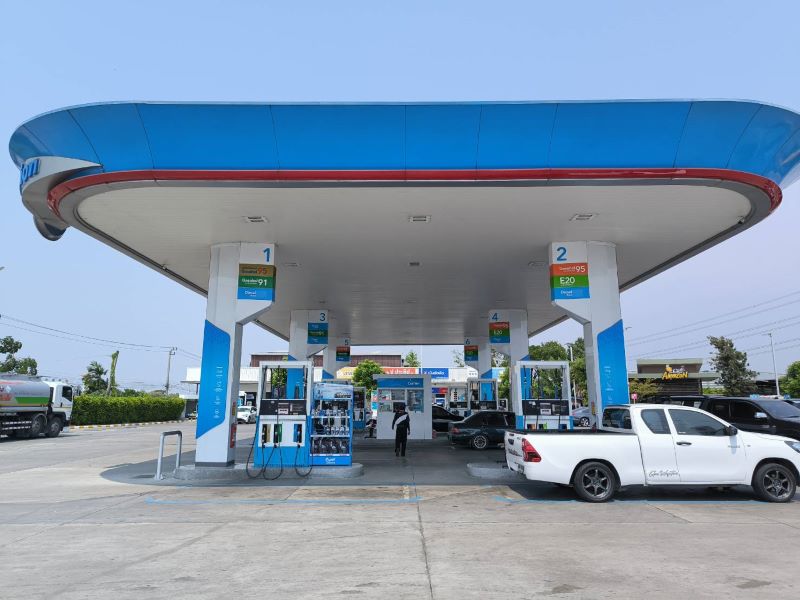
If you drive a diesel vehicle, you can fill it up with standard or premium diesel.
Tip: Not sure which type of gas to get? Check the sticker on the driver’s seat door. Most newer vehicles will have stickers that tell you which fuels you can use in the vehicle. If you’re driving a rental car, ask the rental company which fuel type you should use.
Gas Stations in Thailand
You’ll find gas stations all across Thailand featuring both local and international fuel brands. Here’s a list of the various gas stations available in the country.
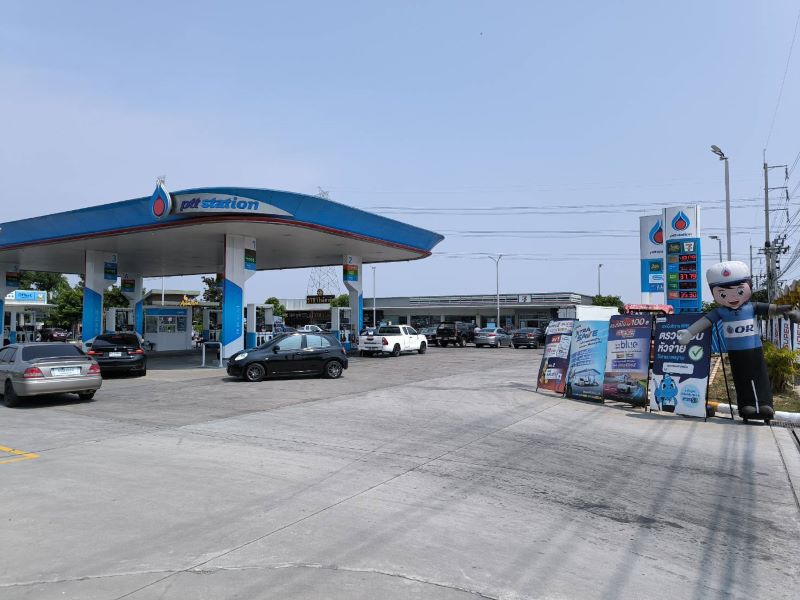
- PTT: This is the largest gas station chain in Thailand with the most branches. It’s located all throughout Thailand. PTT is especially popular with long-distance drivers because its gas stations have clean restrooms, restaurants, convenience stores, souvenir shops, and Café Amazon.
- Bang Chak: Bang Chak is another large gas station chain in Thailand. It further expanded its business after acquiring Esso, the well-known international fuel brand, in 2023. Bang Chak is known for its clean energy.
- PT: You can find PT all throughout Thailand as well. Since it’s not as popular as PTT and Bang Chak, you won’t wait as long to fill up your tank. PT is also known for its own coffee brand, Punthai Coffee, which is strong.
- Susco: Susco is the smallest gas station chain in Thailand. It’s located only in certain provinces.
- Shell: Shell is a British gas station company that has chains in Thailand. Since it’s a leading gas company, many people trust its gas quality. But gas prices from Shell are slightly more expensive than gas from other brands.
- Caltex: Caltex is another international company with chains in Thailand. It’s known for its gas quality. Some people claim that Caltex has the best gas in Thailand. But its gas prices are also more expensive than other companies.
Which Gas Brand Should You Choose?
In my case, I normally fill up my tank at Bang Chak because it’s simply the most convenient station for me to get to.
But when I drive to other provinces, PTT is my first choice. Not because of its gas quality, but because of its clean restrooms and convenient stores. Also, many PTT gas stations are safe, even at night. There are people coming and going all the time, and it’s well lit.
I also fill up the tank at other stations from time to time. But I haven’t noticed any difference in gas quality.
24-Hour Stations and Rest Stops for Long Drives
PTT and Bangchak are the most reliable chains for 24-hour stops along major highways. Their locations typically feature well-lit forecourts, 24-hour convenience stores, and clean restrooms, making them practical options for late-night or early-morning trips.
Smaller independent stations and rural PT or Susco branches often close overnight or operate with limited staff. Plan your fuel stops around major chains when driving long distances overnight. If your route includes expressways, keep an Easy Pass or M-Flow account topped up, as busy toll lanes do not always accept cash.
How to Fill Up Your Tank in Thailand
In Thailand, most gas stations offer full service. Just tell them which gas you need and how much, and the attendant will do the rest.
Learning basic Thai phrases helps make sure the attendant understands what you need and doesn’t put in the wrong fuel type.

Here is the speaking pattern used when asking for gas:
- fuel type + how much you want
For example, if you want a full tank of E20, you’d say “E20 Full” in Thai. If you only want THB500 worth of gas, you’d say “E20 THB500.”
And here’s a list of must-know Thai vocabulary for filling up your tank in Thailand.
| Vocabulary | Phonetic | Listen | Definition |
| E20 | E yêe sìb | Gasohol E20 | |
| 91 | gâao sìb èd | Gasohol 91 | |
| 95 | gâao sìb hâa | Gasohol 95 | |
| Diesel | Diesel | Diesel | |
| B7 | B jèd | Diesel B7 | |
| B7 ธรรมดา | B jèd tam ma daa | Normal Diesel B7 | |
| B7 พิเศษ | B jèd pí sèd | Premium Diesel B7 | |
| 200 บาท | sǒng róoi bàad | THB200 | |
| 500 บาท | hâa róoi bàad | THB500 | |
| 1000 บาท | nèung pan bàad | THB1,000 | |
| เต็มถัง | dtem tǎng | full gas tank | |
| ดีเซล เต็มถัง | Diesel dtem tǎng | Fill a full tank of diesel | |
| 95 เต็มถัง | gâao sìb hâa dtem tǎng | Fill a full tank of gasohol 95 | |
| E20 THB500 | E yêe sìb hâa róoi bàad | Fill up gasohol E20 for THB500 | |
| สแกน | Scan | Scan a QR code for mobile payment |
Payment Options
You have three ways to pay for gas in Thailand.
- Cash: Most gas stations in Thailand still accept paper cash.
- Credit and debit cards: Visa and MasterCard are accepted at most gas stations throughout Thailand.
- Banking app: If you have a Thai bank account, you can pay by scanning the QR code.
One important caveat when it comes to paying with a credit or debit card: some gas station attendants have been caught stealing people’s credit card numbers, expiration dates, and three-digit CVV numbers.
With this info, they can buy things online without you knowing. So, if you pay for gas with a debit or credit card at a lesser-known gas station in the countryside, it might be good to keep your card in sight at all times.
Membership Cards
All gas stations in Thailand offer membership cards that give you points every time you get gas. You can then use the points for discounts on gas or other shops like Amazon Cafe. But signing up is very difficult for foreigners without a Thai ID or Pink ID card, since online registration generally requires a 13-digit Thai ID number.
Best Credit Cards for Filling Up Your Tank
Certain credit cards give you anywhere from 1 to 3 percent cashback every time you fill up your tank at a specific gas station.
As an expat in Thailand, your options are quite limited. But you can check out these two credit cards:
- Krungsri Signature Card: This card runs regular promotions with Bang Chak, giving you up to 3 percent cashback.
- Kasikorn Passion: While it’s not a credit card that offers cash-back benefits, you can quickly accumulate points with it. Then you can use the points to get discounts on gas later on.
Monitoring Fuel Prices
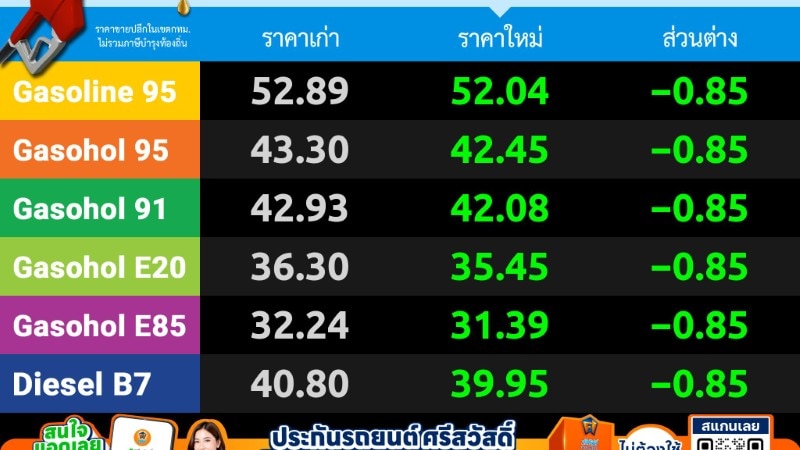
Gasohol E20 costs about THB35.69 a litre in Bangkok, the cheapest of the everyday fuels, based on PTT and Bangchak pump prices from 9 October 2026. The rest of the Bangkok price board on that date, per litre:
- Gasohol E85: THB31.63 (only some stations sell it)
- Gasohol 91: THB41.07
- Gasohol 95: THB41.44
- Diesel (B7): THB42.94
- Diesel B20: THB37.19
Prices outside Bangkok run about THB0.40 a litre higher, and premium grades cost THB7 to THB8 a litre more than the regular version. (Verified October 2026.)
Fuel prices in Thailand change all the time. If you’re serious about getting the best price per liter, you can check out the following resources:
- PTT oil prices: PTT’s official daily price board, with separate Bangkok and regional prices.
- Bangchak oil prices: Bangchak’s official price board, which also shows tomorrow’s price once a change is announced.
- แจ้งเตือนราคาน้ำมัน: When there’s a price change for gas in Thailand on any given day, the page lets you know at 6 p.m.
- Global Petrol Prices: Weekly updates for gas prices in Thailand.
What to Do if You Fill up with the Wrong Fuel?
While it might seem impossible, filling up with the wrong gas happens to people from time to time. If you mistakenly put diesel in a gas car (and vice-versa) and try to drive away, you won’t get far. Your vehicle’s engine will begin to shake until it stalls.
Although it’s not dangerous, it can be scary. If this happens to you, do the following:
- Pull to the side of the road
- Immediately turn off the ignition
- Call a qualified mechanic
The mechanic may call a tow truck to bring your vehicle to the shop, or he will fill up a gas can with the right gas, run a temporary line to your engine, and then drive it to the shop.
Once your vehicle is at the shop, the mechanic will drain and clean your fuel system. If no damage was done, you can add the correct fuel type and drive as usual. If you damaged any part of your fuel system, he may have to change some parts.
If this happens in a rental car, contact the company and explain everything in detail. If it’s your own car, contact your insurance company. You might be able to make a claim if you have Type 1 insurance.
Read more: Car Insurance in Thailand: A Complete Buying Guide
Filling Up With LPG
Because of increasing gas prices, many car owners in Thailand install Liquefied Petroleum Gas (LPG) systems in their cars. This way, their cars can run with LPG, which is almost 50 percent cheaper than gas.
When you need to fill up with LPG, you have to look for the right gas station. These gas stations will have a big LPG sign in front.
Of all the companies mentioned above, only PTT and PT have LPG gas stations in Thailand. But as of now, the number is quite limited.
Most of the time, you have to go to independently owned LPG gas stations, and standards vary. As a rule of thumb, you should only fill up your tank with LPG from a gas station with newer pumps.
EV Charging at Thai Gas Stations
Major fuel chains like PTT and Bangchak now install EV chargers alongside regular pumps, especially on highway routes connecting major cities and tourist areas.
- PTT EV Station PluZ: PTT has the widest network coverage, with fast chargers at many highway stations. This makes it the most reliable option if you are driving in Thailand between provinces.
- Bangchak: Bangchak offers EV chargers at a growing number of stations, often paired with solar-powered forecourt canopies.
- Other networks: Malls, condominiums, and independent operators also run charging points outside traditional gas stations, so download dedicated charging apps alongside your fuel apps.
If you are buying an electric car in Thailand, check which charging networks cover your regular routes before choosing a home charger.
Tip: Charger speeds and plug types vary by station. Check the network’s mobile app to confirm availability and working status before driving to a station.
Frequently Asked Questions
What types of fuel are available in Thailand?
Thailand has two main fuel categories: diesel and bensin (gasoline). Diesel comes in standard Diesel (B7), Diesel B20, and Premium Diesel. Bensin comes in Gasohol E85, Gasohol E20, Gasohol 91, Gasohol 95, Bensin, and Premium Bensin.
What’s the difference between Gasohol E20 and Gasohol 91 or 95?
Gasohol E20 is 20% ethanol and 80% gasoline, and it’s one of the cheapest options that many cars and motorcycles can run on. Gasohol 91 and 95 are both 10% ethanol and 90% gasoline, differing only in octane rating (91 vs. 95); some drivers find they perform better on long drives.
How do I know which fuel type my car takes?
Check the sticker on the inside of the driver’s door. Most newer vehicles list the fuel types they can use. If you’re driving a rental car, ask the rental company which fuel type to use.
Which gas station chain has the most locations in Thailand?
PTT is the largest gas station chain in Thailand with the widest coverage, making it a popular stop for long-distance drivers. Its stations typically have clean restrooms, restaurants, convenience stores, and Café Amazon coffee shops. Bang Chak, PT, Shell, Caltex, and Susco are the other main chains.
How do I find the nearest gas station in Thailand?
Search “gas station” in Google Maps, which shows the closest stations with their brand and opening hours. PTT, Bangchak, Shell, and Caltex also run their own station finders on their official websites or apps.
Can I pump my own gas at a Thai gas station?
No, most gas stations in Thailand are full-service. You tell the attendant which fuel type you want and how much (either a set amount in THB or a full tank), and they handle the pumping.
How do I pay for gas in Thailand?
You can pay with cash, credit or debit card (Visa and MasterCard are widely accepted), or by scanning a QR code through a Thai banking app. At smaller or rural stations, it’s worth keeping your card in sight, since some attendants have been caught skimming card details.
Can expats sign up for gas station membership or points cards in Thailand?
It’s very difficult for foreigners without a Thai ID or Pink ID card. All the major chains offer membership cards that earn points toward gas or shop discounts, but online registration generally requires a 13-digit Thai ID number. Expats without one usually have to call the chain’s customer service to attempt manual registration, and success varies.
What should I do if I put the wrong fuel in my car in Thailand?
Pull over to the side of the road immediately and turn off the ignition. Then call a qualified mechanic, who can either tow the car to a shop or run a temporary fuel line to get it there. Once at the shop, the mechanic drains and cleans the fuel system before refilling with the correct fuel.
Is there EV charging at gas stations in Thailand?
Yes. PTT and Bangchak provide EV chargers at a growing number of stations, with PTT’s EV Station PluZ offering the widest highway coverage. Charging speeds vary by location, so check the operator’s app before heading to a specific station.
Are gas stations in Thailand open 24 hours?
Many PTT and Bangchak stations along major highways operate 24 hours, particularly larger branches with attached convenience stores. Rural and independent stations often close overnight, so plan fuel stops around major chains when driving after dark.
Has Esso in Thailand fully changed over to Bangchak?
Yes. Bangchak acquired Esso’s Thailand operations in 2023 and finished rebranding all stations nationwide. Esso-branded stations no longer operate in Thailand.
Which fuel is the cheapest option in Thailand?
Gasohol E20 is generally the cheapest petrol option due to its 20% ethanol blend, and it works in most modern cars and motorbikes. Fuel prices fluctuate daily, so check a local fuel-price app when you fill up rather than expecting a fixed rate.
Do Thai gas stations have restrooms and food available?
Most major chains operate full rest stops with clean restrooms, convenience stores, and coffee shops like Café Amazon at PTT or Punthai Coffee at PT. Smaller independent stations often provide only fuel pumps without extra amenities.
Sources Cited
- Bangchak Corporation, official newsroom (confirms nationwide Esso-to-Bangchak rebrand completion)
- PTT Station map, PTT Oil and Retail Business (station search near you or along a route)
- PTT Oil and Retail Business, oil price page (Bangkok and regional pump prices effective 9 October 2026)
- Bangchak Corporation, oil price page (Bangkok pump prices effective 9 October 2026)
- Bangchak Corporation, mobile application page (station search and fuel price alerts)
- Shell Thailand, station locator (Shell station map)
- Caltex Thailand, Find Us page (Caltex station and service centre search)



 Deutsch:
 Français:
'/%3E%3Cpath%20fill='%23b2b2b2'%20d='M241%20382q0%2016%2017%2026%2017%2011%2042%2011t42-11q16-11%2017-26V269H241'/%3E%3Cpath%20fill='%239f7e00'%20d='M241%20379q0%2014%208%2023%209%209%2021%209%2014%200%2021-9%209-9%209-23V269h-59'/%3E%3Cpath%20d='M241%20339v-70h59v110q0%2014-9%2023l-6%205v-68h-15v72q-8%200-14-4v-68zm59%2040c0%2022%2015%2032%2029%2032%2021%200%2030-18%2030-32v-40h-59'/%3E%3Cpath%20fill='%239f7e00'%20d='M266%20277v5h2v12h-3v-5h2v-5h-9v5h2v5h-4v9h3v18h-5v10h34v-10h-5v-18h3v-9h-4v-5h2v-5h-9v5h2v5h-3v-12h2v-5zm42%20101q0%2010%206%2017%206%206%2015%207%2010-1%2016-7%206-7%206-17v-29h-43'/%3E%3Ccircle%20fill='%230044ad'%20cx='329.5'%20cy='372'%20r='6'/%3E%3Cellipse%20fill='%230044ad'%20cx='300'%20cy='340'%20rx='16'%20ry='21'/%3E%3C/svg%3E) Español:
Español: