I’m all for the easy way out…
Learning how to read Thai is often a stumbling block for students of the Thai language. Some students have opted to forgo the pleasure. Others have stops and starts. Then there are those who soar through all with ease (and those, we admire through clinched teeth).
I’m of the stops and starts variety. I also go for the easiest way possible, which is what you’ll get here.
Note: In this post I won’t be taking you through the Thai alphabet letter by letter. I’ll be sharing methods and available resources for beginners learning to read and write Thai. And while my way may not be your way, you’ll still find decent resources.
Alternatively, you can head over to Learn Thai from a White Guy website. After enter your email, you get free five Thai lessons to help you read Thai within two weeks.
Contents
- Reading Thai the Easy Way...
- Thai Consonants: The 3 Classes You Need to Know
- Thai Vowels and Tone Marks: The Basics
- Getting the Thai Sounds Down...
- Testing Your Alphabet Skills Via Flashcards...
- Testing Your Alphabet Skills Via Flashcards (SRS)...
- Writing Thai the Easy Way...
- Putting It All Together...
- Frequently Asked Questions
- What to Read Next
Reading Thai the Easy Way…
Before you begin reading, you’ll need to know what each letter sounds like, its class, and if it has a different sound at the beginning of a word than at the end of a word.
And if you’ve started to panic at the thought of learning 44 Thai consonants (along with their initial and final sounds), 32 different vowel configurations, numbers, and all those extra symbols, then head over to Thaipod101 Alphabet Made Easy.
Thai Consonants: The 3 Classes You Need to Know
Thai has 44 consonant letters, though only 21 consonant sounds. Two of the 44 (ฃ and ฅ) are obsolete and show up mostly in dictionaries and old texts, not everyday Thai.
Every consonant belongs to one of three classes. The class doesn’t change how a letter sounds on its own, but it changes the tone a syllable takes once you add a tone mark, a vowel, or a word ending. That’s why learning the classes early pays off once you get to tone rules.
- Mid class (อักษรกลาง): 9 letters — ก จ ฎ ฏ ด ต บ ป อ
- High class (อักษรสูง): 11 letters — ข ฃ ฉ ฐ ถ ผ ฝ ศ ษ ส ห
- Low class (อักษรต่ำ): 24 letters — ค ฅ ฆ ง ช ซ ฌ ญ ฑ ฒ ณ ท ธ น พ ฟ ภ ม ย ร ล ว ฬ ฮ
You don’t need to memorize every letter’s class on day one. Learn the shape and sound of each consonant first, then come back to the classes once you’re reading full syllables and want to know why the tone changes. Thai Alphabet: Consonants and Vowels lists every letter with its class marked, if you want the full chart.
Thai Vowels and Tone Marks: The Basics
Thai vowels don’t sit in one predictable spot the way English vowels do. A vowel symbol can appear before, after, above, or below its consonant, and some wrap around the consonant on two sides at once. Counting the short and long version of each, Thai has 32 vowel forms.
Tone marks sit above the initial consonant of a syllable. Combined with the consonant’s class and the vowel’s length, they set the syllable’s tone. Thai script has four tone marks:
- ่ ไม้เอก (mai ek)
- ้ ไม้โท (mai tho)
- ๊ ไม้ตรี (mai tri)
- ๋ ไม้จัตวา (mai chattawa)
Together with an unmarked syllable, these give Thai its five tones: mid, low, falling, high, and rising. Which mark produces which tone depends on the consonant’s class, which is why the class list above is worth learning before you tackle tone rules in depth. For the full rule set, see Thai Tone Rules Explained.
If you want a faster path through all of this than working letter by letter, How to Learn Thai Language Fast and the best apps for learning Thai cover structured routes and app-based study that pair well with the resources below.
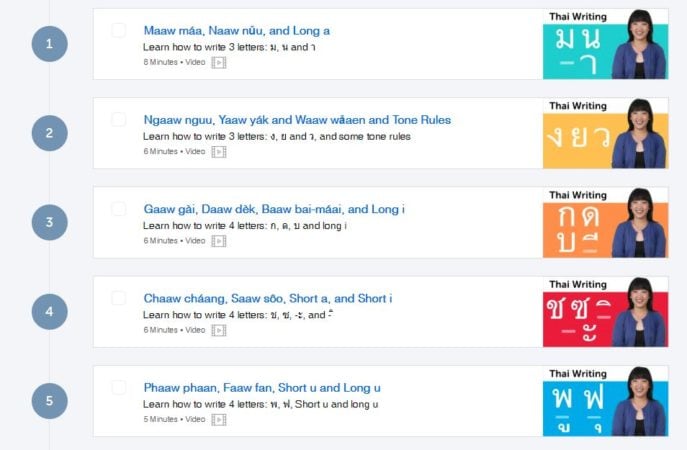
How it works… as you can see from the image, you get access to different videos. Each video consists of a few consonants and vowels.
These consonants and vowels are grouped based on their sounds and appearance. You also learn how to pronounce them correctly from a native speaker.
There are 25 videos in total. It takes 2 hours and 40 minutes to watch them all.
Prepare a notebook, pronounce and write down each consonant and vowel repeatedly, and you should be able to memorize all of them within a week.
You can rewatch these videos as many times as you want to. Note: Although these lessons are only available for paid members, you can use their 7-day free trial and learn all of them.

Getting the Thai Sounds Down…
Your next move is to get the actual sounds and full names into your head. IMHO, the best Thai alphabet sources available on the Internet are:
- e-learning at Sriwittayapaknam (offline – waiting)
Thai reading, Thai alphabet, Thai alphabet test, Lesson one, Lesson two, Lesson three, and Lesson four.
- Langhub.com
Three Consonants Classes, Vowels and Numbers With Thai Script.
You’d think that learning to read Thai with 60 Minutes would interfere with learning the individual names, but it didn’t for me.
The Thai I learned at ashoka10’s Channel and Learn Thai Podcast slid to the front. What I learned at 60 Minutes stayed in the background until I needed to remember which letter had two sounds, and what class they were. Then visual linking clicked in.
Testing Your Alphabet Skills Via Flashcards…
If you are in Thailand, you can purchase flash cards at most Thai bookstores with a children’s section (all in Thai).
To my knowledge, there are no Thai flashcards that include everything – alphabet, graphic, English explanation and examples – so if it’s important to you, you’ll need an additional resource.
Suggestion: Buy two sets of flashcards with complimenting elements (I used the colour Thai version, with the English / Thai black and white).
And you can always print your own from slice-of-thai.com, Thai consonant/vowel flashcards. Or by printing an existing set and/or creating a new one at Cram (formerly Flashcard Exchange).
Testing Your Alphabet Skills Via Flashcards (SRS)…
SRS (Spaced Repetition Systems) are basically digital flash cards. Some are online, other SRS programs can be downloaded to your computer. Some, like the Cram have Thai sets created by other users.
Others are a clean slate (no Thai available).
- Anki (download)
A program designed to help you remember words and phrases (Mac, Windows, Linux and Debian).
- The Mnemosyne Project (download)
A flash-card program to help you memorise question/answer pairs, but with an important twist: it uses a sophisticated algorithm to schedule the best time for a card to come up for review (Mac, Linux and Windows).
Writing Thai the Easy Way…
When I started writing Thai, I felt forced into an uncomfortable scrunch when using the course books from AUA. It was definitely not for me. You might not feel the pinch so go ahead and try them. But I did. Beware. The books are poorly reproduced so they are also difficult to read. Eye strain. Hand strain. That’s all the excuse I needed to bail.
Knowing there just had to be a better way, I started hounding the different bookstores in Bangkok.

For those living in Thailand, kindergarten books for practicing the Thai alphabet are not difficult to find. Again, just drop by that Thai bookstore with the childrens’ section.
And just like their counterpart in the West, they have ample space to practice your new alphabet. Over and over.
If you prefer a grown-up approach, then Reading Thai is Fun by James Neal might just be the one for you.
In Reading Thai is Fun, James shows you how to feel the natural flow of writing Thai by using the cursive style of an adult. Not the formal boxy style taught to children.

To understand what I mean, grab a stack of scrap paper.
Then, as big as you like (I used a 1/4 page for each), fluidly write the Thai letter ม in the graphic to the left.
Each letter has a start and finish, so be sure to note the drawing direction at learningthai.com/writing_09 (site offline for now).
Keep tracing over that letter until you own it. Until you are in the alphabet zone if you like. I like.
Putting It All Together…
- To get a general feel, flip through 60 Minutes to Learn the Thai Alphabet.
- With paper and pen, work through each letter at Reading Thai is Fun while……intermittently clicking on relevant sounds found at learningthai.com/writing, Practice Writing Thai Letters (site offline for now). If tech savvy, record each into a loop for hands-free ease.
Soon you’ll have the shapes, sounds, tones and class down solid. You’ll also be ready for Thai / English readers found at Thai publishers such as Nanmeebooks. Right?
More Reading and Writing Tips…
- Practice writing the Thai script for at least 15 minutes a day.
- Listen to spoken Thai often, no matter how bored, frustrated, or confused.
- Load down an iPod for short walks around town.
- Grab a stack of flash cards when headed out the door.
What You Might Not Know…
- Spoken Thai and written Thai are not always the same.
- You are not going blind, there really are missing letters in Thai words.
- Yes, some Thai words are read from middle to left then top to bottom.
- If the lack of spaces between words frustrates you, hark back to Illuminated Manuscripts.
More Reading and Writing Resources…
- Consonant shape learning aids
Scroll down to find his notes on useful patterns.
- Thai Alphabet
Wikipedia resource on the Thai script/ alphabet.
- Thai Font Comparison.
If you’ve ever been confused at trying to read Thai around town, here’s a good round up of available Thai fonts to defog your brain.
Shortly after taking on the Thai alphabet, I found myself sitting in a taxi at a long light on Paholyothin in Bangkok. Looking out the window to my left, I was thrilled to be able to read a street sign in Thai.
I wish you the same joy.
Frequently Asked Questions
How many letters are in the Thai alphabet?
Thai has 44 consonant letters, though 2 of them (ฃ and ฅ) are considered obsolete and rarely used today. The alphabet also includes 32 vowel forms and 4 tone marks.
What are the three consonant classes in Thai?
Thai consonants split into mid class, high class, and low class. The class doesn’t change the letter’s sound by itself, but it determines how a syllable’s tone shifts once a tone mark, vowel length, or ending is added.
How long does it take to learn to read Thai?
Most learners can memorize the consonant and vowel shapes within a few weeks of daily practice, but reading full sentences smoothly, with correct tones, usually takes a few months of consistent reading and writing practice.
Do Thai tone marks always produce the same tone?
No. The same tone mark can produce a different tone depending on the consonant class it’s paired with and whether the vowel is short or long. That’s why learning consonant classes comes before tone rules.
Are there spaces between words in written Thai?
No. Thai is written without spaces between words within a sentence; spaces are used only between phrases or sentences. Recognizing where one word ends and the next begins comes with vocabulary and reading practice.
What’s the best way to practice writing Thai by hand?
Trace each letter repeatedly with pen and paper, following its correct stroke order and starting point, until the shape feels natural. Kindergarten practice books, sold in most Thai bookstores, are built for exactly this kind of repetition.



 Deutsch:
 Français:
 Español: