

Your Thai health insurer just denied a claim. Here’s what actually works to get it reversed: how to read the denial letter, what the insurer’s own complaints process looks like, and when to take the case to Thailand’s Office of Insurance Commission (OIC).
A denied claim almost never means the case is closed. Thai insurers, local and international alike, reject a share of claims automatically on first submission, often over something small, such as a missing stamp on a receipt, a mismatched diagnosis code, or a hospital the insurer classifies as “non-network” for that particular policy.
Some of those denials are correct, but a lot of them are not. The only way to find out which kind you are dealing with is to push back through the right channel.
This guide walks through why claims get rejected in Thailand, how to appeal through your insurer first, and how to escalate to the OIC if the insurer will not budge, plus what to have ready before you send anything.
Contents
Key Takeaways
- Most claim rejections in Thailand fall into four buckets: undisclosed pre-existing conditions, missing or incomplete paperwork, treatment at a hospital the policy does not cover for direct billing, and exclusion clauses the policyholder never read closely.
- Ask your insurer for the denial in writing, with the specific policy clause cited, before you do anything else. A verbal “not covered” from a call center is not a real answer.
- Every insurer in Thailand runs an internal complaints process, and you have to go through it before the OIC will get involved.
- The Office of Insurance Commission (OIC) takes consumer complaints by phone on 1186, online through its complaint portal, or in person at its Bangkok office, and it can compel an insurer to respond.
- Since March 20, 2025, new and renewed individual health policies in Thailand can carry a co-payment clause if you rack up repeated small claims. That is a policy term, not a rejection, and it is worth telling the two apart.
- Keep every piece of correspondence in writing. Phone calls with brokers and call centers are the single biggest source of “he said, she said” disputes that go nowhere.

Why Health Insurance Claims Get Rejected in Thailand
Thai health insurers reject claims for a handful of recurring reasons. Almost all of them trace back to one of four things:
- What you told the insurer when you applied
- What paperwork the hospital handed you
- Which hospital you walked into
- What the policy wording actually excludes
Pre-Existing Condition Disputes
A pre-existing condition dispute happens when the insurer decides your current claim connects to a health issue you had, or should reasonably have known about, before the policy started. Thai insurers run what the industry calls post-claim underwriting. They issue the policy first and only pull your full medical history once you file a significant claim.
If that history turns up something you did not declare on the application, from a previous diagnosis to a medication you were already taking, the insurer can deny the specific claim or, in worse cases, void the policy entirely.
This is where most of the ugliest disputes start, because the definition of “pre-existing” is broader than most people assume. A single visit to a doctor for symptoms that later turn out to be connected to a bigger diagnosis can count, even if you were never told what it meant at the time. How pre-existing conditions actually work under Thai health insurance covers how insurers define the term and what counts as disclosure.

It doesn’t matter if it’s chronic or not. Even a broken arm that is completely healed is a pre-existing condition. And if you leave out important medical information, that can mean cancellation of the policy from the beginning.
Carsten Creutzburg, insurance broker with 20+ years’ experience
Tip: If a broker tells you not to bother mentioning a minor health issue on the application, get that advice in writing or ignore it. Verbal reassurance from a broker means nothing to the insurer’s underwriting team once a claim is on the table.
Missing or Incomplete Documentation
Thai insurers reject a large share of claims purely on paperwork grounds. The most common gaps are:
- An itemized bill without procedure codes
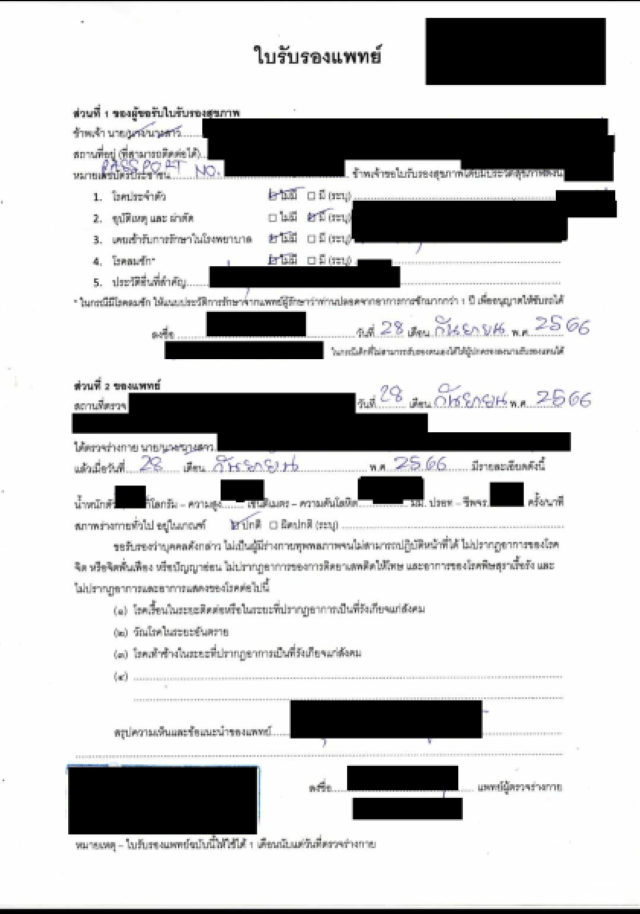
- A medical certificate (ใบรับรองแพทย์) that does not spell out the diagnosis
- A discharge summary that does not match what was billed
Thai hospital billing departments are used to producing these documents for insurance claims, but the level of detail varies a lot between a small provincial hospital and a large Bangkok private hospital, and it is the patient, not the hospital, who ends up dealing with the rejection.
The safest habit is to request a complete, itemized copy of every bill and medical record before you leave the hospital, even for outpatient visits, and to keep your own copies separately from whatever the hospital sends the insurer directly.
Network vs Non-Network Hospital Confusion
Network confusion happens when a policyholder assumes a hospital offers direct billing when it does not, or assumes “direct billing” means every cost is covered without a pre-approval call. Direct billing (cashless treatment) means the insurer settles with the hospital directly at the point of care; outside that network, or for any non-emergency admission, you typically pay first and file for reimbursement afterward.
Even inside a hospital’s own network, insurers apply what they call “reasonable and customary” limits on specific procedures, and a bill that runs above that internal benchmark gets the excess kicked back to the patient.
The only reliable way to avoid a surprise is to call your insurer directly for pre-approval before any planned admission or procedure, rather than trusting the hospital’s billing desk to confirm coverage on your behalf.
Other Common Triggers
A few other patterns show up often enough to flag on their own.
- Late notification: most policies set a window, commonly 30 days after treatment, to submit a claim. Miss it and the insurer can deny on procedure alone, regardless of whether the treatment itself was covered.
- Exclusion clauses: dental, cosmetic, and outpatient physiotherapy are commonly excluded or capped low on cheaper plans, and policyholders often only discover the cap when a claim comes back partially paid.
- The co-payment rule: since March 20, 2025, Thailand’s insurance regulator requires new and renewed individual health policies to carry a clause that triggers a co-payment, not a rejection, if you file three or more claims in a year for a defined list of minor conditions (headaches, flu, muscle inflammation, diarrhea, acid reflux) totaling more than 200% of your annual premium, or three claims for general illness totaling more than 400% of your annual premium. Hitting either threshold means a 30% co-payment on your next policy year; hitting both pushes it to 50%. Major surgery and critical illness claims are excluded from the rule entirely. (Verified September 2026.)
A co-payment clause differs from an outright rejection. It is a cost-sharing term written into the policy itself, and disputing it works differently from disputing a denial. You are checking whether the insurer applied the trigger correctly, not arguing that the treatment should have been covered in full.
The Insurer’s Internal Appeal Process
Every licensed insurer in Thailand has to run an internal complaints process, and you have to go through it before the OIC will step in on your behalf. Treat it as a paper trail you are building, not a formality to get past quickly.
- Get the denial in writing. Ask the insurer, by email, for the exact policy clause, exclusion, or condition it is relying on to deny the claim. A phone rejection from a call center agent is not something you can appeal against, because there is nothing specific to argue with.
- Match the denial against your policy wording. Pull up your actual policy document, not the marketing brochure, and find the clause the insurer cited. Insurers sometimes cite a clause that does not quite match the situation, and that gap is exactly what an appeal argues.
- Build your file. Gather the itemized hospital bill, the medical certificate, the discharge summary, and, where the dispute is medical rather than procedural, a written second opinion from the treating doctor or another specialist.
- Submit a formal written appeal. Address it to the insurer’s complaints or customer relations department by name if you can find one, attach your documentation, and state plainly what you are asking for: full payment, partial payment, or a reversal of the co-payment trigger.
- Give it a deadline. State that you expect a written response within 15 business days and that you intend to file a complaint with the OIC if the matter is not resolved. Insurers respond faster once the OIC is mentioned by name.
A reputable, independent insurance broker can carry real weight at this stage, because brokers deal with the same insurers’ claims departments constantly and often have a direct contact rather than a general call center queue. Insurance brokers in Thailand covers how to pick one and what a broker can and cannot do for you once a claim is already in dispute.

When and How to Escalate to the OIC
The Office of Insurance Commission (OIC) is Thailand’s insurance regulator, and it takes consumer complaints against any insurer licensed to operate in the country. Escalate once the insurer’s own complaints department has denied your appeal, gone silent past a reasonable deadline, or given you an answer that does not actually address the policy clause in dispute.
What the OIC Does
The OIC reviews consumer complaints against insurers through two separate tracks on its own site: complaint consideration by its officers, and dispute mediation carried out by its professional mediators. Filing a complaint puts the regulator’s name on the notice the insurer receives, and Thai insurers generally answer that faster than another email from the policyholder alone.
How to File a Complaint
You can reach the OIC three ways: by phone, online, or in person.

- Phone: call 1186, the OIC’s consumer hotline, and ask to file a complaint against your insurer. English-language assistance is limited, so having a Thai-speaking friend, partner, or your broker on the line helps. (Verified September 2026.)
- Online: the OIC runs a dedicated complaint filing portal (complaintportal.oic.or.th) where you register, upload your denial letter, policy documents, and supporting evidence, and submit the case directly. (Verified September 2026.)
- In person: bring your policy, ID, and the full paper trail from your insurer appeal to the OIC’s Bangkok headquarters at 22/79 Ratchadaphisek Road, Chankasem, Chatuchak, Bangkok 10900, and open a case with a duty officer. (Verified September 2026.)
What Happens After You File
Once the OIC accepts your complaint, it notifies the insurer and requests a formal, written response addressing the specific dispute. Many cases resolve at this stage simply because the insurer has to justify the denial to a regulator instead of to the policyholder alone.
If the insurer’s response does not resolve things, the OIC can offer mediation between you and the insurer’s representative to reach a settlement. Most insurance policies sold in Thailand also carry a standard optional arbitration clause, so if mediation fails, you or the insurer can take the dispute to arbitration through the OIC’s arbitration institute, or you retain the right to pursue the matter through the Thai courts directly.
Arbitration and litigation are the last resort. Almost every dispute that reaches this article’s earlier steps gets resolved before it needs either.

How to Build a Strong Appeal
A strong appeal comes down to documentation and precision. Neither is complicated, but skipping either is usually what turns a winnable dispute into a rejected one.
Request everything in writing. Every call to the insurer should be followed by an email summarizing what was said. If the insurer will not put a denial reason in writing, say so explicitly in your OIC complaint.
Get the coding right. Ask the hospital’s insurance desk to double-check diagnosis and procedure codes on the bill before submission. A mismatched code is one of the most common, and most fixable, reasons a claim bounces back.
Use a second medical opinion where the dispute is medical. If the insurer is arguing a condition is pre-existing or that treatment was not medically necessary, a written opinion from a specialist carries more weight than your own account of your symptoms.
Quote the policy wording back at the insurer. Referencing the exact clause number and wording in your appeal letter, rather than describing it in your own words, makes it harder for the insurer to reinterpret the clause after the fact.
Loop in your broker early, not as a last resort. A broker who sold you the policy has a commercial relationship with the insurer and often a faster path to a claims manager than a policyholder calling in cold.
Set a deadline and stick to it. Vague appeals that never mention the OIC tend to sit in a queue. Appeals that name a specific date and the regulator tend to get an answer.
Good to Know: If your policy is an international plan rather than a Thailand-licensed local one, disputes still generally route through the insurer’s own complaints process first, but a Thai-licensed local insurer’s conduct is what the OIC can actually regulate and compel a response from. Local versus international health insurance in Thailand covers that distinction in more depth.
Common Mistakes and Pitfalls
A few mistakes show up over and over in expat accounts of Thai insurance disputes, and most of them are avoidable.
In the expat forums, one of the most consistent warnings is around disclosure. Telling a broker about a health condition over the phone means nothing if it never makes it onto the written application. Policyholders who assumed a verbal mention counted as disclosure have had claims denied, or entire policies voided, once the insurer pulled full medical records after a large claim.
Treating the first denial as final is another common one. Insurers count on a share of policyholders simply accepting a rejection rather than pushing back with a written appeal, and the expat community’s general read on the OIC is that it is genuinely useful and consumer-friendly once a complaint is actually filed, rather than an office to be feared or avoided.
Assuming a hospital’s front desk understands your policy better than you do causes a lot of avoidable surprise bills too. Hospital billing staff know their own hospital’s relationship with an insurer, not the fine print of your specific plan, so a “yes, you’re covered” from admissions is not the same as pre-approval from your insurer.
Local insurers draw genuinely mixed reviews from policyholders. Some report agents who go out of their way to help push a claim through, while others report hyper-strict scrutiny on outpatient claims in particular. That inconsistency is itself a reason to keep every document and email, since the same insurer can behave very differently case to case.
One expat’s experience and mistakes using health insurance in Thailand is a useful read on how these gaps actually play out in practice. Muang Thai Insurance review and Cigna Global’s Thailand plan review cover two of the most commonly used providers in more detail.
FAQ
How long does an insurer have to respond to an appeal in Thailand?
There is no single fixed legal deadline for every type of claim, so the practical approach is to set your own deadline, commonly 15 business days, in your written appeal and state that you will file with the OIC if you do not get a substantive response by then.
Does filing a complaint with the OIC cost anything?
Filing a complaint or requesting mediation through the OIC does not require legal representation and is the standard first step for policyholders, at no cost, before a dispute would ever need to move to formal arbitration or the courts.
Can the OIC force my insurer to pay a claim?
The OIC can compel an insurer to formally respond to a complaint and can mediate toward a settlement, which resolves most disputes. Where mediation fails, the remaining paths are the arbitration clause built into most Thai insurance policies or a civil claim through the Thai courts, both of which sit outside the OIC’s own authority to order a payout directly.
Is a co-payment the same as a rejected claim?
No. A co-payment under Thailand’s March 2025 rule means the insurer pays part of a claim and you pay the rest under a pre-agreed percentage, while a rejection means the insurer refuses to pay any part of it. If an insurer applies a co-payment percentage you were not told about or that does not match the claims history triggering it, that is a billable error worth disputing through the same appeal process.
What if my claim was with Thailand’s Social Security System instead of private insurance?
Disputes under the Social Security Office (SSO) scheme run through a separate process from the OIC, since SSO is a government social insurance program rather than a private insurer the OIC regulates. Thailand’s SSO versus private health insurance covers how the two systems differ and where each one’s complaints process actually sits.
Sources Cited
- Office of Insurance Commission (OIC), consumer contact page: confirms the OIC’s hotline number 1186, physical address (22/79 Ratchadaphisek Road, Chankasem, Chatuchak, Bangkok 10900), and email contact, retrieved directly from the OIC’s own site.
- Office of Insurance Commission (OIC), official site navigation: confirms the existence and URLs of the OIC’s separate “Complaint consideration by competent officials,” “Dispute Mediation by Professionals,” and online complaint filing system (complaintportal.oic.or.th/ppms) as distinct consumer channels.
- OIC complaint portal (complaintportal.oic.or.th): the OIC’s own online system for filing an insurance complaint, linked directly from the OIC’s official site.
- Siam Legal International, “New Thai Health Insurance Co-Pay Rule Going Into Effect March 20th”: confirms the March 20, 2025 effective date, the 200%/400% of annual premium claim thresholds, the resulting 30%/50% co-payment percentages, the major-surgery and critical-illness exclusion, and that the rule applies to new policies and renewals from that date.
- Rajah & Tann Asia, legal update on Thailand’s co-payment clause: cross-reference confirming the same March 20, 2025 effective date and the underlying OIC Order No. 14/2564 (life insurance) and OIC Order No. 15/2564 (non-life insurance).
- Lexology, “First-step analysis: bringing insurance litigation proceedings in Thailand”: confirms that Thai insurance policies commonly carry a standard optional arbitration clause submitting disputes to the OIC’s arbitration institute as an alternative to a civil lawsuit.