Learn how American curriculum international schools in Thailand work, including GPA grading, AP courses, accreditation, tuition fees, and key differences from British schools. Explore top American schools in Bangkok, Chiang Mai, Phuket, and across Thailand.
There’s a lot to think about when it comes to choosing an international school – fees, accreditation, location, exam results.
Compared to other factors, curricula the schools choose to follow may seem fairly low down on the list for many parents at first.
However, it could end up making a big difference in your children’s educational prospects.
International schools are differentiated from local schools by the curricula they follow. Namely, local schools follow the host country’s national curriculum, while international schools follow ‘international’ curricula.
The two most popular national curricula at Thailand’s international schools are the British and American, and you often hear schools that follow either referred to as British or American schools, respectively.
For citizens of those countries, deciding on either a British or an American school may seem like a no-brainer.
However, for other nationalities, or for those not particularly committed to their home country, there’s a lot more leeway in deciding what kind of school you’d prefer to send your children to.
In this article, we’re going to take an in-depth look at American schools in particular. We’ll explore what the American curriculum entails, what qualifications you or your child will end up with, and what differentiates American schools from others.
Finally, if all this sounds good to you, we’ll throw in a list of American-curriculum schools here in Thailand so you can check them out for yourself.
Disclaimer: Some links in this article go to our partners, and we may earn a commission if you use them. It costs you nothing extra, and we only recommend services we'd use ourselves. Read more in our Advertising Disclosure.
Contents
- Key Takeaways
- What American Curriculum Actually Means
- American Schools in Thailand - What To Expect
- Assessments
- Differences Between American Schools and Other Schools
- Why Choose an American International School?
- AP and Accreditation, Explained
- The Credit System Behind an American Diploma
- How to Choose Between American Schools
- Fees Overview
- Admissions
- Do You Need a Visa to Enroll Your Child in an American School?
- American Curriculum Schools in Thailand
- Now, on to You
- Frequently Asked Questions
- Q: What is an American international school?
- Q: How much does an American international school cost in Bangkok?
- Q: What is the difference between the American and British curriculum?
- Q: What are AP courses and why do they matter?
- Q: What accreditation should I check for?
- Q: Is an American curriculum school good preparation for a US university?
- Q: Are American international schools in Thailand religiously affiliated?
- Q: Where are American international schools located in Thailand?
- Q: Does my child need a Thai visa to attend an American school?
- Q: How many credits does my child need to graduate from an American school in Thailand?
- Q: Can non-American students earn a US-recognized diploma from these schools?
- Sources Cited
Key Takeaways
- Bangkok has over 25 American curriculum international schools, with about 50 spread across Thailand including Chiang Mai, Phuket, and beyond.
- The American curriculum assesses students through a GPA that combines exams, homework, participation, and attendance, rather than relying on end-of-year exams alone.
- AP courses are available at more than 10 schools in Thailand and can earn students college credits, potentially reducing university fees.
- Students study a broad range of subjects right through to the end of high school, giving them flexibility to explore different fields before committing to a specialty.
- Always verify a school’s accreditation first: reputable bodies operating in Thailand include Cognia, MSA, NEASC, and WASC.
- Many American schools in Thailand have Christian missionary roots, so it is worth checking how religion factors into daily school life before enrolling.
- Fees range from around THB100,000 to THB1,000,000 per year, with additional costs for registration, transport, and building fees on top of tuition.


What American Curriculum Actually Means
Defining what the American curriculum is can be a little tricky, as a single national syllabus does not exist.
In fact, as of the Elementary and Secondary Education Act of 1965, the idea of a single American national curriculum is prohibited.
Instead, each state oversees a curriculum based on its own state standards. International schools generally follow the curriculum of the state where they are accredited.
To ensure consistency across different states, the majority of American schools, including American international schools in Bangkok, aim to meet a nationwide set of principles known as the Common Core framework. This guarantees students hit national targets in math and English language arts regardless of their specific school.
Additionally, students are assessed continuously via a Grade Point Average (GPA) rather than a single end-of-year exam. The GPA is a cumulative measure of a student’s performance across assignments, participation, and tests throughout the year.
This provides a broad, holistic approach to learning, allowing schools flexibility in how they teach as long as students demonstrate a high level of academic competence.
Common Core Standards
The Common Core State Standards Initiative provides a set of guidelines detailing what each student should know at the end of each school grade from Kindergarten to Grade 12.
The Standards themselves are divided up between English Language Arts and Mathematics.
English Language Arts covers five key components:
- reading
- writing
- speaking and listening
- language
- media and technology
Mathematics covers eleven separate domains, which students are expected to have a good grasp of, namely:
- counting and cardinality
- operations and algebraic thinking
- number and operations in base 10
- measurement and data
- geometry
- number and operations in fractions
- ratios and proportional relationships
- the number system
- expressions and equations
- statistics and probability
- functions
Math is taught sequentially, so students can expect to progress from algebra to trigonometry to calculus and so on.
American Schools in Thailand – What To Expect
Below are some of the things you’ll run across with American international schools in Thailand.
School System
Those of us who’ve spent a great deal of our lives watching U.S. media are probably familiar with the different stages of the U.S. school system: kindergarten, elementary school, middle school (or junior high), and high school.
However, you may not be aware of exactly how each stage breaks down age-wise, so here’s a quick guide.
Kindergarten
Kindergarten covers students aged around five years or younger.
As one would expect, the emphasis here is on learning through play, with the very basics of education, letters, numbers, drawing, shapes, colors, being gradually introduced.
Kindergarten is not compulsory in Thailand, although it’s extremely popular with parents keen to give their kids a head start.
Elementary School
Elementary school (sometimes also known as grade school) is the U.S. equivalent to the British primary school.
It covers students from age six to 11 or 12, and the first to fifth grade of education.
Just like primary school, the emphasis here is on continuing to develop basic skills in reading, writing, and math, as well as social skills.
Middle School
Middle school (sometimes also known as junior high) covers students from age 12 to 14, and the sixth to eighth grades of education.
Middle schoolers move on to study more technical subjects, such as foreign languages and computing.
High School
High school covers students from age 14 to 18, and the ninth to twelfth grades of education.
High school is all about preparing students for college or university, and it’s during this time that students complete college-entrance exams such as the ACT or SAT (which we cover in more detail next).
School Calendar and School Day
Expect the majority of American international schools in Thailand to follow the Northern hemisphere academic calendar, running from August or September to June or July, with half-term holidays in October, December (Christmas), and March or April (Easter).
This is notably different to the Thai school calendar, which runs from May to March with a short break around September or October and a longer break in April, so students transferring from a local school may want to bear that in mind.
Individual teaching days are usually the same as other international schools, running from 8 am to 4 pm Monday to Friday.
Extracurricular Activities
Extracurricular activities, particularly sports, are a big deal in American schools, perhaps even more so than their European counterparts, and American schools in Thailand are no different.
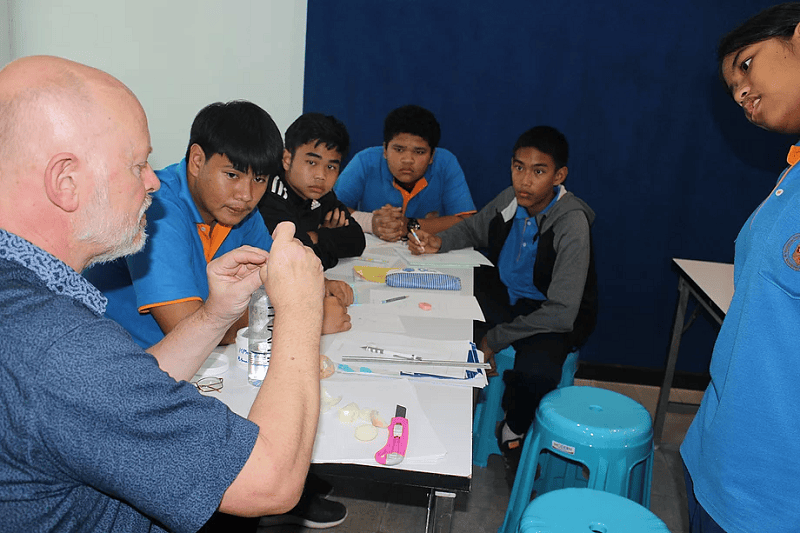
For example, International School Bangkok boasts a huge and varied number of clubs, councils, and events ranging from environmental activist clubs and community outreach to chess and babysitting, all good stuff for that all-important GPA.
For sports, expect classic American pursuits such as basketball and softball or baseball to be present, as well as sports more popular with local and other international students such as football (soccer) and rugby.
Assessments
Assessments in American school systems are a continuous process, with every essay, exam, and course taken over the course of the school year contributing to the student’s GPA.
Other things which might affect students’ GPAs include homework assignments, participation in class, and attendance.
In short, it’s an average grade of the student’s performance over the course of the year. This differs from systems such as the British, where the emphasis in assessment is much more on end-of-school exam results.
Student performance is tracked through the use of a transcript, which details all the courses the student has taken, their grades, notable extracurricular activities, and so on.
At the end of high school, this transcript is then sent on to prospective colleges as part of the application process.
On top of this transcript, students aiming to enroll into an American college may take additional assessments.
These include the following.
SAT
Standing for Scholastic Aptitude Test (SAT) is a standardized test administered by the College Board. Its purpose is to determine the readiness of high school students for higher education.
Although not mandatory, the majority of colleges and universities in the U.S. expect a SAT score as part of the application.
The SAT is a multiple choice exam consisting of two sections: math and evidence based reading. There is also an optional essay section, which is scored separately.
Students are scored based on a combination of the two exams, with passing scores landing between 400 and 1600 points.
The exam itself lasts around three hours, with potentially an additional 50 minutes for the essay section.
The exams are offered yearly during August, October, November, December, March, May, and June.
ACT
Another option for students who don’t fancy the SAT is the American College Testing (ACT).
The ACT is another multiple-choice test, although it covers a broader range of subjects than the SAT, namely English, math, reading, science, and yet another optional writing section.

The ACT is set by ACT Inc., a non-profit organization based in Iowa.
The ACT exam is a little shorter than the SAT, clocking in at two hours and 55 minutes (three hours and 35 minutes with the essay).
Each section of the ACT is graded on a 1 to 36 point scale, with your total score being an average of the four (also graded from 1 to 36).
Generally speaking, there is little difference between the SAT or ACT in the eyes of most colleges. However, the ACT’s addition of a science section might be beneficial for students looking at studying in the STEM fields.
With competition for top college places becoming ever more fierce, some students have even begun taking both.
Whether that sounds like a practical option or a bridge too far to cross is, of course, up to you.
Other Assessments
SATs and the ACT are not the only assessments in the American curriculum. Here are the others.
Preliminary SAT (PSAT)
The PSAT, or National Merit Scholarship Qualifying Test (NMSQT), is, as the name suggests, a standardized test students can take before the SAT.
But it’s more than just a practice test, high-achieving students may be entitled to a scholarship.
Like the SAT, the PSAT is divided into math and evidence-based reading sections, but it clocks in at a much more brisk two hours and 45 minutes.
Advanced Placement (AP)
AP tests are subject-based college-level exams, administered at the end of an Advanced Placement course students enroll in during high school.
Getting a good score on your AP nets you college credits, which can potentially lower your overall tuition.
There are currently well over 30 subjects offered by AP, though which subjects in particular depend on the school.
Exams are graded on a 1 to 5 scale. Advanced Placement courses tend to be immensely popular with international school parents, and often the presence of AP courses is a big sell for international schools.
Differences Between American Schools and Other Schools
In real terms, there aren’t too many differences between schools which follow the American curriculum and schools which don’t.
Chances are your children will still be learning how to spell and count and mix things up in test-tubes. However, there are a couple of key differences.
Perhaps the biggest difference is the reduced focus on exams. All students who’ve been through the British system, for example, are familiar with the stress of passing those all-important SATs and GCSE exams at the end of each “Key Stage” of their education.
As American students are predominately assessed by their GPA, of which passing exams is just one part, far less hinges on getting good exam results.
That’s not to say that American students don’t get their fair share of tests, and in fact the frequent standardized testing in American schools has been a source of criticism in some areas.
However, international schools are generally exempt from much of this relentless standardized testing, and students are only expected to pass their required courses.
Another key difference is the broadness of the American education system. In the British education system, education becomes narrower and more focused the higher up you go.
By the time you get to A-Levels, it’s common for students to be studying just four or five subjects. However, they study those four or five subjects in much greater depth.
It’s assumed that by that stage in their education, students know what field in which they want to study and will be getting more and more specialized accordingly.
By contrast, students at American schools continue to study all subjects right up until they leave high school.
This gives them a greater range of knowledge in all subjects, but lacks the depth of individual subject-knowledge that the British students get, or students at an IB school.
For some this is a benefit. Many students still don’t know what they’d like to do with their lives in high school, and having a broad knowledge base increases their options.
However, for others it may mean they’re on the back-foot in their chosen subject compared to students who’ve been studying it for 10 or 12 hours a week.
Your mileage may vary.


Why Choose an American International School?
Either way, American schools are extremely popular among non-Americans.
According to some reports, up to 75 percent of students at American international schools are non-Americans.
There are a whole host of reasons for non-Americans to choose to study at an American international school.
These include:
Preparing to Study or Live in America
Perhaps the most obvious and commonplace reason to enroll students into an American school is to familiarize them with the education system before moving over there, either for further study, or permanently.
A student arriving with SAT and/or AP scores, and with an in-depth knowledge of how the system works, will obviously be at a great advantage over a student without.
Wide-Ranging Courses and Subjects
As stated above, the American curriculum is all about producing well-rounded students, knowledgeable in a whole host of different areas.
Students study all subject areas right up until the end of high school, giving them a broad knowledge base.
Flexibility
American schools tend to have greater autonomy in how they approach their content.
Of course, this can be a double-edged sword, as while it allows teachers greater freedom to explore subjects they’re interested in, it can make choosing a school unpredictable.
Developing Strong Academic and Social Skills
With the GPA system of assessment, students are evaluated using a broad range of criteria.
Creativity and critical thinking skills are encouraged, and things like class participation are factored into assessment, encouraging students to take part more.
AP and Accreditation, Explained
Advanced Placement (AP)
Advanced Placement (AP) courses are college-level classes taken in high school. A qualifying score on an AP exam can earn US college credit, which may reduce the time or cost of university study. It strengthens university applications worldwide and provides essential higher education experience.
Accreditation
Accreditation ensures that a school meets recognized quality standards and that the resulting high school diploma is valid for university entry. Look for schools accredited by major recognized bodies such as Cognia, the Middle States Association of Colleges and Schools (MSA), the New England Association of Schools and Colleges (NEASC), or the Western Association of Schools and Colleges (WASC). These organizations certify educational quality, curriculum standards, and school management.
Accreditation status can change, so you should always confirm a school’s current accreditation directly on its own official website rather than relying on third-party directories.
The Credit System Behind an American Diploma
Behind the GPA and the transcript sits a credit system most parents outside the US haven’t encountered before: the Carnegie unit. One Carnegie unit represents roughly 120 hours of class time with a teacher, the equivalent of a single year-long course meeting most school days.
Most accredited American high schools require somewhere between 18 and 24 credits, earned over four years, to award a diploma. These are typically spread across English, mathematics, science, social studies, physical education or health, and a language other than English, with the remaining credits open to electives such as AP courses, art, or computer science.
Some schools also offer distinct diploma tracks alongside the standard diploma, most often an Honors track or the AP Capstone Diploma, built around a two-year AP Seminar and AP Research sequence. Per College Board’s own guidance, AP Capstone is only available at schools that have specifically registered to offer it and trained teachers for the program, so it isn’t automatically available just because a school offers other AP courses. If a particular diploma track matters for your child’s college plans, ask the school directly whether it’s offered.
Individual schools set their own exact requirements within that range, and requirements can differ between a school’s Pre-K to Grade 5, middle, and high school divisions. Ask for the school’s official graduation-requirement sheet rather than assuming, particularly if your child is transferring in partway through high school, since credits earned under a different curriculum, whether British, IB, or Thai, don’t always convert one to one.
GPA itself is often reported two ways. An unweighted GPA stays on the standard 4.0 scale regardless of course difficulty. A weighted GPA gives extra credit for harder courses, commonly scoring an A in an AP or Honors class at 5.0 rather than 4.0, which is why two students with similar grades but different course loads can post different GPAs. Many schools also run a local chapter of the National Honor Society to recognize top academic performers, though the specific GPA threshold for membership is set by each individual school chapter rather than by a single national standard.
How to Choose Between American Schools
There are several key factors to evaluate before enrolling your child in an American international school:
- Accreditation: Verify that the school is accredited by a recognized US body (such as Cognia, MSA, NEASC, or WASC).
- AP Program: Check which specific Advanced Placement courses are available, as options vary widely by school.
- Location: Factor in traffic and commute times. Schools are concentrated in major hubs, but long travel times can impact daily routines.
- Fees: Calculate the total cost, including tuition, registration, and facility fees.
- Values: Understand the school’s culture. Some American schools in Thailand have Christian missionary origins, so check how religion factors into daily school life to ensure it aligns with your family.
Fees Overview
Tuition fees at American international schools span a wide spectrum. You can find fees starting roughly around THB100,000 per year, going up to roughly THB640,000 at Pre-K and about THB1,160,000 at High School per year at the top tier. Always confirm current fees directly with the school as they change annually.
Keep in mind that published tuition often excludes mandatory extras like application, registration, transportation, and building fees. For more context on educational expenses, see the guide on international school fees and our overview of the cost of living in Thailand for a family.
Admissions
The admissions process varies between institutions. Many operate on a rolling admissions basis, accepting students year-round, while others stick to a fixed intake tied to the start of the academic year. The most popular schools frequently maintain waitlists, making early application essential.
Depending on the age of the student and the school’s requirements, applicants may need to complete entrance exams or language proficiency assessments. Older children transferring from non-English-medium schools often face language requirements to ensure they can fully access the curriculum.
Do You Need a Visa to Enroll Your Child in an American School?
Enrolling your child at an American international school in Thailand is a school admissions process, not an immigration one. The school can issue an enrollment letter, but it cannot grant your family a visa on its own. Whether you need a separate visa route depends on why you’re in Thailand in the first place.
- You already hold a Thai visa through work, marriage, retirement, or a long-term category. If you’re in Thailand on a Non-Immigrant B visa with a work permit, a marriage visa, a retirement visa, an LTR visa, or a Thailand Privilege card, enrolling your child at school doesn’t change or replace that visa. Check our Thailand visa guide for how dependents are handled under your specific route.
- Your only reason for staying in Thailand is to accompany your child at school. This is what Thailand’s Non-Immigrant O Guardian visa is built for. As detailed in TSK’s Thai family visa guide, the guardian route requires a THB500,000 bank deposit and a letter from the child’s school confirming enrollment, issued per child. It carries no right to work in Thailand.
A Non-Immigrant ED visa, the category normally used for adult students, is not the route for parents accompanying a school-age child, a distinction covered in our Thailand education visa guide. Whichever route applies to your family, confirm the current requirements with Thai Immigration or a visa professional before you commit to a school, since visa eligibility can affect timing around enrollment and deposits.
American Curriculum Schools in Thailand
There are about 50 international schools offering the American Curriculum across Thailand.
As one would expect, the majority are located in Bangkok. However, they can be found all across the country.
Let’s look at some of them.
Bangkok
There are currently over 25 schools offering the American curriculum in Bangkok, so there’s plenty to choose from.
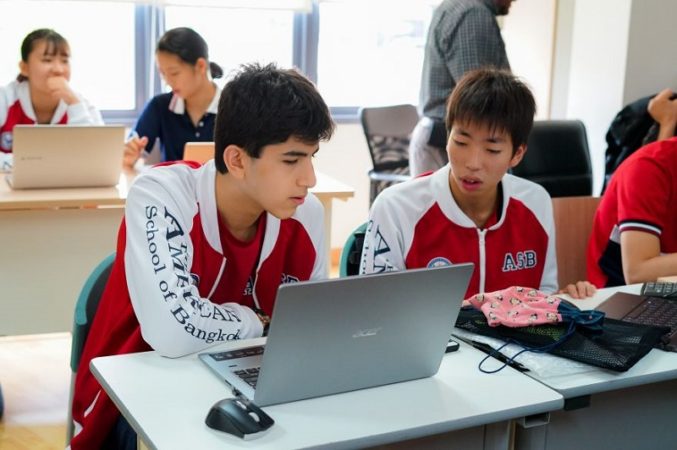
Some of the more popular schools include:
- International School Bangkok (ISB)
- Berkeley International School
- American School of Bangkok
- Wells International School
- King Mongkut’s International Demonstration School, an AP and STEAM-focused school
Central Thailand
There are a handful of American schools located in the country’s central region.
The town of Saraburi boasts an impressive four American schools:
- Saint John Mary International School
- Adventist International Mission School
- California Prep International School
- John Wyatt Montessori International School & Learning Centre
The small town of Chai Nat also boasts an American school, Manorom International Christian School.
Northern Thailand
There are seven American international schools in the northern capital of Chiang Mai, namely:
- Grace International School
- Chiang Mai International School
- Americana Chinese International School
- Nakornpayap International School
- American Pacific International School
- Unity Concord International School
- Ambassador Bilingual School
Chiang Rai also boasts three American schools:
- Chiang Rai International Christian School
- Chiang Rai International School
- One Hope International School
Southern Thailand
The bulk of American schools in Thailand’s south are, as one would expect, focused on the expat hub of Phuket, which contains three:

There is also the American Prep International School, based in Hat Yai, and the Theodore International School in Chumphon.
East Thailand
Pattaya boasts one American school, International School Eastern Seaboard.
Northeast Thailand
For Northeast Thailand, there’s the Korat Adventist International School (KAIS), an international Adventist-affiliated school in Korat.
Now, on to You
American international schools can offer plenty to prospective students, even for those who aren’t American and have no desire to study in America.
The broad curriculum and focus on developing students’ social skills in addition to their academic skills provides students with a well-rounded education, suitable for higher education anywhere.
Thankfully, Thailand is well-provided for when it comes to American international schools, with a wealth of high-quality institutions from which to choose, many of which are relatively inexpensive compared to their counterparts in Europe and elsewhere in Asia.
With the right research, it’s more than likely that there’s a school out there for you or your children.
Frequently Asked Questions
Q: What is an American international school?
A: An American international school is a school outside the United States that follows a US-style curriculum, typically based on individual state standards and the Common Core framework, assessed through a cumulative GPA rather than end-of-year exams alone.
Q: How much does an American international school cost in Bangkok?
A: Fees vary widely by school and grade level, roughly from THB100,000 per year at the lower end to well over THB1,000,000 per year at the most established schools, before registration, transport, or building fees. Fees change from year to year, so always confirm current pricing directly with the school before budgeting.
Q: What is the difference between the American and British curriculum?
A: American schools assess students continuously through GPA across the full range of subjects up to graduation, while British schools narrow focus toward a smaller set of subjects at A-Level and weight results more heavily toward final exams.
Q: What are AP courses and why do they matter?
A: Advanced Placement (AP) courses are college-level classes taken in high school, tested through standardised subject exams graded 1 to 5. A qualifying score can earn US college credit, which may reduce time or cost at university. AP availability depends on the individual school.
Q: What accreditation should I check for?
A: Look for accreditation from Cognia, the Middle States Association (MSA), the New England Association of Schools and Colleges (NEASC), or the Western Association of Schools and Colleges (WASC). Accreditation status is normally listed on the school’s own website; confirm it there rather than relying on third-party directories.
Q: Is an American curriculum school good preparation for a US university?
A: Yes, for students planning US higher education, an American curriculum school familiarises them with GPA-based assessment, SAT/ACT testing, and the US application process. Non-US-bound students can still use AP results and a broad subject base toward universities elsewhere.
Q: Are American international schools in Thailand religiously affiliated?
A: Some are. A number of American curriculum schools in Thailand, particularly outside Bangkok, have Christian missionary origins. How much religion factors into daily school life varies by school, so it’s worth asking directly if this matters to your family.
Q: Where are American international schools located in Thailand?
A: Most are concentrated in Bangkok, with further clusters in Chiang Mai, Chiang Rai, and Phuket. Coverage thins out in the Northeast, where options are limited outside Nakhon Ratchasima (Korat).
Q: Does my child need a Thai visa to attend an American school?
A: Not through the school itself. Enrollment lets the school issue a confirmation letter, but your family still needs an underlying Non-Immigrant visa, either through your own work, marriage, retirement, or LTR visa, or through the Non-Immigrant O Guardian visa if accompanying your child at school is your only basis for staying in Thailand.
Q: How many credits does my child need to graduate from an American school in Thailand?
A: Most accredited schools require 18 to 24 credits, known as Carnegie units, across four years of high school, spanning English, math, science, social studies, and electives. The exact number and mix is set by each school, so ask for its official graduation-requirement sheet.
Q: Can non-American students earn a US-recognized diploma from these schools?
A: Yes. Up to 75 percent of students at American international schools in Thailand are non-Americans, and the diploma itself isn’t restricted by nationality. It’s awarded to any student who completes the accredited school’s coursework and credit requirements, regardless of citizenship.
Sources Cited
- International School Bangkok: https://www.isb.ac.th/
- Cognia: https://www.cognia.org/
- Middle States Association of Colleges and Schools (MSA-CESS): https://www.msa-cess.org/
- New England Association of Schools and Colleges (NEASC): https://www.neasc.org/
- Western Association of Schools and Colleges (WASC): https://www.acswasc.org/


 Deutsch:
 Français:
'/%3E%3Cpath%20fill='%23b2b2b2'%20d='M241%20382q0%2016%2017%2026%2017%2011%2042%2011t42-11q16-11%2017-26V269H241'/%3E%3Cpath%20fill='%239f7e00'%20d='M241%20379q0%2014%208%2023%209%209%2021%209%2014%200%2021-9%209-9%209-23V269h-59'/%3E%3Cpath%20d='M241%20339v-70h59v110q0%2014-9%2023l-6%205v-68h-15v72q-8%200-14-4v-68zm59%2040c0%2022%2015%2032%2029%2032%2021%200%2030-18%2030-32v-40h-59'/%3E%3Cpath%20fill='%239f7e00'%20d='M266%20277v5h2v12h-3v-5h2v-5h-9v5h2v5h-4v9h3v18h-5v10h34v-10h-5v-18h3v-9h-4v-5h2v-5h-9v5h2v5h-3v-12h2v-5zm42%20101q0%2010%206%2017%206%206%2015%207%2010-1%2016-7%206-7%206-17v-29h-43'/%3E%3Ccircle%20fill='%230044ad'%20cx='329.5'%20cy='372'%20r='6'/%3E%3Cellipse%20fill='%230044ad'%20cx='300'%20cy='340'%20rx='16'%20ry='21'/%3E%3C/svg%3E) Español:
Español: