

Thailand has no dedicated visa for bringing your elderly parents to live with you. Here are the three real paths expats actually use, what each one costs, and where the health insurance math gets hard.
Expats who move to Thailand for work, retirement, or a Thai spouse eventually ask the same question: can Mom or Dad come live here too? The honest answer is that Thai immigration law was not built around this situation.
There is no “parent visa” and no family reunification category for aging parents. The Long-Term Resident (LTR) program offers no shortcut either.
That does not mean it is impossible. It means the options are narrower and more conditional than most people expect, and getting the wrong information from a forum thread or an agency’s sales page can waste months.
This guide walks through the three routes that actually work: the LTR visa’s dependent rules (and why parents usually fall outside them), the Non-Immigrant O-A and O-X retirement visas a parent might qualify for in their own right, and the fallback of repeated tourist-visa stays. That last option got meaningfully harder after the visa exemption rules changed on September 15, 2026.
Contents
- Key Takeaways
- There Is No Dedicated Parent Visa in Thailand
- Why the LTR Visa Dependent Category Does Not Cover Parents
- Non-Immigrant O-A Visa: The Realistic Path for Most Parents
- Non-Immigrant O-X Visa: 10 Years, But Only for 14 Nationalities
- Repeated Tourist Stays: The Fallback With New Limits
- A Paid Alternative: Thailand Privilege Membership
- Health Insurance Considerations for Elderly Parents
- Comparing the Options
- Common Mistakes and Pitfalls
- FAQ
- Does Thailand have a specific visa for elderly parents?
- Can I add my parent as a dependent on my LTR visa?
- What is the easiest visa route for a parent to actually get?
- Can my parent just keep re-entering Thailand on tourist stays instead of getting a long-stay visa?
- Does my parent's home-country health insurance count toward the Thai visa requirement?
- Sources Cited
Key Takeaways
- Thailand has no “parent visa.” Your options are limited to your parent qualifying independently, or riding along on short-term entries.
- The LTR visa’s dependent category covers spouses and children under 20 only. Parents cannot be added as dependents, no matter how well you qualify.
- A parent aged 50 or over can apply for their own Non-Immigrant O-A retirement visa if they can show THB800,000 in savings or THB65,000 in monthly income, and health insurance worth at least US$100,000 (THB3,000,000).
- The 10-year O-X visa is only open to nationals of 14 countries, including the US, UK, Canada, and most of Western Europe, so it rules out most parents by nationality alone.
- Since September 15, 2026, most visa-exempt stays dropped from 60 days to 30, and land-border entries under the exemption are capped at twice per calendar year, which closes off the old border-run strategy.
- Health insurers routinely cap enrollment age somewhere in the 60s to 70s and slow renewals after that, so buy the policy before your parent’s next birthday makes it harder or more expensive.

There Is No Dedicated Parent Visa in Thailand
Thai immigration categories are built around work, investment, marriage to a Thai national, retirement, or education. None of them address an adult child sponsoring a parent the way, say, family reunification visas work in some Western countries. If an agency or a forum post tells you Thailand has a “family visa for parents,” they are either confusing it with the spousal Thai family visa or simply wrong.
That leaves three genuine routes, in order of how likely they are to actually work:
- Your parent qualifies for their own long-stay visa. The Non-Immigrant O-A or O-X visa, issued on the parent’s own age, savings, and insurance, not on your status as their child.
- Your parent qualifies for their own LTR visa under the Wealthy Pensioner category, which has a higher bar than O-A but comes with a 10-year permit and none of the annual renewal hassle.
- Repeated short-term stays on a visa exemption or tourist visa, which works for visits but breaks down fast for anyone trying to actually live here.
What does not work: adding your parent as a dependent on your own LTR visa. That is the misconception worth clearing up first.
Why the LTR Visa Dependent Category Does Not Cover Parents
The Board of Investment’s LTR program lets qualifying visa holders bring dependents into Thailand on the same 10-year permit. It is a genuinely good deal for spouses and young children.
It is also where most of the confusion about a “parent visa” starts, because people assume “dependent” is a broad category. It is not.
The BOI’s own LTR documentation defines a dependent as the legal spouse or children under 20 years old of the LTR visa holder, with a maximum of four dependents per applicant. Parents are not listed anywhere in that definition.
It does not matter how financially dependent your parent actually is on you. Thai immigration does not recognize that relationship for LTR purposes.
If Your Parent Qualifies for Their Own LTR Visa
There is one LTR route that can work, but it depends on your parent’s own finances, not yours. The Wealthy Pensioner category is open to anyone aged 50 or over with:
- Passive income of at least US$80,000 a year from pensions, rent, dividends, interest, or realized capital gains, or
- Passive income of at least US$40,000 a year, combined with an investment of at least US$250,000 in Thailand (government bonds, direct company investment, or real estate).
On top of the income test, the applicant needs one of the following:
- Health insurance covering at least US$50,000 in hospitalization costs
- Proof of active social security benefits that cover treatment in Thailand
- A bank deposit of at least US$100,000 held for 12 months
If your parent’s retirement income clears the US$80,000 bar on its own, the Wealthy Pensioner LTR is worth serious consideration. It is a 10-year permit, allows multiple re-entries, and does not require the annual paperwork cycle of a Non-Immigrant visa.
For most retirees, though, this income level puts it out of reach, which is why the O-A visa below is where most people land.
Good to Know: A parent applying for their own Wealthy Pensioner LTR visa applies as the main qualified person, not as anyone’s dependent. Once they hold that LTR visa, they could in theory sponsor their own spouse or minor children as dependents, but that has no bearing on your visa status or theirs relative to you.

Non-Immigrant O-A Visa: The Realistic Path for Most Parents
For most families, the Non-Immigrant “O-A” (Long Stay) visa is the option that actually fits. It is open to all nationalities, it is the standard retirement visa route, and the financial bar is far lower than the LTR program.
Requirements
To qualify, your parent needs to independently meet these conditions, verified against the Ministry of Foreign Affairs’ own guideline on the O-A visa:
- Age: 50 years or older at the time of application.
- Finances: a bank deposit of at least THB800,000 held for the three months before applying, documented monthly income of at least THB65,000, or a combination of deposit and annual income totaling THB800,000.
- Health: a medical certificate confirming the applicant does not have any of a short list of prohibited conditions (including active tuberculosis and drug addiction).
- Health insurance: this is where the real cost surprise usually shows up. See below.
Costs and the Health Insurance Requirement
The O-A visa’s current health insurance minimum is US$100,000 (THB3,000,000), and it trips up families relying on older guides. The original 2019 rule set the minimum at THB40,000 for outpatient care and THB400,000 for inpatient care, a figure that still circulates widely online but was superseded.

Since October 1, 2021, the Ministry of Public Health’s amended criteria require coverage of not less than US$100,000 (THB3,000,000), covering all medical expenses including COVID-19 treatment, for both the initial application and every extension.
The policy can be Thai or foreign, but a foreign policy has to be certified by an embassy in Thailand or notarized through the applicant’s home country’s foreign ministry.
That US$100,000 minimum is exactly where age becomes a problem. Insurers price and sometimes decline coverage based on age at enrollment, and a THB800,000 bank balance does not help if no insurer will sell your parent a compliant policy. More on that below.
For the visa’s other mechanics, including the annual renewal cycle and the 90-day address reporting requirement, see our full guide to the Thailand retirement visa, and our breakdown of the mandatory health insurance rules for retirees.
Tip: Some embassies were slow to update their published checklists after the 2021 change, so you will still see the old THB40,000/THB400,000 figures on embassy PDFs and immigration-agency blogs. Confirm the current requirement directly with the embassy or consulate where your parent is applying before buying a policy, since buying to the wrong minimum wastes money either way.

Non-Immigrant O-X Visa: 10 Years, But Only for 14 Nationalities
The O-X visa offers a 10-year permit (issued in two 5-year blocks) instead of the O-A’s annual renewal, which sounds like the obvious upgrade. The catch is nationality.
According to Thailand’s consular affairs department, the O-X is only available to citizens of:
- Japan, Australia, Canada, and the United States
- Denmark, Finland, France, Germany, Italy, the Netherlands, Norway, Sweden, Switzerland, and the United Kingdom
If your parent does not hold one of those 14 passports, the O-X is not an option regardless of finances. For parents from most of Asia, Africa, Latin America, and Eastern Europe, this route is closed by definition, and the O-A visa above is the only long-stay route worth pursuing.
Requirements for Eligible Nationalities
- Age: 50 or over.
- Finances: a Thai bank deposit of at least THB3,000,000, or a deposit of at least THB1,800,000 combined with annual income of at least THB1,200,000. The deposit must stay at THB3,000,000 for the first year and no less than THB1,500,000 after that, and the funds can only be spent inside Thailand.
- Health insurance: outpatient coverage of at least THB40,000 and inpatient coverage of at least THB400,000, per the O-X guideline published by Thailand’s consular affairs department. This is far lower than the O-A’s current US$100,000 minimum, since the O-A’s insurance criteria were amended in 2021 and the O-X’s were not.
- No employment of any kind is permitted on this visa.
Repeated Tourist Stays: The Fallback With New Limits
Families who cannot meet the O-A or O-X financial thresholds, or whose parent holds a passport that is not on the O-X list, sometimes fall back on visiting Thailand repeatedly on a visa exemption or tourist visa rather than settling permanently. This can work for genuine visits, but it is a poor substitute for actually living somewhere, and it got considerably harder in September 2026.
As of September 15, 2026, Thailand cut the standard visa exemption from 60 days to 30 days for nationals of the roughly 60 countries that qualify for it, according to Thailand’s Tourism Authority. The exemption is also now explicitly framed as being for tourism purposes, not extended residence.
A second, separate change limits land-border entries under the visa exemption to no more than twice per calendar year for most nationalities (Malaysia, Brunei, Indonesia, and Singapore are exempt from this cap). Air arrivals are not subject to the land-border limit.
Combined with a single 30-day extension at an immigration office, the realistic ceiling under this route is now around 60 days at a time, down from the roughly 90 days that used to be possible under the old 60-day exemption plus extension. Our full breakdown of the change and what it means for long-stay visitors is here: Thailand scraps the 60-day free pass.
For a parent who wants to spend part of the year with you rather than move permanently, tourist visas (which allow longer stays than the exemption in some cases) or the multiple-entry tourist visa remain workable. What no longer works well is treating repeated exemption entries as a permanent-residence workaround.
Immigration officers have always had discretion to question frequent re-entries with no visa, and the twice-a-year land-border cap removes the loophole that made visa runs a viable long-term strategy for some long-stayers. Overstaying, even briefly, carries fines and can affect future entry; see our guide to overstaying a visa in Thailand before assuming a few extra days will not matter.
A Paid Alternative: Thailand Privilege Membership
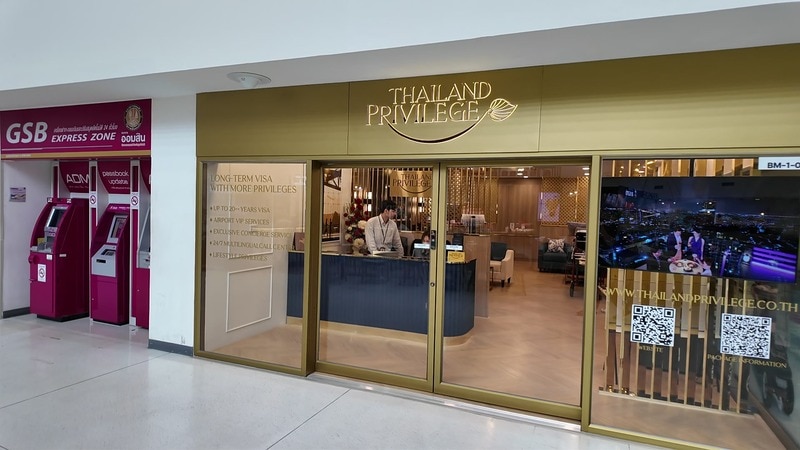
One legitimate option that sidesteps the income and insurance tests entirely is Thailand’s paid membership visa program, marketed as Thailand Privilege (formerly Thailand Elite). Membership is purchased rather than qualified for, which removes the pension-income and bank-deposit hurdles that block many parents from the O-A or O-X routes.
It comes with a real cost, and the exact pricing and inclusions change by tier and over time, so check current figures before treating this as a budget option. We cover the program in detail, including current membership tiers and what they include, in our Thailand Privilege Card review.
Health Insurance Considerations for Elderly Parents
Even when a parent clears the visa’s age and financial bar, the insurance requirement is often the harder wall to climb, and it gets harder every year they wait.
Age Caps and Rising Premiums
Insurers set their own underwriting rules, and they are not obligated to sell a policy to everyone who applies. In practice, most Thai domestic insurers stop accepting brand-new applicants somewhere in their 60s to early 70s, and many stop renewing policies once a holder reaches their mid-to-late 70s or 80.
International insurers are generally more flexible about the age at which they will accept a new applicant, but they price that flexibility into the premium. Costs typically climb steeply through a policyholder’s 50s and 60s regardless of which type of insurer you use.
A parent who is 68 today and waits three years to apply for an O-A visa may find their insurance options narrower and considerably pricier than they would have been at 65.
Tip: If your parent is planning to apply for an O-A or O-X visa, get an insurance quote before booking a flight or renting a place in Thailand. If a compliant policy is not available at a price your parent can sustain, that changes which visa route makes sense, and it is far better to learn this before committing to a plan.

What to Check Before Buying
- Pre-existing conditions: many policies exclude or heavily surcharge conditions the applicant already has, which matters more for elderly applicants than younger ones. Our guide to pre-existing condition health insurance in Thailand covers what is typically excluded and which insurers are more accommodating.
- Renewal guarantees: ask explicitly whether the insurer guarantees renewal regardless of age or claims history, since a policy that satisfies the visa requirement today but gets non-renewed in three years leaves your parent without both insurance and a valid visa basis.
- Whether the policy is on the Immigration Bureau’s accepted list: for the O-A visa specifically, a foreign policy needs embassy certification or notarization to count, which some international insurers handle routinely and others do not.
If your parent already holds insurance from their home country, do not assume it satisfies Thai visa requirements. It almost never does on its own, since it needs the specific coverage minimum, Thailand-based treatment coverage, and the certification described above.
A local broker familiar with visa-compliant policies can save weeks of back-and-forth; see our list of insurance brokers in Thailand.
Comparing the Options
The Wealthy Pensioner LTR offers the longest permit at 10 years but the highest income bar, while the Non-Immigrant O-A visa stays the only route open to any nationality at a much lower financial threshold.
| Route | Who qualifies | Financial requirement | Health insurance | Duration |
|---|---|---|---|---|
| LTR Wealthy Pensioner | Age 50+, any nationality | US$80,000/year passive income, or US$40,000/year plus US$250,000 Thai investment | US$50,000 hospitalization cover, active social security, or US$100,000 deposit held 12 months | 10 years |
| Non-Immigrant O-A | Age 50+, any nationality | THB800,000 deposit or THB65,000/month income | US$100,000 (THB3,000,000) minimum, since October 2021 | 1 year, renewable annually |
| Non-Immigrant O-X | Age 50+, 14 eligible nationalities only | THB3,000,000 deposit, or THB1,800,000 deposit plus THB1,200,000/year income | THB40,000 outpatient / THB400,000 inpatient | 10 years (two 5-year permits) |
| Thailand Privilege membership | No income or age test; purchase-based | Membership fee (varies by tier, check current pricing) | Not a program requirement | 5 to 20 years depending on tier |
| Visa exemption / tourist visa | Passport-dependent, no financial test | None | Not required by immigration, but strongly advisable | 30 days exemption (from Sept 15, 2026), longer with a tourist visa |
Common Mistakes and Pitfalls
The most common mistake is assuming a parent visa exists at all, and only discovering during the actual application that “dependent” on the LTR program means spouse and children, not parents. By the time that gets sorted out, weeks can be lost.
A second mistake is applying for O-A insurance at the outdated THB40,000/THB400,000 minimum because that is what an older blog post or an out-of-date embassy PDF still shows. Immigration and the insurer will both flag a policy that does not meet the current US$100,000 requirement, and buying the wrong policy twice is expensive.
A third mistake is nationality assumptions. Families sometimes plan around the O-X visa’s 10-year term without checking the eligible-country list first, only to find their parent’s passport is not on it. Check the 14-country list before doing anything else if the O-X looks appealing.
A fourth is treating the pre-September-2026 border-run pattern as still available. The twice-a-year land-border cap and the shorter 30-day exemption were designed specifically to close off that workaround, and immigration officers are aware of the change.
Finally, families sometimes wait too long to shop for insurance, only to find that the parent’s age has pushed them past a Thai insurer’s new-enrollment cutoff by the time they are ready to apply. Get a quote early, even before the rest of the paperwork is ready.

FAQ
Does Thailand have a specific visa for elderly parents?
No. There is no dedicated parent visa or family reunification category for aging parents in Thai immigration law. A parent has to qualify independently for the O-A, O-X, or LTR Wealthy Pensioner visa, or rely on repeated short-term entries.
Can I add my parent as a dependent on my LTR visa?
No. The LTR program’s dependent category, as defined by Thailand’s Board of Investment, covers only a legal spouse and children under 20. Parents do not qualify as dependents under any LTR category.
What is the easiest visa route for a parent to actually get?
For most families, the Non-Immigrant O-A visa is the most realistic option, since it is open to all nationalities and has a lower financial bar than the LTR or O-X visas. The health insurance requirement, currently US$100,000 in coverage, is usually the harder condition to satisfy, not the savings threshold.
Can my parent just keep re-entering Thailand on tourist stays instead of getting a long-stay visa?
They can, but it is not a reliable substitute for a proper visa. Since September 15, 2026, most visa-exempt stays are capped at 30 days, and land-border entries under the exemption are limited to twice per calendar year for most nationalities. This makes indefinite stays through repeated short entries much harder than it used to be, and immigration officers can question a pattern of frequent, unexplained re-entries.
Does my parent’s home-country health insurance count toward the Thai visa requirement?
Usually not without extra steps. A foreign policy has to meet the specific coverage minimum in USD or THB and be certified by a Thai embassy or notarized through the home country’s foreign ministry before it satisfies the O-A or O-X requirement. Check with the embassy handling the application before assuming an existing policy qualifies.
Sources Cited
- Thailand Board of Investment, LTR Visa program site: definition of LTR dependents (spouse and children under 20 only) and the four LTR visa categories.
- BOI, Application for Qualification Endorsement for Wealthy Pensioner: income thresholds (US$80,000/year or US$40,000/year plus US$250,000 investment) and health insurance/deposit requirements for the LTR Wealthy Pensioner category.
- Ministry of Public Health, Guideline on the Amendment to Additional Criteria for Purchasing Health Insurance for Non-Immigrant O-A Visa: confirms the current US$100,000 (THB3,000,000) health insurance minimum for O-A applicants and extensions, effective October 1, 2021, superseding the earlier THB40,000/THB400,000 figures.
- Ministry of Foreign Affairs, Guideline on Non-Immigrant O-A Visa Application: age (50+) and financial requirements (THB800,000 deposit or THB65,000/month income) for the O-A visa.
- Ministry of Foreign Affairs, Consular Affairs, Non-Immigrant Visa O-X (Long Stay 10 Years): eligible nationality list, financial thresholds, and health insurance minimums for the O-X visa.
- Tourism Authority of Thailand Newsroom, Thailand introduces new 30-day and 15-day visa exemption rules from 15 September: confirms the September 15, 2026 reduction of the visa exemption from 60 to 30 days and the twice-per-calendar-year land-border entry cap.