Chinatown and the old town are Bangkok’s cheapest central address for people who’d rather have great food and old temples than a gym and a pool. Homes are mostly shophouses and older apartments, and the MRT Blue Line runs right through the middle.
Your mornings here start with temple doors opening and market carts rattling past before dawn. Your nights belong to the charcoal grills on Yaowarat Road, where the stalls fire up around dusk and the crowds follow the smoke.
Prices below are in baht, with US$ conversions at roughly THB33 to US$1.
This guide covers where the area starts and ends, what it costs, where to eat, drink and shop, what Yaowarat looks like after dark, how flooding and healthcare work, and how it compares with Sam Yan and Charoen Krung.
Disclaimer: Some links in this article go to our partners, and we may earn a commission if you use them. It costs you nothing extra, and we only recommend services we'd use ourselves. Read more in our Advertising Disclosure.
Contents
- Key Takeaways
- Thailand Starter Kit Rating
- Location
- Pros and Cons of Living in Chinatown and the Old Town
- What Daily Life Looks Like in Chinatown and the Old Town
- Chinatown and the Old Town Cost of Living at a Glance
- Accommodation in Chinatown and the Old Town
- Dining Out in Chinatown and the Old Town
- Drinking in Chinatown and the Old Town
- Groceries in Chinatown and the Old Town
- Yaowarat After Dark and the Old Town on Your Doorstep
- Transportation Options for Chinatown and the Old Town
- Flooding in Chinatown and the Old Town
- Healthcare in Chinatown and the Old Town
- International Schools in Chinatown and the Old Town
- Parks in Chinatown and the Old Town
- Other Standout Venues and Features
- Chinatown vs. Sam Yan vs. Charoen Krung
- Should You Live in Chinatown and the Old Town?
- Frequently Asked Questions
- Sources Cited
Key Takeaways
- Chinatown is one of the cheaper central areas, and an older one-bedroom commonly asks THB8,000 to THB15,000 a month.
- Three MRT Blue Line stations serve the area: Wat Mangkon, Sam Yot and Sanam Chai. Silom is about 11 minutes away.
- The food is the reason most people move here, and you’ll eat out far more than you cook.
- Modern condos are scarce. Expect older apartments and shophouses with stairs, no pool and often no gym.
- Samphanthawong, the district at the center, is Bangkok’s smallest by area and has the city’s highest share of elderly residents.
- Chinatown’s risk of a big flood is very low. A few junctions flood in heavy rain, but the water drains within hours.
- Green space is thin, and the streets are loud and hot.
- Food-and-culture retirees, budget nomads and anyone who doesn’t need a modern building get the most out of it. Families will struggle.

Location
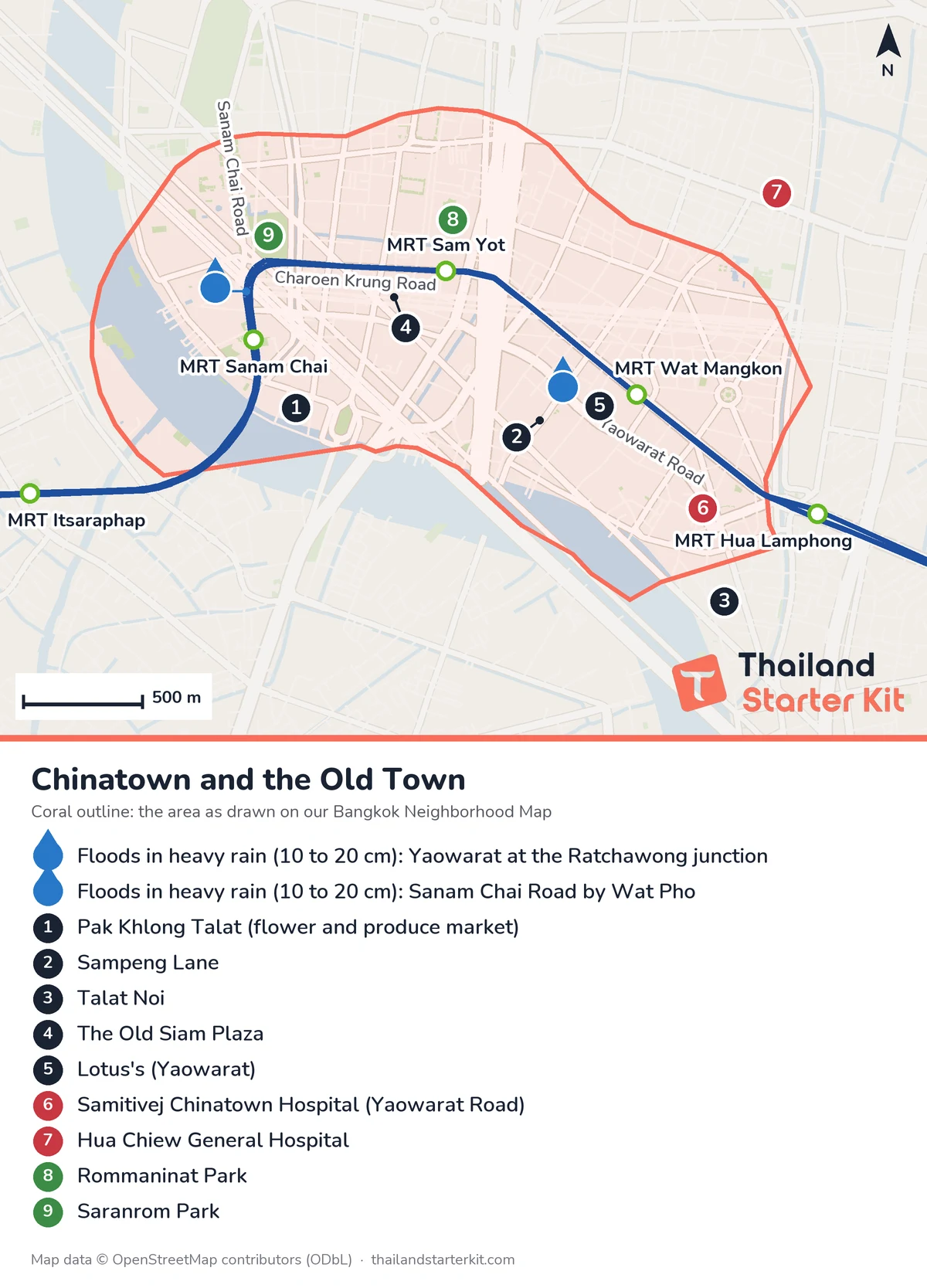
Chinatown and the old town sit on the east bank of the Chao Phraya River, a compact area of about 4 sq km from the river inland to Sam Yot. You can walk most of it if the heat lets you.
The area spans three districts, Samphanthawong, Pom Prap Sattru Phai and Phra Nakhon.
Yaowarat Road is Chinatown’s main artery, 1,532 m of one-way traffic under gold shop signs. Cars run the opposite way to the parallel Charoen Krung Road, so check the direction before you flag a taxi.
Wat Mangkon station sits on Charoen Krung Road, deep in the Chinatown streets. Sam Yot and Sanam Chai are inside Rattanakosin, the old royal city that holds the Grand Palace and Wat Pho.
- East: Hua Lamphong railway station and MRT Hua Lamphong, one stop from Wat Mangkon, then Sam Yan along Rama IV Road.
- South: Talat Noi and the riverside, where Chinatown fades into Charoen Krung and Bang Rak. Talat Noi’s lanes are the best-known stretch of this border.
- North: Sam Yot, Phahurat (the Little India quarter) and Wat Saket’s Golden Mount.
- West: The Chao Phraya River, with Memorial Bridge and the Thonburi side across the water.
Our Sam Yan guide covers the Rama IV end of the Blue Line, and a Charoen Krung guide is planned for the riverside to the south.
Pros and Cons of Living in Chinatown and the Old Town
Chinatown is great if you want street food and temples on your doorstep for a low rent. It’s a poor fit if you need quiet nights, a pool or a modern building with a fast lift.
Pros
- Food day and night: the food is some of the best in Bangkok, and from dusk the Yaowarat stalls take over the pavement.
- Value rents: rents are in the city’s cheapest bracket, which is rare this close to the center.
- Culture on foot: Wat Mangkon Kamalawat, Wat Traimit, Wat Pho and Museum Siam are all near the three stations.
- MRT through the middle: the Blue Line gets you to Silom in about 11 minutes and Siam in about 21.
- Very low flood risk: the area stayed largely dry in 2011 and was unaffected in 2026.
- River and markets: Pak Khlong Talat, the flower and produce market, never closes, so you can buy flowers at 3am.
Cons
- Few modern condos: most housing is old, and units with a pool or gym are rare.
- Noise and crowds: Sampeng’s night wholesale trade and the pre-dawn market trucks keep the street awake, and evening tourists pack the pavements.
- Almost no green space: there’s very little parkland.
- Heat and stairs: sois are narrow, pavements are packed, and shophouses usually mean stairs.
- Thin expat services: services for foreigners are limited, and there’s no big mall or imported grocer.
- Not for families: it’s a poor fit for family life.
What Daily Life Looks Like in Chinatown and the Old Town
Daily life in Chinatown runs on temples and markets by day and Yaowarat’s charcoal grills at night, with the MRT Blue Line as your exit to the rest of Bangkok.
On a weekday the street wakes you before your alarm does. Delivery trucks and market carts start well before dawn, and Pak Khlong Talat is at its busiest while it’s still dark.
Coffee comes from a shophouse cafe, roughly THB80 to THB150 a cup. On the walk to MRT Wat Mangkon you pass Wat Mangkon Kamalawat as it opens its doors at 8am, incense already drifting onto the pavement.
If you work from a laptop, you pick a cafe and stay put for the afternoon. If you work in Silom, you’re at your desk about 11 minutes after the train doors close.
Lunch is a bowl of noodles or a plate of rice for roughly THB50 to THB100. Fishball noodles from a family stall are the local classic, eaten fast under a fan.
Afternoons are for errands. Sampeng Lane trades from 8am to 5pm, so that’s when you go for fabric, stationery or a phone case, squeezing single file through the narrow lane.
Evenings are the main event. Around 6pm the neon comes on over Yaowarat and grill smoke drifts across the road. Soon the pavement is one long queue.
You eat standing up or perched on a plastic stool, then wander over to Soi Nana for a Thai-herb cocktail at Tep Bar. Once the trains stop for the night, a Grab gets you home.
Saturday is for crossing Rattanakosin on foot, from Wat Pho to Museum Siam and on to Saranrom Park. On Sunday evening you stay off Yaowarat, because that’s the crowd peak and a table can take an hour.
When it rains hard, a few junctions flood for a short spell, Yaowarat at Ratchawong among them. You wait it out over a second coffee while the Blue Line keeps running underneath.

Chinatown and the Old Town Cost of Living at a Glance
An older one-bedroom in Chinatown commonly asks THB8,000 to THB15,000 a month, and a modern one near an MRT station asks THB15,000 to THB25,000. That’s well below Sukhumvit or Silom for a central address, and the catch is that the building is usually old.
These are rough asking-rent ranges from public listings seen in 2026, rounded. Check current listings before you budget. Day-to-day spending is in our cost of living in Bangkok guide.
| Item | Typical cost |
|---|---|
| Older studio or small apartment (20 to 28 sqm) | roughly THB5,000 to THB9,000 a month (about US$150 to US$275) |
| Modern studio (25 to 35 sqm), few available | roughly THB10,000 to THB17,000 a month (about US$305 to US$515) |
| One-bedroom, older building (35 to 50 sqm) | roughly THB8,000 to THB15,000 a month (about US$245 to US$455) |
| One-bedroom, modern building near the MRT (30 to 45 sqm) | roughly THB15,000 to THB25,000 a month (about US$455 to US$760) |
| Two-bedroom | roughly THB22,000 to THB45,000 a month (about US$670 to US$1,365) |
| Noodle or rice dish at a street stall | roughly THB50 to THB100 a dish |
| Coffee at a shophouse cafe | roughly THB80 to THB150 a cup |
| MRT ride within the Blue Line stations here | from about THB17 a trip (fares are distance-based) |
| Motorbike taxi, short ride | roughly THB20 to THB40 |
Deposits are normally two months’ rent plus one month in advance, the usual Bangkok setup. To get the price down, read how to negotiate your rent down.
Accommodation in Chinatown and the Old Town
Housing in Chinatown means older apartment blocks and shophouses, often above a shop or a food stall. Land around Yaowarat is among Bangkok’s priciest and largely held by Thai-Chinese families, according to Wikipedia, so modern towers are rare.
Modern but Small Condos
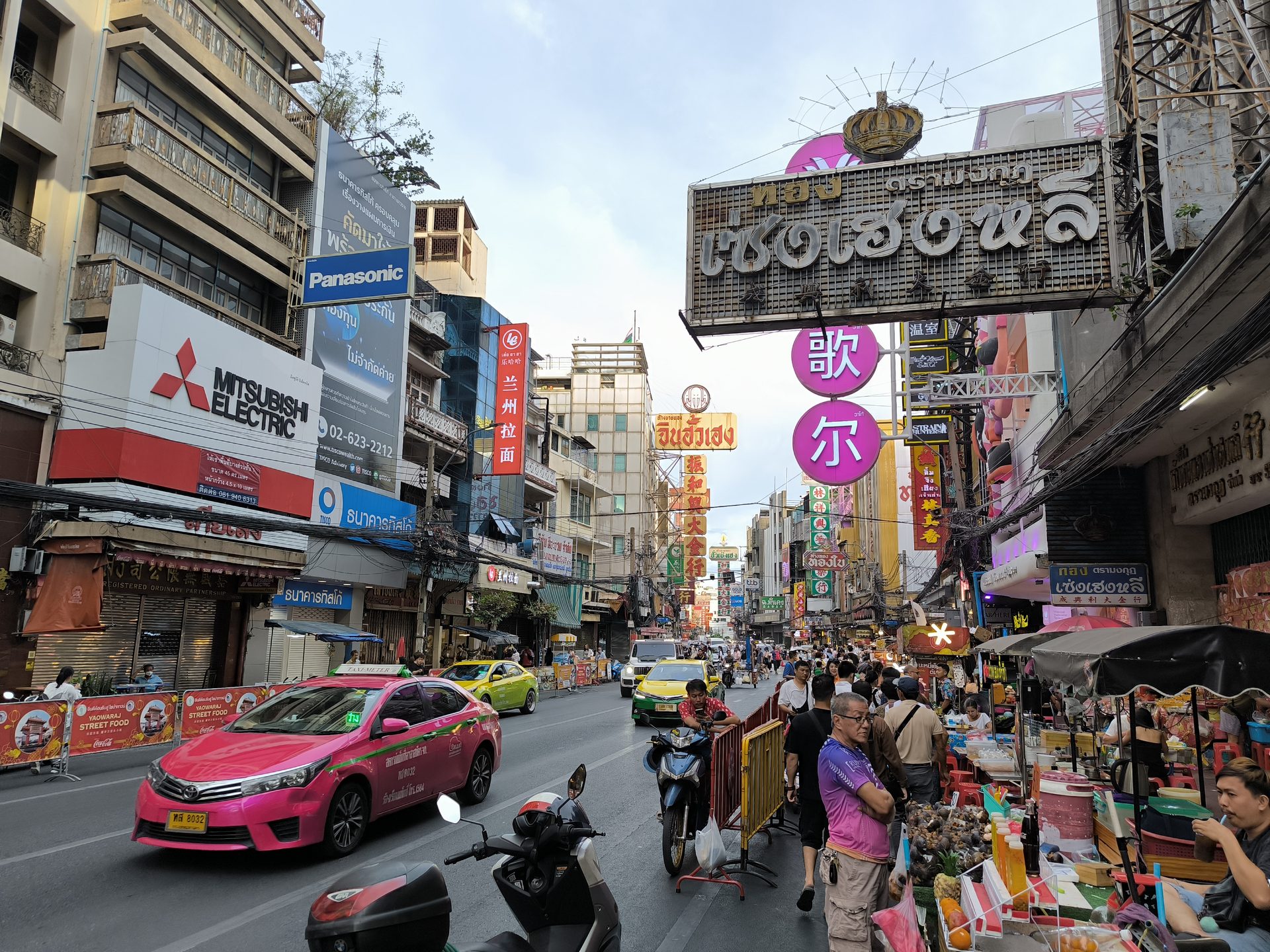
Modern studios near the Blue Line stations ask roughly THB10,000 to THB17,000, and there aren’t many of them. Start searching a month ahead.
The Old Siam Plaza on Charoen Krung and Tri Phet Roads was renovated in 2023, and its fourth floor now holds 128 homes, according to Wikipedia. That makes it one of the few new residential projects on Rattanakosin Island.
Luxury Condos
Chinatown has almost no luxury condos. The high-end towers are in Silom, Sathorn and along the river toward Charoen Krung, a short Blue Line or boat ride away.
Bigger, Older, Affordable Condos
Older apartment blocks give you 35 to 50 sqm for roughly THB8,000 to THB15,000. Lobbies are tired and lifts are slow, but you get room to spread out.
View in person, and ask about water pressure and the air conditioner. Our guide to which condo developments to rent covers what to check.
Tip: Visit once at night before you sign. Some sois are silent at 4pm and loud at midnight, and a bedroom above a food stall or a market lane tells you the truth quickly.
Townhouses and Gated Communities
Gated communities don’t exist in Chinatown, and nobody moves here for a lawn. The closest thing is a restored shophouse, which is rare to find for rent and usually comes with steep stairs and no parking.
If you need a house with parking, our On Nut guide and Ratchada guide cover areas with more room.
Budget Options
The cheapest rooms are in older apartment buildings on the back sois, where small studios can start near THB5,000.
Check the air conditioning, the noise at night and where the trash goes. For more budget areas, see our guide to underrated Bangkok neighborhoods and our Phra Khanong guide.
Dining Out in Chinatown and the Old Town
Chinatown has Bangkok’s most concentrated food scene. Old family shops feed you through the day, then Yaowarat’s stalls take over at night.
Street Food
Yaowarat’s street food starts filling up around 6pm, and the evening is when you want to be there. A 2017 city pilot scheme set the street food zone at 6pm to midnight, though individual stalls keep their own hours.
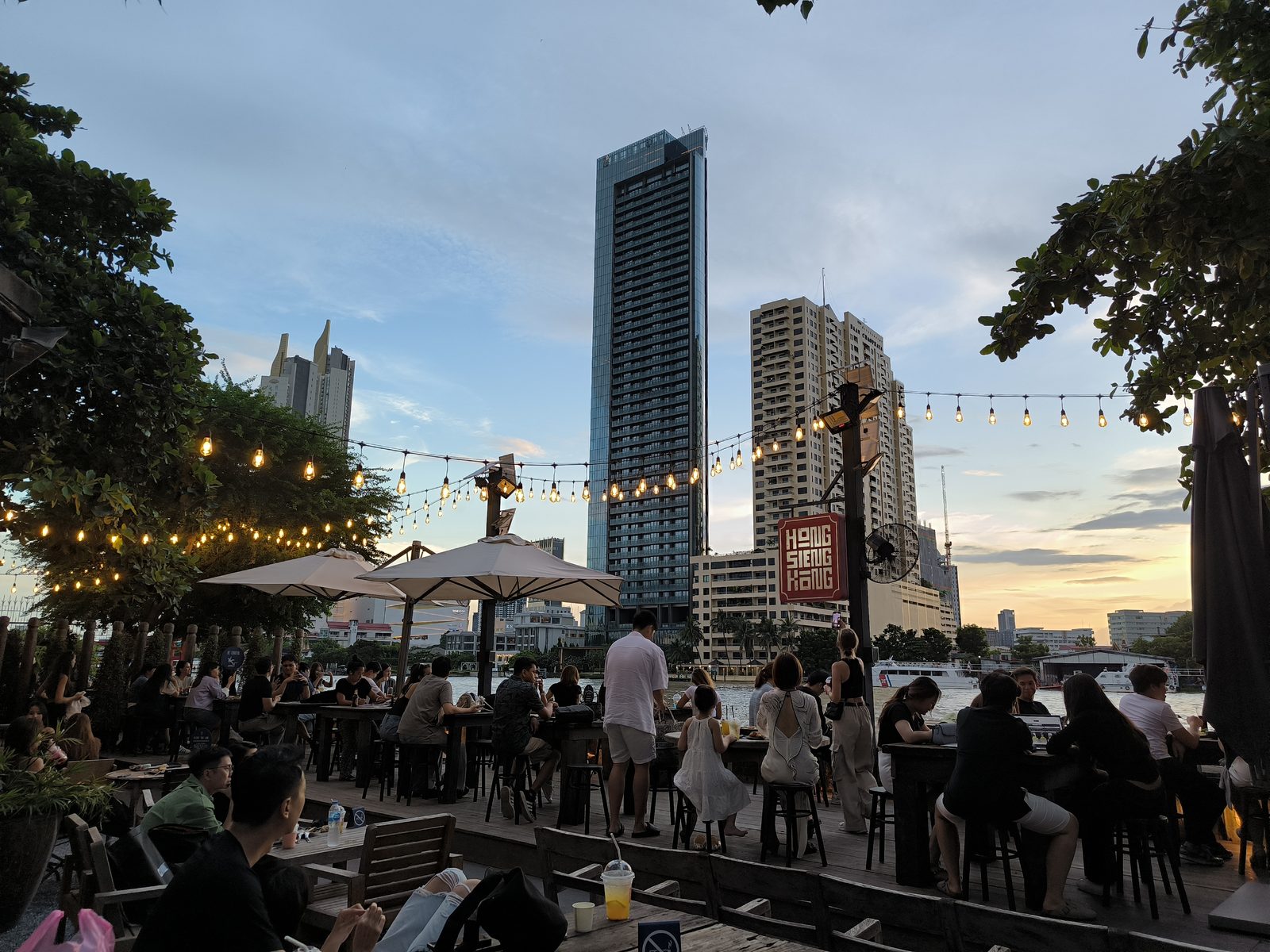
You’ll smell the grills before you see them. Bring cash, expect queues and eat standing up. Weeknights are calmer than weekends.
- Lim Lao Ngow: a family fishball noodle shop with Michelin Bib Gourmand recognition in past Bangkok guides, known for bouncy handmade fishballs. It sits opposite Wat Ko (Wat Samphanthawong), in front of the Chia Tai building.
- Nai Mong Hoi Thod: oyster omelets, crisp or soft, at 539 Phlap Phla Chai Road, about 100 m from MRT Wat Mangkon.
Talat Noi is credited as the birthplace of kuaitiao khua kai, wide rice noodles dry-fried with chicken and egg. Look for it on the lanes near the river.
Popular Dining Spots
Chinatown’s daytime dining happens indoors, in the shophouse cafes and old family restaurants on the ground floors of the old buildings. That’s where you’ll have lunch while the street waits for dusk.
Sunday evening is the crowd peak on Yaowarat itself, and a table anywhere can take an hour.
Drinking in Chinatown and the Old Town
Drinking in Chinatown means a cocktail in a small themed bar on Soi Nana, then a late plate on Yaowarat on the walk home.
- Tep Bar: a Thai-herb cocktail bar at 69-71 Soi Nana, open from 6pm (5pm on weekends), with live semi-traditional music late in the evening.
- Teens of Thailand: a gin bar at 76 Soi Nana in an old two-story building, with only about 15 seats.
Both are small, so go early or expect a wait. For a longer night, take a taxi to Silom.
Check how you’re getting home before the third round. Once the MRT closes for the night, it’s Grab or a taxi.
Groceries in Chinatown and the Old Town
Groceries in Chinatown come from open-air markets and convenience stores, with only small supermarkets in the area. You can cook at home, but with a THB50 noodle dish downstairs, eating out is cheaper and easier.
Fresh Markets
Pak Khlong Talat is Bangkok’s main flower market, and it sells fruit and vegetables too. It’s open 24 hours a day and busiest before dawn, when the boats and trucks arrive.
Sampeng Lane and Phahurat (Little India) sell fabrics, spices and bulk goods rather than daily groceries. There are plenty of markets across the area, from morning food markets to wholesale lanes.
Supermarkets
Big C and Lotus’s are among the area’s grocers, plus Mini Big C and 7-Eleven stores. There’s no large imported-food grocer.
Imported cheese and good bread mean a Blue Line ride to Silom or Siam. Delivery apps cover the rest.
Yaowarat After Dark and the Old Town on Your Doorstep
Chinatown’s signature is Yaowarat Road after dark, and the old town’s lanes and temples are a short walk from your door. No other central area gives you this much history for this little rent.
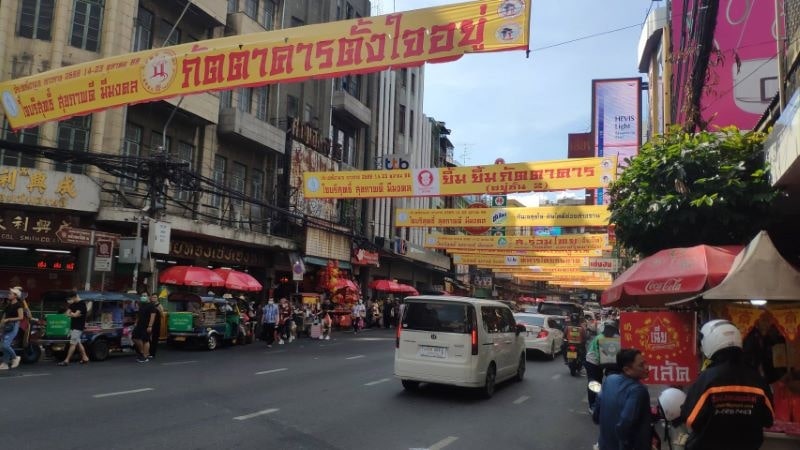
Yaowarat Road at Night
Yaowarat Road turns into a food street at dusk, lit by neon signs and charcoal grills. During Chinese New Year the road closes to traffic and becomes one long pedestrian street.
If you live on or near the road, weekends and festival nights stay loud until the stalls pack up. The upside is that dinner is a short walk down the road.
Sampeng Lane
Sampeng Lane is a narrow wholesale market, officially Soi Wanit 1, that dates to the founding of Bangkok in 1782. The day trade runs from 8am to 5pm, and the night trade starts around 11pm.
Most night customers arrive between 1am and 6am, according to Wikipedia. If your bedroom window faces the lane, you’ll hear them.
Talat Noi
Talat Noi is a riverside quarter of shrines, old shophouses and street art, about 900 m from MRT Hua Lamphong. It holds the Chow Sue Kong Shrine (1804) and a Portuguese-founded church dating from 1787.
The neighborhood has 6,865 registered residents in 0.449 sq km. Many are older Thai-Chinese families, so you’ll be one of very few foreigners.
The MRT Stations and Rattanakosin
Wat Mangkon, Sam Yot and Sanam Chai are the three Blue Line stations that opened the old town to commuters on 29 July 2019, as part of a 14-km extension. Each station is themed on its surroundings.
- Wat Mangkon: Sino-Portuguese design, with dragons and water lilies on the walls. It’s the stop for Wat Mangkon Kamalawat, which is free and open 8am to 4pm.
- Sam Yot: three exits, including a Sino-Portuguese entrance building, about 300 m from Phahurat Road.
- Sanam Chai: next to Museum Siam, with an early Rattanakosin interior. Wat Pho, Saranrom Park and Pak Khlong Talat are all nearby.
Building Rules in the Old Town
New buildings on Rattanakosin Island face strict design rules, and that keeps modern condo supply low. Since 2019, new facades have to be beige with dark grey tiled roofs.
Awnings, air-conditioner units and antennas aren’t allowed on the front either. Existing buildings aren’t affected, so in practice you rent what’s already there, wall-mounted air-con units and all.
Transportation Options for Chinatown and the Old Town
The MRT Blue Line is Chinatown’s transport spine, with Wat Mangkon, Sam Yot and Sanam Chai stations, while river boats and motorbike taxis fill the gaps.
MRT Blue Line
Wat Mangkon, Sam Yot and Sanam Chai are the area’s three stations, and Hua Lamphong is the next stop east. The line carries on west to Itsaraphap, across the river.

Typical travel times from the area:
- Silom: about 11 minutes.
- Asok: about 19 minutes, via the Blue Line to Sukhumvit.
- Siam: about 21 minutes.
Fares are distance-based and start from about THB17 a trip.
Getting to the Airports
Suvarnabhumi Airport is about 45 minutes from Chinatown, and Don Mueang about 54. With luggage, a taxi or Grab beats the trains.
Our Bangkok airport transfers guide has the options and costs.
Motorbike Taxis
Motorbike taxis wait at the mouths of the bigger sois, and a short ride costs roughly THB20 to THB40. They’re handy for cutting across crowded Yaowarat or getting from a back-soi flat to the station.
Wear the helmet they hand you.
Taxis and Grab
Taxis are easy to find, but the main roads crawl in the evening, especially around Yaowarat. Grab is the usual choice after the trains stop.
For the whole city, see our Bangkok transportation guide.
Buses and Boats
City buses run along the main roads, though most residents take the train. Chao Phraya Express Boats stop near Sanam Chai, and the Talat Noi riverside has several piers, including Marine Department and Si Phraya.
The orange-flag boat charges a flat fare of roughly THB20. Check which flag stops at your pier, since services vary by day and direction.
Flooding in Chinatown and the Old Town
Chinatown’s risk of a big flood is very low. It had only brief riverside flooding in 2011 and was unaffected in 2026.
Heavy rain still floods a few junctions for a short time, mainly on Yaowarat and Charoen Krung Roads near Ratchawong, and on Sanam Chai Road in front of Wat Pho.
The water usually drains within a few hours. It’s a nuisance for walking and taxis, but no risk to upper-floor flats. Our guide to flood-free Bangkok neighborhoods compares areas.
Healthcare in Chinatown and the Old Town
Chinatown has a private hospital on Yaowarat Road and a second one close by, with more options one MRT ride away.
Hospitals
These are the nearest hospitals, measured from the center of the area:
- Samitivej Chinatown Hospital: a boutique private hospital in the Samitivej group at 624 Yaowarat Road, about 1.3 km away.
- Hua Chiew General Hospital: run by the Poh Teck Tung Foundation, about 1.5 km away. It’s accredited through 23 April 2027.
- Taksin Hospital: a public hospital about 1.6 km away.
- BNH Hospital: on Convent Road in Silom, a short ride away, with a history going back to 1898.
Our guide to private hospitals in Bangkok compares prices and insurance acceptance.
Clinics
Small clinics and traditional Chinese medicine shops line the main roads. For a general doctor, the hospitals’ walk-in outpatient clinics are the easiest option.
Dentists
We can’t point you to a specific dentist in the area, so start with our Bangkok dentists guide. The Dental Hospital at Chulalongkorn University on Henri Dunant Road is a few Blue Line stops east.
Get a written treatment quote before you agree to any work.
Veterinarians
The area has only a few vet clinics. Chulalongkorn University’s Small Animal Teaching Hospital on Henri Dunant Road runs a 24-hour emergency clinic.
Call first, since hours change on weekends. Our Bangkok veterinarians guide has more.
International Schools in Chinatown and the Old Town
Chinatown has no international school inside the area, so families would do the school run by taxi or school bus.
- International Pioneers School: British curriculum, open since 1998, about 2.4 km away.
- Shrewsbury International School Bangkok Riverside: about 3.9 km away.
Few schools sit within 3 km. Our guide to international schools in Bangkok has fees and curricula.
Parks in Chinatown and the Old Town
Parks are Chinatown’s weak spot, with very little parkland, and Rommaninat Park near Sam Yot is the main one.
Rommaninat Park covers about 11 acres on the site of the old Klong Prem Prison and houses the Bangkok Corrections Museum. It’s your morning walk before the temples open.
Saranrom Park sits near Sanam Chai station, and the Chao Phraya Sky Park runs along Phra Pok Klao Bridge. Neither is big enough for a long run.
Other Standout Venues and Features
Chinatown’s other standouts are temples, museums and markets, all within walking distance of the three MRT stations.
- Wat Traimit: the temple of the Golden Buddha, which also houses the Yaowarat Chinatown Heritage Center.
- Wat Mangkon Kamalawat: the city’s largest Chinese Buddhist temple, free and open 8am to 4pm.
- Wat Pho: the temple of the Reclining Buddha, a short walk from Sanam Chai station.
- Museum Siam: directly in front of Sanam Chai’s Exit 1.
- Phahurat: Bangkok’s Little India, a short walk from Sam Yot station.
Chinatown vs. Sam Yan vs. Charoen Krung
Pick Chinatown for the lowest rents and the best food, Sam Yan for student prices one stop from Silom, and Charoen Krung for galleries by the river.
| Factor | Chinatown | Sam Yan | Charoen Krung |
|---|---|---|---|
| Vibe | Street food, temples and old shophouses | Campus town with cheap food and 24-hour mall zones | Galleries, riverside hotels and natural wine bars |
| Price tier | Value | Mid | Upper |
| Food | 5 out of 5 | 4 out of 5 | 4 out of 5 |
| Nightlife | 4 out of 5 | 2 out of 5 | 3 out of 5 |
| Culture | 5 out of 5 | 4 out of 5 | 5 out of 5 |
| Green space | 1 out of 5, Rommaninat Park | 3 out of 5, Chula Centenary Park | 2 out of 5 |
| Rail access | MRT Blue Line, Silom about 11 minutes | MRT Blue Line, Silom one stop | BTS Saphan Taksin and river boats, Silom about 13 minutes |
| Best for | Food-and-culture lovers, budget nomads, retirees who like the street | Students, budget nomads, people working in Silom | Creatives and retirees who want a calmer riverside |
Sam Yan is a few minutes east on the Blue Line and costs more. You’re paying for newer buildings and a calmer student crowd.
Charoen Krung sits to the south and is the priciest of the three. You get galleries, riverside hotels and bigger old units.


If food and temples are why you’re here, Chinatown wins. If you need a quieter bedroom, look at Sam Yan or the riverside. Our Bangkok neighborhoods guide compares more areas.
Should You Live in Chinatown and the Old Town?
Chinatown suits people who’d trade a pool and a quiet bedroom for great food and low rent at a central address.
- Retirees: the culture and food are hard to beat, and you’ll have plenty of older neighbors. It’s still a weak fit for most retirees, because stairs, crowds and noise wear you down. Our cheap retirement guide covers other budget options.
- Digital nomads: shophouse cafes, the Blue Line and low rent all help. It’s a fair fit, held back by noise and old housing.
- Budget expats: a modern one-bedroom for THB15,000 to THB25,000, or an older one for less, close to the center. The trade-off is fewer amenities.
- Business people: Silom is about 11 minutes away, but there are no modern office buildings here, so it’s a weak fit.
- Families: a poor fit. There’s no international school, little green space and the streets are crowded.
Guides to Silom, Sathorn and Charoen Krung are on the way.
Frequently Asked Questions
How much is rent in Chinatown?
An older one-bedroom in Chinatown typically asks THB8,000 to THB15,000 a month, and a modern one near an MRT station asks THB15,000 to THB25,000. Older studios can start near THB5,000.
What is the nearest station in Chinatown?
MRT Wat Mangkon on the Blue Line is the main Chinatown station, with Sam Yot and Sanam Chai covering the old town. Hua Lamphong is the next stop east.
Does Chinatown flood?
Chinatown’s risk of a big flood is very low, and it was unaffected in 2026. Heavy rain floods a few junctions, but the water drains within a few hours.
Is Chinatown good for families?
Chinatown isn’t an easy fit for families. There’s no international school inside the area, little green space and homes are mostly small.
Is Chinatown safe?
Use normal big-city sense. Keep your phone and wallet in front of you in the Yaowarat crowds, and watch the narrow sois late at night.
How do I get to the airports from Chinatown?
Suvarnabhumi is about 45 minutes from Chinatown, and Don Mueang about 54. With luggage, a taxi or Grab is easier.
What are Yaowarat and Rattanakosin?
Yaowarat is the main road of Bangkok’s Chinatown, and Rattanakosin is the old royal city island that holds the Grand Palace and Wat Pho. Both fall inside this guide’s area.
Is Chinatown good for digital nomads?
Chinatown works for budget nomads who prefer atmosphere to amenities. Shophouse cafes and the Blue Line help, but noise and old housing count against it.
Is there a hospital near Chinatown?
Yes. Samitivej Chinatown Hospital is at 624 Yaowarat Road, and Hua Chiew General Hospital is about 1.5 km away.
Sources Cited
- Tourism Authority of Thailand: the Wat Mangkon, Sam Yot, Sanam Chai and Itsaraphap stations and the 14-km extension.
- Samitivej Chinatown Hospital: 624 Yaowarat Road address.
- Hospital Accreditation Institute: Hua Chiew General Hospital accreditation through April 2027.
- Time Out Bangkok, Tep Bar: address and opening hours.
- Time Out Bangkok, Teens of Thailand: address and seating.
- Wongnai, Lim Lao Ngow (Wat Ko / Chia Tai): location and 2026 reviews.
- Wongnai, Nai Mong Hoi Thod: address, distance from MRT Wat Mangkon and 2026 reviews.
- Khaosod English: the 2019 Rattanakosin rules on building colors and facades.
- Wikipedia, Yaowarat Road: length, one-way direction, Chinese New Year closure, land prices.
- Wikipedia, Talat Noi: shrines, population, food and MRT access.
- Wikipedia, Sampheng: operating hours.
- Wikipedia, Pak Khlong Talat: 24-hour market and the pre-dawn peak.
- Wikipedia, Samphanthawong: smallest district, elderly share.
- Wikipedia, Wat Mangkon Kamalawat: opening hours and free entry.
- Wikipedia, The Old Siam Plaza: 2023 renovation and 128 residential units.
- Wikipedia, Rommaninat Park: size, history and museum.
- International Pioneers School: British curriculum and founding year.
- Shrewsbury International School Bangkok: Riverside campus.
- Chao Phraya Express Boat: flat fares on the orange line.
- Bangkok Metropolitan Administration open data: road-flooding records for 2023 to 2025.