
Sending packages from Thailand abroad is easier than most people think. This guide covers Thailand Post, DHL, FedEx, container shipping, freight forwarders, and what customs rules to know before you ship.
If you live or vacation in Thailand, there’s a good chance you may have to send something back home. Whether it’s a personal letter, business package, or a purchase from an incredible shopping experience, you’ll want to know where you can get the cheapest international shipping rates from the most reliable international shipper.
This shipping guide details each step in sending items from Thailand to anywhere abroad. You’ll learn how to prepare your package, assemble and fill out the correct documents, and select the best shipper. You’ll also learn about shipping policies officials use when sending your shipment outside of Thailand.
If you want to save time and skip the lengthy read, fill out the form on our contact page and get five free quotes from moving companies within 24 hours.
If you’re looking to send items to Thailand, check out our guide to shipping to Thailand.
We also offer exclusive shipping tips for Thailand Starter Kit Premium members only including:
- Local Shipping Company That’s 50% Cheaper than Other Moving Companies
- A Seamless Shipping Experience: Sending Items from Thailand to the World
- Recommended Method to Send Money from Thailand
- and much more.
Disclaimer: Some links in this article go to our partners, and we may earn a commission if you use them. It costs you nothing extra, and we only recommend services we'd use ourselves. Read more in our Advertising Disclosure.
Contents
- Key Takeaways
- Preparing a package
- Paperwork
- Choosing How to Ship: Sea, Air, Courier, or Excess Baggage
- Bulk Shipping
- Shipping From Thailand to USA
- Shipping Companies
- Shipping Agents
- Thai Export Paperwork for a Departing Resident
- Customs
- Shipping Pets and Vehicles Out of Thailand
- Shipping Insurance
- Common Mistakes
- Frequently Asked Questions
- Do I pay export tax on my personal belongings when leaving Thailand?
- Do I need a permit to export a Buddha image or antique from Thailand?
- Is it cheaper to ship out of Thailand by sea or by air?
- How do I export a pet from Thailand?
- Can I ship my car out of Thailand?
- What's the difference between a freight forwarder and a shipping agent?
- Can I just pay for extra checked baggage instead of shipping a box?
- What items can never leave Thailand, no matter the permit?
- Now, on to You
Key Takeaways
- Always wrap items in plastic before packaging to protect against water damage; shipping containers can reach over 40 degrees Celsius.
- Fill out the CN22 customs declaration form accurately; incomplete or missing forms will prevent your package from leaving Thailand.
- Thailand Post is the cheapest option but has mixed reliability; DHL and FedEx cost more but are better for valuable or time-sensitive shipments.
- For large shipments or moving an entire household, container shipping (FCL or LCL) via a freight forwarder is the best approach.
- Packages from Thailand may face extra customs scrutiny at the destination due to drug and counterfeit goods enforcement concerns.
- For a 0.5kg document to the US, EMS World costs around THB1,700 while DHL is around THB1,177 and UPS around THB1,400.
- Shipping agents act as intermediaries with carriers and can help with paperwork, customs clearance, and logistics coordination.
- Common mistakes include incorrect packaging, missing paperwork, undeclared item values, and not accounting for import duties at the destination.


Preparing a package
When preparing a package for international shipping, take extensive care while packaging items. FedEx recommends this packing process. Shipping services worldwide subject packages to a wide array of abuse, and this is especially true for international shipping from Thailand. Marking your package fragile does little if anything in preventing rough handling.
One consideration is water damage, an issue that is often not accounted for until it is too late. A good practice is to wrap any items inside a plastic bag before packaging. This helps your items stay dry.
Finally, shipping containers can get hot. Be aware of this when shipping items sensitive to high temperatures. Expect your items to reach temperatures of at least 105 degrees Fahrenheit.
There may be other times, though, when you won’t be the one preparing your package for shipping. If this is the case, it’s important to find out who will prepare your package, and by what methods. Most private shippers can take photos of your package after they’ve prepared it for shipping.
You may also want to look into having a shipping company take care of preparing your belongings for shipping to ensure that the utmost care is taken and your goods arrive in good condition.
Paperwork
When you ship your items from Thailand, you’ll have to fill out a Customs Declaration form known as CN 22. You can get the form from your shipper.
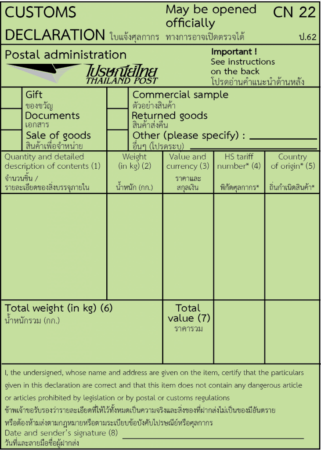
Some shippers may help you fill out the form. Without this form filled you won’t be able to ship your package out of Thailand. Be sure to fill out the sender’s and receiver’s address, the item you’re shipping, the quantity, and the value.
Choosing How to Ship: Sea, Air, Courier, or Excess Baggage
When you’re leaving Thailand, the method you pick depends more on how much you’re moving and how soon you need it than on chasing the lowest quoted price. There are four realistic options: sea freight, air freight, an international courier, and paying your airline for extra checked baggage.
- Excess baggage: works only for what fits in a couple of extra suitcases. You pay the airline directly, at check-in or in advance online, and your belongings travel with you on the same flight. It’s the fastest option by far, but it doesn’t scale past a few bags, and the per-kilogram cost is the highest of any method here.
- Courier (DHL, FedEx, UPS, or Thailand Post EMS): suits parcels up to around 30 kilograms. See the Shipping Companies section below for a provider-by-provider breakdown and a cost comparison table.
- Air freight: for loads too big for a courier parcel but still time-sensitive. This moves as commercial air cargo rather than a courier shipment, and almost always needs a freight forwarder to book, since airlines don’t sell cargo space directly to individuals shipping small volumes.
- Sea freight (LCL or FCL): the cheapest option per kilogram for a genuinely large move, a full household, or a vehicle. See the Bulk Shipping section below for how LCL and FCL work. As already noted on this page, sea freight runs roughly five to six times cheaper than air freight, but takes far longer.
| Method | Best For | Typical Transit Time | How It’s Priced |
|---|---|---|---|
| Excess baggage | A couple of extra suitcases | Same day, travels with you | Per bag or per kilogram over your ticket’s free allowance, set by the airline |
| Courier (DHL, FedEx, UPS, EMS) | Parcels up to about 30kg | A few days to about two weeks, depending on service level | Per kilogram or dimensional (volumetric) weight, whichever is higher |
| Air freight | Bulky loads too big for a courier parcel, still time-sensitive | About a week door to door | Per chargeable weight (actual or volumetric), booked through a forwarder |
| Sea freight (LCL/FCL) | Full household moves, vehicles, bulk goods | Several weeks to a couple of months | Per cubic meter (LCL) or per container (FCL) |
None of these are fixed quotes. Rates move with fuel surcharges and seasonal demand, so get a current number from the airline, courier, or forwarder directly before you commit. If coordinating a forwarder yourself feels like too much, a full-service mover will handle freight, paperwork, and pickup as one package instead.
Bulk Shipping
If you are looking to ship large amount of goods, or perhaps moving the entire contents of a home, then you’ll need to look at freight forwarding and container shipping.
Container Shipping
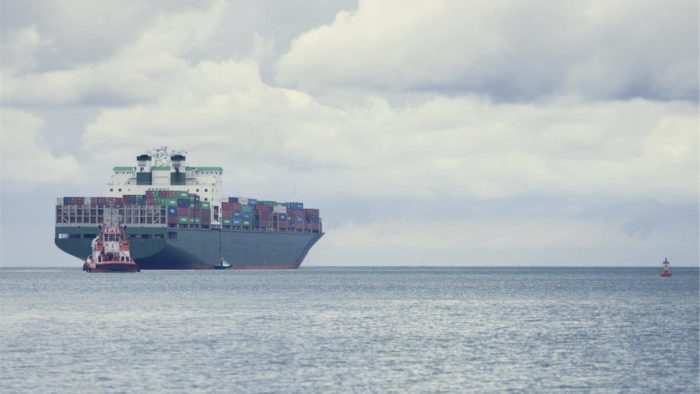
Container shipping involves shipping goods via a freight container usually aboard a freighter ship. Container shipping is best suited for individuals who are looking to ship a significant quantity of goods or individuals looking to ship a vehicle, motorcycle, building materials, or other large items. When choosing container shipping, you have two major options:
- LCL = Less than Container Load
- FCL = Full Container Load
LCL involves sharing a container with other shippers. Essentially, you’re paying for partial space in a container, usually by the cubic meter. As such, it is cheaper as you are only paying for a small area of a much larger container. This is great for individuals who have items that are too large to ship via standard international shipping but are not a large enough quantity to warrant an entire container.
The major drawback of LCL shipping is that you must wait until the entire container is filled and ready to ship. Therefore, you may wait months just until the container is filled and ready to ship before having to wait additional time for the actual transportation of the goods.
FCL involves filling an entire shipping container usually with at least 30 m³ cubic meters of goods. Although the price is significantly higher, you will have more control over when and where the container is filled and shipped.

The total price for shipping with a container depends on how much of the container you fill. Most shipping companies offer half containers at 20 feet long, or LCL, and full containers at 40 feet long, or FCL. Prices vary by shipper.
According to Freightos, the estimated cost of shipping a 20-foot container from Bangkok (THBKK Port) to New York is currently around US$5,800 to US$7,750, while a 40-foot container is around US$6,600 to US$8,850 for the same route. The estimated transit time is around 43 to 56 days. Adding insurance to either container type would run you another US$100 to US$200. All taxes are calculated by the value of items you ship. You can use an online import duty calculator to estimate the taxes for your shipment.
Some shipping companies offer all-inclusive services and give you the option of using the full container load or less than container load so that you can meet your budget.
Freight Forwarder
Those considering container shipping will have to begin by choosing a freight forwarder. A freight forwarder is a firm that acts as an intermediary between you (the customer) and a commercial freight shipping company. A freight forwarder will offer a full range of services, consisting of sourcing a freight shipper, negotiating shipping prices, preparing the correct documents, tracking the shipment, storing the shipment, and helping with inland transportation.
A freight forwarder does not actually ship your freight. They are an industry broker who will help you navigate the complex facets of international freight shipping. They have industry relations with many shipping services and extensive knowledge of shipping logistics.
Most of the forwarders don’t list shipping costs or times on their websites because it will vary depending on several factors:
- gross (real) weight of the package
- size (dimensional weight)
- distance it needs to travel
- level of service you require
If you’re shipping a palette of feathers, for example, the shipper would charge you by dimensional weight. Otherwise, they’d lose money because the real weight is so light. If you wonder what the cut-off is between real weight and dimensional weight, contact the freight forwarder.
When it comes to shipping times, it’s best to contact a freight forwarder to see what option is best for you. Shipping by air is not always the quickest method. Sometimes shipping by sea will be quicker than shipping by air.
You can use this form to find a suitable freight forwarder. Once you submit the form, you will get free quotes from shippers within 24 hours.
You can also visit the official Thai Customs website that details the process of importing procedures and exporting procedures for Thailand.
Shipping From Thailand to USA
When shipping items from Thailand to the U.S., you have several options. For packages weighing around 30 kilograms or less, you can choose between the postal service or courier services. Costs depend on factors such weight, dimensions, destination, and shipping method.
Courier services like DHL or FedEx have higher base rates but provide more reliability and speed. For example, shipping a 10-kilogram package via FedEx costs around THB8,500, which is about THB500 more than shipping via Thailand Post’s EMS World option. Courier services take two to five days to deliver, while the postal service takes five to 10 business days.
For large or heavy items weighing 50 kilograms or more, air or sea freight is more cost-effective. Sea freight is five to six times cheaper than air freight but takes up to two months to reach your door. Air freight arrives within a week. These freight rates can be affected by peak seasons, which are usually between August and October.
When shipping from Thailand to the U.S., it’s important to prepare your package properly, fill out the correct documents, and understand customs requirements.
Shipping Companies
Although there are many private and government funded shippers available, the shipping services listed below are just a few of the more popular options you have in Thailand.
Note that these services only work when you want to ship a few items to other countries. If you need to send many of your belongings overseas, including moving out from Thailand, it’s better to use a relocation company instead.
Thailand Post
Thailand Post is the main method of delivery for most people in Thailand. They have branches in most sub districts in the kingdom. So finding a branch shouldn’t be a hassle. But the question of Thailand Post’s reliability is often a topic of debate. I’ve never had any challenges using Thai Post, but many users have claimed they’ve had packages stolen, lost, delayed, or damaged.
These claims may drive customers away from using its services, especially if they’re shipping valuable or fragile items. Take such complaints lightly, as everyone has different experiences. I also recommend new customers look at its shipping options and rules on the official Thai Post website.
Thailand Post offers these options for international shipping:
- Registered
- ePacket
- EMS World and Courier Post
Registered is the cheapest yet slowest option suitable for small items or inexpensive goods as tracking is limited. The ePacket service is a fully-trackable, affordable, and quick way to ship items not exceeding 2 kilograms to 53 countries. EMS World is similar to express shipping from other providers. You can estimate your EMS shipping costs using this chart. Lastly, Courier Post is also an express shipping service for packages up to 200 kilograms and includes one-stop custom clearance both in Thailand and destination country.
Thailand Post offers insured shipping with tracking but it doesn’t cover much. It’s also hard to make a claim unless you purchase additional insurance.
You can track your shipment on Thailand Post by entering your 13-digit tracking number on the Thailand Post website.
DHL
DHL offers fast and reliable international shipping services for urgent or valuable shipments. It has designated DHL Service Points across Thailand, either offices or kiosks, in cafes or malls for dropping off packages. You can find the location nearest to you by using its location finder.
The drawbacks of DHL are still the lack of offices compared to Thailand Post, and its expensive express shipping fees. If a package is heading to a region that lacks a DHL office, a third-party service is used to deliver the package to its final destination, negating DHL’s tracking service. DHL Guidelines can be found here.
DHL provides three international shipping options:
- Express
- Express Worldwide
- Express Easy
Express and Express Worldwide offer door-to-door service, allowing you to conveniently prepare and print labels at home and have a courier collect your package. On the other hand, Express Easy is ideal when you prefer to drop off your shipment at a designated Service Point location. The costs and shipping times vary slightly.
DHL provides insured shipping. If you have high-value items, you can purchase additional insurance coverage. It can offer insurance directly, or in the case of bulk shipments, refer you to a third-party insurer.
You can track your DHL shipment by entering your tracking number or ID on the DHL website. It offers tracking on up to 50 packages at a time. If you aren’t shipping in bulk, then tracking your package won’t be a problem.
FedEx
FedEx offices are located in 10 cities throughout Thailand, including Bangkok, Chiang Mai, Phuket, Pattaya, and Nakhon Ratchasima, among others. It’s usually reliable, quick, and has many shipping options.
Fedex offers standard custom clearance services, but additional options are available if your shipment requires special clearance needs.
FedEx offers insurance as an add-on. They also have a money-back guarantee, ensuring that if they fail to deliver the package within the commitment time, FedEx refunds you for the shipping charges. For shipping restrictions, check out the FedEx Thailand export restrictions.
Tracking is available on all packages sent through FedEx and can be monitored via its website or mobile app.
UPS
UPS Thailand has its main hub in Bangkok plus customer centers located across the country in Chiang Mai, Pattaya, Surat Thani, and Phuket. Like FedEx, it’s a popular pick for people who want to send packages overseas.
UPS offers the same shipping services as other providers. But what separates UPS from other shippers is their Volume Shipping option. If you export products out of Thailand regularly, and depending on the size of your shipments, you can select either low- or high-volume shipping. In this case, your shipments would be automated and move through the shipping process quicker.
UPS covers up to US$100 per shipment. If your parcel is worth more than that, you can purchase additional insurance during checkout.
You can easily track your package online using the provided tracking number. They also have a feature under UPS My Choice where you can edit how, when, and where you want your package to be delivered at any time.
International Shipping Services Comparison
The following is a comparison of a package sent from Bangkok, Thailand to New York, USA. This comparison shows only base shipping cost and doesn’t account for additional services. Moreover, different shipping providers may include additional services like tracking, insurance, and online shipping, so there are other factors besides price and duration to consider.
Item: Legal Document
Weight: 0.5 kg
Value: N/A
| Service | ETA | Method | Cost |
| Thailand Post Registered Mail | 14-20 days | air | THB765 |
| Thailand ePacket | 7-14 days | air | THB720 |
| Thailand Post EMS World | 3-5 days | air | THB1,700 |
| DHL | 3 days | air | THB1,177 |
| FedEx | 3 days | air | THB2,331 |
| UPS | 2 days | air | THB1,400 |
Shipping Agents
Using a shipping agent can be beneficial if you’re shipping large items, or if you’re unfamiliar with the procedures and regulations involved with international shipping. Shipping agents differ from freight forwarders in that they represent the shipping line (or carrier) and serve as a point of contact throughout the shipping process, particularly when dealing with port-related procedures.
Process
After choosing a shipping agency, you can provide them with information about your shipment, including its description, weight, dimensions, destination, and any other requirements you may have. The agent then presents you with a range of shipping options and prices.

The shipping agent helps ensure that you have all the necessary documents and import-export licenses for your shipment. They also assist with the customs clearance process at your destination.
Once you have selected your preferred shipping method, you can opt to add additional tracking and insurance coverage to your shipment. You can then arrange to either have your items picked up or dropped off at a designated location.
Keep in mind that shipping agents may charge additional service fees or commissions, which can increase the overall cost of your shipment. It’s a good idea to contact multiple agents and request detailed quotes based on your specific shipping requirements
Shipping Agent Companies
Here are a few recommended companies you can use to ship from Thailand:
Seven Seas Worldwide
Seven Seas Worldwide is an international shipping provider that ships to countries in North America, Europe, UK, Asia, and Africa. Previous customers have said its prices are good compared to other shipping agents and that shipping times usually take two to three months by sea. You can get a free instant quote on its website.
Siam Shipping / DocShipper
Siam Shipping is one of the leading shipping agents in Thailand for international shipping services. It also provides freight forwarding and can ship via sea, air, road, and railway. Its agents are also fluent in multiple languages, such as English and French.
DPX Logistics
DPX Logistics is a smaller company based out of Bangkok. It can assist in shipping items door-to-door via air and can clear imported goods by express within one to three business days. However, it doesn’t ship to the U.S. or most European countries, except England. It mostly services countries within Asia, such as Hong Kong, Japan, China, and Singapore.
Asian Tigers
Asian Tigers is a Thailand-based company specializing in relocation services both internationally and domestically. It can take care of everything, from packing and unpacking all your household items and furniture to dealing with custom regulations to assisting in insurance claims for damaged or lost items.
Thai Export Paperwork for a Departing Resident
Whichever method you use, someone has to file a customs declaration before your shipment leaves Thailand. For a single parcel, that’s the CN22 form covered above. For a container or a full household move, it’s a formal export entry, and it helps to know upfront what your forwarder handles versus what you have to supply yourself.
A freight forwarder or shipping agent normally handles:
- Booking space with the airline or shipping line and preparing the bill of lading or air waybill.
- Filing the formal customs export entry with Thai Customs.
- Coordinating pickup, packing (if you’ve paid for a full-service pack), and delivery to the port or airport.
You’ll still need to supply:
- A copy of your passport, and evidence of your visa status if you’re leaving Thailand for good.
- An itemized packing list with a description and declared value for every item. This is what customs checks against the restricted and prohibited categories below.
- Proof of ownership or a receipt for higher-value items, if your shipper or a customs officer asks for one.
- Any permit paperwork for a restricted category, covered next.
Thailand generally doesn’t charge export duty on your own used personal belongings. The customs step here is about declaring what’s inside and confirming nothing in the shipment is banned or permit-restricted, not about paying tax to leave.
Customs
Thai Customs
Often packages shipped from Thailand take longer to arrive at their destination as a result of customs holding packages. Thailand is a major source country for a variety of drugs, contraband, and counterfeit items, and as such, many countries hold packages arriving from Thailand for longer than usual times. These packages are searched more diligently for banned items as well. For instance, packages arriving at the USA from Germany will make it through customs faster than items arriving at the USA from Thailand.
To avoid any additional customs delays, be sure to include the following info on all international packages leaving Thailand:
- weight
- country of origin
- shipper’s name and address
- description of item(s) in English
- quantity of each item in package
- purchase price in currency of package’s destination
These items are banned from being exported out of Thailand:
- narcotics
- counterfeit trademark goods
- fake currency, bonds, or coins
- obscene literature and pornographic materials
- endangered species and wildlife
- IPR infringing goods e.g. musical tape, CD, VDO, computer software, etc.
What You Cannot Ship Out of Thailand
Beyond the banned items listed above, Thai Customs requires a permit from a specific government agency before it will clear certain other goods for export. Ship any of these without the paperwork, and Customs holds the shipment at the point of export in Thailand, not at the destination.
| Category | Agency That Issues the Permit |
|---|---|
| Buddha images, artifacts, and antiques | Fine Arts Department |
| Firearms, ammunition, explosives, and equivalents | Department of Provincial Administration |
| Plants and plant parts | Department of Agriculture |
| Live animals and animal carcasses | Department of Livestock Development |
| Food, medicine, cosmetics, and food supplements | Food and Drug Administration |
| Cigarettes, tobacco, and alcoholic beverages | Excise Department |
| Vehicle parts | Ministry of Industry |
| Communication radios and telecom equipment | National Broadcasting and Telecommunications Commission (NBTC) |
Buddha images and antiques are the category departing expats hit most often, since souvenir shops across Thailand sell both. Exporting a Buddha image or an antique without the Fine Arts Department’s written permission is a genuine legal risk, not a formality you can skip. Apply well ahead of your departure date. This isn’t something you can sort out the day before your flight.
International Customs
When shipping your package from Thailand, your package may be held up in customs at the port of arrival. In America, for example, your package could stay in customs until they’ve thoroughly checked that it contains no illegal items. If you want your package to go through customs as quickly as possible, there are two steps you could take.
- Follow U.S. Customs and Border Protection’s import guidelines.
- Check that the shipper is part of the Customs Trade Partnership Against Terrorism Program, or CTPAT.
If you’re having trouble locating your shipment, contact the shipper or the Customs and Border Protection.
Shipping Pets and Vehicles Out of Thailand
Pets and vehicles don’t move through the same channels as parcels or freight containers. Both need sign-off from a Thai government agency before they leave, on top of whatever your destination country requires on arrival.
Exporting a Pet
The Department of Livestock Development (DLD) has to sign off before a dog or cat can leave Thailand. In practice that means a working microchip, an up-to-date rabies vaccination plus any other vaccination your destination requires, a veterinary health certificate, and an export permit, usually arranged through a DLD office at the departure airport in the days just before you fly.
Start with your destination country’s import rules, not Thailand’s export rules. Countries including the UK and EU members require a rabies antibody titer test and a waiting period of several months before your pet can enter, so that timeline, not the Thai paperwork, is usually what decides when you can actually leave. If you went through Thailand’s own pet import process when you arrived, our guide to having a pet in Thailand covers the same agencies from the other direction.
Exporting a Vehicle
Shipping a personal car or motorcycle out of Thailand means deregistering it with the Department of Land Transport, then filing a standard customs export entry like any other cargo. Given the cost of container shipping a vehicle and the paperwork involved, most departing residents find it cheaper and simpler to sell locally and buy again at the destination. Our guide to buying a car in Thailand is a useful reference for how the local used-car market prices vehicles, if you’re weighing a sale against shipping.
If you do want to ship a vehicle, work through a freight forwarder or shipping agent who has handled a vehicle export before. It’s specialized enough that doing it yourself is rarely worth the risk.
Shipping Insurance
You can purchase additional protection when moving items via shipping insurance.
Insurance coverage costs depend on the Cost, Insurance, and Freight (CIF) value, item types, original port, destination port, and shipping companies.


In the case of household items, the cost of insurance can be 3 percent to 5 percent of the CIF value, and comes with coverage of up to 110 percent of the CIF value.
Shipping insurance covers goods being damaged, or loss due to theft, water, weather, or accidents.
Please note that your goods must be packed by a professional company in order to get the full coverage.
To buy shipping insurance, you can directly contact an insurance broker
Common Mistakes
Avoid these common errors when shipping to ensure your product arrives at its destination safely and on time:
- shipping prohibited items
- packaging items incorrectly
- failing to account for duty and VAT
- setting inaccurate shipping weights
- selecting the wrong shipping service
- misunderstanding custom’s procedures
- failing to include the required paperwork
- filling out addresses and forms incorrectly
Frequently Asked Questions
Do I pay export tax on my personal belongings when leaving Thailand?
Generally no. Thailand doesn’t charge export duty on your own used personal belongings. The customs step is about declaring what’s in the shipment and confirming nothing is banned or permit-restricted, not about paying tax to export it.
Do I need a permit to export a Buddha image or antique from Thailand?
Yes. Buddha images, artifacts, and antiques need written permission and an export permit from the Fine Arts Department. Shipping one without that paperwork risks having Thai Customs hold the shipment at the point of export.
Is it cheaper to ship out of Thailand by sea or by air?
Sea freight is roughly five to six times cheaper than air freight, but takes several weeks to a couple of months instead of about a week. For a small parcel, a courier or Thailand Post is usually cheaper than either.
How do I export a pet from Thailand?
You’ll need a working microchip, current vaccinations, a veterinary health certificate, and an export permit from the Department of Livestock Development, usually arranged at the departure airport shortly before your flight. Check your destination country’s import requirements early, since those (not the Thai side) usually set the real timeline.
Can I ship my car out of Thailand?
Yes, after deregistering it with the Department of Land Transport and filing a customs export entry. Given the cost and paperwork, many departing residents sell locally instead and buy again at their destination.
What’s the difference between a freight forwarder and a shipping agent?
A freight forwarder is an intermediary who books space with a carrier, prepares documents, and coordinates logistics on your behalf. A shipping agent represents the carrier itself and acts as your point of contact for port-related procedures. In practice the two roles often overlap, and either one can help with customs clearance.
Can I just pay for extra checked baggage instead of shipping a box?
For a couple of extra suitcases, yes. Airlines charge for excess baggage per bag or per kilogram over your ticket’s free allowance, and the exact rate depends on the airline and route, so check your airline’s own baggage page before you fly.
What items can never leave Thailand, no matter the permit?
Narcotics, counterfeit trademark goods, fake currency or coins, obscene or pornographic materials, endangered species and CITES-listed wildlife, and IPR-infringing goods are prohibited outright. Buddha images, antiques, firearms, plants, live animals, and several other categories aren’t banned but do need a permit from the relevant agency first.
Now, on to You
By following this guide, you should be able to mitigate as much risk and unnecessary spending as possible. So whether you are an expat living abroad, a tourist on a shopping spree, or someone doing business in Thailand, you will be well equipped to handle any of your shipping needs, and you’ll be sure to get the best deal possible.


 Deutsch:
 Français:
'/%3E%3Cpath%20fill='%23b2b2b2'%20d='M241%20382q0%2016%2017%2026%2017%2011%2042%2011t42-11q16-11%2017-26V269H241'/%3E%3Cpath%20fill='%239f7e00'%20d='M241%20379q0%2014%208%2023%209%209%2021%209%2014%200%2021-9%209-9%209-23V269h-59'/%3E%3Cpath%20d='M241%20339v-70h59v110q0%2014-9%2023l-6%205v-68h-15v72q-8%200-14-4v-68zm59%2040c0%2022%2015%2032%2029%2032%2021%200%2030-18%2030-32v-40h-59'/%3E%3Cpath%20fill='%239f7e00'%20d='M266%20277v5h2v12h-3v-5h2v-5h-9v5h2v5h-4v9h3v18h-5v10h34v-10h-5v-18h3v-9h-4v-5h2v-5h-9v5h2v5h-3v-12h2v-5zm42%20101q0%2010%206%2017%206%206%2015%207%2010-1%2016-7%206-7%206-17v-29h-43'/%3E%3Ccircle%20fill='%230044ad'%20cx='329.5'%20cy='372'%20r='6'/%3E%3Cellipse%20fill='%230044ad'%20cx='300'%20cy='340'%20rx='16'%20ry='21'/%3E%3C/svg%3E) Español:
Español: