This article will take approximately 16 minutes to read. Don't have the time right now? No worries. Email the ad-free version of the article to yourself and read it later!
During the cold season, Bangkok ranks among the most polluted cities in the world. Air purifiers are a great tool to protect Thailand’s residents from harmful particles in the air.
But finding a good air purifier can become confusing and many people end up using air purifiers incorrectly.
Read this article to learn what factors you need to consider when buying air purifiers and how to use them properly.
If you just want to know which air purifier you should get in Thailand, it’s WEDO AIR.
Contents
- Key Takeaways
- Thailand's PM2.5 Levels and When You Actually Need a Purifier
- Tip #1 - Don’t Get Fooled by Marketing Hype
- Tip #2 - Beware Of Air Purifiers That Are “Smart”
- Tip #3 - Go Straight to the Numbers
- Tip #4 - Check The Manufacturer
- How to Size an Air Purifier for Your Room
- Breathe Safe with Smart Air and Get A Discount
- The Sqair
- Blast Mini
- The Blast
- Other Air Purifier Brands Sold in Thailand and Typical Prices
- Frequently Asked Questions
Key Takeaways
- An effective air purifier is really just a fan and a HEPA filter; fancy add-ons rarely improve the air you breathe.
- Be wary of smart auto modes and built-in sensors, which are often inaccurate and can drop the machine to low power when the air is actually dirty.
- Judge a purifier by its Clean Air Delivery Rate (CADR in m3/hr) against your room volume rather than the vague square-meter claims on the box.
- For most rooms a CADR around 300 m3/hr handles PM2.5; for virus protection you want 6 to 12 air changes an hour, so look at 500 to 1,000 m3/hr.
- Check the manufacturer and ask for third-party test results to avoid cheap OEM units with fake specs.
- Skip the auto mode and run the purifier yourself on polluted days.

Thailand’s PM2.5 Levels and When You Actually Need a Purifier
Thailand’s National Environment Board tightened the country’s official PM2.5 standard in 2023. The new limit is 37.5 micrograms per cubic metre (µg/m³) for a 24-hour average and 15 µg/m³ for the annual average, down from the previous 50 µg/m³ and 25 µg/m³ limits.
The World Health Organization’s 2021 guideline is stricter. It recommends 15 µg/m³ for a 24-hour average and just 5 µg/m³ annually, less than half of Thailand’s own annual limit. Bangkok and much of the country regularly exceed both standards during the dry season.
PM2.5 refers to particles 2.5 microns or smaller. They’re small enough to bypass the nose and throat, which normally filter out larger dust and pollen, and reach deep into the lungs. That size threshold is also why filter quality matters more than marketing claims, covered further down.
Pollution season in Bangkok typically runs from December to April, with the worst weeks falling between January and March. In Chiang Mai and the rest of Northern Thailand, agricultural burning can push the season into April and produce air quality worse than Bangkok’s on the bad days.
An air purifier earns its keep on these high-PM2.5 days. Outside burning season, when the AQI is normally low, running one matters far less.
Tip #1 – Don’t Get Fooled by Marketing Hype
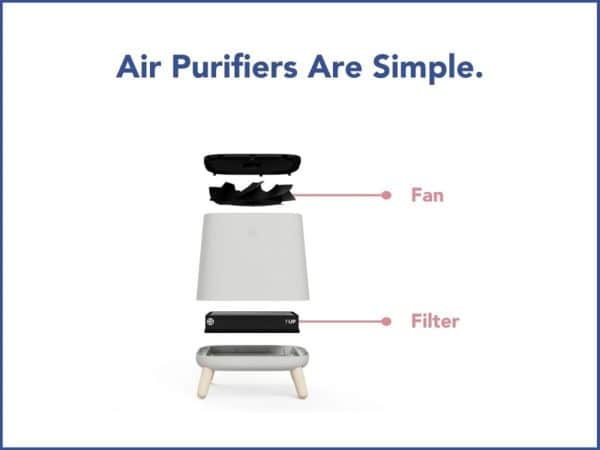
The truth is: air purifiers are simple machines. They basically consist of a fan and a HEPA filter, and that’s all we need to breathe clean air.
Big tech companies, however, usually don’t make profits from promoting simple technologies. That’s why they use clever marketing to trick you into buying fancy-looking machines with pointless add-ons like built-in particle readers that are inaccurate, unreliable auto-modes, and ionizers which, according to scientific findings, have little-to-no effect and even produce ozone which is a dangerous pollutant.
Unfortunately, most people don’t know the simple science behind purifiers, hence, they easily overspend on something that doesn’t deserve a high price tag.
When buying an air purifier, don’t forget one crucial thing: fancy ads, marketing and gimmicks will trick you into spending more without giving you more of what you need the most: clean air.
The bottom line is that you only need a fan and a HEPA filter.
Tip #2 – Beware Of Air Purifiers That Are “Smart”
We don’t see what we breathe, hence, so-called “smart air purifiers” that claim to be in full control of the “unseen” sound pretty tempting, right? Unfortunately, they’re pretty unreliable and not recommended.
How do these air purifiers work?
Well, they have an auto-mode which corresponds to a built-in particle reader which is usually made of inferior technology.
Accurate and precise air readers definitely exist, but we’re talking about a complex technology that works with laser-based light scattering to individually count particles. These devices cost between THB 5,000 and 15,000 Baht..
You can be certain that an air purifier costing just THB 3,000 Baht doesn’t use high-quality technology to measure the air quality.

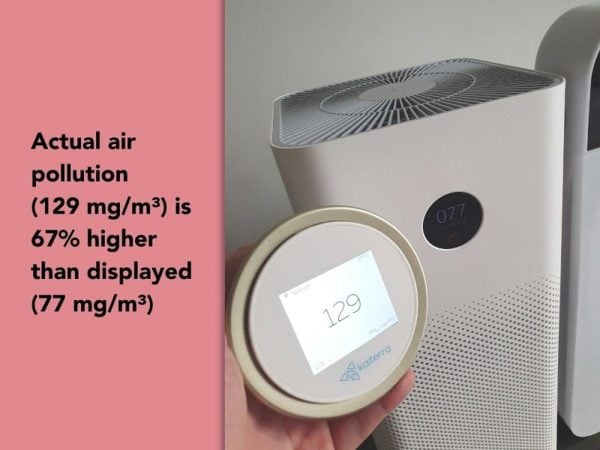
Inferior monitors inside an air purifier are only one part of the problem. The position of integrated sensors is the more critical issue. The sensor is located in the air purifier itself and the air, for sure, is always clean there.
Regardless of whether the air purifier is running at the lowest or highest level, the air quality right at the air purifier itself is always cleaner than the air at the other end of the room.
So, if you set your air purifier on auto-mode, the machine will always follow the sensor’s incorrect information and automatically set itself on low-performance mode or it may even deactivate itself once it detects the air to be good.
Insufficient filtering due to an incorrect mode may eventually result in serious health consequences, especially on very polluted days.
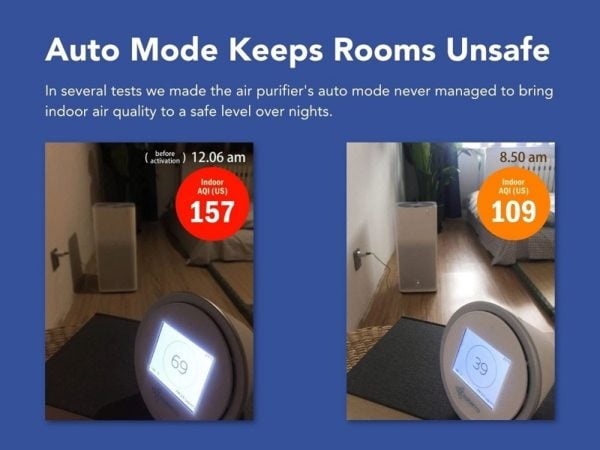
Simply put, although your air purifier is switched on, it won’t function properly, and the quality of the air you breathe will be inconsistent. This is why we never recommend using the auto mode and trusting integrated sensors.
Tip #3 – Go Straight to the Numbers
When buying an air purifier, it is important to know if its cleaning capacity fits the size of your room.
Normally, manufacturers help by providing an official square meter recommendation. Although useful in some cases, note that there is no standard for this metric and each manufacturer may provide different information.
Instead, we recommend to focus on the Clean Air Delivery Rate per hour (CADR m3/hr). This information reveals how many cubic meters of air will be cleaned within 60 minutes.
The higher the CADR rate, the better the performance of the air purifier. If the CADR is not clearly displayed in the shop or on the product description, ask the seller.
Knowing the CADR lets you easily determine the air purifier that’s best for you.
Here’s an example: If your room is 40 sqm and has 3-meter high walls, the total volume will be 120 m³. Therefore, an air purifier with a CADR of 315 m³/hr can provide 2.63 air changes in 60 minutes. (315 divided by 120)
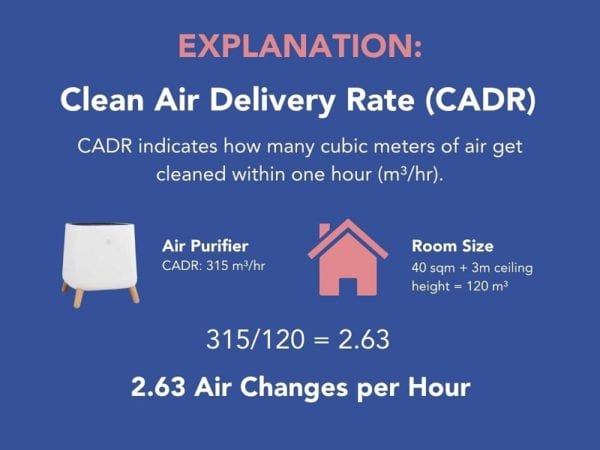
This is usually enough to keep your air safe from PM2.5. If your main concern is viruses like Covid-19 please note that the WHO recommends 6-12 air changes per hour to minimize the risk of indoor transmission. In this case, you may look for stronger air purifiers with CADR between 500 and 1000 m³/hr .
Tip #4 – Check The Manufacturer
More and more no-name and OEM air purifiers are available in Thailand for an incredibly cheap price. Yet, most of them aren’t transparent with their data. Thus, it’s difficult to verify whether the CADR rating is true.
To avoid scams, check the manufacturer, ask for 3rd party test results, just to make sure you’re buying a legit machine.
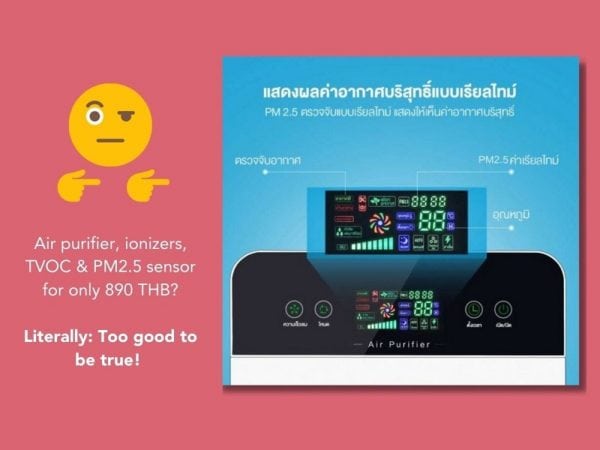
And by the way, since we’re talking about scams: many of these OEM air purifiers claim to have Ionizers, PM2.5 sensors, TVOC sensors, and some other fancy gimmicks for less than 1000 Thai Baht. Rest assured: This is too good to be true.
How to Size an Air Purifier for Your Room
Tip #3 above explains the core idea: divide a purifier’s CADR by your room’s volume to see how many air changes per hour it delivers. The table below turns that into a quick reference for common Thailand living spaces, so you don’t have to do the math yourself.
The U.S. Environmental Protection Agency publishes a minimum CADR by floor area for portable air cleaners, based on a standard 2.4-metre (8-foot) ceiling. The figures below convert that guidance to square metres and to CADR in m³/hr, which is how most air purifiers sold in Thailand list their specs.
| Room size | Typical Thai room | Minimum CADR (m³/hr) |
|---|---|---|
| ~9 sqm | Small home office or storage room | 110 |
| ~19 sqm | Standard bedroom | 220 |
| ~28 sqm | Studio condo | 330 |
| ~37 sqm | 1-bedroom condo living area | 440 |
| ~47 sqm | Open-plan 1 to 2-bedroom unit | 550 |
| ~56 sqm | 2-bedroom condo or small house room | 660 |
Ceilings higher than 2.4 metres, common in townhouses and some condo living rooms, need a proportionally larger CADR. As a rule of thumb, add about 25% to the target CADR for a 3-metre ceiling.
CADR alone doesn’t guarantee clean air. Check the filter grade too. A “true HEPA” filter meets the U.S. Department of Energy standard: it captures at least 99.97% of particles at 0.3 microns, the hardest particle size to trap. Since PM2.5 particles are 2.5 microns or smaller, a true HEPA filter removes them with room to spare.
Some budget units advertise a “HEPA-type” or “HEPA-style” filter. These look similar but aren’t tested to the same standard, and they typically block a smaller share of fine particles. Where a filter grade is listed, H13 or higher on the European EN 1822 scale (99.95% efficiency or better at the filter’s most penetrating particle size) is a safe bet for PM2.5.
An activated carbon layer, often bundled alongside the HEPA filter, targets odors and volatile organic compounds. It doesn’t meaningfully improve PM2.5 removal, which is entirely the HEPA layer’s job.
Breathe Safe with Smart Air and Get A Discount
Thanks for reading our 4 tips on how to choose a good air purifier in Thailand.
We’re a Smart Air, a social enterprise and certified B-Corp that provides free education and manufactures cost-effective air purifiers.
Smart Air promotes the simple fact that air purifiers are just fans and filters. By cutting out fancy yet pointless marketing gimmicks such as ionizers, and photocatalytic filters, we’re able to give you more clean air at a fraction of the cost the “big guys” would charge you.
The Sqair
The Sqair is a great air purifier for rooms up to 40 square meter. The Sqair packs a CADR of 315 m³/hr into a sleek, modern design, which fits perfectly in your bedroom, living room, or study. Real beech wood legs from sustainable forestry reduce noise and vibrations. Like designer furniture, The Sqair combines elegance with functionality.
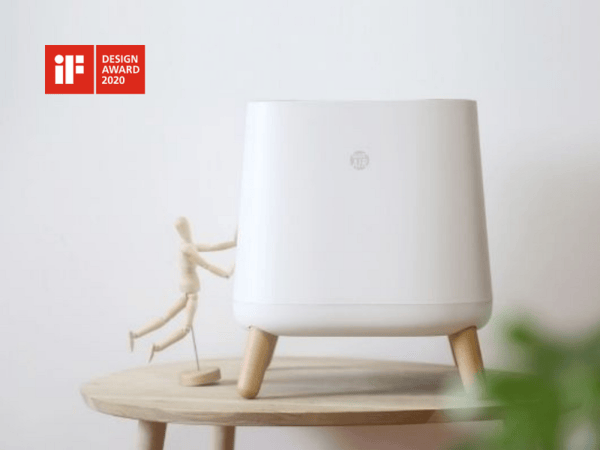
The Sqair has been awarded with the IF Design Award 2020.
Blast Mini
If you are looking for a quiet and affordable air purifier for larger spaces, the Blast Mini is the perfect solution for you.
Thanks to its powerful fan, the Blast Mini sends high volumes of air through a large HEPA filter. An exceptional Clean Air Delivery Rate (CADR) of 585 m³/hr ensures that
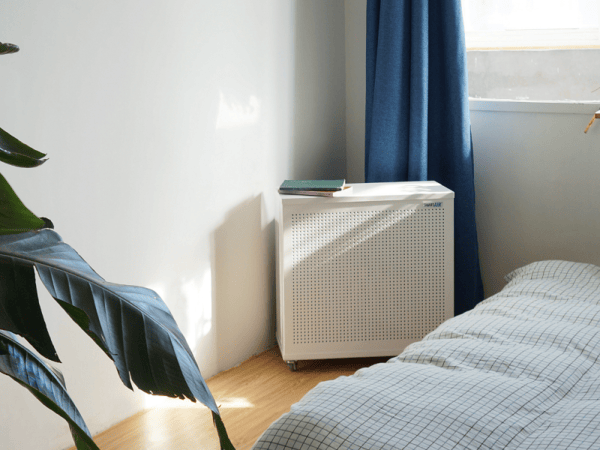
The Blast Mini cleans large spaces up to 85 m² in just 25 minutes.
With that type of muscle, the Blast Mini is perfectly suitable for big condos, offices or gyms. Or you run the Blast on low in a normal apartment and you have the quietest clean air on the block! Promised!
The Blast
The Blast is the perfect solution for large areas like an office, town house, or gym. An exceptional Clean Air Delivery Rate (CADR) of 890 m³/hr ensures an outstanding
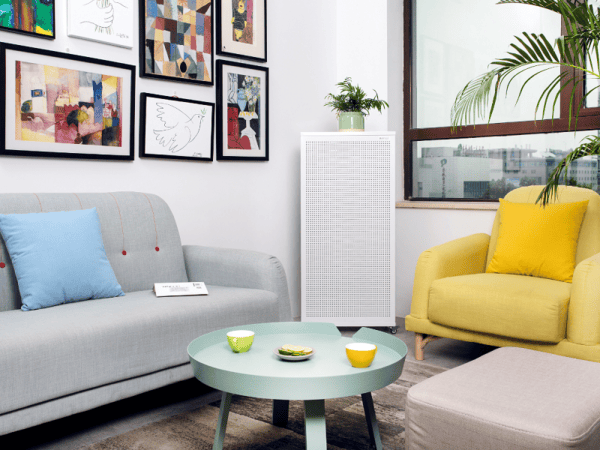
cleaning performance of rooms up to 130 sqm.
Nearly 4,000 air holes ensure a generous distribution of the air outlet, which makes the Blast the quietest air purifier on the market. On high, the Blast is not louder than 48 decibels which resemble soft rainfall. The Blast is a perfect air purifier for all of those who are sensitive to noise but doesn’t want to miss out on reliable air purification.
Other Air Purifier Brands Sold in Thailand and Typical Prices
Beyond the models above, Thailand’s market carries most of the global air purifier brands sold across Southeast Asia, including Xiaomi, Philips, Sharp, Blueair, and Levoit, alongside a long tail of unbranded and OEM units on Lazada and Shopee.
Price tends to track CADR and filter grade more closely than it tracks brand name. As a general guide:
- Budget, under about 3,000 THB. Small desktop units with a low CADR and often an unverified filter grade. Fine for a small bedroom on a mild day, not enough for burning season.
- Mid-range, roughly 5,000 to 15,000 THB. True HEPA filters with a CADR generally in the 200 to 400 m³/hr range, enough for a bedroom or studio condo.
- High-CADR, 20,000 THB and up. CADR above 500 m³/hr, suited to open-plan living areas, offices, or homes that prefer fewer, stronger units over one per room.
Whatever brand you choose, apply the same checks from Tip #3 and Tip #4 above: confirm the CADR against your room size using the table further up this page, and ask for third-party test data rather than trusting the box.
Frequently Asked Questions
Do I need to run my air purifier all day during burning season?
Yes. Continuous operation is standard practice during Thailand’s pollution season, roughly December through April. PM2.5 is often invisible and odorless at harmful levels, so running the unit around the clock keeps indoor air clean instead of reacting only once the air outside smells or looks bad.
How often should I replace the HEPA filter?
Most manufacturers recommend replacing a HEPA filter every 6 to 12 months, more often if you run the unit continuously through burning season or live in a dusty or high-traffic home. Check the guidance for your specific model, since filter life depends on filter surface area and how polluted the air is where you live.
Do I need one air purifier per room, or can one unit cover my whole condo?
Match the unit’s CADR to the room it sits in, not your whole home’s floor area. A single high-CADR unit can service an open-plan living and dining area, but a closed bedroom needs its own purifier, or the door needs to stay open so air can circulate between rooms.
What AQI level means I should switch my purifier to full power?
There’s no single official cutoff, but many people step up fan speed once the local Air Quality Index moves from “moderate” into “unhealthy for sensitive groups” or worse. Checking a real-time AQI app for your city is more reliable than judging by how the air looks or smells, since PM2.5 is often invisible.



 Deutsch:
 Français:
 Español: