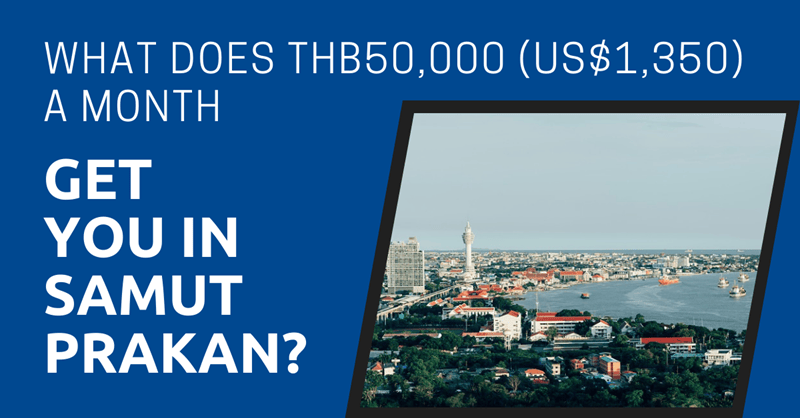
Nobody plans to move to Samut Prakan, and then it becomes home. South of Bangkok with the BTS, Suvarnabhumi on the doorstep, and strong international schools, it’s a settled, family-oriented base at well below central-Bangkok rents.
I’ve been living in Samut Prakan since 2014 with my wife and two daughters. I never planned to end up here. We were staying near Suvarnabhumi Airport after arriving in Thailand, a friend pointed my wife toward a condo complex on the Bangkok-Samut Prakan border, and that was that.
Over a decade later, Samut Prakan is genuinely home. Most expats who end up here follow a similar unplanned path. The province doesn’t have Phuket’s beaches or Chiang Mai’s reputation. What it does have is solid infrastructure, reasonable costs, good international schooling, proximity to Bangkok, and a quiet functionality that suits settled expats, particularly families, better than most alternatives.
Disclaimer: Some links in this article go to our partners, and we may earn a commission if you use them. It costs you nothing extra, and we only recommend services we'd use ourselves. Read more in our Advertising Disclosure.
Contents
- Key Takeaways
- About Samut Prakan
- Pros and Cons
- Quality of Life
- Cost of Living
- Accommodation
- Food
- Getting Around
- Long-Distance Travel
- Healthcare
- Exercise and Fitness
- Social Life and the Expat Community
- Nightlife
- Activities
- Weather
- Air Quality
- Flooding
- Education and Family Life
- Job Opportunities
- Popular Neighborhoods
- Should You Live in Samut Prakan?
- Sources Cited
Key Takeaways
- Samut Prakan is a large province directly south and east of Bangkok, home to around 1.3 million people and one of Thailand’s busiest airports: Suvarnabhumi.
- One person can live comfortably on about THB40,000 to 56,000 a month, and rent is the big swing. Families spend more, particularly once international school fees enter the picture.
- The BTS extends into the province as far as Kheha station. The MRT Yellow Line, opened at the end of 2023, connects Samrong BTS station to Lat Phrao in Bangkok.
- Thainakarin Hospital on Bangna-Trad and Sikarin Samut Prakan Hospital on Sukhumvit Road are the main accessible private hospitals.
- International schools in the province include Concordian International School (full IB, trilingual) and Raffles American School Bangkok (American curriculum).
- Parts of the province flood every rainy season. In 2026 the worst was in Bang Phli, Bang Bo and Bang Sao Thong, where some estates sat in up to 2 metres of water for over a week, so pick your street, building and floor with care.
- The expat community is settled and family-oriented rather than transient, which shapes the social character of the place.
About Samut Prakan
Samut Prakan sits at the mouth of the Chao Phraya River as it meets the Gulf of Thailand, bordering Bangkok on the north and west. It’s a large province by area, encompassing everything from dense urban neighborhoods adjacent to Bangkok to industrial estates, riverside communities, and the wetland areas of the Green Lung.
The province’s most famous asset is Suvarnabhumi Airport, which despite being associated in most people’s minds with Bangkok is technically in Samut Prakan. That airport proximity is a practical daily-life feature: international connections are nearby, and the airport road network shapes how traffic moves across the province.
Industry is the other defining feature. Bang Pu Industrial Estate and the broader industrial corridor have brought a mixed population of Thai workers, Japanese corporate expats, and multinational company families, which partly explains the density of international schools relative to the province’s tourist profile.
Pros and Cons
Reasons to move to Samut Prakan:
- Direct BTS access to central Bangkok, with the newer MRT Yellow Line adding further connectivity
- Significantly cheaper rent than central Bangkok for comparable or larger spaces
- Good international schools at several price points
- Suvarnabhumi Airport essentially on your doorstep
- Large, settled expat community with a genuine community feel
- Good public transport: BTS, MRT, buses, vans, songthaews, and ferries
- Safe and relatively quiet outside industrial and rush-hour corridors
Reasons it might not work for you:
- No beaches or significant natural draw of its own
- Limited outdoor recreation; malls become the default social space
- Air quality deteriorates from January to May due to PM2.5 from northern burning and regional sources
- Flooding in low-lying areas during the rainy season
- Traffic is genuinely bad during morning and evening rush hours on key roads
- Not as cosmopolitan or varied as central Bangkok for food, nightlife, and culture
Quality of Life
Quality of life in Samut Prakan is best understood through the lens of what kind of expat you are.
- If you’re a single person looking for nightlife, cultural events, and constant stimulation, the province will feel thin.
- If you’re a family that needs good schools, a functional city, international grocery access, and a social community built around similar households, it delivers well.
The day-to-day life is calmer than Bangkok without being rural. You can reach Suvarnabhumi in under 30 minutes from most parts of the province, and central Bangkok is 30 to 45 minutes away on the BTS or by car outside rush hours. The basics work: roads are maintained, utilities are reliable, and the malls provide climate-controlled refuge on hot days.
What the province lacks is recreation depth. The Green Lung and Bang Pu Pier provide outdoor options, but the overall menu is shorter than in other expat destinations. The malls absorb the gap, which is fine in practice but not for everyone’s idea of a good life.
Cost of Living
One person can live comfortably in Samut Prakan on about THB40,000 to 56,000 a month. It’s cheaper than Bangkok mainly because of rent. Food, utilities, and daily expenses track closely to Bangkok levels, but the housing gap is meaningful.
Here’s a realistic monthly breakdown for one person:
- Rent: THB9,000 to 25,000 depending on type and location. On FazWaz, condos average about THB9,600 for a studio, THB13,000 for a one-bedroom and THB24,400 for a two-bedroom.
- Food: around THB12,000 for a mix of local restaurants, Asian dining, and home cooking
- Transportation: around THB2,000 using BTS/MRT, vans, and songthaews
- Health insurance: around THB3,600 if you’re 35 to 40, for an inpatient-only plan with THB5 million cover. Luma’s indicative Hi5 rates run THB3,240 to 3,780 a month at those ages. (Verified October 2026.) It costs more if you’re older or add outpatient cover. See our Thailand health insurance guide.
- Utilities: around THB3,000 for electricity, water, and internet
- Social activities: THB3,000 for meals out, drinks, and occasional activities
- Visa-related: THB500
- Miscellaneous: THB6,900
- Total: THB40,000 to 56,000 per month (Verified October 2026.)
For a full comparison of costs across Thailand, see our cost of living in Thailand guide.
Accommodation
Rent in Samut Prakan is meaningfully cheaper than Bangkok, and the newer condominium stock along the BTS extension corridor is genuinely good quality.
Condos
Studio and one-bedroom condos in newer buildings along the BTS Samut Prakan extension start at THB8,000 to 9,000 per month.
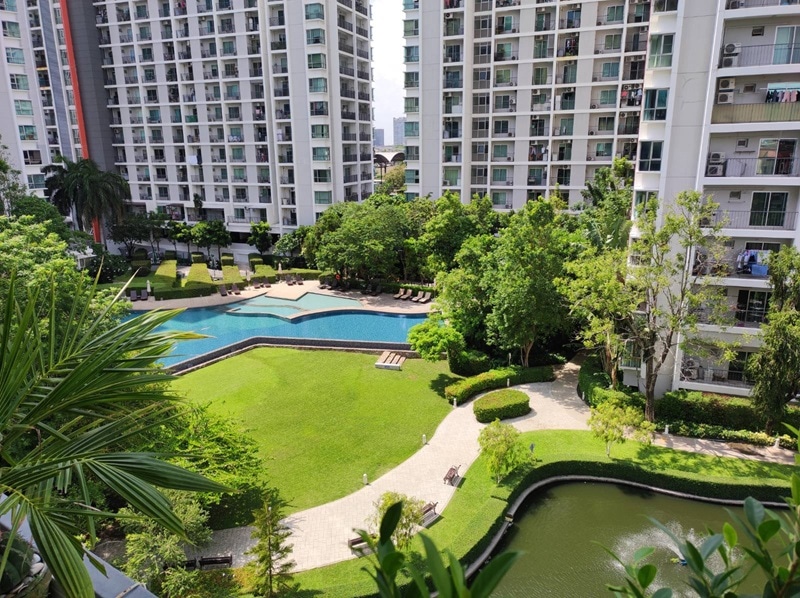
- NUE Noble at BTS Sri Lasalle is one frequently cited example, with studios from around THB8,000.
- The Parkland Srinakarin offers two-bedroom units at around THB15,000. Further in toward Samrong and Bearing, near the BTS and Yellow Line connections, one-bedroom condos in modern buildings run THB10,000 to 15,000.
The province offers more green space around condominium complexes than equivalent Bangkok buildings at the same price point. Pools and gyms are common amenities in newer buildings.
Houses
Gated community houses are available throughout the province. A detached house in an established community like Ananda Beach Life runs around THB25,000 per month. For families who want space, this is the right category: you get a proper house with a garden and security at prices that don’t exist in central Bangkok.
Townhouses
Townhouses are plentiful but quality varies significantly. Go for one in a newly completed community with an active management team; older townhouse estates sometimes have poor pool and gym maintenance.
Management matters most when the water comes. In the September 2026 floods, residents of one gated estate off Bang Na-Trat Road in Bang Bo borrowed boats to get kids and older neighbours out. In the estate’s LINE group, they grumbled that the management company collected its fees right on time but did little once the flooding started. So before you sign, ask the neighbours how management handled the last flood.
The Bang Kaew district behind Mega Bangna has newer townhouse communities available in the high teens per month.
Food
Samut Prakan’s food scene is broad enough to keep most expats well-fed and genuinely happy, particularly for those who enjoy Thai, Japanese, and Korean cuisine.
Local Thai Food
Local shops and small restaurants throughout the province serve regional Thai dishes from southern curries to northern noodle soups to northeastern grilled meats. A meal and drink at a local spot starts around THB100. Noir in the Lasalle area is one well-regarded option for a more established Thai restaurant experience.

Japanese and Korean Food
The Japanese corporate community has driven exceptional Japanese restaurant density for a province of this size. You could eat at a different Japanese restaurant for months without repeating. Sushi Dai, Momotaro, and Daya Korean Barbecue are consistent community recommendations, at around THB300 per person.
Indian Food
A recommendation that comes up consistently in the expat community: Flavors of India is regarded as the best Indian food in the province. Garlic naan with masala dishes is the order. Meals run around THB200 per person.
Western and Italian
Western food options exist but are narrower than in Bangkok or Pattaya. Buonissimo Italian Restaurant and Pizzeria is the reliable Italian option, doing pizza, pasta, and salads well. A margherita pizza starts around THB300.
Groceries
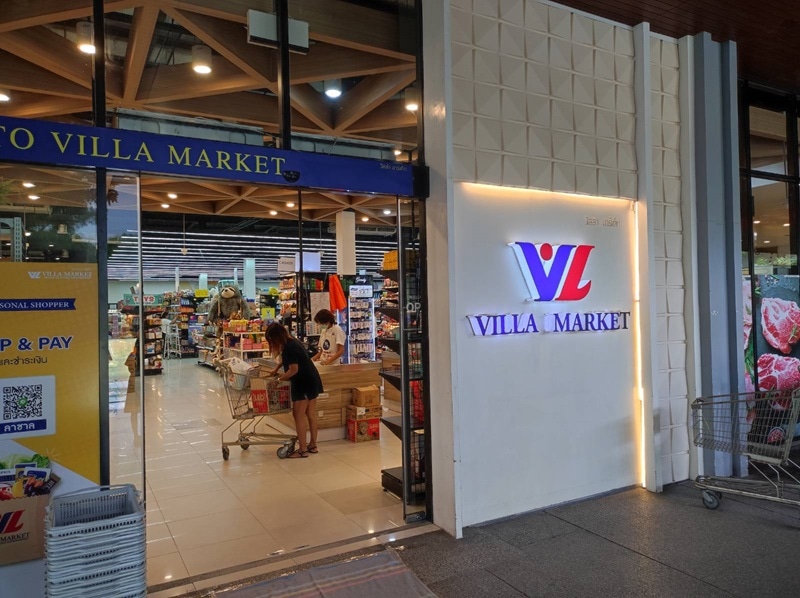
- Villa Market: the best for imported Western goods, and the most expensive
- Tops Market: a good balance of Thai and imported, at similar pricing to Villa
- Lemon Farm: boutique healthy foods, dried goods, and fresh local produce
- Makro: bulk buying for dry goods, seafood, and imported cheeses
- Big C and Lotus’s: budget-friendly, with limited imports
- fresh markets: morning markets throughout the province for organic fruit and vegetables at the best prices
Getting Around
Samut Prakan has better public transport than most Thai provinces, and the network has improved significantly with the BTS extension and the 2023 MRT Yellow Line opening.
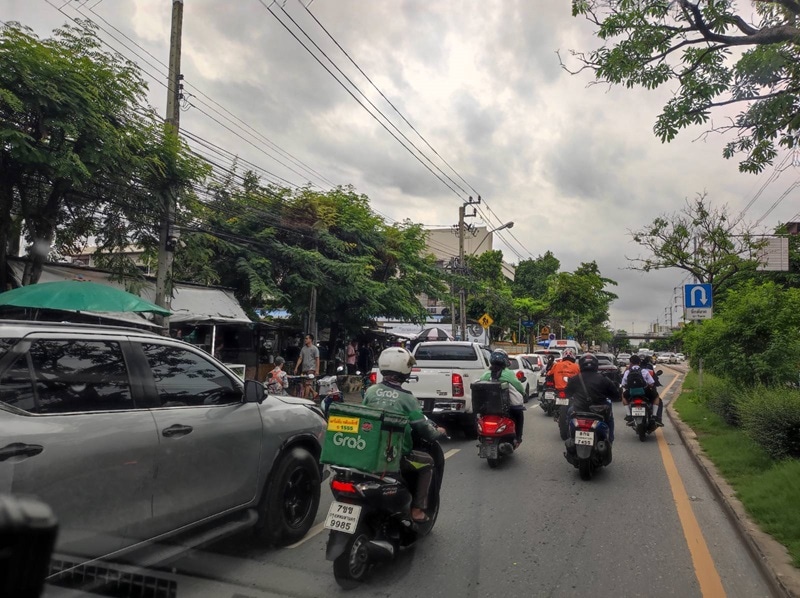
- BTS and MRT Yellow Line are the backbone for daily movement. The BTS Green Line extends to Kheha station, and the MRT Yellow Line connects Samrong BTS station to Lat Phrao in Bangkok. Together they open up most of central Bangkok within 45 minutes from most parts of the province.
- Buses run along major roads for THB10 to 40 per trip. Useful for routes not covered by rail.
- Vans run up and down Srinakarin Road and other main corridors for around THB20 for a short trip. Faster and more flexible than buses.
- Songthaews cover most major roads for THB10 per ride. Cheap and practical once you know the routes.
- Taxis are metered with a THB35 flag fall, easy to find throughout the province at all hours.
- Motorcycle taxis cover soi connections for THB20 to 60 depending on distance.
- Ferries serve two main routes: the Pu Chao Saming Prai ferry across the Chao Phraya in Phra Pradaeng District, and Samut Prakan Pier to Phra Samut Chedi Pier. A third runs from Bangkok’s Wat Bang Na Nok to the Green Lung (THB8).
Long-Distance Travel
For long-distance travel, Suvarnabhumi Airport’s proximity is the province’s key transport advantage. Domestic flights to Chiang Mai, Phuket, and other destinations are 20 to 30 minutes away. Bangkok is 30 minutes by BTS or car outside rush hours, and Pattaya is about 90 minutes by road.
Healthcare
Samut Prakan’s private hospital options require crossing into Bangkok for the best care, but there are accessible options close to the province border.
- Thainakarin Hospital on Bangna-Trad Highway (Km 3.5) is the most convenient major private hospital for most Samut Prakan residents. It’s technically in Bangkok’s Bang Na district but effectively serves the Samut Prakan corridor. Routine consultations run around THB1,000 to 1,500.
- Sikarin Samut Prakan Hospital is a 100-bed private hospital on Sukhumvit Road at Km 34, affiliated with the JCI-accredited Sikarin Bangkok Hospital. A more affordable private option than Thainakarin.
- Ramathibodi Chakri Naruebodindra Hospital is a government-affiliated premium facility related to the respected Ramathibodi Hospital in Bangkok. Prices are somewhat lower than private hospitals; useful for non-emergency treatment where you have time to travel.
- Samut Prakan Hospital is the main public hospital with 594 beds, affiliated with Srinakharinwirot University Faculty of Medicine. Affordable, comprehensive, and the right choice for budget-conscious expats who don’t mind longer waits.
Pharmacies, clinics, and dentists are widely available. LDC Dental on Srinakarin Road is a consistently recommended local option, with cleanings running around THB1,500 per person.
On insurance: a stay of a few days at a private hospital without insurance runs around THB50,000. An inpatient-only plan with THB5 million cover and no deductible costs about THB3,200 to 3,800 a month at 35 to 40, and about THB5,600 at 50, on Luma’s indicative Hi5 rates. (Verified October 2026.) Age and outpatient cover move the price a lot, so get a personal quote. See our Thailand health insurance guide.
Exercise and Fitness
- The Green Lung (Sri Nakhon Khuean Khan Park and Botanical Garden) is the province’s best outdoor recreation space: bike rentals around THB100, ferry access for THB8, and a full day of trails and birdwatching. It’s technically in Samut Prakan despite often being associated with Bangkok.
- Bang Pu Recreation Center is a free pier extending into the Gulf, good for walking among seagulls and watching marine wildlife at low tide. A genuinely pleasant morning option.
Most condo complexes have gyms and pools included. Sports clubs for football, Muay Thai, martial arts, tennis, badminton, ballet, and dance operate throughout the province, and Mega Bangna has an indoor driving range and outdoor water park area.
Social Life and the Expat Community
The expat community in Samut Prakan has a distinct character: it’s settled.
- The majority of long-term expats here are raising families, married to Thai nationals, or working at nearby institutions or industrial companies.
- It’s not a transient backpacker scene or a retiree party circuit.
- People have kids in school, know their neighbors, and build friendships over years rather than weeks.
The practical entry point for social life here is condo community life: pools and gyms are where genuine friendships form, because residents see each other regularly. From those initial connections, the network expands to bike rides, park meetups, restaurant groups, and weekend trips. Facebook groups for expats in Samut Prakan and the broader Bangna-Bearing-Lasalle corridor are the best digital resource for community connection before and after arrival.
Nightlife
Nightlife in Samut Prakan is extensive in terms of venues but modest in ambition. Every major road has clubs, pubs, and restaurants covering every demographic, from family-friendly seafood spots to late-night karaoke bars to Japanese-style izakayas. Bangkok’s central nightlife is 30 to 45 minutes away by BTS or taxi for anyone who wants something more developed.
Activities
Green Lung and Outdoors
The Green Lung (Sri Nakhon Khuean Khan Park) is the standout nature option: kayaking, cycling, bird watching, and exploring the mangrove network in a setting that genuinely surprises people who assume Samut Prakan is all industrial estates. The Get Growing Community Farm within the Green Lung area works well for families with younger children.
Historical and Cultural Sites
- The Ancient City (Mueang Boran): a sprawling outdoor recreation of Thailand’s historical landmarks. Go in the cool season and avoid mid-day in summer.
- Erawan Museum: the iconic three-headed elephant visible from the highway, with an interesting interior that most residents have never actually entered.
- Phi Suea Samut Fort Museum: accessible by ferry, a few hours well spent exploring a riverside fort.
- Naval Museum: free entry, worth a visit if you’re near Samut Prakan Immigration.
Avoid: the Crocodile Farm and Zoo has a well-documented history of poor animal welfare. It’s not worth supporting regardless of what else is nearby.
Malls
- Mega Bangna: over 400 stores, cinema, IKEA, an outdoor water park, dog walk, and driving range. A full day’s destination in itself.
- Imperial World Samrong: dated but charming, with an ice skating rink and a character that newer malls don’t match.
- JAS URBAN: worth visiting for the outdoor market, food, and cinema.
- Robinson Lifestyle Samut Prakan: a solid everyday mall on Srinakarin Road.
Weather
Samut Prakan follows central Thailand’s weather patterns. The hot season from February to June is serious, with temperatures reaching 40°C at the peak. The rainy season from July to October brings heavy thunderstorms, typically lasting an hour or two before clearing. The cool season from November to January is the most pleasant, with occasional December mornings dropping to around 17°C.
Air Quality
Air quality is Samut Prakan’s significant environmental drawback. From January to May, PM2.5 levels rise substantially as burning smoke travels from northern Thailand and neighboring countries. During the worst months, staying indoors with air purifiers running is the practical response.
An air purifier in your bedroom and living space isn’t optional here; it’s standard equipment for any expat household during the burning season. Outside those months, air quality is generally acceptable, though the province’s industrial and highway character means it never reaches the clean-air levels of a coastal or mountain city.
Flooding
The September 2026 floods hit Bang Phli, Bang Bo and Bang Sao Thong hardest. Whole housing estates there sat in up to 2 metres of water, and some stayed flooded for more than a week.
The river districts drained first. Mueang Samut Prakan (which includes Samrong Nuea and Pak Nam), Phra Pradaeng and Phra Samut Chedi were off the Department of Disaster Prevention and Mitigation (DDPM) flood list by 12 October. Bang Phli, Bang Bo and Bang Sao Thong still had 6,530 households under water that day. (Verified October 2026.)
Nowhere came through completely dry. The DDPM counted flooding in all six districts, and the governor declared every subdistrict a disaster zone. So judge the street and the building, not just the area name.
The flooding started on 23 September 2026, when heavy rain met a high tide. At its peak, about 260,000 households in the province were affected, and nine people died.
The province sits at sea level at the mouth of the Chao Phraya, and drainage varies a lot from one street to the next. Water from eastern Bangkok also drains to the sea through Samut Prakan. That’s why Bang Phli, Bang Bo and Bang Sao Thong, on its route, held the water longest. If you’re also looking at the Bangkok side of the border, our guide to Bangkok neighborhoods that stayed dry covers which districts there flooded and which didn’t.
Area by Area in 2026
The deepest water was in low housing estates off Bang Na-Trat and King Kaeo roads. Main roads closer to Bangkok, like Srinakarin and Thepharak, flooded for a few days and then drained.
| Area | Key roads / neighborhoods | 2026 status | Note |
|---|---|---|---|
| Bang Bo | Chuan Chuen village, Bang Na-Trat Km 29 (Bang Bo subdistrict) | Flooded badly | A canal wall behind the estate gave way. Water on estate roads was over 2 metres deep on 28 September, and about 700 homes were hit. Bang Bo was still on the DDPM flood list on 12 October. |
| Bang Na-Trat Km 12 to 15 | Bang Na-Trat Road at Km 12 to 14; Green Valley estate at Km 15 (Bang Chalong, Bang Phli) | Flooded badly | Green Valley had water close to 2 metres deep on 28 September and stayed under for 8 to 9 days. The road at Km 12 to 14 was still flooded on 2 October. |
| King Kaeo Road | Windmill and Pleno On Nut (Soi King Kaew 37), both in Racha Thewa; an estate on Soi King Kaew 19 | Flooded badly | A wall broke at Windmill on 28 September, with chest- to head-high water and 600+ homes stuck. Pleno On Nut (400+ homes) had been flooded for 7 days by 2 October. Two men died at the King Kaew 19 estate on 27 September. |
| Bang Phli Yai | Chaturamit community; homes along Khlong Samrong | Flooded badly | 600 households flooded in Chaturamit and 300+ people in the Bang Phli Yai shelter on 28 September. On the 2 October warning list for rising water along Khlong Samrong. |
| Bang Sao Thong | Sisa Chorakhe Yai and Sisa Chorakhe Noi | Flooded badly | Police were helping residents in flooded parts of both subdistricts on 26 September. The DDPM warned on 30 September that water would stay 7 to 10 days, and the district was still on its list on 12 October. |
| Bang Kaew | Estates behind Mega Bangna | No reports found | We found no reports naming flooded estates here. Bang Kaew is in Bang Phli, though, and was on the 2 October warning list for rising water along Khlong Samrong. |
| Samrong Nuea | Srinakarin and Thepharak roads around BTS Samrong; Sukhumvit | Flooded briefly | Deep water on both roads from 24 to 26 September, worst at BTS Samrong. By 28 September cars could get through. On the 2 October warning list. |
| Srinakarin Road | Si Dan to La Salle; the Bang Na-Srinakarin junction | Flooded briefly | Three lanes under water at kerb height on 28 September, going down. After more rain on 2 October, about 15 cm on the inbound side. |
| Thepharak | Thepharak Road from Sasikan village to the Thepharak junction | Flooded briefly | Two to three lanes under water on 28 September, going down, with cars getting through. On the 2 October warning list. |
| Mueang / Pak Nam | Sukhumvit near the Naval Academy; Phraeksa (Soi Mangkon-Nakhadi, Soi Ying Charoen) | Flooded briefly | Water rose on Sukhumvit by the Naval Academy on 25 September, and Phraeksa sois flooded on 26 September. Mueang was off the DDPM flood list by 12 October. |
| Phra Samut Chedi | Suk Sawat Road | Flooded briefly | A storm on 21 September put 20 to 30 cm of water on Suk Sawat Road. We found no street reports from the main flood. Off the DDPM list by 12 October. |
| Phra Pradaeng | Whole district | No reports found | Counted as flooded by the DDPM until at least 10 October and off its list by 12 October. We found no reports naming streets or estates. |
| Bang Pu | Sukhumvit at Bang Pu; Bang Pu Industrial Estate | No reports found | Inside the disaster zone, which covered all of Mueang district, but we found no 2026 reports naming streets here. |
Samrong Nuea and Bang Kaew in 2026
Both areas we recommend below flooded in 2026, in different ways.
In Samrong Nuea, the water was mostly on the roads. Srinakarin and Thepharak had deep water around BTS Samrong and the Bang Na-Srinakarin junction from 24 to 26 September. By 28 September it was down to two or three lanes at kerb height, and cars could get through.
Streets here also flood during heavy rain in an ordinary year. On 15 September, ten days before the big storm, one downpour flooded all three lanes of both roads around Samrong Nuea.
Bang Kaew is in Bang Phli, where the water stayed longest. On 2 October, the Royal Irrigation Department opened the Bang Phli sluice gate, and the DDPM warned of rising water along Khlong Samrong in Bang Kaew, Bang Phli Yai, Samrong Nuea and Thepharak. We found no reports naming flooded estates in Bang Kaew itself. Nearby estates on Bang Na-Trat and King Kaeo roads were under water for a week or more.
People in Bang Phli Yai were still posting photos of water around their homes in early October. For the lucky ones, it stopped just short of the front door.
Neither is a reason to rule the area out. Both are a reason to check the building.
Checks Before You Rent
Ask about September 2026 before you sign. Anyone who lived there then will remember how high the water got.
- Water level: Ask the landlord, the building’s juristic office and a neighbour how deep the water got and how many days it stayed. Look for water marks on walls and gate posts.
- Floor: Ground-floor condos, townhouses and single-storey houses take the water. A unit a few floors up keeps your things dry, though you may be stuck inside until the street drains.
- Parking: Ask where residents moved their cars in 2026. Raised or multi-storey parking saves you a flooded car.
- Pumps and power: Ask whether the building or estate runs its own pumps and a backup generator, and whether the power and lifts kept working.
- Electrical safety: If water comes into your home, switch off at the main breaker before it reaches the sockets, and stay well away from power lines. On 27 September 2026, two men died in a flooded Bang Phli estate when a crane lifting a submerged car touched an overhead line. Expat forum regulars were blunt about it: once everything is standing in water, treat every cable as live.
- Who to call: The DDPM hotline is 1784, or LINE @1784DDPM, 24 hours a day. In a flood, the DDPM also sends Cell Broadcast alerts to phones in the affected subdistricts.
Education and Family Life
This is where Samut Prakan genuinely stands out compared to other Bangkok-adjacent provinces.
- Concordian International School in Bang Kaew, Bangplee is a full IB World School offering PYP, MYP, and DP programs from Nursery to Grade 12, with around 1,100 students. It’s the only fully trilingual IB school in Thailand, using English, Chinese, and Thai as languages of instruction.
- Raffles American School Bangkok in Bang Phli follows an American curriculum from Nursery to Grade 12, with campuses for early years and middle/high school and a wide range of extracurricular activities.
- Bangkok Chicago Christian International School and Thai-Singapore International School are additional options, the latter with a reputation for academic rigor.
At the lower-cost end, Assumption Samut Prakan and St. Joseph Bang Na School offer bilingual programs at THB80,000 to 120,000 per year, significantly below full international school fees. For a broader comparison, see our guide to international schools in Thailand.
Job Opportunities
Samut Prakan offers more employment opportunities for foreigners than most provinces outside Bangkok, driven by two sectors.
- Teaching is the most accessible route, with positions at international schools, private schools, and language centers throughout the province. Competition is real, and qualifications and experience matter. Raffles American School and Concordian hire internationally.
- Industry is the other path: Bang Pu Industrial Estate has multinational companies including Mattel, Nestlé, and NHK, among many others. If you have skills in engineering, manufacturing, logistics, or supply chain management, there are genuine opportunities here.
Remote work and online business function well from Samut Prakan, supported by reliable internet infrastructure and straightforward BTS access to Bangkok for meetings or networking.
Popular Neighborhoods
Samrong Nuea Subdistrict
The most practical choice for most expats, particularly newcomers. Northwestern Samut Prakan close to Bangkok’s border, with BTS access (Samrong and Bearing stations), the MRT Yellow Line, a wide variety of food, international schools within reach, and strong general convenience. Popular with young expat families, retirees, and English teachers. It’s my starting recommendation.
Flood note: Srinakarin and Thepharak roads here flooded for several days in September 2026. See Flooding for the area-by-area picture.
Bang Kaew District
Popular with expat families specifically because of proximity to Concordian International School and Raffles American School Bangkok. Filled with established and newer gated communities. A quieter residential feel than Samrong, with the tradeoff of needing your own vehicle for most errands.
Flood note: Bang Kaew is in Bang Phli, the district that held water longest in 2026, and nearby estates sat in up to 2 metres of water. Ask how your estate fared before you sign (see Flooding).
Areas to Approach Carefully
- Bang Poo Subdistrict: industrial character, poor rainy-season drainage, electricity outages during storms, and limited amenities for expats. Not recommended for residential life.
- Bang Phli Noi Subdistrict: close to the airport flight path (noise), congestion on King Kaew Road, and lingering concerns following a 2021 chemical explosion that residents described as affecting air quality for years afterward.
- Thepharak: heavy truck traffic on Thepharak Road, particularly during rush hours, which creates safety concerns for motorcyclists and pedestrians.
Should You Live in Samut Prakan?
Samut Prakan works best for:
- expat families who want good international schooling, a settled community, and space that Bangkok can’t provide at the same price
- professionals working in the Bang Pu industrial corridor who want to live near work
- remote workers and retirees who want Bangkok access without Bangkok prices or intensity
It’s a poor fit for people who need the entertainment density of central Bangkok, meaningful beach or nature access, or the social variety of a larger expat hub.
The honest version of Samut Prakan’s appeal is exactly what I said at the start: nobody plans to end up here, and then it becomes home. It’s a province that rewards people who settle into it rather than just passing through.
Sources Cited
- Thai PBS, 27 September 2026: Samut Prakan governor declares all six districts flood disaster zones; flooding from heavy rain and a high tide since 23 September.
- Government Public Relations Department (prd.go.th), 30 September 2026: DDPM report, flooding in all six Samut Prakan districts, eight deaths.
- The Nation, 29 September 2026: DDPM figures, 260,784 Samut Prakan households affected, the most of any province.
- The Nation, 30 September 2026: DDPM Cell Broadcast alert, water in Bang Phli, Bang Bo and Bang Sao Thong to stay for 7 to 10 days; hotline 1784.
- Bangkok Biz News, 2 October 2026: DDPM alert after the Royal Irrigation Department opened the Bang Phli sluice gate; subdistricts along Khlong Samrong.
- Thai PBS, 12 October 2026: DDPM report, 6,530 households still flooded in Bang Phli, Bang Bo and Bang Sao Thong; nine deaths in the province.
- The Bangkok Insight, 10 October 2026: DDPM report, flooding still counted in all six Samut Prakan districts (223,346 households).
- Sanook, 28 September 2026: Chuan Chuen village, Bang Na-Trat Km 29, Bang Bo subdistrict, flooded after a canal wall broke; 700+ homes.
- Khao Chao Baan, 28 September 2026: water over 2 metres deep on Chuan Chuen estate roads; about 700 homes affected.
- Daily News, 28 September 2026: Green Valley estate, Bang Na-Trat Km 15, Bang Phli, flooded close to 2 metres deep.
- Spacebar, 6 October 2026: Green Valley (Bang Chalong) under deep water for 8 to 9 days.
- FM91 via LINE Today, 2 October 2026: Bang Na-Trat Road at Km 12 to 14 still flooded.
- Thai Post, 28 September 2026: wall collapse floods Windmill village, King Kaeo Road, Racha Thewa; 600+ homes.
- Thai Post, 2 October 2026: Pleno On Nut, Soi King Kaew 37, Racha Thewa, flooded for 7 days; 400+ homes.
- Thai Post, 28 September 2026: 600 households flooded in Chaturamit community, Bang Phli Yai; 300+ people in the Bang Phli Yai shelter.
- MGR Online, 26 September 2026: police help residents in flooded parts of Sisa Chorakhe Yai and Sisa Chorakhe Noi, Bang Sao Thong.
- The Bangkok Insight, 28 September 2026: Samrong Nuea police road report, Srinakarin, Thepharak and Sukhumvit water levels.
- FM91, 2 October 2026: Samrong Nuea police road report after rain, Srinakarin and Thepharak.
- Thai Post, 25 September 2026: Sukhumvit by the Naval Academy, Thepharak, Srinakarin and Phraeksa roads flooded in Mueang Samut Prakan.
- Thairath, 26 September 2026: flooding in Chonthep village, Bang Phli, and Soi Mangkon-Nakhadi and Soi Ying Charoen, Phraeksa.
- TNews, 22 September 2026: 20 to 30 cm of water on Suk Sawat Road, Phra Samut Chedi, after a storm on 21 September.
- Thansettakij, 26 September 2026: Srinakarin and Thepharak roads flooded around BTS Samrong and the Bang Na-Srinakarin junction.
- Bangkok Biz News, 15 September 2026: a downpour flooded all three lanes of Srinakarin and Thepharak roads around Samrong Nuea.
- Khaosod English, 27 September 2026: electric shock deaths during a flooded-car recovery in Bang Phli.
- Luma, indicative Hi5 premiums supplied to the Thailand Starter Kit, 6 October 2026: inpatient-only, THB5 million cover, Zone C, no deductible; THB38,838 a year at 35, THB45,356 at 40, THB67,400 at 50.



 Deutsch:
 Français:
'/%3E%3Cpath%20fill='%23b2b2b2'%20d='M241%20382q0%2016%2017%2026%2017%2011%2042%2011t42-11q16-11%2017-26V269H241'/%3E%3Cpath%20fill='%239f7e00'%20d='M241%20379q0%2014%208%2023%209%209%2021%209%2014%200%2021-9%209-9%209-23V269h-59'/%3E%3Cpath%20d='M241%20339v-70h59v110q0%2014-9%2023l-6%205v-68h-15v72q-8%200-14-4v-68zm59%2040c0%2022%2015%2032%2029%2032%2021%200%2030-18%2030-32v-40h-59'/%3E%3Cpath%20fill='%239f7e00'%20d='M266%20277v5h2v12h-3v-5h2v-5h-9v5h2v5h-4v9h3v18h-5v10h34v-10h-5v-18h3v-9h-4v-5h2v-5h-9v5h2v5h-3v-12h2v-5zm42%20101q0%2010%206%2017%206%206%2015%207%2010-1%2016-7%206-7%206-17v-29h-43'/%3E%3Ccircle%20fill='%230044ad'%20cx='329.5'%20cy='372'%20r='6'/%3E%3Cellipse%20fill='%230044ad'%20cx='300'%20cy='340'%20rx='16'%20ry='21'/%3E%3C/svg%3E) Español:
Español: